topaz-framework
 Yuvraj Soni
django
Comments (0)
Sign in to leave a comment
System Requirements
System Requirements Document (SRD)
Project Name: topaz-framework
1. Introduction
The topaz-framework is a cutting-edge project aimed at providing a robust, scalable, and user-friendly framework for developers and organizations to build modern applications. Designed with flexibility and performance in mind, this framework will cater to diverse user needs, including web and mobile applications, backend systems, and AI integrations.
This document outlines the system requirements for the topaz-framework, ensuring clarity and alignment with the vision of Yuvraj Soni, the project initiator. The framework will be tailored to the Indian context, considering locale-specific defaults such as IST timezone, INR currency, and regional preferences.
2. System Overview
The topaz-framework will serve as a versatile platform for developers, offering tools and libraries to streamline application development. It will support both frontend and backend development, integrate AI capabilities, and provide database solutions for structured and unstructured data.
Key features include:
- A modular architecture for scalability.
- Support for web and mobile applications.
- AI-powered tools for enhanced user experience.
- Comprehensive database solutions, including RDBMS, NoSQL, and VectorDB.
- Docker and Kubernetes orchestration for deployment.
3. Functional Requirements
As story points:
- As a User, I should be able to build web applications using React.
- As a Developer, I should be able to integrate AI models like GPT 5.2 for user-friendly responses.
- As an Admin, I should be able to manage database migrations using Alembic.
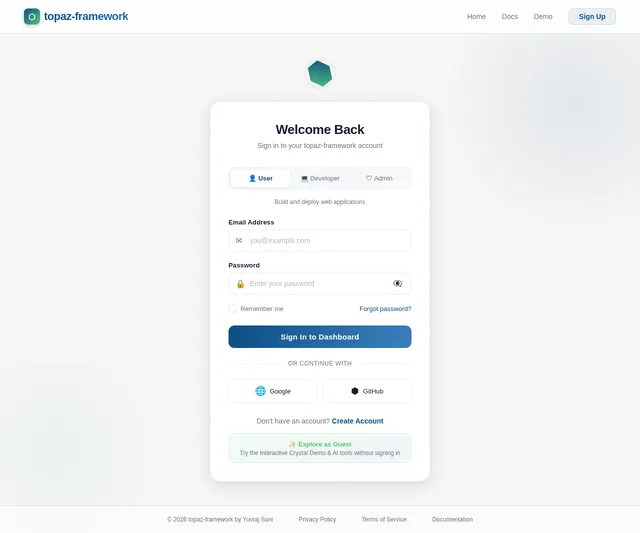
- As a Guest, I should be able to access demo features of the framework.
- As a User, I should be able to deploy applications using Docker and Kubernetes.
- As a Developer, I should be able to utilize Langchain for AI tool integration.
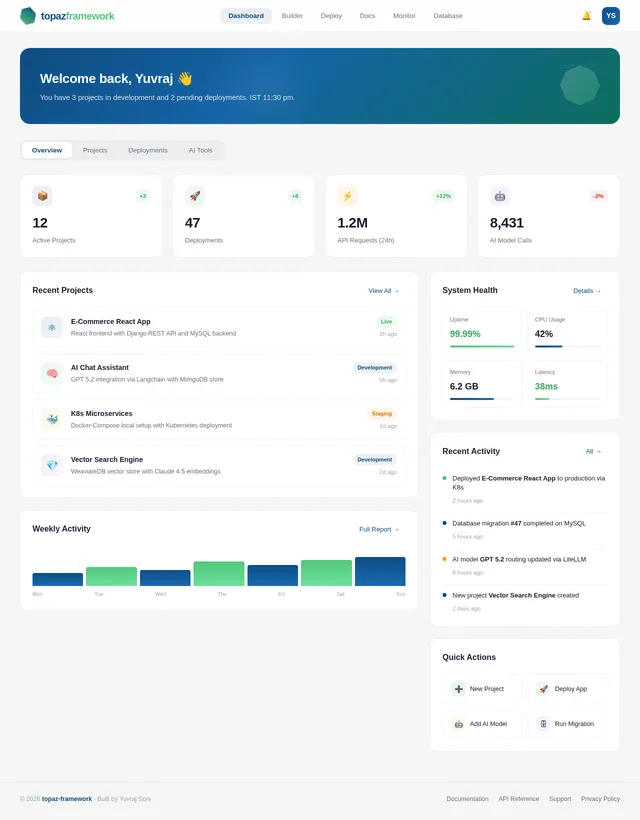
- As an Admin, I should be able to monitor system health and performance metrics.
4. User Personas
1. User
- Primary end-user of applications built on the framework.
- Focused on ease of use and functionality.
2. Developer
- Builds applications using the framework.
- Requires extensive documentation, tools, and libraries.
3. Admin
- Manages and monitors applications and system resources.
- Ensures security, scalability, and performance.
4. Guest
- Temporary user accessing demo features.
- Limited access to framework functionalities.
5. Visuals Colors and Theme
The topaz-framework will adopt a modern and professional aesthetic with the following color palette:
- Primary Color: Topaz Blue (#0F4C81) – representing innovation and trust.
- Secondary Color: White (#FFFFFF) – for clean and minimalistic design.
- Accent Color: Emerald Green (#50C878) – symbolizing growth and creativity.
- Background Color: Light Gray (#F5F5F5) – ensuring readability and comfort.
The theme will emphasize simplicity, elegance, and functionality, with a focus on intuitive navigation and responsive design.
6. Signature Design Concept
Interactive Crystal Interface
The homepage of the topaz-framework will feature an interactive 3D crystal that dynamically changes based on user interactions. This crystal will serve as a visual metaphor for the framework's modularity and adaptability.
Key Features:
- 3D Animation: The crystal rotates and morphs as users hover over different sections.
- Interactive Sections: Each facet of the crystal represents a core feature (e.g., AI tools, database solutions, deployment options). Clicking a facet zooms into detailed information.
- Color Transitions: The crystal subtly shifts colors (Topaz Blue, Emerald Green) based on user actions, creating a mesmerizing effect.
- Micro-Interactions: Hover effects, smooth transitions, and subtle vibrations enhance the tactile experience.
- Background: A gradient backdrop that transitions from dawn to dusk hues based on the time of day, creating a living environment.
This design concept will make the homepage unforgettable, engaging users from the first glance.
7. Non-Functional Requirements
- Performance: The framework must handle high traffic and concurrent users efficiently.
- Scalability: Support for scaling applications horizontally and vertically.
- Security: Implement robust authentication, authorization, and encryption mechanisms.
- Localization: Default settings tailored for Indian users (e.g., IST timezone, INR currency).
- Accessibility: Ensure compliance with WCAG 2.1 standards for accessibility.
- Reliability: Maintain 99.99% uptime with automated failover mechanisms.
8. Tech Stack
Frontend:
- React for Web
- React Native for Mobile
Backend:
- Python
- Django
Database:
- RDBMS: MySQL or MariaDB (with Alembic for migrations)
- NoSQL: MongoDB
- VectorDB: WeaviateDB
AI Models:
- GPT 5.2 for user-friendly responses
- Claude 4.5 Opas for academic or coding work
- Gemini 3 Pro for friendly responses
- Google Nano Banana for image generation
AI Tools:
- Litellm for LLM Routing
- Langchain
Orchestration:
- Local: Docker, Docker-Compose
- Server-Side: Kubernetes
9. Assumptions and Constraints
Assumptions:
- The framework will primarily target developers and organizations in India.
- Users will have access to modern hardware and internet connectivity.
- The framework will be compatible with major browsers and mobile platforms.
Constraints:
- Development must adhere to the specified tech stack.
- Deployment must support Docker and Kubernetes environments.
- AI integrations must comply with ethical guidelines and data privacy laws.
10. Glossary
- Framework: A structured platform for application development.
- RDBMS: Relational Database Management System.
- NoSQL: Non-relational database system.
- VectorDB: Database optimized for vector-based data storage.
- AI Models: Artificial intelligence systems for specific tasks.
- Orchestration: Automated configuration and management of systems.
- WCAG: Web Content Accessibility Guidelines.
This document provides a comprehensive overview of the topaz-framework project, ensuring alignment with Yuvraj Soni's vision and the needs of its target users.
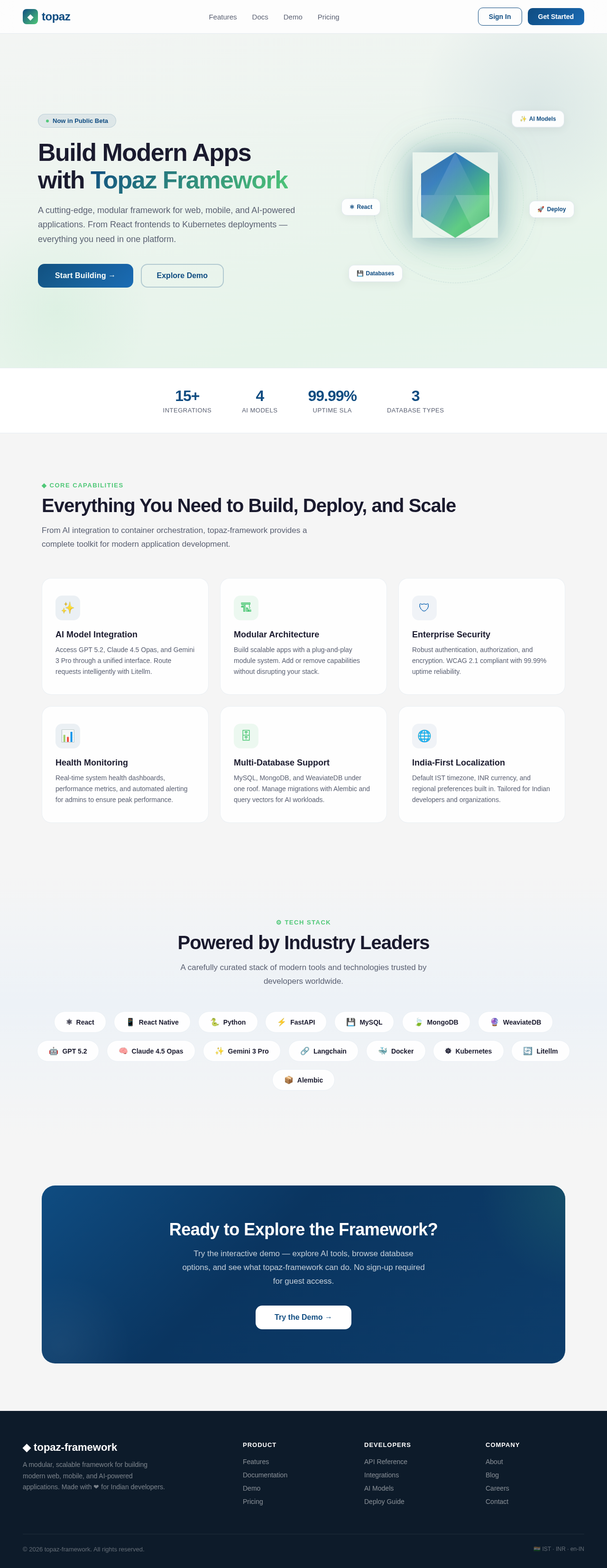
Build Modern Apps with Topaz Framework
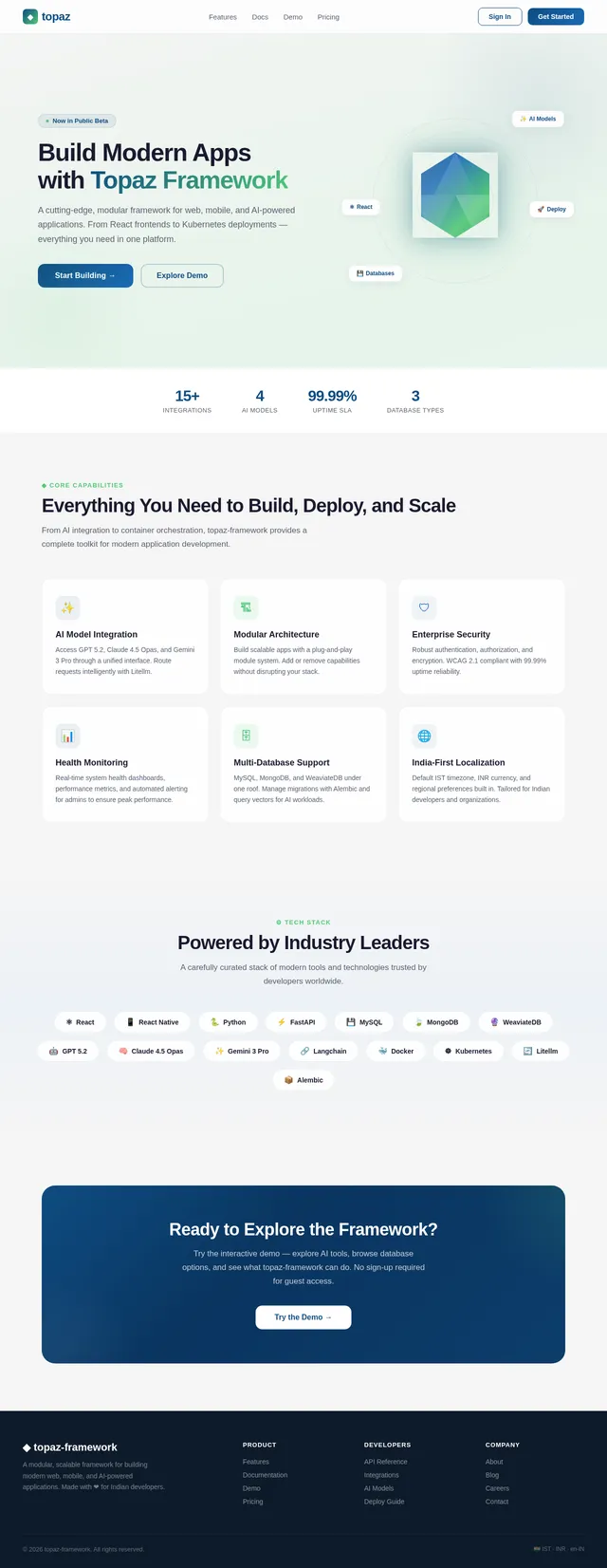
A cutting-edge, modular framework for web, mobile, and AI-powered applications. From React frontends to Kubernetes deployments — everything you need in one platform.
Everything You Need to Build, Deploy, and Scale
From AI integration to container orchestration, topaz-framework provides a complete toolkit for modern application development.
AI Model Integration
Access GPT 5.2, Claude 4.5 Opas, and Gemini 3 Pro through a unified interface. Route requests intelligently with Litellm.
Modular Architecture
Build scalable apps with a plug-and-play module system. Add or remove capabilities without disrupting your stack.
Enterprise Security
Robust authentication, authorization, and encryption. WCAG 2.1 compliant with 99.99% uptime reliability.
Health Monitoring
Real-time system health dashboards, performance metrics, and automated alerting for admins to ensure peak performance.
Multi-Database Support
MySQL, MongoDB, and WeaviateDB under one roof. Manage migrations with Alembic and query vectors for AI workloads.
India-First Localization
Default IST timezone, INR currency, and regional preferences built in. Tailored for Indian developers and organizations.
Powered by Industry Leaders
A carefully curated stack of modern tools and technologies trusted by developers worldwide.
Ready to Explore the Framework?
Try the interactive demo — explore AI tools, browse database options, and see what topaz-framework can do. No sign-up required for guest access.
No comments yet. Be the first!