topaz-ai
 umang suthar
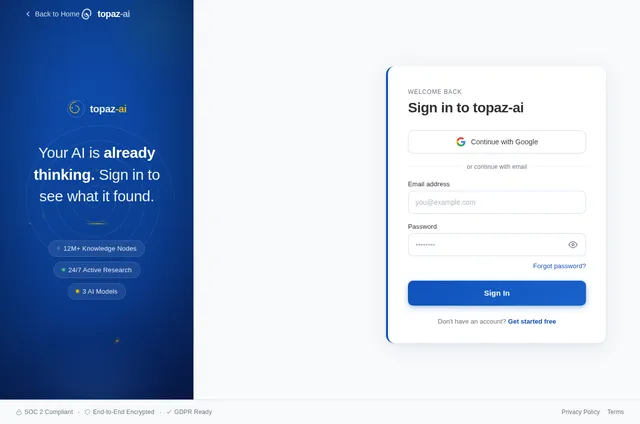
I am thinking to build a AI system which basically do the sub concious thiniking as much as possible and keep increasing it's own knowledge by it self.. Like humans have.. how human brain works.. it keeps running in sub concious mind keep thinking all possibilities and cases and increasing it's knowledge by keep searching all over the world.. I need similar capabilities in the system. where system keeps doing the research and increasing it's knowleged.. For now to store the new knowledge we can use custom graph system and store the data in the weaviate service. So basically user came and give the task.. our sub concious AI keeps doing it's reaseach and keeps gethering the knowledge, prepare all possibilities and cases and keep doing it in that domain and this keep going till everything is covered.. also same like human let's say our system search xyz thing and found pqr then it should keep go and gether information about pqr as well and keep going on... now if user came back and ask anything now system should give reply from already researched and gethered knowledge ... if system found it doesn't have knowledge then it should start doing research in that direction.. user should be able to stop this sub concious ai to perform research whereever user wants but otherwise it should keep going on


Comments (0)
Sign in to leave a comment
System Requirements
System Requirements Document (SRD)
Project Name: topaz-ai
1. Introduction
The topaz-ai project, envisioned by Umang Suthar, aims to create an advanced AI system that mimics the human brain's subconscious thinking. The system will autonomously and persistently conduct research, gather knowledge, and explore all possible scenarios and cases, continuously expanding its knowledge base. This AI will proactively generate hypotheses, ask follow-up questions, and explore conditional branches to ensure comprehensive understanding. Designed for a broad audience, topaz-ai is not limited to any specific domain and aspires to be a universal tool for knowledge discovery and problem-solving.
This document outlines the system requirements for topaz-ai, including its functional and non-functional aspects, user personas, design concepts, and technical specifications. The system will integrate internet research capabilities to ensure it has access to the latest and most comprehensive information.
2. System Overview
The topaz-ai system is a self-driven AI designed to emulate subconscious human thinking. Its core functionalities include:
- Autonomous research and knowledge gathering from both internal and external sources, including the internet.
- Persistent exploration of interconnected topics and scenarios.
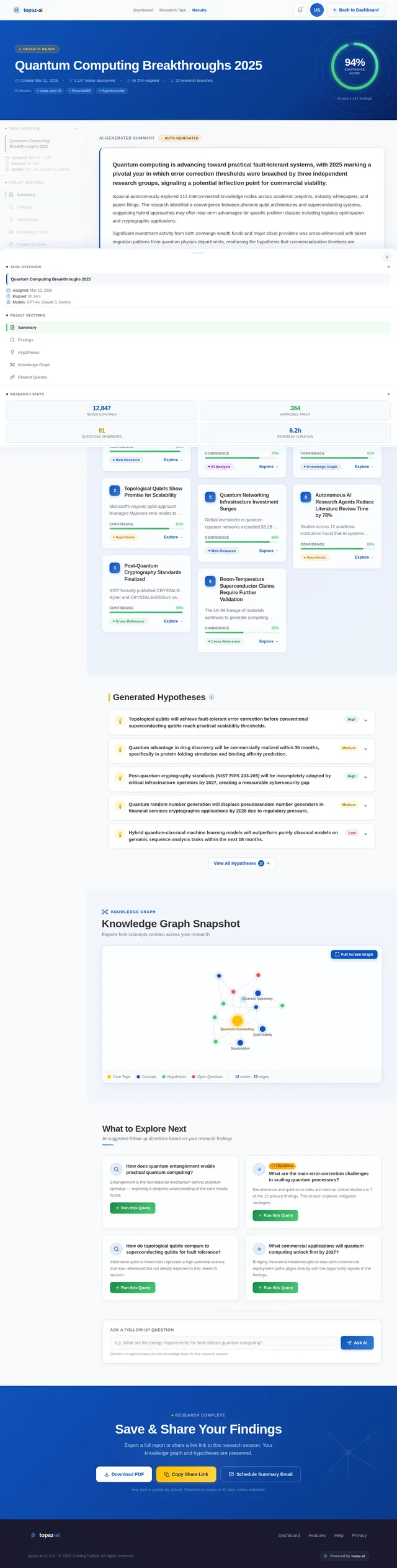
- Proactive generation of questions and hypotheses to deepen understanding.
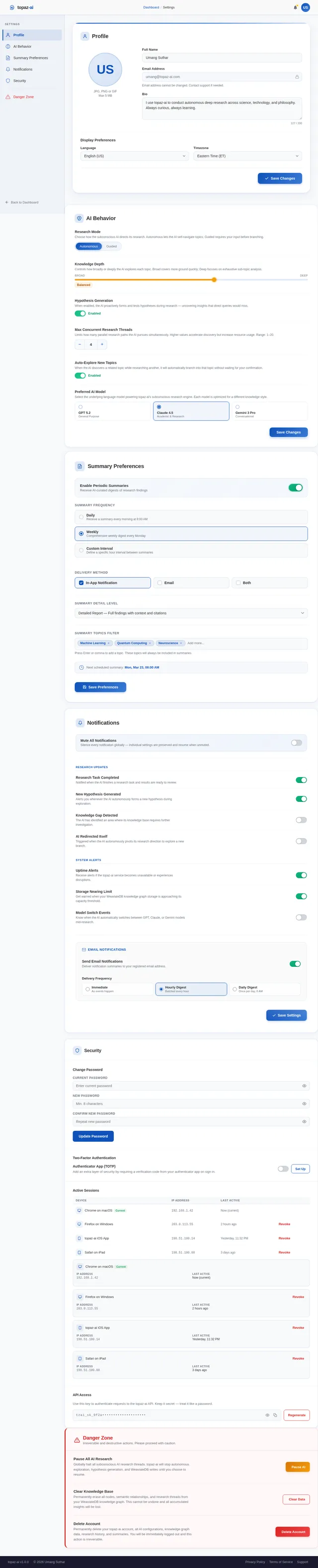
- Optional periodic summaries of findings for user review.
- A user-controlled mechanism to pause, stop, or redirect the AI's research.
- Recursive exploration of "what if" scenarios and edge cases to ensure comprehensive coverage.
- Internet research capabilities to gather real-time information and expand its knowledge base dynamically.
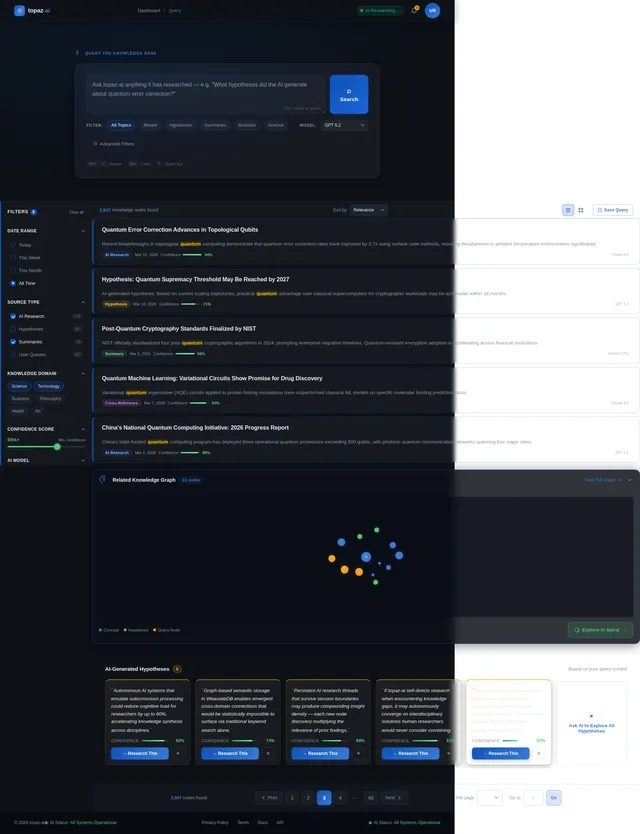
The system will leverage a custom graph-based knowledge storage mechanism integrated with WeaviateDB to manage and retrieve interconnected semantic data efficiently. It will also utilize internet research capabilities to gather real-time information and expand its knowledge base dynamically.
3. Functional Requirements
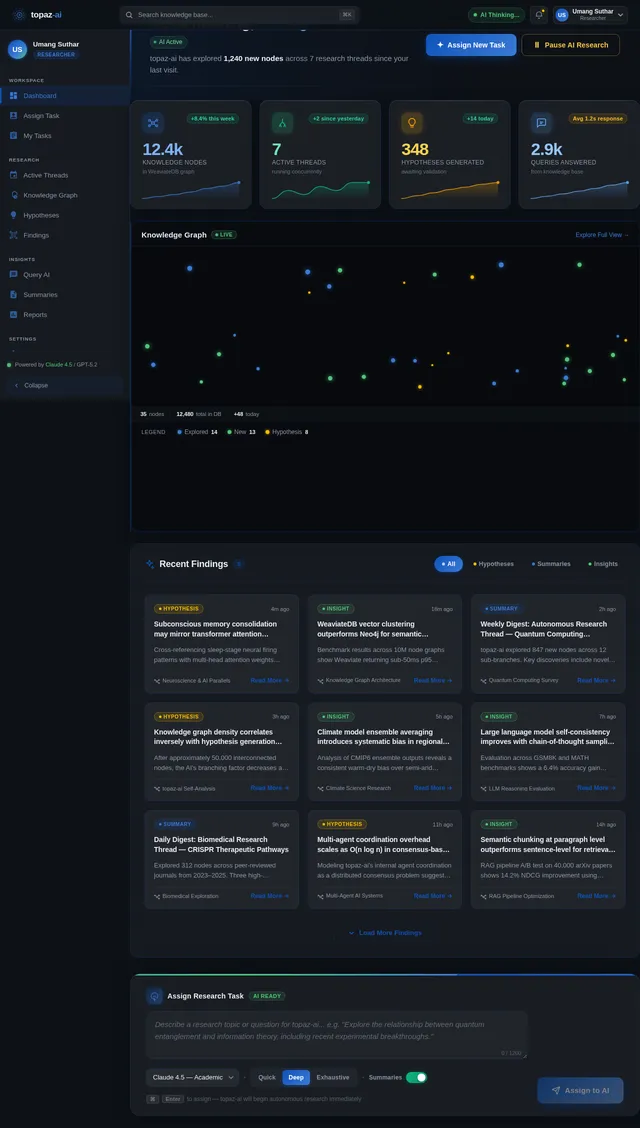
- As a User, I should be able to assign tasks to the AI for research.
- As a User, I should be able to view the AI's progress and findings.
- As a User, I should be able to pause or stop the AI's research at any time.
- As a User, I should be able to query the AI for information from its knowledge base.
- As a User, I should be able to enable or disable periodic summaries of the AI's findings.
- As a User, I should expect the AI to autonomously generate and explore follow-up questions and scenarios.
- As a User, I should expect the AI to continue researching and expanding its knowledge base even after completing a task.
- As a User, I should expect the AI to self-direct its research when encountering new topics or gaps in its knowledge.
- As a User, I should be able to allow the AI to research from the internet to gather real-time information.
- As a User, I should be able to selectively re-run tasks or trigger the AI to regenerate specific research outputs.
4. User Personas
-
General User:
- Description: Individuals from any background seeking information or insights.
- Needs: Easy access to a vast, continuously updated knowledge base.
- Goals: Obtain accurate, comprehensive answers to queries and benefit from the AI's proactive research capabilities.
-
Researcher:
- Description: Academics, scientists, or professionals conducting in-depth research.
- Needs: A system capable of exploring complex topics, generating hypotheses, and uncovering edge cases.
- Goals: Leverage the AI's autonomous research to save time and gain unique insights.
-
Business User:
- Description: Entrepreneurs or organizations seeking strategic insights or problem-solving.
- Needs: A tool that can analyze scenarios, predict outcomes, and provide actionable intelligence.
- Goals: Use the AI to make informed decisions and stay ahead in their domain.
-
Tech Enthusiast:
- Description: Individuals interested in cutting-edge AI technology.
- Needs: A system that demonstrates advanced AI capabilities and provides a hands-on experience with autonomous learning.
- Goals: Explore the AI's potential and experiment with its features.
5. Visuals Colors and Theme
The visual theme for topaz-ai should evoke intelligence, innovation, and trust. Updated color palette:
- Primary Color: Black (#000000) – Represents sophistication and modernity.
- Secondary Color: Vibrant Electric Blue (#007FFF) – Symbolizes intelligence and depth.
- Accent Color: Bright Neon Green (#39FF14) – Adds energy and highlights key elements.
- Background: Charcoal Gray (#1C1C1C) – Ensures readability and a sleek interface.
- Text: Soft White (#F5F5F5) – Provides contrast and clarity.
The UI should be minimalistic yet futuristic, with smooth transitions and intuitive navigation.
6. Signature Design Concept
"The Infinite Knowledge Spiral"
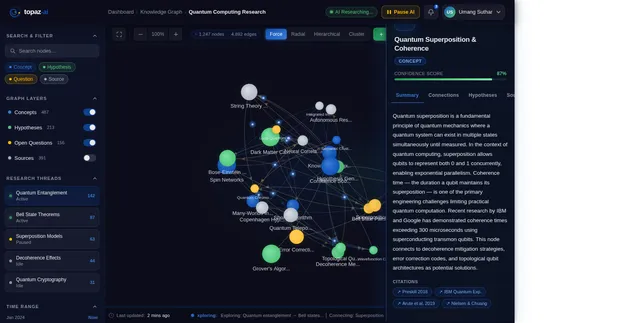
The homepage of topaz-ai will feature an interactive 3D spiral that symbolizes the infinite growth of knowledge. Users will see a dynamic, glowing spiral composed of interconnected nodes (representing knowledge points).
- Animation: The spiral will rotate slowly, with nodes lighting up as the AI explores new topics. Clicking on a node will zoom into its details, showing related topics and insights.
- Interaction: Users can drag, zoom, and explore the spiral, making it a tactile and immersive experience.
- Transitions: Smooth animations will guide users between nodes, creating a sense of flow and continuity.
- Micro-interactions: Hovering over a node will display a brief summary, while clicking will reveal detailed insights.
- Background: A subtle gradient that shifts colors based on the time of day, creating a living, dynamic interface.
This design will make the AI's knowledge exploration visually captivating and instantly memorable.
7. Non-Functional Requirements
- The system must handle concurrent user queries without performance degradation.
- The AI should operate continuously with minimal downtime.
- Data storage and retrieval must be optimized for speed and scalability.
- The system must ensure data security and user privacy.
- The UI must be responsive and accessible across devices.
- Internet research must be conducted securely, with safeguards against misinformation and malicious content.
8. Tech Stack
- Frontend: React for web interface.
- Backend: Python with FastAPI for API development.
- Database:
- VectorDB: WeaviateDB for semantic knowledge storage.
- RDBMS: MySQL for structured data storage.
- AI Models:
- GPT 5.4 for user-friendly responses.
- Claude 4.6 Opas for academic and coding tasks.
- Gemini 3.1 Pro for conversational interactions.
- Google Nano Banana for image generation.
- AI Tools: Langchain, Litellm for LLM routing.
- Orchestration: Docker and Kubernetes for deployment and scalability.
9. Assumptions and Constraints
- The system assumes a reliable internet connection for continuous research and updates.
- Initial knowledge gathering will be broad, with no domain-specific focus.
- Users will have the option to pause or redirect the AI's research.
- The system will rely on WeaviateDB for efficient semantic data storage.
- The AI's periodic summaries will be optional and configurable.
- Internet research will be conducted using secure APIs and filtered for quality and relevance.
10. Glossary
- Subconscious AI: An AI system that autonomously and persistently conducts research and expands its knowledge base.
- WeaviateDB: A vector database designed for semantic search and knowledge graph storage.
- Hypotheses: Assumptions or questions generated by the AI to explore new topics or scenarios.
- Periodic Summaries: Optional summaries of the AI's findings, provided to the user at configurable intervals.
- VectorDB: A database optimized for storing and retrieving vectorized data, often used in AI applications.
- Selective Re-run: A feature allowing users to manually trigger the AI to regenerate specific research outputs.
This document outlines the foundation for topaz-ai, a groundbreaking AI system designed to emulate human subconscious thinking. With its autonomous research capabilities, internet integration, and user-centric design, topaz-ai has the potential to revolutionize knowledge discovery and problem-solving.

The AI That Never Stops Thinking
topaz-ai autonomously explores, researches, and connects knowledge — building an ever-expanding understanding of the world so you can discover what matters, when it matters.
Knowledge, Visualized
Intelligence That Works for You
Always On
topaz-ai researches around the clock without prompting, continuously expanding its knowledge base while you focus on what matters.
Self-Directed
Autonomously follows knowledge threads, generating hypotheses and exploring conditional branches to uncover deeper insights.
Graph-Powered
Built on a WeaviateDB semantic knowledge graph that interconnects every discovery, enabling rich contextual retrieval.
Core Features
Intelligence That Works for You
Process
How topaz-ai Thinks
From a single prompt to an ever-expanding knowledge spiral — four steps is all it takes.
Assign a Task
Provide a research prompt or question. topaz-ai takes it from there, autonomously.
AI Explores
Autonomous branching, hypothesis generation, and follow-up questions in real time.
Knowledge Grows
Graph nodes accumulate in WeaviateDB, building an ever-expanding semantic network.
You Discover
Query findings, review summaries, and explore the infinite knowledge spiral.
Assign a Task
Provide a research prompt or question. topaz-ai takes it from there, autonomously.
AI Explores
Autonomous branching, hypothesis generation, and follow-up questions in real time.
Knowledge Grows
Graph nodes accumulate in WeaviateDB, building an ever-expanding semantic network.
You Discover
Query findings, review summaries, and explore the infinite knowledge spiral.
Who It’s For
Built for Every Mind
Whether you’re exploring a curiosity, conducting deep research, or driving business strategy — topaz-ai adapts to how you think.
General User
Curious minds from any background seeking answers
- Easy access to a vast, always-updated knowledge base
- Accurate, comprehensive answers powered by AI research
- Simple interface to explore complex topics effortlessly
Researcher
Academics and scientists conducting deep investigations
- Autonomous exploration of complex, branching topics
- Hypothesis generation and follow-up question discovery
- Graph-powered semantic connections across domains
Business User
Professionals needing strategic insights on demand
- Periodic AI-generated summaries and research digests
- Natural language queries for rapid decision support
- Continuously evolving intelligence without manual input
Trusted by Curious Minds
See how researchers, professionals, and lifelong learners use topaz-ai to unlock knowledge they never knew existed.
Start Your Knowledge Journey
topaz-ai never stops learning — and neither will you.
No comments yet. Be the first!