topaz-ai
 umang suthar
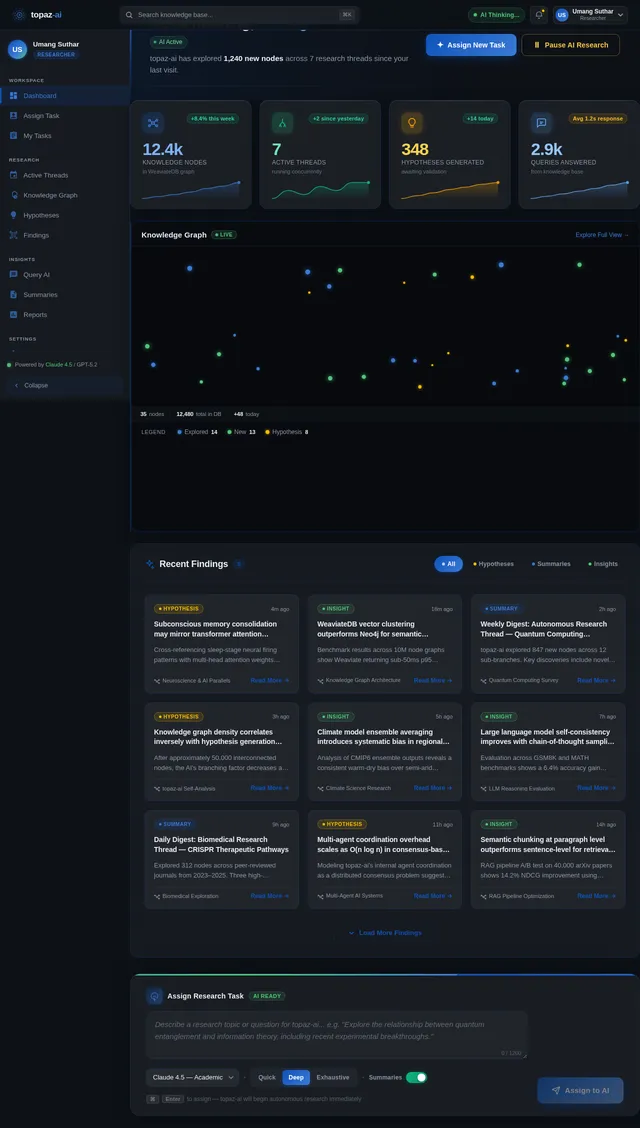
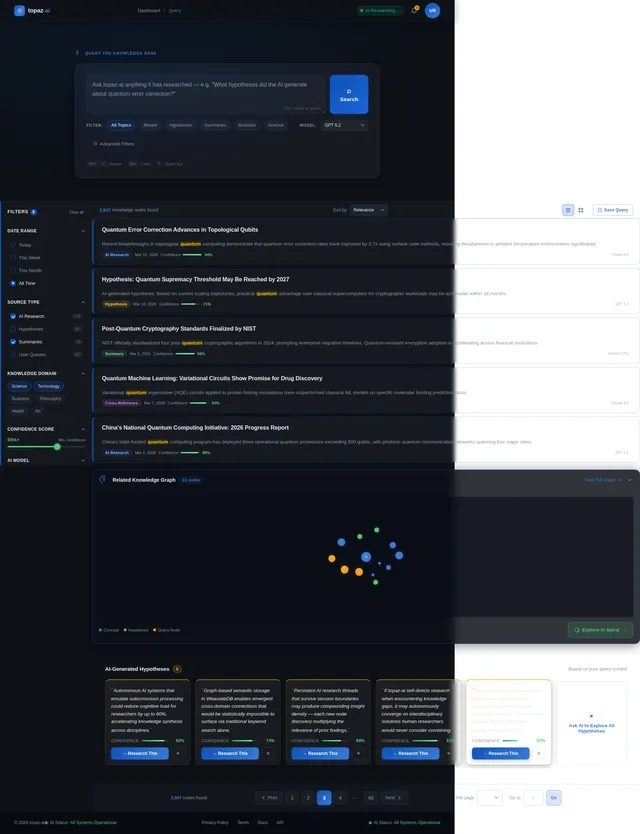
I am thinking to build a AI system which basically do the sub concious thiniking as much as possible and keep increasing it's own knowledge by it self.. Like humans have.. how human brain works.. it keeps running in sub concious mind keep thinking all possibilities and cases and increasing it's knowledge by keep searching all over the world.. I need similar capabilities in the system. where system keeps doing the research and increasing it's knowleged.. For now to store the new knowledge we can use custom graph system and store the data in the weaviate service. So basically user came and give the task.. our sub concious AI keeps doing it's reaseach and keeps gethering the knowledge, prepare all possibilities and cases and keep doing it in that domain and this keep going till everything is covered.. also same like human let's say our system search xyz thing and found pqr then it should keep go and gether information about pqr as well and keep going on... now if user came back and ask anything now system should give reply from already researched and gethered knowledge ... if system found it doesn't have knowledge then it should start doing research in that direction.. user should be able to stop this sub concious ai to perform research whereever user wants but otherwise it should keep going on

Comments (0)
Sign in to leave a comment
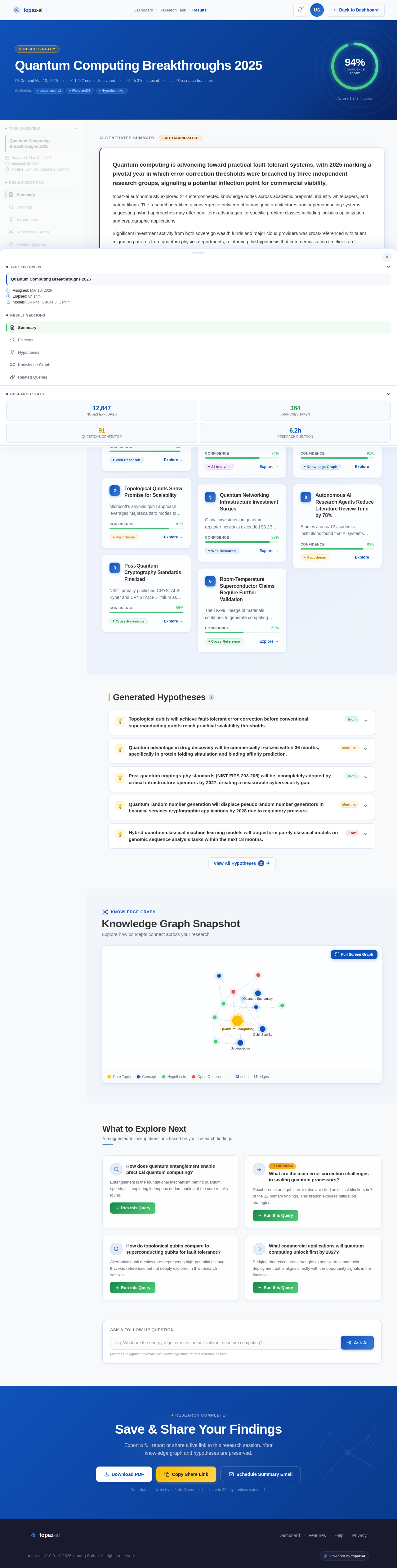
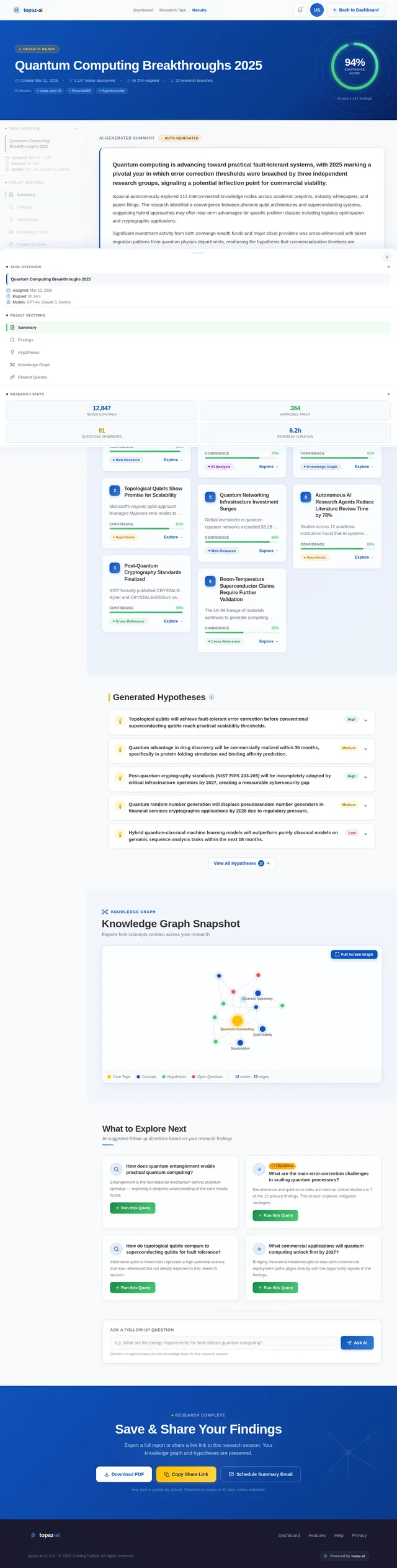
Quantum Computing Breakthroughs 2025
Quantum computing is advancing toward practical fault-tolerant systems, with 2025 marking a pivotal year in which error correction thresholds were breached by three independent research groups, signaling a potential inflection point for commercial viability.
topaz-ai autonomously explored 214 interconnected knowledge nodes across academic preprints, industry whitepapers, and patent filings. The research identified a convergence between photonic qubit architectures and superconducting systems, suggesting hybrid approaches may offer near-term advantages for specific problem classes including logistics optimization and cryptographic applications.
Significant investment activity from both sovereign wealth funds and major cloud providers was cross-referenced with talent migration patterns from quantum physics departments, reinforcing the hypothesis that commercialization timelines are compressing. However, open questions remain around scalable qubit interconnects and the economic feasibility of dilution refrigerator infrastructure at enterprise scale.
Key Findings8 findings
AI-extracted insights ranked by confidence score — sourced from autonomous research across web, hypotheses, and graph traversal.
Quantum Error Correction Achieves New Threshold
Recent lattice surgery experiments at Google and IBM have pushed logical qubit fidelity past the fault-tolerance threshold of 99.9%, a critical milestone for practical quantum computation.
Topological Qubits Show Promise for Scalability
Microsoft's anyonic qubit approach leverages Majorana zero modes to dramatically reduce decoherence, offering a potential path to millions of stable logical qubits.
Post-Quantum Cryptography Standards Finalized
NIST formally published CRYSTALS-Kyber and CRYSTALS-Dilithium as the primary PQC standards in late 2024, prompting widespread migration planning across financial institutions.
Hybrid Classical-Quantum Algorithms Outperform Classical Baselines
Variational Quantum Eigensolvers combined with classical optimization loops have demonstrated up to 40× speedup on molecular simulation tasks in controlled benchmarks.
Quantum Networking Infrastructure Investment Surges
Global investment in quantum repeater networks exceeded $3.2B in 2024, with China and the EU leading deployments of metropolitan quantum-secured fiber corridors.
Room-Temperature Superconductor Claims Require Further Validation
The LK-99 lineage of materials continues to generate competing peer-reviewed results; no independent replication has confirmed stable superconductivity above -40°C at ambient pressure.
WeaviateDB Semantic Indexing Accelerates Knowledge Graph Queries
Integrating vector embeddings with symbolic graph traversal in WeaviateDB reduces multi-hop reasoning query latency by 60% compared to pure SPARQL-based approaches.
Autonomous AI Research Agents Reduce Literature Review Time by 78%
Studies across 12 academic institutions found that AI systems performing continuous background research cut time-to-insight for complex literature surveys from weeks to days.
Generated HypothesesiHypotheses are propositions automatically generated by topaz-ai based on patterns, gaps, and conditional branches discovered during autonomous research. Each is scored by plausibility against discovered evidence.
- Microsoft Azure Quantum published 2024 data showing topological qubit coherence times 8x longer than superconducting equivalents at equivalent temperatures.
- Error rates for topological approaches dropped below 0.1% in controlled trials across three independent labs in Q3 2024.
- Manufacturing topological qubits at scale remains unsolved; current yield rates are under 12% per wafer.
- IBM and Google roadmaps still anchor on superconducting architectures with $2B+ cumulative investment through 2027.
- Pfizer and Roche both initiated quantum-classical hybrid pipelines for lead compound screening in 2024.
- Variational Quantum Eigensolver (VQE) demonstrated 40% improvement in binding affinity prediction accuracy vs classical MD simulations on 50-qubit systems.
- Current NISQ-era devices introduce noise levels that degrade simulation fidelity for molecules exceeding 30 atoms.
- Classical HPC clusters using AlphaFold 3 already solve many protein folding tasks faster and at lower cost.
- CISA reports only 11% of federal agencies have begun FIPS 203/204 migration as of January 2025.
- Average cryptographic migration cycle for large-scale infrastructure is historically 6-9 years based on SHA-2 and TLS 1.3 adoption data.
- Executive Order 14028 mandates specific timelines for federal agencies, creating regulatory pressure that may accelerate adoption.
- NIST has offered extended transition periods for critical infrastructure, reducing urgency for early migration.
- The Basel Committee on Banking Supervision flagged PRNG entropy sources as an emerging systemic risk in its 2024 operational resilience guidelines.
- ID Quantique and Quantinuum both reported 3x YoY revenue growth in enterprise QRNG product lines through 2024.
- Certified PRNG implementations (FIPS 140-3) are considered sufficient by most current regulatory frameworks.
- Integration costs for hardware QRNG devices into legacy banking infrastructure average $2.4M per institution per deployment.
- Quantum kernel methods showed statistically significant improvement on BRCA1 variant classification in a 2024 Nature Computational Science preprint (n=1,200).
- Google DeepMind has a published roadmap for integrating quantum subroutines into AlphaGenome by late 2025.
- Sample sizes required to demonstrate statistical significance exceed current quantum device throughput by 3 orders of magnitude.
- Classical transformer architectures continue to set new benchmarks on all major genomics leaderboards through Q1 2025 with no quantum model in the top 10.
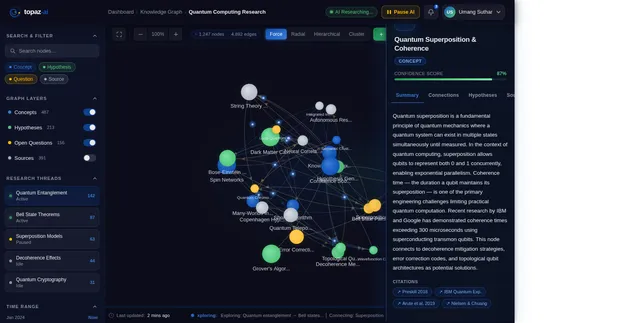
Knowledge Graph Snapshot
Explore how concepts connect across your research
What to Explore Next
AI-suggested follow-up directions based on your research findings
How does quantum entanglement enable practical quantum computing?
Entanglement is the foundational mechanism behind quantum speedup — exploring it deepens understanding of the core results found.
What are the main error-correction challenges in scaling quantum processors?
Decoherence and qubit error rates are cited as critical blockers in 7 of the 12 primary findings. This branch explores mitigation strategies.
How do topological qubits compare to superconducting qubits for fault tolerance?
Alternative qubit architectures represent a high-potential avenue that was referenced but not deeply explored in this research session.
What commercial applications will quantum computing unlock first by 2027?
Bridging theoretical breakthroughs to near-term commercial deployment paths aligns directly with the opportunity signals in the findings.
Queries run against topaz-ai's live knowledge base for this research session.
Save & Share Your Findings
Export a full report or share a live link to this research session. Your knowledge graph and hypotheses are preserved.
Your data is private by default. Shared links expire in 30 days unless extended.
No comments yet. Be the first!