terra-local
 Rahin Mon
Enakku local ai venum android ku
Comments (0)
Sign in to leave a comment
System Requirements
System Requirements Document (SRD) for terra-local
1. Introduction
The terra-local project is an innovative Android application designed to provide a fully offline, on-device AI assistant tailored for personal use. This system combines advanced AI capabilities such as chat assistance, task execution, voice recognition, and image recognition, all while ensuring user privacy and seamless performance without internet dependency.
This document outlines the system requirements for terra-local, ensuring it meets the needs of its primary user, Rahin Mon, in Egypt, and adheres to the specified focus on personal use.
2. System Overview
terra-local is a personal AI assistant designed to operate entirely on an Android device. Its primary goal is to empower users with a versatile and private AI tool that can:
- Respond to text and voice-based queries.
- Execute tasks as instructed by the user.
- Recognize and analyze images.
- Operate offline to ensure data privacy and reliability.
The system is tailored for individual use, focusing on Rahin Mon's specific needs, and is not intended for business or multi-user environments. By leveraging cutting-edge AI models and technologies, terra-local ensures high performance while maintaining simplicity and ease of use.
3. Functional Requirements
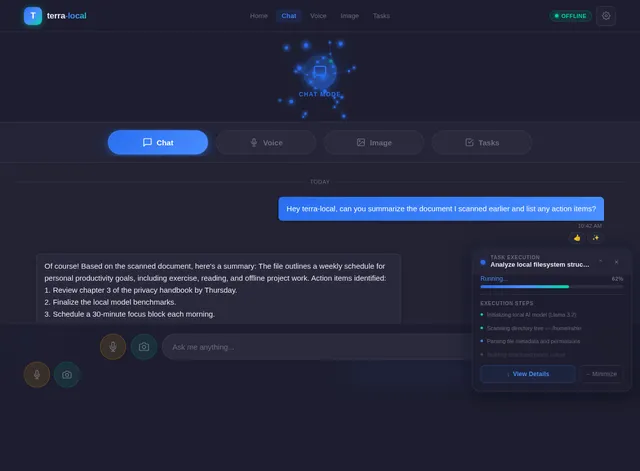
- As a User, I should be able to interact with the AI assistant via text-based chat.
- As a User, I should be able to interact with the AI assistant using voice commands.
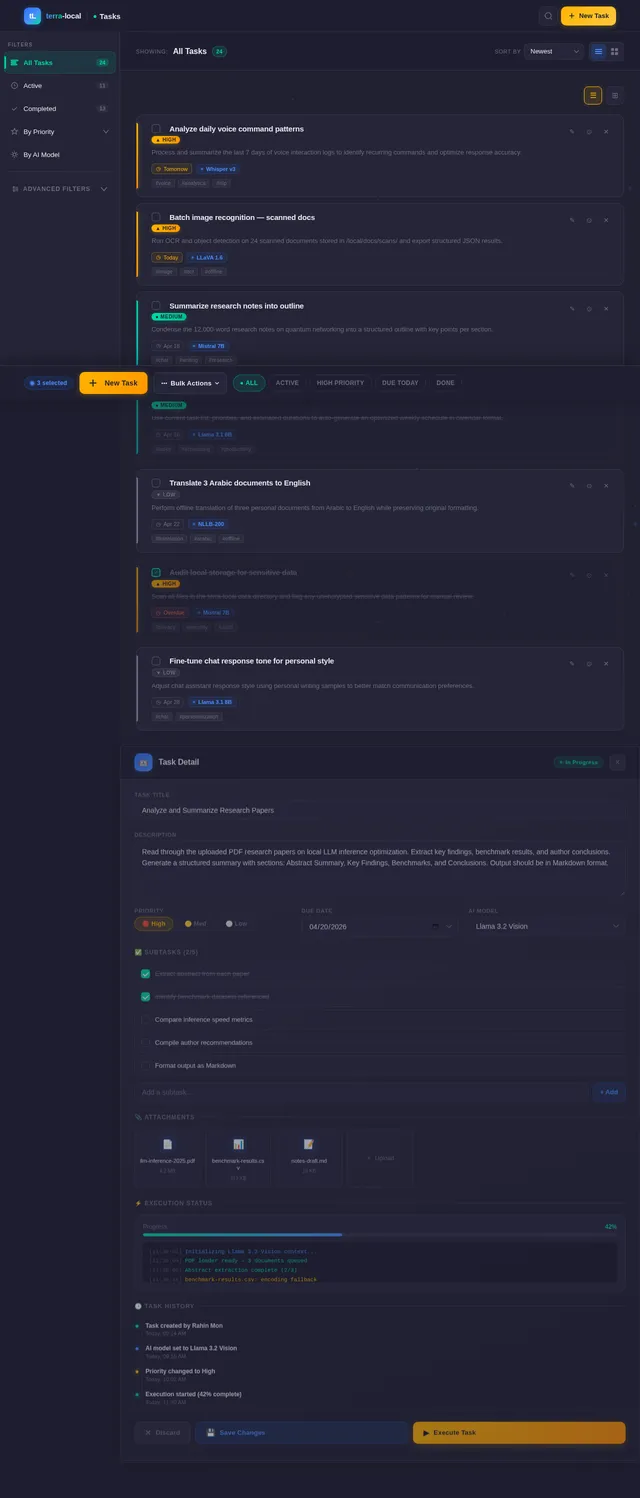
- As a User, I should be able to ask the AI assistant to perform specific tasks and have them executed.
- As a User, I should be able to use the AI assistant to recognize and analyze images.
- As a User, I should be able to use all features offline without requiring an internet connection.
- As a User, I should have my data processed and stored locally to ensure privacy.
- As a User, I should have the AI assistant tailored for personal/individual use only.
4. User Personas
1. Primary User: Rahin Mon
- Demographics: Individual user based in Egypt.
- Goals: Utilize a private, offline AI assistant for personal tasks and interactions.
- Needs: A versatile tool that combines chat, voice, task execution, and image recognition capabilities.
- Pain Points: Privacy concerns with online AI tools, reliance on internet connectivity, and overly complex systems designed for multi-user or business environments.
5. Visuals Colors and Theme
The visual identity of terra-local will reflect its focus on simplicity, privacy, and advanced technology. Below is the unique color palette designed for the project:
- Background: #1E1E2F (Deep Midnight Blue)
- Surface: #2A2A3D (Charcoal Gray)
- Text: #E8E8F2 (Soft White)
- Accent: #FFB400 (Warm Amber)
- Muted Tones: #6C6C80 (Muted Slate)
This palette ensures a modern, sleek, and professional look while maintaining readability and user comfort during extended use.
6. Signature Design Concept
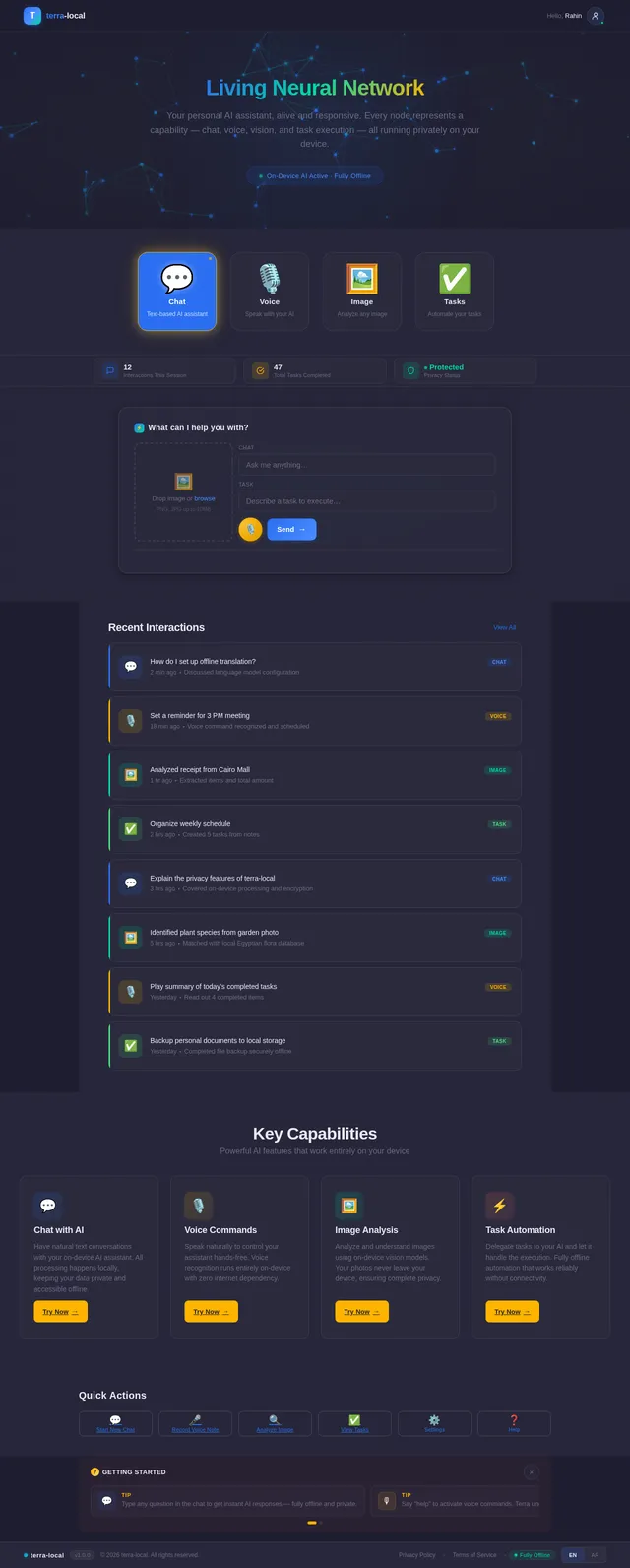
The terra-local home screen will feature a "Living Neural Network" design. Upon launching the app, users will see an animated, glowing neural network web that reacts dynamically to their interactions.
Key Features:
- Interactive Animation: The neural network pulses and shifts in response to user input, such as typing or speaking, creating a sense of connection with the AI.
- Color Transitions: The network's nodes and lines subtly shift colors based on the user's activity (e.g., warm amber for voice commands, cool blue for image recognition).
- Micro-Interactions: Hover effects and touch gestures cause ripples across the network, enhancing the tactile experience.
- Centralized Focus: The center of the network highlights the current mode (chat, voice, task, or image recognition) with a glowing icon and label.
This design not only creates a visually stunning first impression but also reinforces the app's identity as a cutting-edge, intelligent assistant.
7. Non-Functional Requirements
- The system must operate entirely offline, with no dependency on internet connectivity.
- All data must be processed and stored locally on the device to ensure user privacy.
- The app must be optimized for Android devices with at least 4GB of RAM.
- The system should provide responses within 1 second for chat and voice interactions.
- Image recognition tasks should complete within 3 seconds for standard images (up to 12MP).
- The app must support English and Arabic languages for text and voice interactions.
8. Tech Stack
Frontend
- React Native: For building the Android app interface.
Backend
- Python: For AI model integration and task execution.
- FastAPI: For managing local API interactions.
Database
- MySQL: For structured data storage and retrieval.
- WeaviateDB: For vector-based AI data storage.
AI Models
- GPT 5.4: For user-friendly chat responses.
- Claude 4.6 Opas: For coding and academic task execution.
- Google Nano Banana: For image recognition and analysis.
AI Tools
- Litellm: For LLM routing.
- Langchain: For chaining AI model interactions.
Local Orchestration
- Docker: For containerized app development.
- docker-compose: For managing multi-container setups.
9. Assumptions and Constraints
Assumptions
- The app will be used exclusively by Rahin Mon for personal purposes.
- The target device will have sufficient storage and processing power to handle AI tasks locally.
- Users will not require cloud-based features or multi-user support.
Constraints
- The system must operate entirely offline, limiting access to external APIs or cloud-based services.
- The app must be optimized for Android devices only, with no support for iOS or other platforms.
10. Glossary
- AI (Artificial Intelligence): Technology that enables machines to mimic human intelligence.
- Chat Assistant: A feature that allows users to interact with the system via text or voice.
- Task Execution: The ability of the system to perform specific actions as instructed by the user.
- Voice Recognition: Technology that processes and understands spoken commands.
- Image Recognition: The ability to analyze and interpret visual data from images.
- Offline: Functionality that does not require internet connectivity.
- On-Device: Processing and storage that occur locally on the user's device.
End of Document
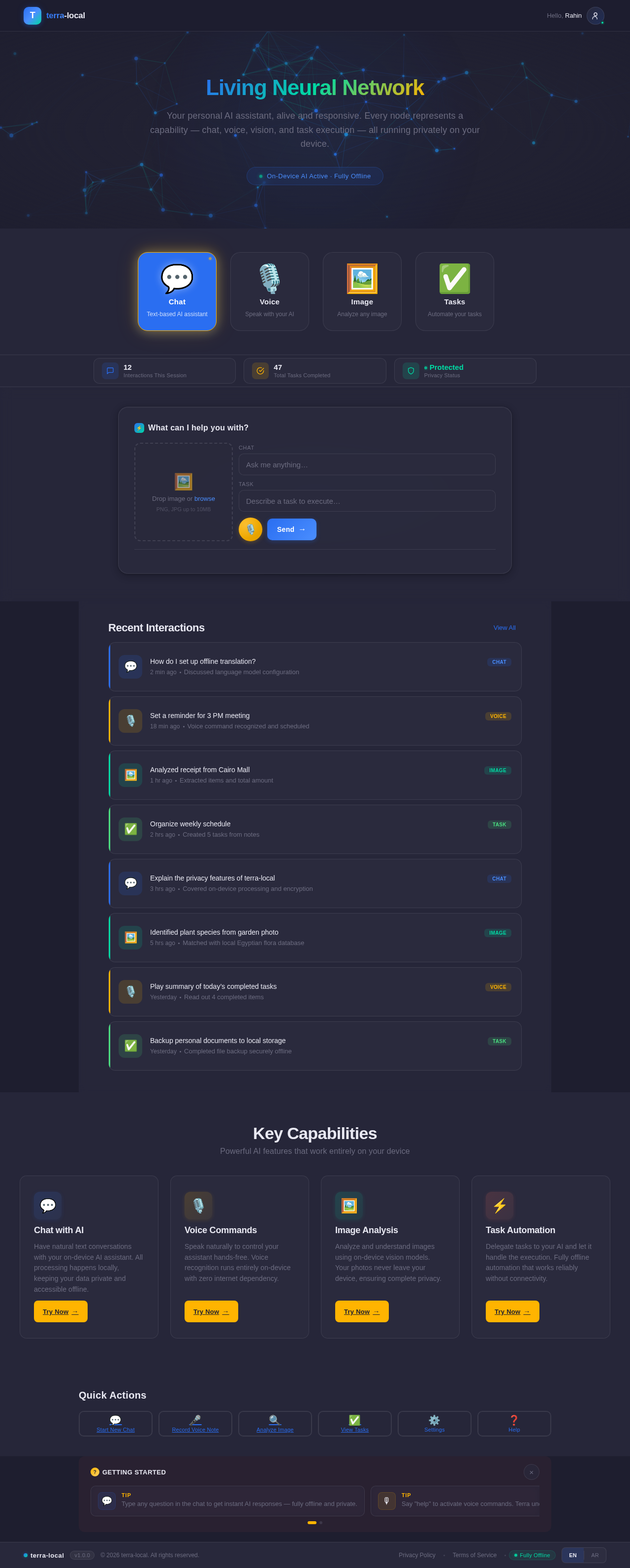
AI Neural Network Visualization
Living Neural Network
Your personal AI assistant, alive and responsive. Every node represents a capability — chat, voice, vision, and task execution — all running privately on your device.
Animated visualization of an interconnected neural network with glowing nodes and pulsing connections representing terra-local AI capabilities.
What can I help you with?
Recent Interactions
Key Capabilities
Powerful AI features that work entirely on your device
Chat with AI
Have natural text conversations with your on-device AI assistant. All processing happens locally, keeping your data private and accessible offline.
Try Now→Voice Commands
Speak naturally to control your assistant hands-free. Voice recognition runs entirely on-device with zero internet dependency.
Try Now→Image Analysis
Analyze and understand images using on-device vision models. Your photos never leave your device, ensuring complete privacy.
Try Now→Task Automation
Delegate tasks to your AI and let it handle the execution. Fully offline automation that works reliably without connectivity.
Try Now→
No comments yet. Be the first!