strong-multiplier
🎮 Core Concept of "1mx" Crash is a real‑time multiplayer betting game where: A round starts at a multiplier of 1.00x The multiplier increases continuously (e.g., 1.00 → 1.01 → 1.02 → …) At a provably‑fair random moment, the multiplier crashes Players must cash out before the crash to lock in their multiplier If they don’t, they lose their bet The tension comes from the multiplier rising quickly while the crash point is unknown. ⚙️ Game Mechanics (Developer‑Ready) 1. Round Lifecycle State: WAITING Players place bets. Countdown timer (e.g., 5 seconds). State: RUNNING Multiplier increases smoothly in real time. State: CRASHED Multiplier stops at a predetermined crash point. State: SETTLEMENT Payouts are calculated and broadcast. State: RESET New round begins. 2. Multiplier Growth Formula Most crash games use an exponential curve: 𝑚 𝑢 𝑙 𝑡 𝑖 𝑝 𝑙 𝑖 𝑒 𝑟 ( 𝑡 ) = 𝑒 𝑘 𝑡 Where k controls speed. Alternatively, a simpler linear or pseudo‑exponential curve works: Code multiplier += multiplier * growthRate * deltaTime 3. Crash Point Generation (Provably Fair) Use a server seed, client seed, and nonce to generate a crash point: Code hash = HMAC_SHA256(serverSeed, clientSeed + ":" + nonce) crashPoint = 1 / (1 - (int(hash, 16) / 2^256)) Or a simpler version: Code crashPoint = max(1.00, (100 / (100 - (hash % 100)))) Players can verify fairness by checking the server seed after it’s revealed. 4. Cashout Logic Players send a cashout request during the RUNNING state. Server checks: Was the request received before crash time What was the multiplier at that exact timestamp Payout = bet * multiplier Important: Cashout must be validated server‑side only. Never trust client timestamps. 🌐 Networking & Real‑Time Architecture Crash is fundamentally a real‑time multiplayer game, so the networking layer matters more than the UI. 1. Use WebSockets for Global Game State WebSockets are ideal because: Low latency Bidirectional Supports thousands of concurrent players Perfect for broadcasting multiplier updates Server → Clients Current multiplier Round state Crash event Other players’ cashouts (optional) Clients → Server Bet placement Cashout request 2. Tick Rate Recommended: 20–30 ticks per second for multiplier updates Broadcast only when the multiplier changes enough to matter (e.g., 0.01 increments) 3. Server Architecture A typical setup: Backend Language Options Node.js (fast prototyping, great WebSocket ecosystem) Go (excellent concurrency, low latency) Elixir/Phoenix (best-in-class real-time performance) Rust (high performance, safety, but more complex) Framework Suggestions Node.js → ws or socket.io Go → gorilla/websocket Elixir → Phoenix Channels Rust → tokio + warp or axum State Management Use an in‑memory game loop: Current multiplier Crash point Player bets Player cashouts Round timers For scaling horizontally, use: Redis pub/sub for state replication A single authoritative game server for the multiplier loop 🧮 Anti‑Cheat & Integrity 1. Server‑side authoritative state Clients never calculate: Multiplier Crash point Cashout timing 2. Provably fair hashing Publish: Previous round’s server seed Next round’s server seed hash 3. Rate limiting Prevent spam cashout attempts. 🎨 Frontend Implementation Tech Stack React / Vue / Svelte Canvas or WebGL for smooth multiplier animation WebSocket client for real‑time updates UI Elements Live multiplier graph Cashout button Bet input Round history Leaderboard 🧱 Database Layer Use a transactional DB PostgreSQL or MySQL for bets, payouts, user balances Redis for real‑time state caching Tables users bets rounds cashouts seeds (for provably fair) 🧪 Testing Strategy Unit tests Crash point generation Multiplier curve Cashout timing Load tests WebSocket concurrency Broadcast performance Security CONCERNS Replay attacks Timestamp spoofing Balance manipulation
Comments (0)
Sign in to leave a comment
System Requirements
System Requirements Document (SRD)
Project Name: strong-multiplier
1. Introduction
The strong-multiplier project is a real-time multiplayer betting game designed to deliver high-stakes excitement through a crash multiplier mechanic. Players wager on a continuously increasing multiplier, aiming to cash out before an unpredictable crash point. This document outlines the system requirements for the project, ensuring clarity and alignment for development and implementation.
Bob Snow, based in the US, has emphasized a minimalist HUD design, with wagering and game animation as the central focus, while keeping peripheral features like chat and historical multipliers neat and unobtrusive. The project will initially focus on three core pages: a Landing Page, a Gameplay Page, and a Player Profile Page.
2. System Overview
The strong-multiplier system is built around the core concept of a crash multiplier game. Players place bets, watch the multiplier rise, and must decide when to cash out before the multiplier crashes. The system is designed to be provably fair, ensuring trust and integrity among players.
Key components include:
- Real-time multiplayer gameplay powered by WebSockets for low-latency updates.
- Provably fair mechanics using server-side hashing for crash point generation.
- Minimalist HUD with a central focus on wagering and game animation.
- Peripheral features such as chat, historical multipliers, and a "Big Wins" leaderboard.
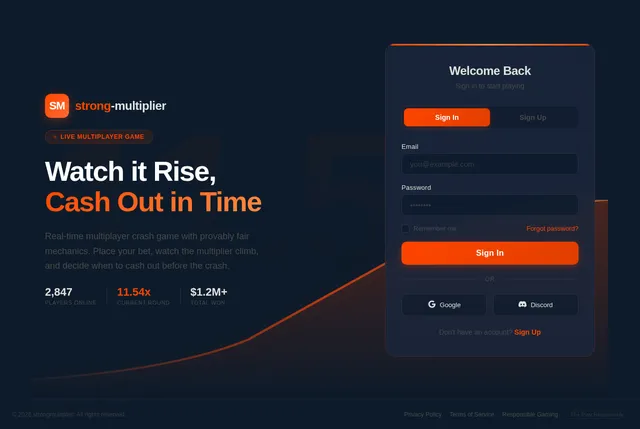
- Landing Page for user authentication and onboarding.
- Player Profile Page for managing personal details.
The system will prioritize scalability, fairness, and an engaging user experience.
3. Functional Requirements
Story Points:
- As a Player, I should be able to sign in or sign up from the Landing Page.
- As a Player, I should be able to place bets before the round starts.
- As a Player, I should be able to see the multiplier increase in real-time during the round.
- As a Player, I should be able to cash out my bet before the multiplier crashes.
- As a Player, I should be able to view a "Big Wins" leaderboard showcasing high multipliers achieved by other players.
- As a Player, I should be able to view historical multipliers from previous rounds.
- As a Player, I should be able to chat with other players during the game via a thin chat window on the Gameplay Page.
- As a Player, I should be able to access my Player Profile Page to view and edit personal details.
- As an Admin, I should be able to manage server seeds for provably fair crash point generation.
- As an Admin, I should be able to monitor player activity and enforce anti-cheat measures.
4. User Personas
1. Player
- Description: Casual or competitive users who participate in the game by placing bets and cashing out before the multiplier crashes.
- Goals: Maximize winnings, enjoy the thrill of the game, and interact with other players.
- Pain Points: Unfair gameplay, laggy animations, or unclear betting mechanics.
2. Admin
- Description: System operators responsible for maintaining game integrity and managing backend operations.
- Goals: Ensure provably fair gameplay, monitor server performance, and prevent cheating.
- Pain Points: Complex server management or insufficient anti-cheat tools.
5. Visuals Colors and Theme
Color Palette:
The strong-multiplier project will feature a sleek, minimalist theme with the following custom color palette:
- Background:
#0D1B2A(Deep Ocean Blue) - Surface:
#1B263B(Dark Slate Blue) - Text:
#E0E1DD(Soft Ivory White) - Accent:
#FF4500(Burnt Orange) - Muted Tones:
#4A4A4A(Charcoal Gray)
This palette ensures a modern, clean aesthetic while emphasizing the tension and excitement of the gameplay.
6. Signature Design Concept
Bold Design Idea: Dynamic Multiplier Animation with Peripheral Glow
The Gameplay Page will feature a central multiplier animation that dynamically grows in size and intensity as the multiplier increases. The animation will include a glowing effect that pulses outward, creating a sense of escalating tension.
-
Animation Details:
- The multiplier starts small and grows exponentially in size and brightness as the round progresses.
- A glowing ring surrounds the multiplier, pulsing faster as the crash point nears.
- When a player cashes out, their multiplier briefly flashes in their accent color before fading out.
-
Peripheral Design:
- The Big Wins leaderboard and Historical Multipliers are displayed below the animation in a clean, tabular format.
- A thin chat window is positioned on the right, with smooth scrolling and a minimalist design.
-
Micro-Interactions:
- Hovering over the chat window highlights messages with a subtle glow.
- Clicking on a historical multiplier reveals a tooltip with round details.
This design ensures the gameplay remains visually captivating while maintaining a clean and functional layout.
7. Non-Functional Requirements
- Scalability: The system must support up to 10,000 concurrent players without performance degradation.
- Latency: Real-time updates must occur within 50ms to ensure smooth gameplay.
- Security: Implement server-side validation for all critical game mechanics to prevent cheating.
- Fairness: Use provably fair hashing for crash point generation.
- Accessibility: Ensure the UI is usable for players with visual impairments (e.g., high-contrast mode).
8. Tech Stack
Frontend:
- React for Web
Backend:
- Python
- FastAPI
Database:
- MySQL (preferred) or MariaDB with Alembic for migrations
AI Tools:
- GPT 5.4 for user-friendly responses
Local Orchestration:
- Docker
- docker-compose
Server-Side Orchestration:
- Kubernetes
9. Assumptions and Constraints
- Players will primarily access the system via desktop browsers.
- The system will initially launch in the US, using USD as the default currency.
- The crash multiplier mechanic will remain the core gameplay feature for the MVP.
- Additional features like power-ups or challenges will be considered in future updates.
10. Glossary
- Crash Multiplier: The continuously increasing multiplier that players wager on.
- Provably Fair: A system that allows players to verify the fairness of game mechanics using cryptographic hashing.
- HUD: Heads-Up Display, the graphical interface players interact with during gameplay.
- Big Wins Leaderboard: A table showcasing the highest multipliers achieved by players.
- Historical Multipliers: A record of multipliers from previous rounds.
- WebSockets: A protocol enabling real-time communication between the server and clients.
This concludes the updated System Requirements Document for strong-multiplier. Let me know if further refinements are needed, Bob!
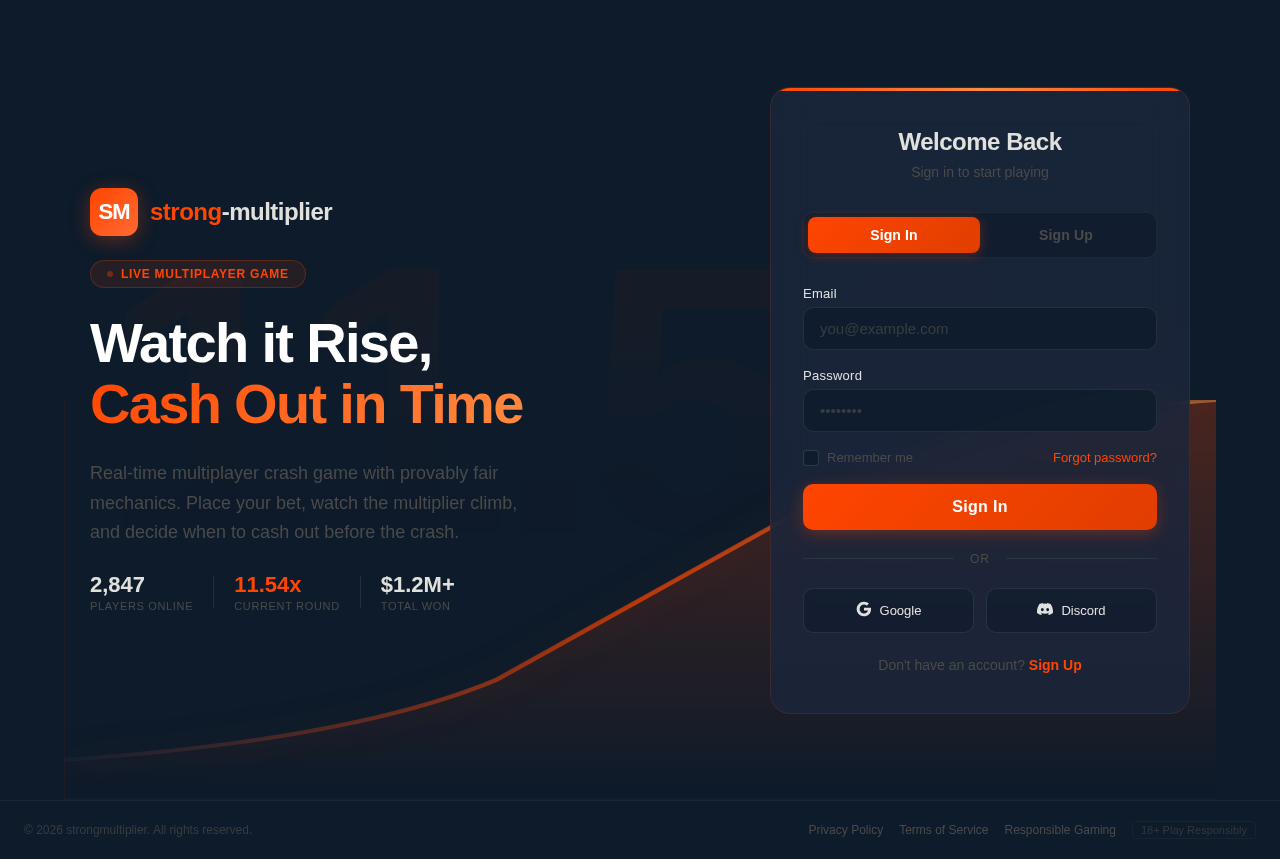
Watch it Rise,
Cash Out in Time
Real-time multiplayer crash game with provably fair mechanics. Place your bet, watch the multiplier climb, and decide when to cash out before the crash.
No comments yet. Be the first!