starry-parking
 SHWETA SATPUTE
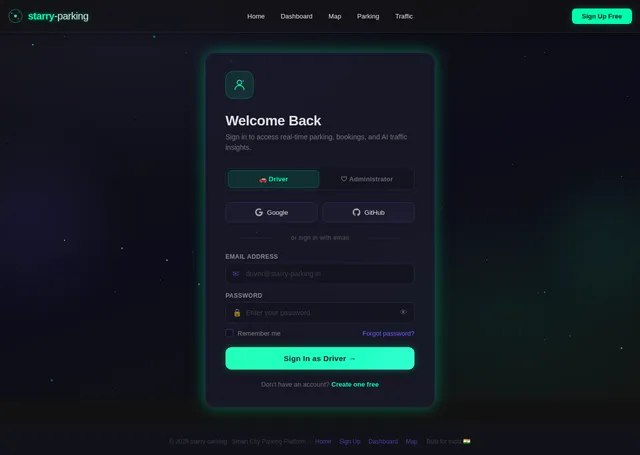
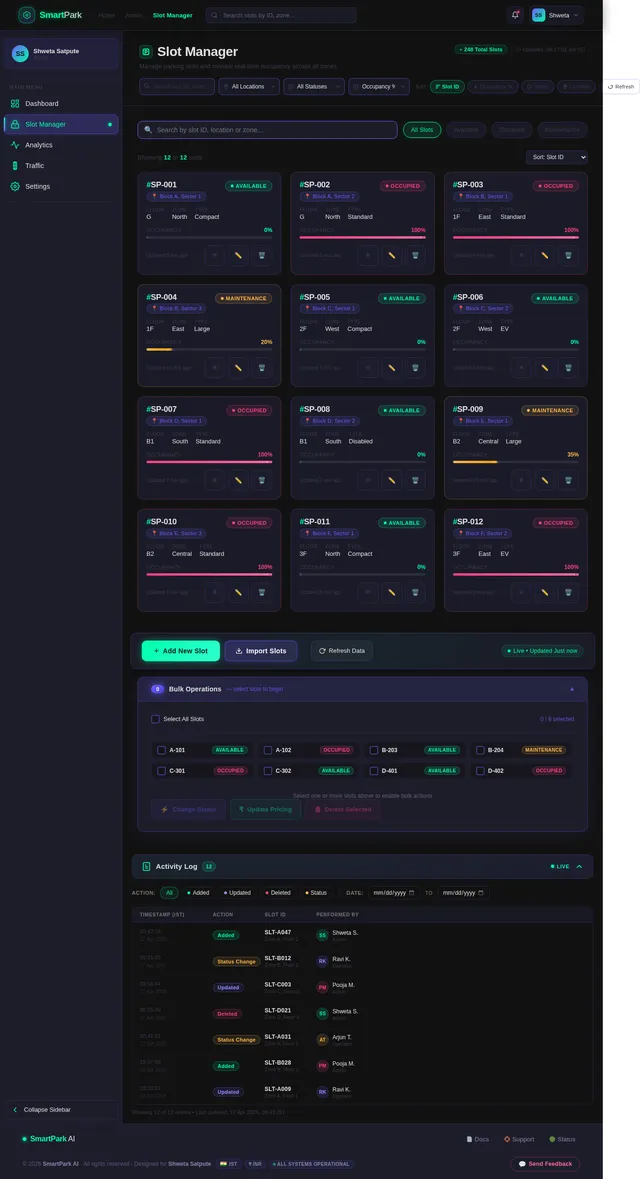
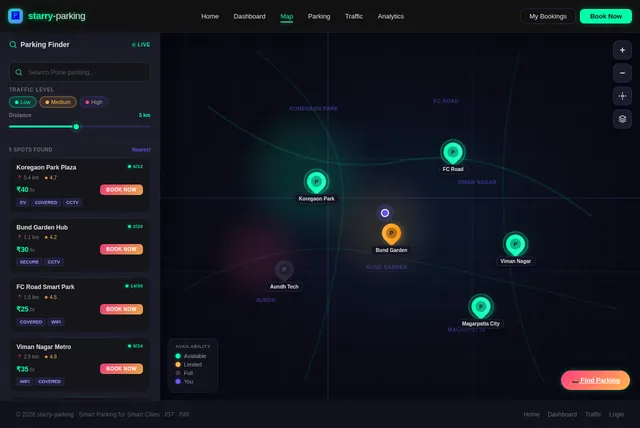
Create a modern, professional, and responsive full-stack website for a project named "SmartPark AI – Intelligent Parking & Traffic Prediction System". THEME: - Smart city + futuristic AI theme - Use dark mode with neon blue / green highlights - Clean UI with smooth animations PAGES & FEATURES: 1. HOME PAGE - Logo: "SmartPark AI" - Tagline: "Smart Parking. Smarter Traffic." - Hero section with smart city background - CTA button: "Find Parking Now" - Navigation: Home | Features | About | Contact | Login 2. USER SYSTEM - Sign up / Login authentication - Dashboard showing: - Available parking slots (real-time simulation) - Book / Reserve parking - Nearby parking (map view) - Booking history 3. ADMIN PANEL - Add/remove parking slots - Monitor occupancy - View analytics (charts, graphs) 4. AI TRAFFIC PREDICTION - Display traffic levels (Low / Medium / High) - Show graph visualization - Predict traffic based on time/location (dummy ML logic allowed) 5. IOT PARKING SIMULATION - Randomly update parking slot availability - Auto refresh every few seconds 6. MAP INTEGRATION - Google Maps / Leaflet - Show parking locations + traffic density 7. EXTRA FEATURES - Notification (booking confirmation) - Dummy payment system - Search & filter parking - Dark/light mode toggle 8. DESIGN REQUIREMENTS - Use cards, gradients, hover effects - Mobile responsive design - Smooth transitions 9. OUTPUT REQUIRED - Complete frontend + backend code - Proper folder structure - Setup instructions - Sample data Make the website look like a real startup SaaS product.

Comments (0)
Sign in to leave a comment
System Requirements
System Requirements Document (SRD) for starry-parking
1. Introduction
The SmartPark AI project is a modern, professional, and responsive full-stack website designed to revolutionize parking and traffic management. By leveraging AI, IoT, and smart city principles, this platform aims to provide users with real-time parking availability, traffic predictions, and seamless booking experiences. This document outlines the updated system requirements to incorporate the latest user-requested features and ensure alignment with the project's vision.
This SRD has been tailored for SHWETA SATPUTE, based in India, and considers locale-specific defaults such as INR currency, IST timezone, and regionally relevant user behaviors.
2. System Overview
The SmartPark AI system is an intelligent parking and traffic prediction platform that integrates AI, IoT, and mapping technologies. It caters to both end-users (drivers) and administrators, offering features like real-time parking slot availability, traffic predictions, and booking management. The system is designed to be scalable, secure, and user-friendly, with a futuristic theme that aligns with the concept of a smart city.
Key components include:
- User System: For drivers to find, book, and manage parking slots.
- Admin Panel: For administrators to manage parking slots and monitor analytics.
- AI Traffic Prediction: To provide traffic insights and forecasts.
- IoT Parking Simulation: For real-time updates on parking slot availability.
- Map Integration: To display parking locations and traffic density.
3. Functional Requirements
User Stories
- As a User, I should be able to sign up and log in to access the system.
- As a User, I should be able to view available parking slots in real-time.
- As a User, I should be able to book and reserve parking slots.
- As a User, I should be able to view nearby parking slots on a map.
- As a User, I should be able to view my booking history.
- As a User, I should be able to toggle between dark and light modes.
- As a User, I should be able to receive notifications for booking confirmations.
- As a User, I should be able to search and filter parking slots.
- As a User, I should be able to make dummy payments for bookings.
- As an Admin, I should be able to add and remove parking slots.
- As an Admin, I should be able to monitor parking occupancy in real-time.
- As an Admin, I should be able to view analytics through charts and graphs.
- As a System, I should display traffic levels (Low/Medium/High) based on AI predictions.
- As a System, I should show traffic predictions based on time and location.
- As a System, I should randomly update parking slot availability for IoT simulation.
- As a System, I should auto-refresh parking slot availability every few seconds.
- As a System, I should allow the user's choice as a valid input option, as pre-approved by the API supervisor.
4. User Personas
1. End-User (Driver)
- Description: Individuals looking for parking spaces in real-time.
- Goals: Find, book, and manage parking slots seamlessly.
- Key Features: Real-time availability, booking, notifications, traffic predictions.
2. Administrator
- Description: Personnel managing parking facilities and system operations.
- Goals: Monitor and manage parking slots, view analytics, and ensure system efficiency.
- Key Features: Slot management, occupancy monitoring, analytics dashboard.
5. Visuals Colors and Theme
Color Palette
- Background: #121212 (Deep Black)
- Surface: #1E1E2E (Charcoal Gray)
- Text: #E0E0E0 (Soft White)
- Accent: #00FFAB (Neon Green)
- Muted: #3A3A4F (Muted Blue)
This palette reflects a futuristic, smart city aesthetic with a focus on dark mode and neon highlights.
6. Signature Design Concept
Interactive Galaxy Map Homepage
The homepage will feature an interactive galaxy map where each star represents a parking location. Users can hover over stars to see parking availability and click to zoom into a detailed map view. The galaxy will have subtle animations, with stars twinkling and constellations forming dynamically.
- Hero Section: A 3D animated smart city skyline with glowing neon outlines.
- Transitions: Smooth zoom-in and zoom-out effects as users navigate the galaxy.
- Micro-Interactions: Stars will pulse gently when hovered over, and parking details will appear in a floating card.
- Color Shifts: The galaxy background will subtly change hues (blue to green) based on user interactions.
- Call-to-Action: A glowing "Find Parking Now" button that pulses rhythmically.
This design will create an unforgettable first impression, blending functionality with a futuristic aesthetic.
7. Non-Functional Requirements
- Performance: The system should handle up to 10,000 concurrent users.
- Scalability: The architecture should support the addition of new features without major overhauls.
- Security: Implement secure authentication and data encryption.
- Localization: Support for INR currency and IST timezone.
- Accessibility: Ensure WCAG 2.1 compliance for accessibility.
- Responsiveness: Fully functional on mobile, tablet, and desktop devices.
8. Tech Stack
Frontend
- React.js (Web)
- React Native (Mobile)
Backend
- Python with FastAPI
Database
- MySQL (RDBMS) with Alembic for migrations
AI Models
- GPT 5.4 for user-friendly responses
- Google Nano Banana for image generation
AI Tools
- LangChain
- LiteLLM for LLM routing
Orchestration
- Docker and docker-compose for local development
- Kubernetes for server-side orchestration
9. Assumptions and Constraints
- The system assumes reliable internet connectivity for real-time updates.
- Google Maps API will be used for map integration.
- Dummy ML logic will be used for traffic predictions in the initial phase.
- IoT simulation will rely on WebSocket-based random updates.
10. Glossary
- AI: Artificial Intelligence
- IoT: Internet of Things
- WCAG: Web Content Accessibility Guidelines
- IST: Indian Standard Time
- RDBMS: Relational Database Management System
- API: Application Programming Interface
- CTA: Call to Action
No comments yet. Be the first!