spring-hrms
 Priti Tole
# Project: Enterprise HRMS — Human Resource Management System Build a complete, professional, secure, responsive Human Resource Management System (HRMS) for an organization. ## 1. Project objective Create a centralized HR platform that automates employee management, attendance, leave, payroll, performance, recruitment, onboarding, offboarding, training, and HR reporting. This must be a functional full-stack application, not a static UI prototype. All forms, buttons, tables, filters, approvals, dashboards, and reports must connect to working application logic and persistent database records. ## 2. Technology stack Use the following stack if supported by the platform: - Frontend: React + TypeScript + Tailwind CSS - Backend: Python FastAPI - Database: PostgreSQL - Authentication: secure session or token-based authentication - API documentation: OpenAPI/Swagger - Deployment: Docker with environment-based configuration Keep the frontend, backend, database models, business logic, and API layers clearly separated. ## 3. User roles and permissions Implement role-based access control for: 1. Super Admin — system configuration, organization settings, and access management. 2. HR Admin — employee records, recruitment, onboarding, payroll administration, and HR reports. 3. HR Executive — assigned HR operations with limited permissions. 4. Department Manager — team attendance, leave approvals, performance reviews, and team reports. 5. Employee — personal profile, attendance, leave requests, payslips, training, and self-service features. 6. Recruiter — job openings, applicants, interview schedules, and recruitment stages. 7. Payroll Administrator — salary structures, payroll runs, deductions, payslips, and payroll reports. Enforce permissions on the backend, not only by hiding frontend pages. ## 4. Required modules ### A. Employee Management - Employee profiles and unique employee IDs. - Department, designation, reporting manager, employment type, and joining date. - Contact information and emergency contacts. - Secure document storage and access permissions. - Employee status, employment history, and search/filter functionality. ### B. Attendance Management - Check-in and check-out. - Working hours and attendance summaries. - Shift and holiday configuration. - Late arrivals, missing punches, and corrections. - Monthly attendance reports. ### C. Leave Management - Configurable leave types and leave balances. - Leave application with dates, reason, and supporting documents where applicable. - Manager approval and rejection with comments. - Cancellation, leave history, and balance updates. - Notifications and audit history. ### D. Payroll and Salary Management - Salary structures and effective dates. - Earnings, allowances, deductions, and net salary calculations. - Payroll preparation, validation, approval, and processing. - Payslip generation and employee downloads. - Payroll history and reconciliation reports. - Configurable statutory rules and payroll periods. Never hardcode statutory rates or assume legal compliance. Validate calculations against current applicable regulations before production use. ### E. Recruitment and Applicant Tracking - Job requisitions and job postings. - Applicant profiles and resume/document uploads. - Application stages and interview scheduling. - Interview feedback and hiring decisions. - Conversion of selected candidates into employee records. ### F. Onboarding and Offboarding - Joining and exit checklists. - Document verification and policy acknowledgements. - Task assignment and completion tracking. - Asset allocation and return. - Exit interviews, clearance, and final settlement workflow. ### G. Performance Management - Goals, KPIs, and review cycles. - Employee self-assessments. - Manager reviews and feedback. - Review history and performance reports. ### H. Training and Development - Training programs and learning resources. - Employee enrollment and attendance. - Training completion and assessment records. - Skills and certification tracking. ### I. Employee Self-Service - Personal dashboard and profile updates. - Attendance and leave history. - Leave application and approval status. - Payslip access. - Company announcements, holidays, and notifications. - Training and performance information according to permissions. ### J. HR Analytics and Reporting - Total employees and department distribution. - Attendance and leave trends. - Recruitment funnel and hiring statistics. - Payroll summaries. - Employee turnover and onboarding status. - Performance and training reports. - Date, department, employee, and status filters. - CSV and PDF exports where appropriate. ## 5. Design requirements Create a modern enterprise SaaS interface with: - A responsive sidebar and top navigation. - A clear dashboard with relevant KPIs and charts. - Consistent typography, spacing, tables, forms, and status indicators. - Professional employee profile pages. - Search, filtering, sorting, pagination, and useful empty states. - Accessible forms with inline validation and clear error messages. - Responsive layouts for desktop, tablet, and mobile. - Loading states, confirmation dialogs, and success/error feedback. Avoid excessive gradients, unnecessary animations, cluttered dashboards, and decorative components that reduce usability. ## 6. Database and security requirements Design normalized PostgreSQL tables with appropriate foreign keys, constraints, indexes, and migrations. Include: - Secure password hashing and authentication. - Backend-enforced RBAC and organization-level data isolation. - Input validation and safe error handling. - Protection against unauthorized data access and common web vulnerabilities. - Audit logs for sensitive changes and approvals. - Secure document access and file validation. - Environment variables for credentials and secrets. - Automated database backups and a documented recovery strategy. Payroll, employee documents, and personal information must only be accessible to authorized users. ## 7. Business workflow requirements Implement and test complete workflows, including: - Employee creation → onboarding → active employment. - Check-in/check-out → attendance summary. - Leave application → manager approval → balance update. - Salary configuration → payroll validation → authorized approval → payslip generation. - Job requisition → application → interview → selection → onboarding. - Performance review → manager feedback → final review. - Employee exit request → clearance → offboarding completion. Use database transactions where needed to prevent inconsistent updates. ## 8. Development and acceptance criteria Before implementation, produce: 1. A requirements specification. 2. User roles and permission matrix. 3. Screen-by-screen user flows. 4. Database ER diagram and schema. 5. System architecture and API plan. 6. Development milestones and test plan. Build incrementally, keeping the approved requirements and design as the source of truth. After each module: - Run frontend and backend tests. - Validate API authorization. - Test database persistence and error cases. - Check responsive layouts. - Fix broken workflows before moving forward. Do not use fake data as a substitute for implemented functionality. Clearly label any seed/demo data. Deliver maintainable source code, database migrations, API documentation, setup instructions, automated tests, and deployment configuration. Do not claim the system is production-ready until its security, payroll calculations, integration tests, backups, and deployment configuration have been verified.

Comments (0)
Sign in to leave a comment
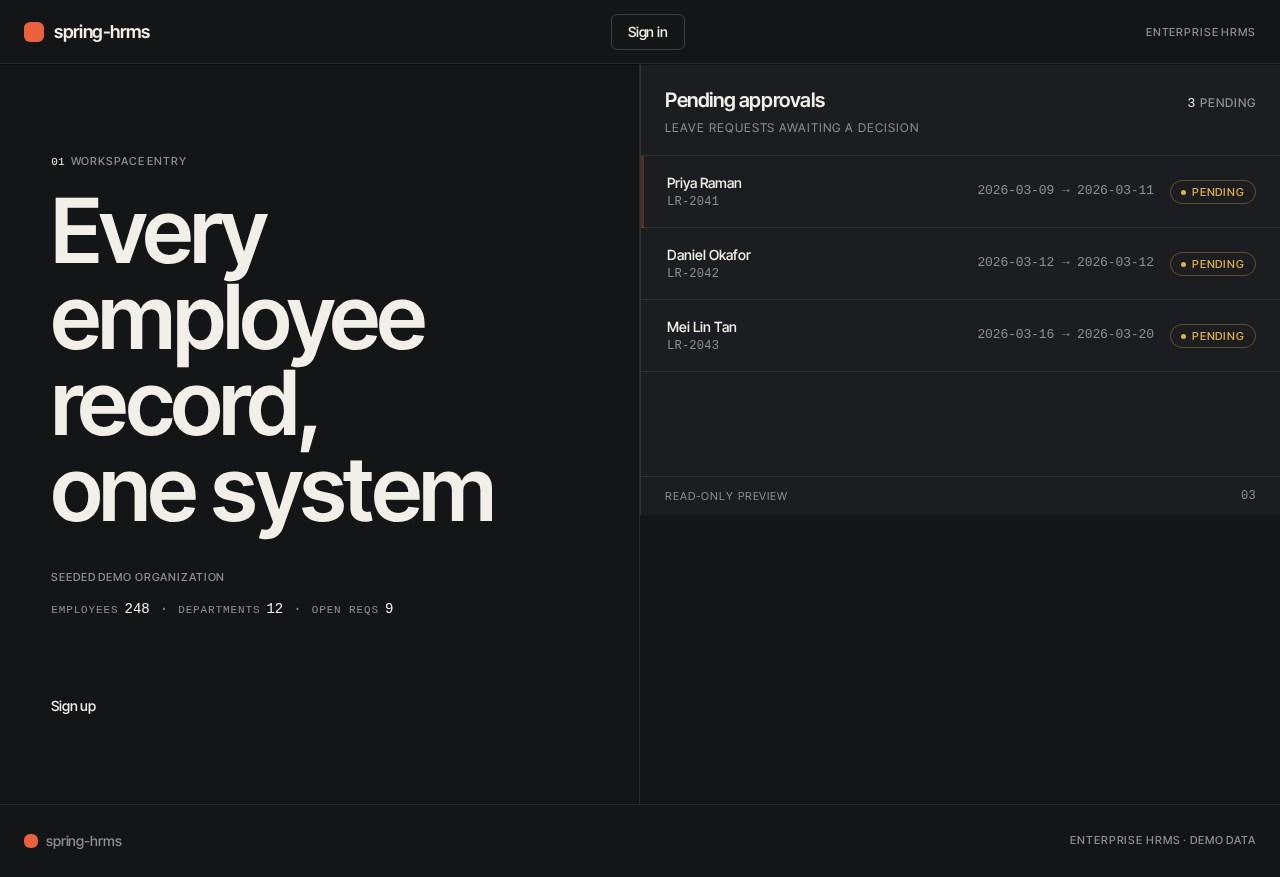
01 Workspace entry
Every employee record, one system
Pending approvals
3 pending- Priya RamanLR-20412026-03-09 → 2026-03-11Pending
- Daniel OkaforLR-20422026-03-12 → 2026-03-12Pending
- Mei Lin TanLR-20432026-03-16 → 2026-03-20Pending
01 Workspace entry
Every employee record, one system
Pending approvals
3 pending- Priya RamanLR-20412026-03-09 → 2026-03-11Pending
- Daniel OkaforLR-20422026-03-12 → 2026-03-12Pending
- Mei Lin TanLR-20432026-03-16 → 2026-03-20Pending
No comments yet. Be the first!