space-emergency
 Shaurya Kumar
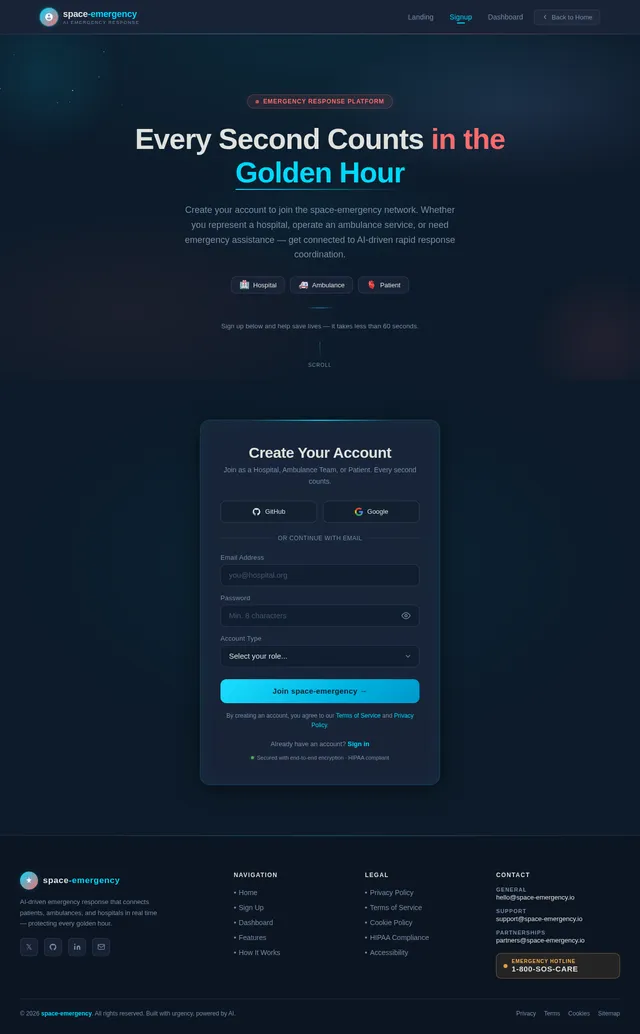
Lifeline X addresses a critical problem in emergency healthcare: delayed response times and lack of coordination between patients, ambulances, and hospitals. Our solution is an intelligent, AI-driven system that quickly detects emergencies, dispatches the nearest medical response, and ensures hospitals are prepped before arrival. By streamlining coordination and enabling real-time data sharing, Lifeline X aims to save lives by reducing delays in the golden hour. We are committed to transforming emergency care with a focus on efficiency, preparedness, and trust, making timely medical intervention accessible to everyone.

Comments (0)
Sign in to leave a comment
System Requirements
System Requirements Document (SRD)
Project Name: space-emergency
1. Introduction
The space-emergency project is designed to revolutionize emergency healthcare response systems by leveraging cutting-edge AI technologies to reduce delays during critical moments, known as the golden hour. This document outlines the system requirements for the project, focusing on its core functionalities, user personas, visual design, and technical specifications.
Shaurya Kumar, based in India, envisions a streamlined, intelligent solution that ensures timely medical intervention through real-time data sharing and coordination between patients, ambulances, and hospitals. This SRD has been updated to include the creation of a landing page as a key deliverable to introduce and promote the project effectively.
2. System Overview
The space-emergency system is an AI-driven platform designed to detect medical emergencies, dispatch the nearest ambulance, and prepare hospitals for incoming patients. The system aims to:
- Minimize response times during emergencies.
- Enhance coordination between patients, ambulance teams, and hospitals.
- Provide real-time data sharing to ensure preparedness and efficiency.
The landing page will serve as the primary interface for introducing the project, showcasing its features, and encouraging stakeholders to engage with the platform.
3. Functional Requirements
Core Functionalities:
- As a User, I should be able to view the mission and vision of space-emergency on the landing page.
- As a User, I should be able to understand the benefits of the system through clear and concise content.
- As a User, I should be able to see a call-to-action (CTA) encouraging hospitals and ambulance services to join the platform.
- As a User, I should be able to sign up for updates or express interest in collaboration via a form on the landing page.
- As a User, I should experience a visually engaging and intuitive interface that reflects the urgency and innovation of the project.
4. User Personas
1. Patients:
- Individuals seeking emergency medical assistance.
- Require quick access to ambulance dispatch and hospital readiness.
2. Ambulance Teams:
- Emergency responders who need real-time dispatch instructions and patient data.
3. Hospital Staff:
- Medical professionals who need advance notice and patient information to prepare for incoming emergencies.
4. General Public:
- Visitors to the landing page who may be interested in learning about the project or supporting its mission.
5. Visuals Colors and Theme
The visual design for space-emergency will reflect urgency, trust, and innovation. Below is the unique color palette for the project:
- Background: #0D1B2A (Deep Navy Blue)
- Surface: #1B263B (Midnight Blue)
- Text: #E0E1DD (Soft White)
- Accent: #FF6B6B (Emergency Red)
- Muted Tones: #778DA9 (Steel Gray)
This palette is designed to evoke a sense of professionalism and urgency while maintaining readability and aesthetic appeal.
6. Signature Design Concept
The landing page for space-emergency will feature a dynamic galaxy-inspired design that visually connects the concept of space with the urgency of emergency healthcare.
Key Features:
- Interactive Galaxy Map: The homepage will display a 3D galaxy map where each star represents a feature or section of the platform. Users can hover over stars to reveal details about the system's functionalities, such as ambulance dispatch, hospital coordination, and AI-driven emergency detection.
- Emergency Pulse Animation: A subtle heartbeat-like animation will run across the page, symbolizing life and urgency.
- Real-Time Data Visuals: A live dashboard showcasing simulated emergency response times and coordination metrics will be displayed to highlight the system's efficiency.
- Micro-Interactions: Buttons and CTAs will glow softly when hovered over, mimicking the effect of stars lighting up in the night sky.
This design will make the landing page unforgettable, immersing users in the vision of space-emergency while clearly communicating its purpose and functionality.
7. Non-Functional Requirements
- The landing page must load within 3 seconds to ensure a seamless user experience.
- The design must be responsive and optimized for both desktop and mobile devices.
- The system must comply with accessibility standards, including WCAG 2.1 guidelines.
- The platform must support localization for Indian users, including timezone and language preferences.
8. Tech Stack
Frontend:
- React for Web
Backend:
- Python
- FastAPI
Database:
- MySQL (with Alembic for migrations)
AI Models:
- GPT 5.4 for user-friendly responses
- Google Nano Banana for image generation
AI Tools:
- Litellm for LLM Routing
- Langchain
Local Orchestration:
- Docker
- docker-compose
Server-Side Orchestration:
- Kubernetes
9. Assumptions and Constraints
Assumptions:
- Users will access the landing page primarily via web browsers.
- The system will initially target Indian users, with potential expansion to other regions.
Constraints:
- The landing page must adhere to data privacy regulations, including GDPR and Indian IT laws.
- Limited budget for initial development may restrict advanced features.
10. Glossary
- Golden Hour: The critical first hour after a medical emergency, where timely intervention can save lives.
- AI-Driven Coordination: The use of artificial intelligence to streamline communication and decision-making during emergencies.
- CTA (Call-to-Action): A prompt on the landing page encouraging users to take specific actions, such as signing up or joining the platform.
- WCAG 2.1: Web Content Accessibility Guidelines, ensuring websites are accessible to all users, including those with disabilities.

Revolutionizing Emergency Healthcare Response
Every second counts during the golden hour. Our AI-driven platform connects patients, ambulances, and hospitals in real-time — ensuring faster dispatch, smarter coordination, and lives saved when it matters most.
Our Mission & Vision
Our Mission
To revolutionize emergency healthcare response by leveraging AI-driven technology that minimizes delays during the golden hour — ensuring every second counts when lives are at stake.
We bridge the critical gap between patients, ambulance teams, and hospitals through real-time coordination and intelligent dispatch systems. Our platform is built to reduce emergency response times, enhance preparedness, and ultimately save more lives across India and beyond.
Our Vision
A world where no life is lost due to delayed emergency response — where intelligent systems seamlessly connect every patient to the nearest ambulance and the best-prepared hospital in real time.
We envision a future where AI-powered emergency detection, automated ambulance dispatch, and hospital coordination work as one unified system. By harnessing real-time data sharing and cutting-edge technology, we aim to set a new global standard for emergency healthcare that is faster, smarter, and accessible to all.
Built for the Golden Hour
Three powerful systems working in unison to minimize emergency response times and save lives when every second matters.
AI-Driven Detection
Our machine learning algorithms analyze real-time sensor data and patient vitals to detect emergencies within seconds, automatically triggering the response chain before critical time is lost.
Explore AI Engine→Real-Time Dispatch
Intelligent routing dispatches the nearest available ambulance with optimized navigation, cutting average response times significantly and ensuring every second of the golden hour counts.
See Dispatch Flow→Hospital Coordination
Hospitals receive advance patient data, vitals, and ETA in real-time, enabling staff to prepare emergency rooms, allocate resources, and assemble specialized teams before the ambulance arrives.
Learn Coordination→Explore the Constellation
Each star in our galaxy represents a vital component of the space-emergency platform. Hover to discover how AI, real-time data, and coordination save lives during the golden hour.
Ambulance Dispatch
AI-powered dispatch engine instantly locates and routes the nearest ambulance to the emergency site, cutting response times by up to 40%.
Real-TimeHospital Coordination
Hospitals receive advance patient data and preparation alerts before arrival, enabling trauma teams to be ready the moment the ambulance docks.
CoordinationPatient Detection
Machine learning algorithms analyze incoming data streams to identify and classify emergency severity in real-time, prioritizing critical cases.
AI-DrivenReal-Time Coordination
Seamless data flow between patients, ambulances, and hospitals ensures every stakeholder has the information they need at every critical moment.
EmergencyAmbulance Dispatch
Real-TimeAI-powered dispatch engine instantly locates and routes the nearest ambulance to the emergency site, cutting response times by up to 40%.
Hospital Coordination
CoordinationHospitals receive advance patient data and preparation alerts before arrival, enabling trauma teams to be ready the moment the ambulance docks.
Patient Detection
AI-DrivenMachine learning algorithms analyze incoming data streams to identify and classify emergency severity in real-time, prioritizing critical cases.
Real-Time Coordination
EmergencySeamless data flow between patients, ambulances, and hospitals ensures every stakeholder has the information they need at every critical moment.
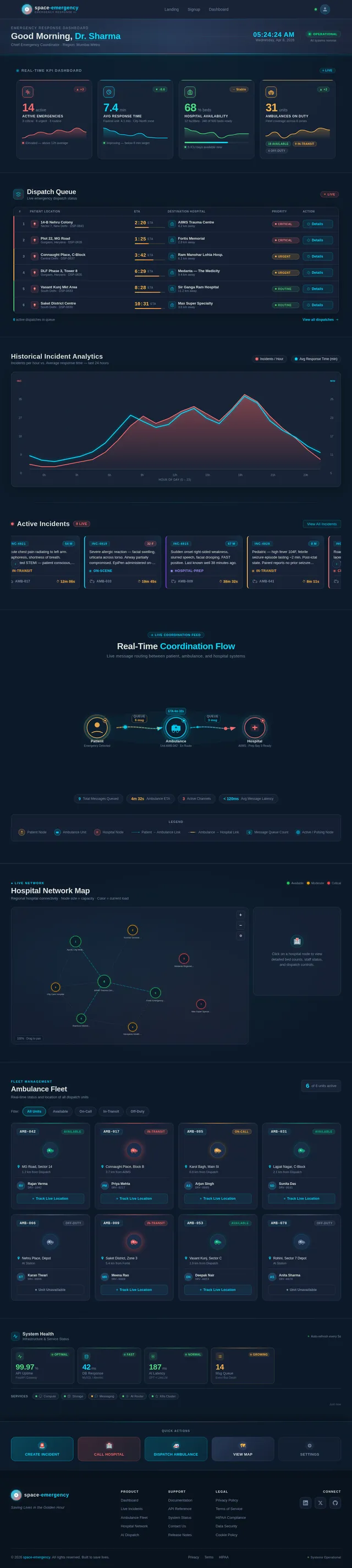
Real-Time Emergency Response Dashboard
Monitoring live performance across our network of hospitals, ambulances, and emergency responders. Every second counts during the golden hour.
Avg. Dispatch Time
0.0 min
Down 46% from national average
Hospitals on Platform
0
Across 28 states in India
Ambulances Active
0
Real-time GPS tracked units
Patients Served
0+
Lives impacted through faster response
Seamless Patient-to-Hospital Data Flow
Every second counts during the golden hour. Our platform orchestrates a synchronized data pipeline between patients, ambulances, and hospitals — ensuring zero information gaps when lives are on the line.
Your Data, Protected at Every Step
space-emergency is built on a foundation of security, compliance, and transparency — because every second counts, and every record matters.
End-to-End Encryption
All patient data, medical records, and communication between ambulance teams and hospitals are encrypted with AES-256 at rest and TLS 1.3 in transit.
GDPR Compliant
Full compliance with the General Data Protection Regulation, ensuring user consent, data portability, and the right to erasure for all EU-based users.
Indian IT Act Compliance
Adherence to the Information Technology Act, 2000 and DPDP Act 2023 for data protection, privacy, and secure handling of sensitive personal health data.
WCAG 2.1 AA Accessible
The platform meets Web Content Accessibility Guidelines 2.1 Level AA, ensuring usability for persons with disabilities through screen readers, keyboard navigation, and high contrast modes.
Trust Indicators
- SOC 2 Type II Audited — Annual third-party security audits confirm operational integrity.
- HIPAA-Ready Architecture — Designed for health data protection with role-based access controls.
- 99.99% Uptime SLA — Mission-critical infrastructure with multi-region redundancy.
- Real-Time Threat Monitoring — 24/7 AI-powered intrusion detection and anomaly alerts.
- Anonymized Analytics — All operational metrics use de-identified data to protect patient privacy.
- Open Security Reporting — Transparent vulnerability disclosure program with responsible reporting.
Your Journey Through the Golden Hour
Every second counts in an emergency. See how Lifeline X coordinates patients, ambulances, and hospitals in real-time to save lives.
Trigger Emergency Alert
Open the app and tap the emergency button. The AI instantly detects the severity of your situation using voice and sensor data.
Share Live Location
Your GPS coordinates are shared in real-time so the nearest ambulance can navigate directly to you without delays.
Track Ambulance Arrival
Monitor the ambulance en route with a live map view and receive estimated arrival time updates every few seconds.
Arrive at Prepared Hospital
The hospital is already briefed on your condition. Medical teams and equipment are ready the moment you arrive.
Trusted by Those Who Matter Most
Hear from the hospitals, paramedics, and patients whose lives have been transformed by the Space-Emergency platform.
Space-Emergency has transformed how we prepare for incoming trauma patients. We now receive real-time data before the ambulance even arrives, cutting our preparation time by 40%.
The AI-driven dispatch system routes us to emergencies faster than anything we have used before. The golden hour is no longer a race against the unknown.
When I had my cardiac episode, the ambulance was at my door in under 8 minutes. The hospital was already prepped when I arrived. This platform saved my life.
The coordination between our ER and ambulance teams has improved dramatically. We receive patient vitals in real-time, enabling us to make critical decisions earlier.
Having patient history and hospital bed availability on our dashboard before arrival is a game-changer. We spend less time coordinating and more time saving lives.
After my accident on the highway, the system automatically detected the collision and dispatched help. I was in surgery within the golden hour. Incredible technology.
Join the Revolution
Every second counts during the golden hour. Be part of the AI-driven platform that is transforming emergency healthcare response and saving lives across India.
No comments yet. Be the first!