solar-project
 Mian Abdullah Maqbool
build this


Comments (0)
Sign in to leave a comment
System Requirements
System Requirements Document
1. Introduction
The Business Process Risk Intelligence System (BPRIS) is a web-based SaaS platform designed to help small and medium-sized enterprises (SMEs) identify and manage operational risks within their business processes. The platform aims to provide SME owners with a clear understanding of potential risks and actionable recommendations to mitigate them, leveraging a combination of structured questionnaires, AI-driven risk scoring, and real-time world signal monitoring.
2. System Overview
BPRIS targets SME owners in sectors such as e-commerce, digital agencies, and food and beverage. It provides a user-friendly interface for business owners to assess their risk exposure through a guided questionnaire, receive a risk score across multiple vectors, and obtain plain-English recommendations powered by a Large Language Model (LLM). The system also monitors external economic and market signals to update risk profiles dynamically.
3. Functional Requirements
User Stories
- As an SME owner, I want to create an account on the BPRIS platform to access risk assessment tools.
- As an SME owner, I want to complete a guided questionnaire covering business identity, revenue structure, supplier dependency, cash flow health, process documentation, growth plans, and external exposure.
- As an SME owner, I want the system to automatically load sector-specific questions based on my selected business sector.
- As an SME owner, I want to receive a risk score across 14-15 different risk vectors after completing the questionnaire.
- As an SME owner, I want to receive personalized, plain-English recommendations based on my risk score.
- As an SME owner, I want to interact with a conversational chat interface to ask questions about my risk profile and receive understandable answers.
- As an SME owner, I want the system to monitor real-world signals and alert me when external factors affect my risk profile.
- As an SME owner, I want to receive a personalized risk report within 10 minutes of signing up.
- As an SME owner, I want to be able to onboard and complete the risk assessment process in under 10 minutes.
- As a project participant, I want to maintain a record of the particulars of the students involved in the project for documentation and tracking purposes.
4. User Personas
- SME Owner: Typically a founder or manager of a small to medium-sized business in sectors like e-commerce, digital services, or food and beverage. They are busy with daily operations and seek affordable tools to manage business risks without hiring expensive consultants.
5. Core User Flows
SME Owner Risk Assessment Flow
- Account Creation: The user signs up and creates an account on the BPRIS platform.
- Questionnaire Completion: The user completes a guided questionnaire tailored to their business sector.
- Risk Scoring: The system processes the responses and generates a risk score across multiple vectors.
- Recommendation Delivery: The user receives plain-English recommendations based on their risk score.
- Conversational Interaction: The user engages with the chat interface to ask questions and receive further insights.
- Real-World Signal Monitoring: The system continuously monitors external signals and updates the user's risk profile as needed.
6. Visuals Colors and Theme
- Professional blues and teals to convey trust and reliability, suitable for a business-focused application.
7. Signature Design Concept
- Clean and modern interface with intuitive navigation, emphasizing ease of use for non-technical users.
8. Interaction Model & Motion Direction
- Smooth transitions and animations to guide users through the questionnaire and risk assessment process, enhancing user engagement.
9. Non-Functional Requirements
- The system must be scalable to support a growing number of users.
- The platform should ensure data security and privacy for all user information.
- The application should be responsive and accessible on both desktop and mobile devices.
10. Tech Stack
- Frontend: React.js or Next.js, Tailwind CSS, Recharts
- Backend: Python, FastAPI, Celery
- AI/ML: scikit-learn, OpenAI API or Anthropic Claude API
- Database: PostgreSQL with JSONB
- Cache/Queue: Redis
- External APIs: NewsAPI, World Bank Open Data API, FRED Economic Data API
- Cloud/Deployment: Docker, Railway or Render
- Project Management: Jira, GitHub, GitHub Actions
11. Assumptions and Constraints
- The platform will initially support three business sectors: e-commerce, digital agencies, and food and beverage.
- The system will be developed and tested over a period of two regular semesters.
- The project will adhere to the milestones and timelines outlined in the project schedule.
12. Glossary
- SME: Small and Medium-sized Enterprises
- SaaS: Software as a Service
- LLM: Large Language Model
- Risk Vectors: Different dimensions or aspects of business risk assessed by the system.
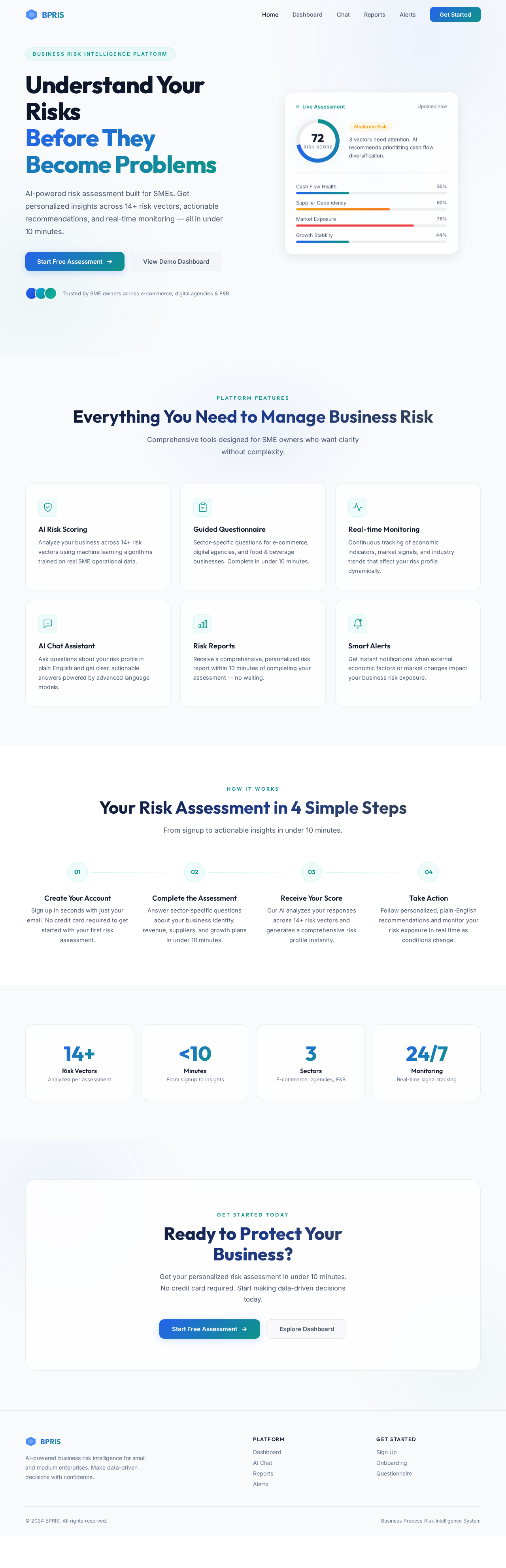
Understand Your Risks
Before They Become Problems
AI-powered risk assessment built for SMEs. Get personalized insights across 14+ risk vectors, actionable recommendations, and real-time monitoring — all in under 10 minutes.
Everything You Need to Manage Business Risk
Comprehensive tools designed for SME owners who want clarity without complexity.
AI Risk Scoring
Analyze your business across 14+ risk vectors using machine learning algorithms trained on real SME operational data.
Guided Questionnaire
Sector-specific questions for e-commerce, digital agencies, and food & beverage businesses. Complete in under 10 minutes.
Real-time Monitoring
Continuous tracking of economic indicators, market signals, and industry trends that affect your risk profile dynamically.
AI Chat Assistant
Ask questions about your risk profile in plain English and get clear, actionable answers powered by advanced language models.
Risk Reports
Receive a comprehensive, personalized risk report within 10 minutes of completing your assessment — no waiting.
Smart Alerts
Get instant notifications when external economic factors or market changes impact your business risk exposure.
Your Risk Assessment in 4 Simple Steps
From signup to actionable insights in under 10 minutes.
Create Your Account
Sign up in seconds with just your email. No credit card required to get started with your first risk assessment.
Complete the Assessment
Answer sector-specific questions about your business identity, revenue, suppliers, and growth plans in under 10 minutes.
Receive Your Score
Our AI analyzes your responses across 14+ risk vectors and generates a comprehensive risk profile instantly.
Take Action
Follow personalized, plain-English recommendations and monitor your risk exposure in real time as conditions change.
Ready to Protect Your Business?
Get your personalized risk assessment in under 10 minutes. No credit card required. Start making data-driven decisions today.
No comments yet. Be the first!