solar-pagina

byEduar

generame una pagina

Landing
Landing

Comments (0)

No comments yet. Be the first!

System Requirements

System Requirements Document for Pagina

1. Introduction

Pagina is a single public web page. The requester, Eduar (PE), asked simply: "generame una pagina" — generate a page. The product intent is therefore a single, self-contained public landing page that presents content to any visitor who opens it, with no account, no data entry, and no transactional workflow. The audience is the general public: an anonymous visitor arriving at the page and reading what it shows.

The page is delivered as a first-party React front end backed by a shared FastAPI service and a MariaDB database provisioned in the scaffold. The visual and tonal direction is warm modernism after Charles & Ray Eames: calm curiosity, honest materials, cream ground, teal block, tomato accent, Jost and Lora typography, and restrained motion.

This document is the System Requirements Document for Pagina. It records the single accepted product requirement (one web page), the single accepted persona (Visitor), the single accepted destination (Landing), and the design, interaction, and technical constraints that make the page implementable and consistent.

Page 1 of 18

2. System Overview

Pagina is one anonymous, publicly reachable web page. A visitor opens the page and reads its content. There is no sign-in, no form submission, no purchase, no messaging, and no persisted visitor-specific state. The page is the whole product.

The current delivery consists of:

  • Frontend (React): renders the Landing page, its hero composition, its modular content panels, and its restrained scroll motion.
  • Backend (FastAPI, shared process): serves any application API the frontend needs to load page content; it is the single backend for the product and is reused rather than duplicated.
  • Database (MariaDB): application-owned persistent storage available to the backend. It does not by itself create domain entities, authentication, or visitor records; the accepted product has no visitor-owned data to persist.

The only active human actor is the Visitor, an anonymous reader. There are no provider-owned or external destinations in the accepted scope. All accepted human-facing behavior is owned by the single first-party page, Landing.

Narrow exclusions: the product is exactly one page. It does not include additional pages, navigation to other destinations, accounts, authentication, checkout, contact forms, or any multi-step workflow.

Page 2 of 18

Removed from scope

  • Additional pages beyond the single Landing page.
  • User accounts, sign-in, and authentication.
  • Forms, submissions, and contact workflows.
  • Commerce, cart, and checkout.
  • Multi-step or multi-page journeys.

2a. Product Interpretation and Delivery Boundary

The request is open-ended: one page, no stated industry, no stated workflow. The delivery boundary is therefore deliberately narrow. Pagina is a public, anonymous, read-only landing page. Everything a visitor can do happens on that one page: arrive, read the hero, scroll through the modular content panels, and optionally follow the page's call to action within the same page.

Access is public and requires no identity. Because no accepted behavior creates durable visitor-specific state, a commitment, an entitlement, or a value transfer, no application-owned identity is introduced. The page is served to anyone who opens it, and no protected destination exists.

The backend and database are provisioned infrastructure. They support serving the page and any content the frontend loads; they do not add product behavior. There is no future-horizon feature set accepted in this request; anything beyond the single page is out of scope rather than deferred.

2c. Page Content and Component Coverage

Page 3 of 18

Landing

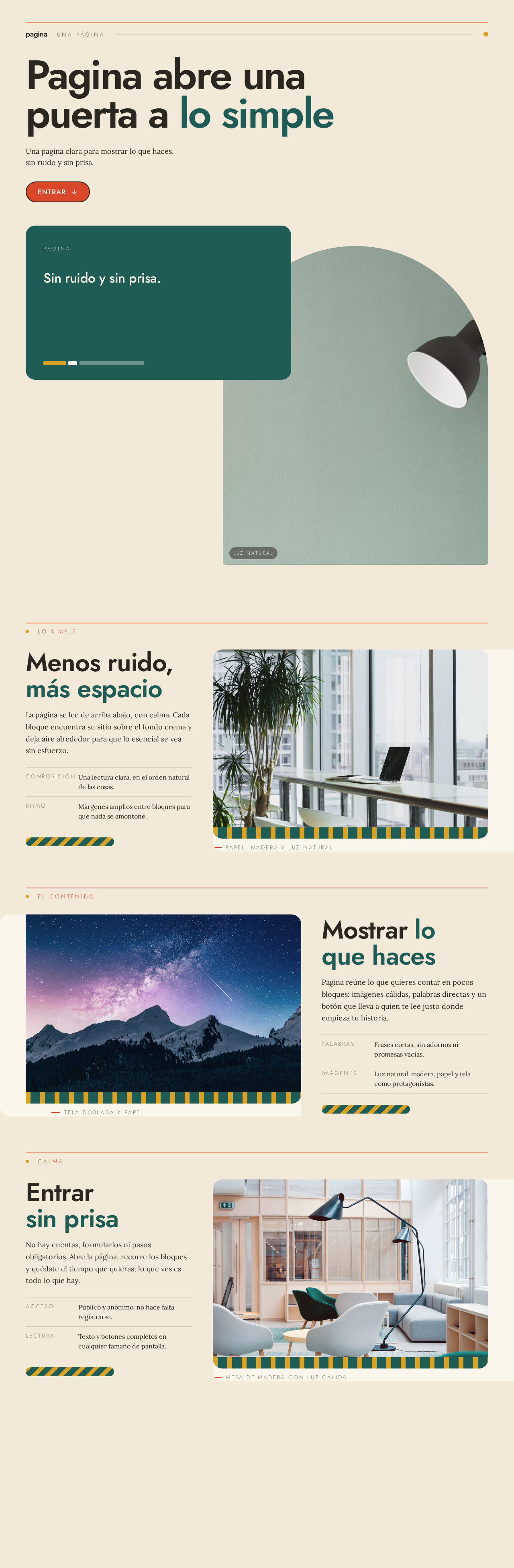
The Landing page is the sole destination. It is publicly reachable, requires no identity, and is owned by the application. It presents the product content to the Visitor in the Eames warm-modernist composition.

Information and state

  • Hero headline: "Pagina abre una puerta a lo simple".
  • Hero subline: "Una pagina clara para mostrar lo que haces, sin ruido y sin prisa."
  • Hero call to action: "Entrar".
  • Modular content panels below the hero, each opened by a 2px tomato rule and a wide-tracked Jost uppercase label.
  • Warm still-life imagery on plain grounds (wood, paper, cloth) and simple geometric pattern strips in mustard and teal.
  • No visitor-specific state; the page is stateless from the visitor's perspective.

Primary actions

  • Read the hero headline, subline, and call to action.
  • Activate the "Entrar" call to action (tomato pill, 2px ink outline, no shadow), which keeps the visitor within the accepted page content.

Supporting actions

  • Scroll through the modular panels.
  • Read each section's label, heading, and body copy.

Domain entities

  • None persisted. The page renders static content; the backend may serve that content, but no visitor record, account, or transaction entity exists.
Page 4 of 18

Component responsibilities

  • Hero composition: a two-part layout on the cream ground — a solid teal block filling the lower left 7 columns, an arch-topped photo panel overlapping its right edge, a 9-column Jost headline above the block, and the tomato CTA under the headline, left aligned.
  • Section opener: a 2px tomato rule with a wide-tracked Jost uppercase label.
  • Photo panel: one per section, running full-bleed to the right edge and cutting the grid on purpose.
  • CTA pill: tomato fill, 2px ink outline, no shadow.
  • Typography system: Jost 600 for headings (sentence case, tight tracking, 44/64/96/128 display scale), Lora for body (18px), wide light Jost for 14px labels.
  • Shape language: rounded panels with 24px radii; one arch top on the main image panel; 2px hard rules separating sections.

States

  • Loading: the page shell and hero render immediately; any content fetched from the backend shows a calm placeholder consistent with the cream ground, without layout shift.
  • Empty: not applicable in the accepted scope — the page always has its hero and section content.
  • Success: the hero, sections, imagery, and CTA render fully; readable text and controls stay whole at 375px, 768px, and 1280px.
  • Error: if backend content fails to load, the page still presents its hero and any locally available content, with a quiet inline notice rather than a blocking error.
  • Recovery: the visitor can reload the page; no partial state is persisted, so recovery is a fresh load.
  • Reduced motion: with prefers-reduced-motion, scroll fades and the hero image pan are replaced by a static arrangement; all content remains fully readable.
Page 5 of 18

3. Functional Requirements

FR-1 — Single public page As a Visitor, I should open Pagina and see one complete public web page, so that I can read what the page presents without any account or setup.

  • Provenance: explicit ("The product is one web page").
  • Trigger/input: the Visitor navigates to the page URL.
  • Observable result: the Landing page renders with its hero and content panels.
  • Access state: anonymous, public; no identity required.
  • Failure/recovery: if the page fails to load, the Visitor reloads; no partial state persists.
  • Continuation: the Visitor reads and scrolls the page.
  • Owner: Landing.

FR-2 — Hero presentation As a Visitor, I should see the hero headline, subline, and call to action on arrival, so that I immediately understand what the page is.

  • Provenance: required_inference (grounded in the accepted page and the supplied entry hero copy).
  • Trigger/input: the page loads.
  • Observable result: headline "Pagina abre una puerta a lo simple", subline "Una pagina clara para mostrar lo que haces, sin ruido y sin prisa.", and CTA "Entrar" are visible and whole at 375px, 768px, and 1280px.
  • Access state: anonymous.
  • Failure/recovery: if fonts or imagery are slow, text renders first in a readable fallback; the hero remains legible.
  • Continuation: the Visitor reads the subline and considers the CTA.
  • Owner: Landing.
Page 6 of 18

FR-3 — Call to action As a Visitor, I should be able to activate the "Entrar" call to action, so that I can proceed into the page's content.

  • Provenance: required_inference (grounded in the supplied entry hero copy and the single-page boundary).
  • Trigger/input: the Visitor activates the tomato pill CTA.
  • Observable result: the page responds within the accepted single-page content (for example, moving focus or scroll to the page's content); no new destination or capability is introduced.
  • Access state: anonymous.
  • Failure/recovery: if the CTA target is unavailable, the page remains readable and the Visitor can scroll manually.
  • Continuation: the Visitor continues reading the page.
  • Owner: Landing.

FR-4 — Modular content panels As a Visitor, I should scroll through modular content panels, so that I can read the page's sections in order.

  • Provenance: required_inference (grounded in the accepted page and the supplied layout direction).
  • Trigger/input: the Visitor scrolls.
  • Observable result: each section opens with a 2px tomato rule and a wide-tracked Jost uppercase label; content and imagery render within the cream margins.
  • Access state: anonymous.
  • Failure/recovery: if an image fails, its panel keeps its layout and the text remains readable.
  • Continuation: the Visitor continues to the next panel.
  • Owner: Landing.
Page 7 of 18

FR-5 — Readable text and controls at every viewport As a Visitor, I should see all headlines, labels, numbers, and controls fully inside the viewport and their containers at 375px, 768px, and 1280px, so that nothing is cropped or covered.

  • Provenance: explicit (creative direction readability rule).
  • Trigger/input: the Visitor views the page at any supported width.
  • Observable result: text wraps or scales (for example clamp(...)) to fit; imagery and decoration may bleed or overlap but never cover readable text or controls.
  • Access state: anonymous.
  • Failure/recovery: if a layout would overflow, text wraps or scales rather than clipping.
  • Continuation: the Visitor reads without obstruction.
  • Owner: Landing.

FR-6 — Reduced-motion support As a Visitor who prefers reduced motion, I should get a usable static arrangement, so that I can read the page without animation.

  • Provenance: explicit (creative direction reduced-motion rule).
  • Trigger/input: the Visitor's prefers-reduced-motion setting is active.
  • Observable result: scroll fades and the hero image pan are disabled; content is fully readable in a static layout.
  • Access state: anonymous.
  • Failure/recovery: not applicable; the static arrangement is the fallback.
  • Continuation: the Visitor reads the page normally.
  • Owner: Landing.

4. User Personas

Page 8 of 18

Visitor

Product context. The Visitor is any anonymous person who opens Pagina. They arrive with no account, no prior session, and no obligation. The page is the entire product, so the Visitor's experience is a single reading visit.

Primary goal. Understand what the page presents and read its content calmly, without noise or pressure.

Distinct accepted responsibilities. The Visitor opens the page, reads the hero headline and subline, considers and may activate the "Entrar" call to action, and scrolls through the modular content panels. The Visitor is the only active human actor; there is no counterparty, recipient, or decision-maker whose state changes as a result of the visit.

Relevant inputs or decisions. The Visitor decides whether to read further and whether to activate the call to action. No data entry, no selection among options, and no commitment is required.

Interactions with other accepted participants. None. The Visitor interacts only with the page itself; the backend and database serve content but are not human participants.

Observable success. The Visitor sees the hero and all content panels fully rendered, with readable text and controls at every supported viewport, and can move through the page without obstruction. The visit is complete when the page has shown its information.

5. Core User Flows

Page 9 of 18

Flow 1 — Visitor opens and reads Pagina

  1. Starting context. The Visitor has the page URL and no account.
  2. Arrival. The Visitor navigates to the page. The Landing page loads publicly; no sign-in is requested.
  3. Hero. The Visitor sees the headline "Pagina abre una puerta a lo simple", the subline "Una pagina clara para mostrar lo que haces, sin ruido y sin prisa.", and the tomato "Entrar" pill under the headline, left aligned, with the teal block and arch-topped photo panel composing the hero.
  4. Reading. The Visitor scrolls. Each section opens with a 2px tomato rule and a wide-tracked Jost uppercase label; photo panels run full-bleed to the right edge.
  5. Decision. The Visitor may activate the "Entrar" call to action, which responds within the accepted single-page content; otherwise the Visitor continues scrolling.
  6. Observable result. All content is visible and readable at 375px, 768px, and 1280px; no text or control is cropped or covered.
  7. Failure/recovery. If content or imagery fails to load, the page still presents its hero and available content with a quiet inline notice; the Visitor reloads to recover, and no partial state persists.
  8. Continuation. The Visitor finishes reading and leaves the page. There is no follow-on destination in the accepted scope.
Page 10 of 18

Flow 2 — Visitor with reduced motion reads Pagina

  1. Starting context. The Visitor's device has prefers-reduced-motion active.
  2. Arrival. The Visitor opens the page.
  3. Static arrangement. Scroll fades and the hero image pan are disabled; the hero and panels render in a static layout.
  4. Reading. The Visitor reads the headline, subline, CTA, and all panels; every item is fully readable.
  5. Observable result. The page is fully usable without animation.
  6. Continuation. The Visitor leaves the page when finished.
Page 11 of 18

6. Visuals Colors and Theme

The CREATIVE DIRECTION is authoritative for this section. The muse is Charles & Ray Eames, and the headline register is warm modernism: order with joy, honest materials, calm curiosity.

Color tokens (light mode only; no dark mode)

  • Background / cream ground: #F2E9D8
  • Surface: #FBF6EC
  • Text / ink: #2B2620
  • Primary / teal block: #1F5C55
  • Accent / tomato (CTA and small rules): #D9482B
  • Muted: #8A7A62
  • Mustard (minor support only): #D9A227

The cream ground holds most of the page. Teal fills one large block. Tomato marks the call to action and small rules. Mustard is a minor support only.

Typography

  • Headings: Jost at 600 weight, sentence case, large sizes with tight tracking.
  • Small labels: wide light Jost, uppercase, wide tracking.
  • Body: Lora.
  • Scale: 1.25 modular; display sizes 44 / 64 / 96 / 128; body 18; labels 14.

Shape language

  • Soft organic-modern shapes; rounded panels with 24px radii.
  • One arch top on the main image panel.
  • Hard 2px rules separate sections.
Page 12 of 18

Layout

  • Asymmetric gallery grid.
  • A teal block fills the left 7 columns of the hero.
  • The headline sits above it in 9 columns.
  • Sections follow as modular panels with wide cream margins.

Imagery

  • Warm still-life photography on plain grounds; natural light on wood, paper, and cloth.
  • Simple geometric pattern strips in mustard and teal.

Avoid

  • No blue or indigo accents on white.
  • No gradient blobs or glass panels.
  • No grid of identical hover-lift cards.
  • No Inter, Roboto, or system fonts.
  • No neon colours or dark mode.
  • The generic indigo/blue-on-white SaaS template is forbidden.
Page 13 of 18

7. Signature Design Concept

The public entry is a two-part Eames composition on the cream ground. A solid teal block (#1F5C55) fills the lower left 7 columns of the hero. A large arch-topped photo panel overlaps its right edge, carrying warm still-life photography on a plain ground. Above the block, the Jost headline at 44px mobile to 128px desktop spans 9 columns: "Pagina abre una puerta a lo simple". Under the headline, left aligned, sits the tomato pill CTA "Entrar" with a 2px ink outline and no shadow. The subline "Una pagina clara para mostrar lo que haces, sin ruido y sin prisa." sits in Lora beneath or beside the headline as the layout allows.

Signature moves carried through the page:

  • A 9-column Jost headline over a solid teal block with an arch-topped photo panel that overlaps the block edge.
  • Section openers use a 2px tomato rule with a wide-tracked Jost label in caps.
  • One photo panel per section runs full-bleed to the right edge and cuts the grid on purpose.
  • The CTA is a tomato pill with a 2px ink outline and no shadow.

Readable text and controls stay whole at every viewport; the arch, overlap, and full-bleed gestures are carried by imagery and decoration, never by cropping text or controls.

Page 14 of 18

8. Interaction Model & Motion Direction

Interaction Model: Animated Motion Tempo: restrained Hero Dimensionality: layered_2d

Landing Hero Motion Brief

  • Focal subject. The arch-topped still-life photo panel overlapping the teal block, with the Jost headline above it.
  • Input → transformation → outcome thesis. As the Visitor arrives and scrolls, the hero image performs a slow, gentle pan within its arch frame while the headline and CTA fade in over 600ms; the outcome is a calm, fully readable hero with no bounce and no particles.
  • Motion vocabulary. Slow 600ms fades on scroll; a gentle pan across the hero image; no bounce; no particles.
  • Composed first frame. Cream ground, teal block in the lower left 7 columns, arch-topped photo panel overlapping its right edge, 9-column Jost headline above, tomato CTA pill under the headline, left aligned.
  • Reduced-motion state. With prefers-reduced-motion, the pan and fades are removed; the hero renders as a static arrangement with all text and controls fully readable.
Page 15 of 18

9. Non-Functional Requirements

  • Single-page delivery. The product is exactly one web page; no additional routes or destinations are introduced. (explicit)
  • Public anonymous access. The page requires no identity, account, or session. (explicit via planning scope access requirement none)
  • Readability at 375px, 768px, and 1280px. Headlines, wordmarks, labels, numbers, cards' text, and controls stay entirely inside the viewport and their containers; text wraps or scales (for example clamp(...)) to fit; no other element covers any part of them. (explicit)
  • Reduced-motion usability. With prefers-reduced-motion, a usable static arrangement is provided; all content remains fully readable. (explicit)
  • Typography fidelity. Jost and Lora are used as specified; Inter, Roboto, and system fonts are not used for headings or body. (explicit)
  • Color fidelity. The specified palette is used; no blue or indigo accents on white, no neon colours, no dark mode. (explicit)
  • Performance. The page shell and hero render promptly; content fetched from the backend does not cause layout shift. (required_inference, supporting the accepted reading experience)
  • Accessibility. Text and controls meet readable contrast against the cream and teal grounds; the CTA is keyboard reachable. (required_inference, supporting the explicit readability rule)
Page 16 of 18

10. Tech Stack

  • Frontend: React application UI, rendering the Landing page and its components.
  • Backend: shared FastAPI process for application APIs and domain modules; reused for any content the frontend loads.
  • Database: MariaDB for application-owned persistent data; provisioned in the scaffold, with no visitor-owned entities required by the accepted scope.
  • Containerization: Docker / docker-compose, with the scaffold services backend, database, and frontend as the runnable inventory.

No additional services are required for the accepted single-page scope.

11. Assumptions and Constraints

  • Assumption: The page's section content beyond the supplied hero copy is presentation-level and does not introduce new capabilities. (labeled assumption)
  • Assumption: The backend serves page content but does not persist visitor data, because no accepted behavior creates durable visitor-specific state. (labeled assumption)
  • Constraint: The product is one page; no additional pages, navigation destinations, accounts, forms, or commerce are added. (explicit)
  • Constraint: The CREATIVE DIRECTION governs palette, typography, shape, layout, imagery, and motion; user design constraints take priority over catalogue defaults. (explicit)
  • Constraint: Readable text and controls are never cropped, clipped, or covered; the arch, overlap, and full-bleed gestures apply to imagery and decoration only. (explicit)
Page 17 of 18

12. Glossary

  • Pagina — The product: a single public web page.
  • Visitor — The anonymous person who opens Pagina and reads its content.
  • Landing — The sole destination of the product; the public entry page.
  • Hero — The top composition of the Landing page: headline, subline, CTA, teal block, and arch-topped photo panel.
  • CTA — Call to action; the tomato "Entrar" pill.
  • Eames warm modernism — The visual direction: cream ground, teal block, tomato accent, Jost and Lora typography, soft organic-modern shapes, restrained motion.
  • Reduced motion — The prefers-reduced-motion setting under which animation is replaced by a static arrangement.
Page 18 of 18
Live
Landing design preview
Landing: Open page anonymously
Landing: Read hero headline and subline
Landing: Activate Entrar call to action
Landing: Scroll through modular panels
Landing: Read section labels and body copy
Landing: Read page with reduced motion
Landing: Read quiet inline notice
Landing: Reload page to recover
Landing: Finish reading and leave