smart-webpage
 Alex Fonville
A webpage that run an idle game.

Comments (0)
Sign in to leave a comment
System Requirements
System Requirements Document (SRD)
Project: smart-webpage Author: Alex Fonville Date: March 1, 2026 Version: 1.0.0 Locale: United States (en-US) | Timezone: America/New_York | Currency: USD
1. Introduction
This System Requirements Document (SRD) defines the functional and non-functional requirements for smart-webpage, a browser-based idle/incremental space exploration game. The project centers on a deep, satisfying gameplay loop involving planetary exploration, resource gathering, crafting, biological material collection, and long-term progression through a tiered tech tree. This document serves as the authoritative reference for all design, development, and architectural decisions related to smart-webpage.
Alex, this document has been generated from scratch based on the full conversation context and design sessions completed to date.
2. System Overview
smart-webpage is an idle/incremental game set in space where the player manages a ship and station, explores procedurally varied planets, collects and refines resources, unlocks blueprints, and progresses through a branching tech tree. The game balances passive automation with active manual exploration to keep engagement high. Rare biological materials discovered on hazardous planets provide a powerful incentive for hands-on play even as automation matures. The game is accessed via a web browser and is designed for long-play-session and idle-session engagement.
Key gameplay pillars:
- Planetary Exploration — Land on planets, navigate hazards, and collect surface resources
- Resource Refining — Process raw resources at the home station into usable materials
- Ship Management — Upgrade the ship for better performance, cargo, and survivability
- Biological Collection — Manually hunt rare biological materials in hazardous biomes
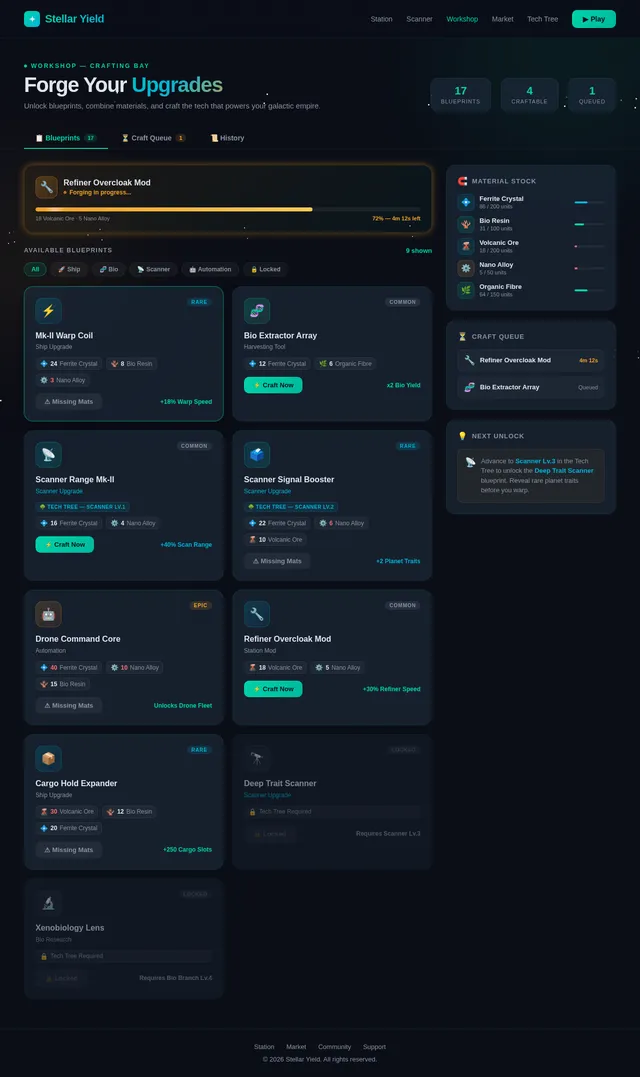
- Blueprint Crafting — Unlock and build permanent upgrades via a resource-driven button system
- Tech Tree Progression — A branching, gradually-revealed tech tree organizing all upgrades
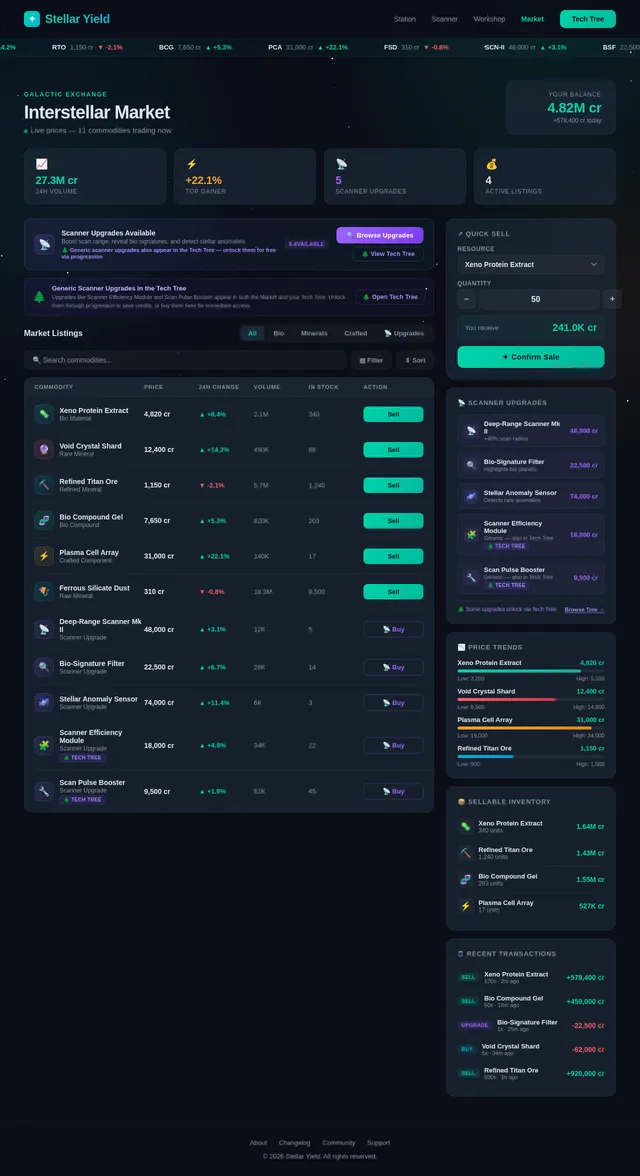
- Market — Buy and sell resources and biological materials for credits
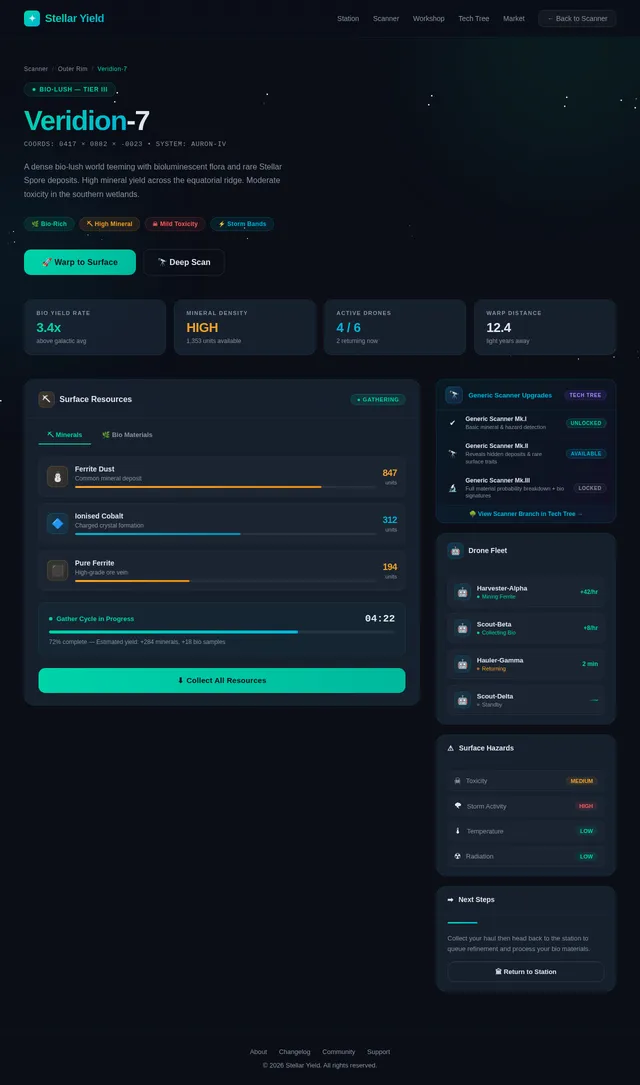
- Scanner System — Upgradeable planetary scanner that reveals increasingly detailed planet data
3. Functional Requirements
3.1 Story Points
- As a Player, I should be able to land on planets and manually explore them to gather surface resources.
- As a Player, I should be able to collect biological materials from planets that only spawn in specific hazardous environments (e.g., heavy winds, lightning storms).
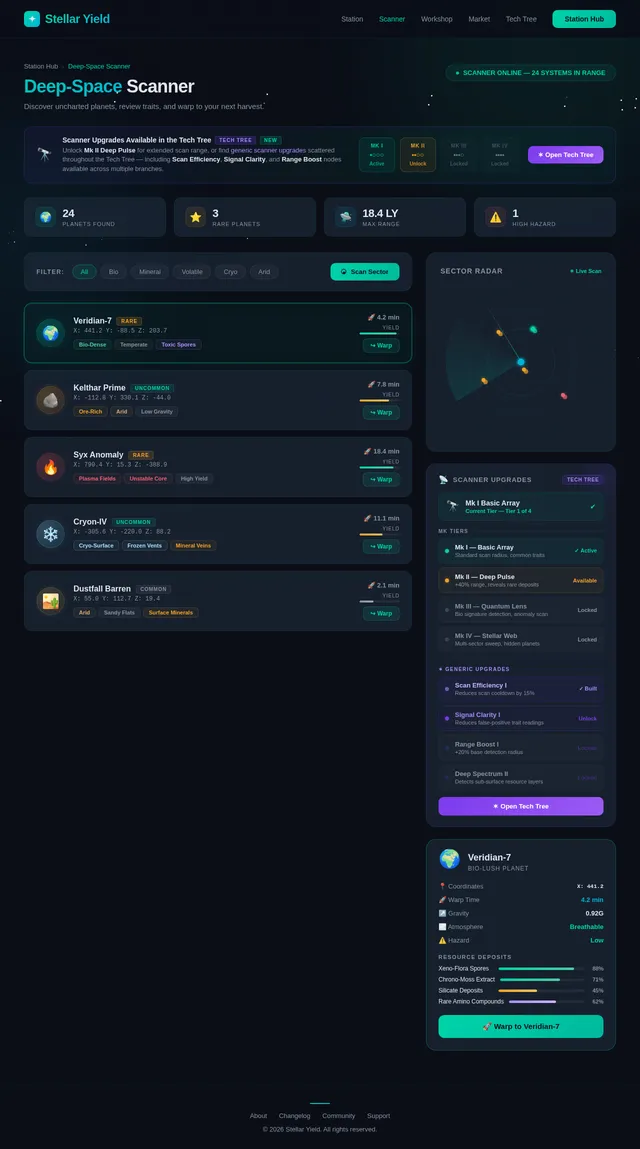
- As a Player, I should be able to use a scanner to survey planets before or during exploration, with detail level increasing as scanner upgrades are unlocked.
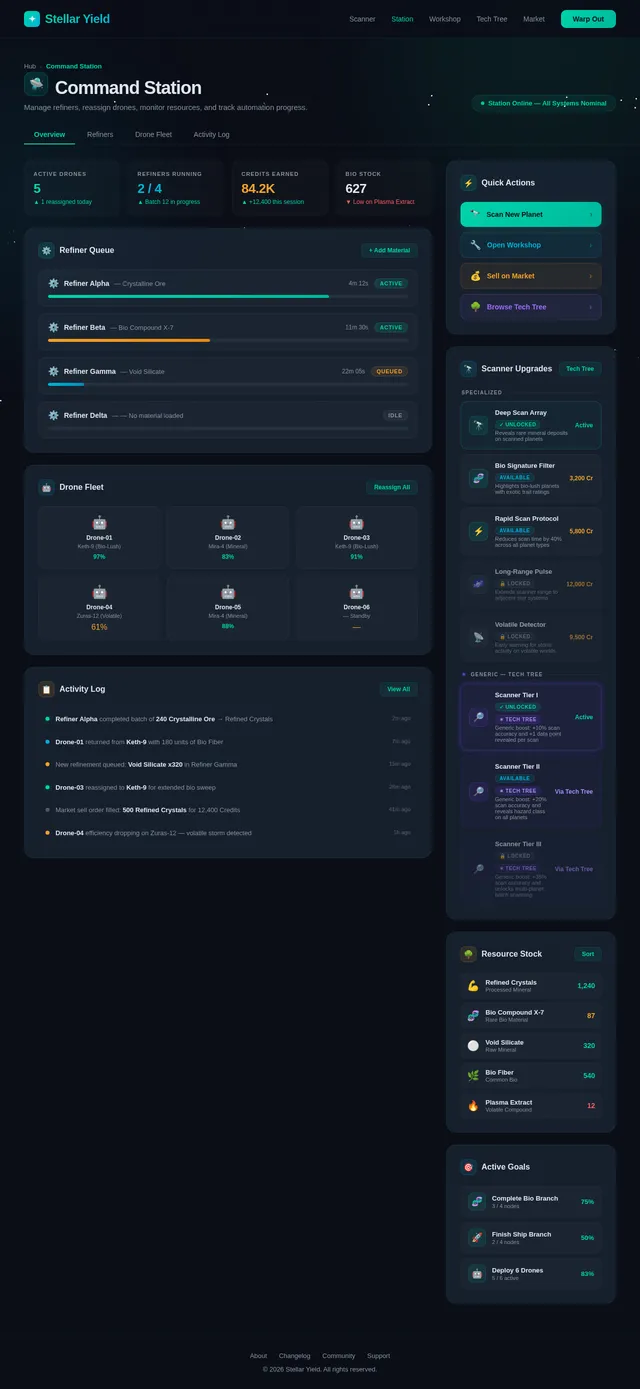
- As a Player, I should be able to return to my station and refine raw resources into processed materials.
- As a Player, I should be able to use credits to unlock a blueprint, which becomes a permanent interactive button on my crafting panel.
- As a Player, I should be able to view a blueprint's unlock cost before purchasing it, and view the required crafting resources after it is unlocked.
- As a Player, I should be able to collect the required resources and click the blueprint button to craft/build the item and receive its permanent effects.
- As a Player, I should be able to see that once a blueprint is built, it is permanently applied and does not need to be re-purchased or rebuilt.
- As a Player, I should be able to progress through a tiered blueprint system where higher-tier blueprints are only unlocked after completing lower-tier prerequisites.
- As a Player, I should be able to explore a branching tech tree that is gradually revealed as I unlock new nodes.
- As a Player, I should be able to choose different specialization paths within the tech tree tied to distinct gameplay loops: (1) Gathering resources on planets, (2) Refining resources at the station, (3) Upgrading the ship, (4) Collecting biological resources.
- As a Player, I should be able to find generic scanner upgrades through the tech tree.
- As a Player, I should be able to sell biological materials and resources at the market for credits, with rare biological materials commanding high prices.
- As a Player, I should be able to see that basic upgrades require only common resources, while advanced upgrades additionally require special or rare resources.
- As a Player, I should be able to automate certain resource gathering tasks as I progress, while retaining a strong incentive to manually explore planets for biological materials.
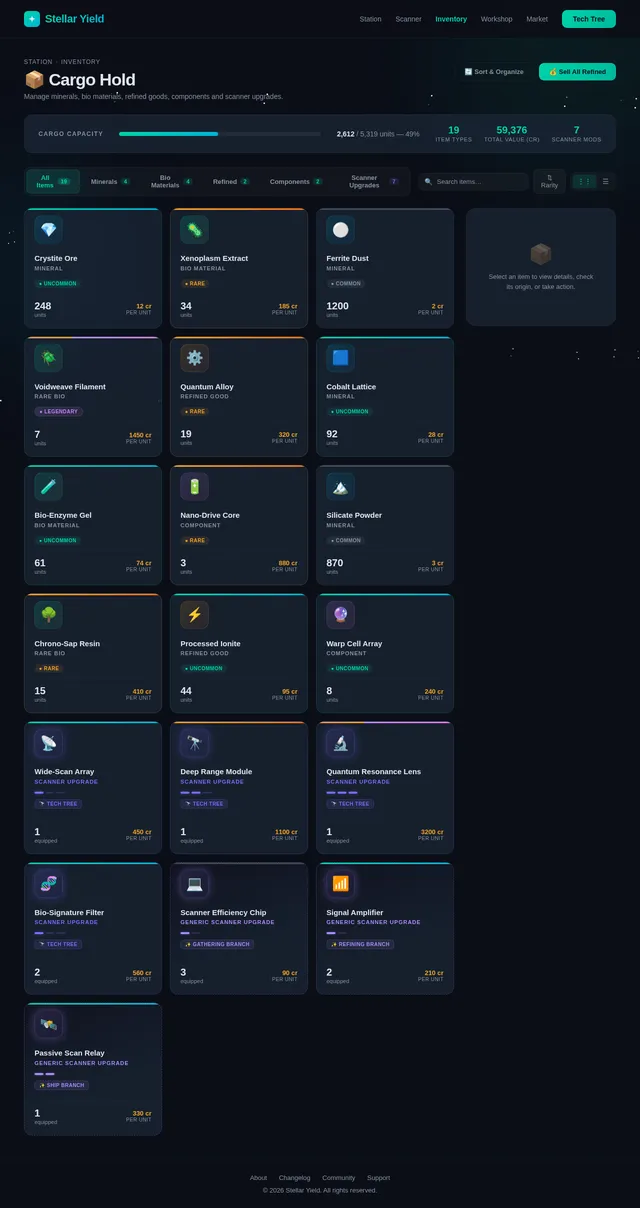
- As a Player, I should be able to view my full inventory including basic resources, special resources, and biological materials.
- As a Player, I should be able to access the Workshop to manage blueprints and crafting.
- As a Player, I should be able to navigate the game from a central Station hub to other areas: Planet exploration, Workshop, Tech Tree, Market, Scanner, and Inventory.
4. User Personas
4.1 The Active Explorer
- Role: Primary Player
- Profile: Engages directly with the game during play sessions. Manually pilots the ship to planets, hunts for rare biological materials in dangerous biomes, and makes strategic decisions about which planets to visit based on scanner data.
- Goals: Find rare biological materials, maximize credits, and push into new regions of the tech tree.
- Motivation: Risk-reward thrill, the excitement of discovery, and satisfaction from rare finds.
4.2 The Idle Optimizer
- Role: Primary Player (alternate style)
- Profile: Prefers to set up automated resource pipelines and check in periodically. Focuses on unlocking automation upgrades in the tech tree and optimizing the refining loop.
- Goals: Maximize passive resource generation, unlock automation nodes, sell in bulk at the market.
- Motivation: Optimization satisfaction, long-term compounding growth, efficiency.
4.3 The Tech Tree Strategist
- Role: Primary Player (progression-focused)
- Profile: Driven by unlocking the full tech tree. Carefully plans their progression path, prioritizes blueprints, and works systematically toward higher-tier nodes.
- Goals: Map out and complete all tech tree branches, unlock rare special blueprints.
- Motivation: Completion, mastery, and discovering what lies deeper in the tech tree.
4.4 The Trader
- Role: Primary Player (economy-focused)
- Profile: Focuses on acquiring and selling high-value biological materials and refined resources on the market. Treats the game as an economic simulation.
- Goals: Maximize credit accumulation, find optimal sell timing, stockpile rare biologicals.
- Motivation: Wealth accumulation, market strategy, economic power.
5. Visuals, Colors, and Theme
5.1 Theme
Deep Space Industrial — A blend of dark cosmic atmospherics with worn, functional station interfaces. The game world feels vast and mysterious on planets, while the station feels like a lived-in operational hub with mechanical UI elements.
5.2 Color Palette
| Role | Color | Hex |
|---|---|---|
| Primary Background | Deep Space Black | #0A0C14 |
| Secondary Background | Dark Navy | #111827 |
| Surface / Cards | Slate Dark | #1E2A3A |
| Primary Accent | Electric Cyan | #00D4FF |
| Secondary Accent | Amber / Gold | #F59E0B |
| Biological / Rare | Bioluminescent Green | #39FF14 |
| Danger / Hazard | Alert Red | #EF4444 |
| Credits / Economy | Warm Gold | #FBBF24 |
| Text Primary | Ice White | #E8F4FD |
| Text Secondary | Muted Steel | #8BA3BC |
| Tech Tree Lines | Neon Purple | #7C3AED |
5.3 Typography
- Headings:
Orbitron(Google Fonts) — futuristic, geometric, space-appropriate - Body / UI:
InterorExo 2— clean, readable at small sizes - Terminal / Code elements:
JetBrains Mono— for scanner readouts, log feeds
5.4 UI Style
- Dark glassmorphism panels for station interfaces
- Glow effects on interactive elements using the Electric Cyan accent
- Hazard zones on planets use pulsing red/amber overlays
- Bioluminescent green reserved exclusively for biological materials to make them visually pop
- Subtle particle/star-field background on all screens
- Tech tree nodes glow and pulse neon purple when newly unlocked
6. Signature Design Concept
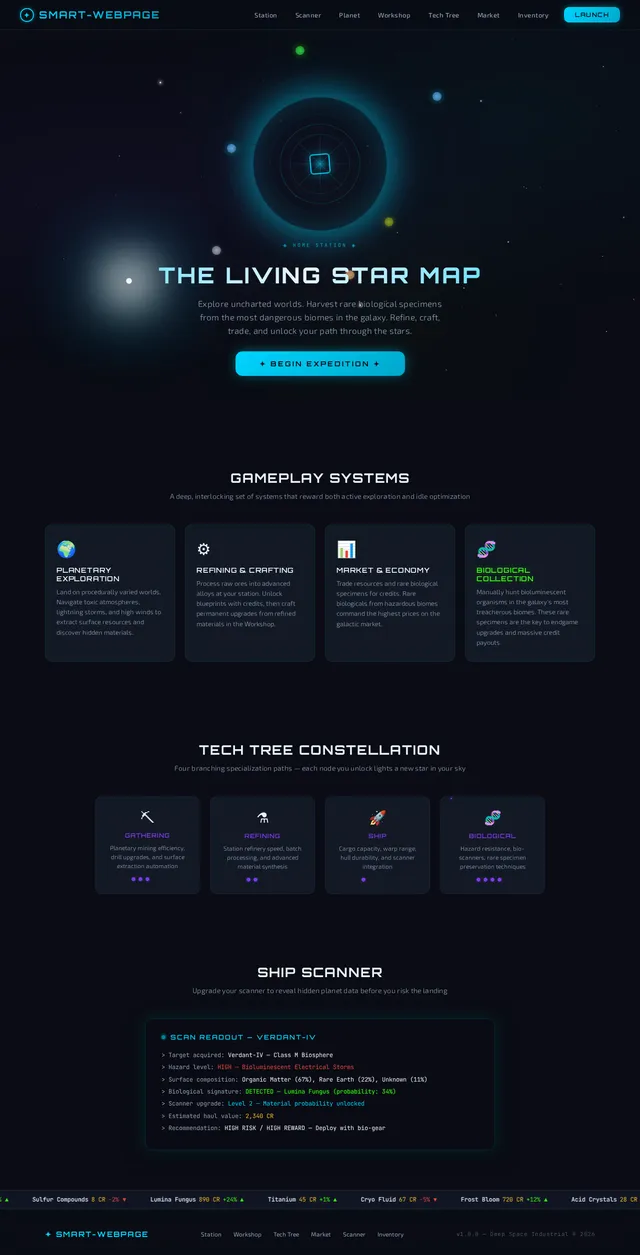
✦ "The Living Star Map" — A Cosmic Command Room Landing Experience
When Alex (or any player) first arrives at smart-webpage, they don't see a menu screen — they see the universe itself.
What the player sees: The entire viewport is an interactive, slowly-rotating 3D star field rendered in WebGL. Stars are not decorations — each glowing node in the field is a location: your home station, explorable planets, market buoys, and deep-space anomalies. The camera drifts lazily through the void with a gentle parallax, as if you're looking out the viewport of a ship drifting in orbit.
The Station — Your Anchor Point: At the center of the star map sits your Home Station, rendered as a beautifully detailed wireframe/holographic structure that slowly rotates. It pulses with a soft Electric Cyan halo. Clicking it zooms the camera forward with a warp-speed star-trail animation that slams into the Station Hub UI.
Planet Nodes: Nearby planets orbit slowly in real-time. Each planet has a distinct color signature based on its biome type:
- Toxic atmosphere = murky greens and yellows
- Lightning storms = flickering electric blue halos around the node
- High winds = swirling particle wisps trailing the planet's orbit
- Biological-rich worlds = faint bioluminescent green auroras pulsing around the planet
Players can hover over a planet node and a holographic data-card floats up, showing the basic scan data. Scanner upgrade level determines how much the card reveals — low-level scanners show just a silhouette and hazard icon; maxed scanners show a full breakdown with material probability percentages.
The Tech Tree Constellation: As players unlock tech tree nodes, new stars light up in the background of the star map — the tech tree IS the star field. Newly unlocked nodes shoot across the sky as a meteor streak before settling into their star position. Undiscovered nodes are invisible dark matter — the player knows something is out there, but can't see it until they earn it.
Biological Material Micro-Interaction: When a player collects a rare biological material, a ghostly green bioluminescent particle burst erupts from the planet node on the star map, drifting slowly across the screen and dissolving — a beautiful ambient reminder of the find.
Transitions:
- All screen transitions use a warp tunnel / hyperspace jump animation — a burst of elongated star streaks that collapse into the destination screen
- The station hub "lands" the camera with a satisfying mechanical thunk and hiss as panels slide into view
- Exiting back to space gracefully pulls the camera back out through the hull viewport
Idle State: When the player is idle on the star map, distant supernovas occasionally flash in the background, comets drift through the field, and a subtle deep-space ambient soundtrack pulses with low bass tones and high crystalline pings — alive, breathing, and endlessly fascinating.
This design makes the star map the living soul of the game — not just a menu, but a world that communicates game state, progression, rarity, and wonder all at once.
7. Non-Functional Requirements
| ID | Requirement | Detail |
|---|---|---|
| NFR-01 | Performance | Game loop should run at a stable 60 FPS on mid-range hardware. Idle calculations should execute in under 100ms. |
| NFR-02 | Scalability | Backend must handle increasing game state complexity as players progress without degrading save/load times. |
| NFR-03 | Persistence | Player game state must be saved automatically at regular intervals (e.g., every 30–60 seconds) and on key actions. |
| NFR-04 | Responsiveness | UI must be functional on desktop browsers (Chrome, Firefox, Edge). Mobile support is a stretch goal. |
| NFR-05 | Offline Progression | Idle resource accumulation should calculate correctly after the player has been offline (offline time catch-up). |
| NFR-06 | Security | Player accounts and game state should be protected from tampering. Server-side validation of key game actions. |
| NFR-07 | Accessibility | Color-blind safe mode option should be available, especially given the heavy use of color-coding for rarity. |
| NFR-08 | Load Time | Initial page load should complete in under 3 seconds on a standard broadband connection. |
| NFR-09 | Browser Compatibility | Target: Chrome 110+, Firefox 110+, Edge 110+. Safari as secondary target. |
| NFR-10 | Availability | System uptime target of 99.5% or better for production deployment. |
8. Tech Stack
8.1 Frontend
| Technology | Purpose |
|---|---|
| React | Web-based game UI, all screens and panels |
| WebGL / Three.js | Star map, planet animations, warp transitions, particle effects |
| CSS Modules / Tailwind CSS | Styling, theming, glassmorphism panels |
8.2 Backend
| Technology | Purpose |
|---|---|
| Python | Core backend language |
| FastAPI | REST API for game state, player actions, market, blueprint management |
8.3 Database
| Technology | Purpose |
|---|---|
| MySQL / MariaDB | Primary relational database for player accounts, game state, blueprints, inventory, market transactions |
| Alembic | Database schema migrations |
8.4 Local Orchestration
| Technology | Purpose |
|---|---|
| Docker | Containerization of all services |
| docker-compose | Local multi-service orchestration (frontend, backend, database) |
8.5 Server-Side Orchestration
| Technology | Purpose |
|---|---|
| Kubernetes | Production deployment, scaling, and service management |
Note: NoSQL (MongoDB), VectorDB (WeaviateDB), and AI model integrations are not required for the current scope of smart-webpage. They are excluded to keep the stack lean and appropriate for a game application. These can be revisited if AI-driven features (e.g., procedural planet descriptions, NPC dialogue) are added in a future version.
9. Assumptions and Constraints
9.1 Assumptions
- The game is single-player; no multiplayer or real-time social features are planned in v1.0.
- Players will primarily use desktop web browsers; mobile is a stretch goal.
- The star map and WebGL animations will be rendered client-side; the server is not responsible for rendering.
- Biological material spawn rules are defined server-side and validated to prevent client-side spoofing.
- The US locale (en-US) is the primary target; currency displayed in USD; timestamps in America/New_York.
- Offline progression catch-up will be capped at a maximum of 24 hours of idle accumulation to prevent exploits.
- All blueprint effects are permanent and non-reversible once crafted.
- The tech tree is fully designed upfront but revealed progressively to the player.
9.2 Constraints
- The tech tree visualization must be performant even as it grows to potentially hundreds of nodes.
- WebGL star map must gracefully degrade on browsers/devices that do not support WebGL 2.0.
- Game state save data must remain backwards compatible across patch versions.
- Initial release targets desktop only; responsive/mobile layout is deferred.
- Third-party API costs (AI models, cloud services) must be minimized given the game's scope.
10. Glossary
| Term | Definition |
|---|---|
| Blueprint | A permanently unlockable crafting recipe, purchased with credits and built by spending required resources. Once built, effects are permanent. |
| Biological Material | A rare resource found only through manual planetary exploration in specific hazardous biome conditions. High sell value; used in special upgrades. |
| Tech Tree | A branching, progressively-revealed upgrade structure organized into four paths: Gathering, Refining, Ship Upgrades, and Biological Collection. |
| Station | The player's home base, used for refining, crafting, market access, tech tree management, and inventory review. |
| Scanner | A ship-mounted device that surveys planets. Upgrades reveal increasingly detailed information about planet resources and conditions. |
| Credits | The primary in-game currency used for unlocking blueprints and market transactions. |
| Basic Resources | Common materials gathered on planets that form the foundation of all crafting and upgrades. |
| Special Resources | Rarer materials required by advanced blueprints. May be gathered, refined, or crafted. |
| Hazard | An environmental danger on a planet (e.g., lightning storms, heavy winds) that increases risk but also correlates with rare biological material spawns. |
| Offline Progression | Automated resource accumulation that continues while the player is not actively playing, calculated upon their return (capped at 24 hours). |
| Workshop | The in-game UI panel where players manage and interact with their unlocked blueprints. |
| Market | The in-game economy panel where players buy and sell resources and biological materials for credits. |
| Warp Transition | The animated screen transition effect styled as a hyperspace jump, used between all major game screens. |
| Biome | The environmental classification of a planet's surface, determining which resources and hazards are present. |
| Node (Tech Tree) | A single upgrade or unlock point within the tech tree. Nodes are hidden until adjacent prerequisite nodes are completed. |
Document generated: March 1, 2026 | smart-webpage v1.0.0 | Author: Alex Fonville
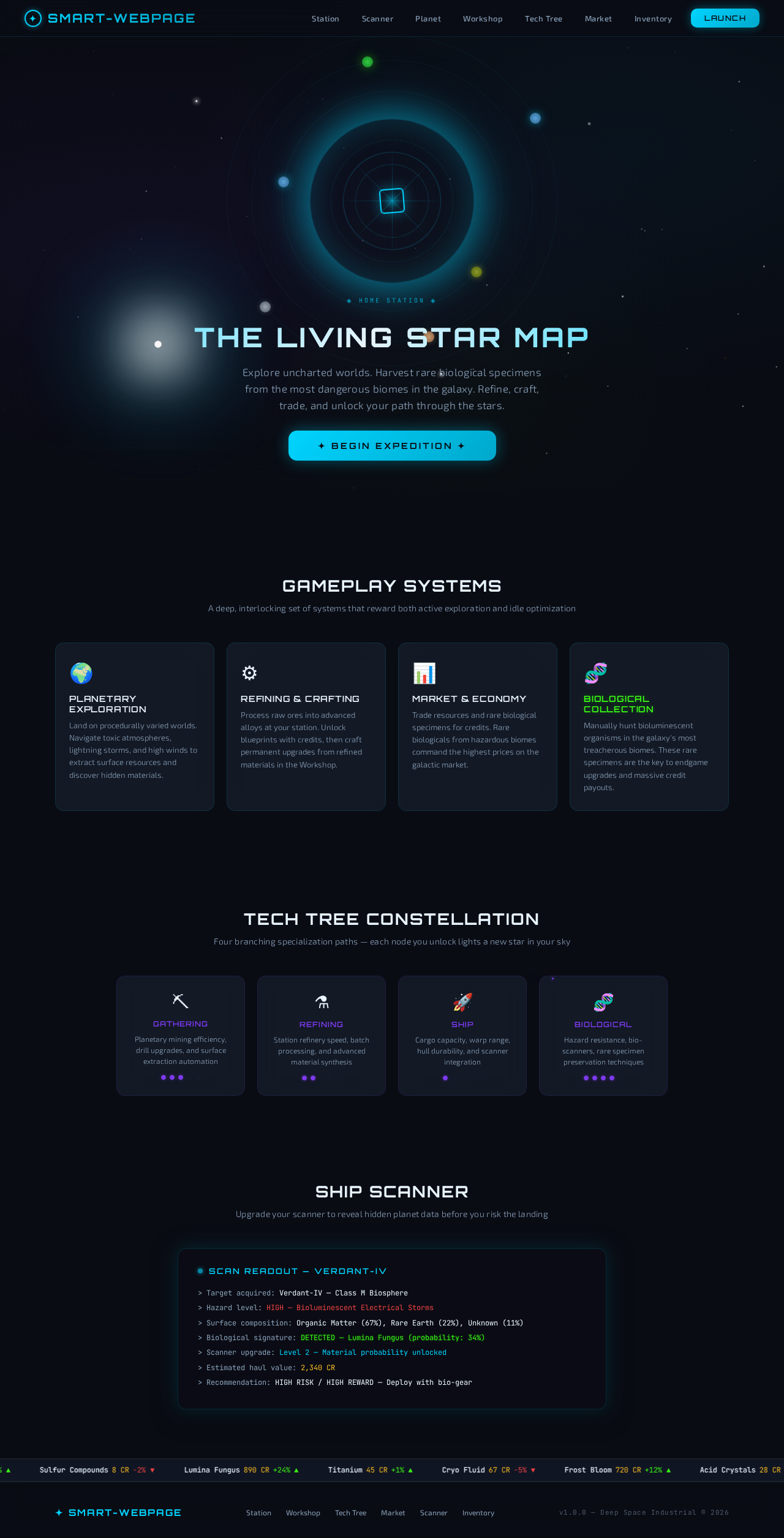
THE LIVING STAR MAP
Explore uncharted worlds. Harvest rare biological specimens from the most dangerous biomes in the galaxy. Refine, craft, trade, and unlock your path through the stars.
GAMEPLAY SYSTEMS
A deep, interlocking set of systems that reward both active exploration and idle optimization
TECH TREE CONSTELLATION
Four branching specialization paths — each node you unlock lights a new star in your sky
SHIP SCANNER
Upgrade your scanner to reveal hidden planet data before you risk the landing
No comments yet. Be the first!