smart-platform
 Eugene McMillian
I wanna build my own deployment platform like Vercel using free ai coding agents api-keys and sdks
Comments (0)
Sign in to leave a comment
System Requirements
System Requirements Document (SRD)
Project Name: smart-platform
1. Introduction
The smart-platform is a next-generation deployment platform inspired by Vercel, designed to simplify hosting, scaling, and CI/CD workflows for developers, startups, and larger teams. By integrating free AI coding agents, APIs, and SDKs, the platform will offer intelligent automation for tasks such as optimization, debugging, and scaling decisions.
This document outlines the system requirements for the smart-platform, providing a comprehensive guide to its functional and non-functional specifications, user personas, design concepts, and technical architecture.
The platform is tailored for a global audience but will incorporate US-specific defaults, such as timezone (EST), currency (USD), and compliance with relevant US regulations.
2. System Overview
The smart-platform will serve as a versatile deployment platform that supports:
- Static sites and frontend applications.
- Backend deployments, including serverless functions and APIs.
- AI-driven automation for deployment optimization, debugging, and scaling.
The platform will cater to individual developers, startups, and enterprise teams, offering a scalable, user-friendly interface with advanced features like custom domains, analytics, and role-based permissions.
Key features include:
- Seamless integration with popular version control systems (e.g., GitHub, GitLab).
- Automated CI/CD pipelines.
- AI-powered coding assistance and debugging tools.
- Flexible deployment options for both frontend and backend applications.
- Team collaboration tools, including role-based access control.
3. Functional Requirements
- As a User, I should be able to deploy static sites and frontend applications effortlessly.
- As a User, I should be able to deploy backend services, including serverless functions and APIs.
- As a User, I should be able to integrate my repository from GitHub or GitLab for automated deployments.
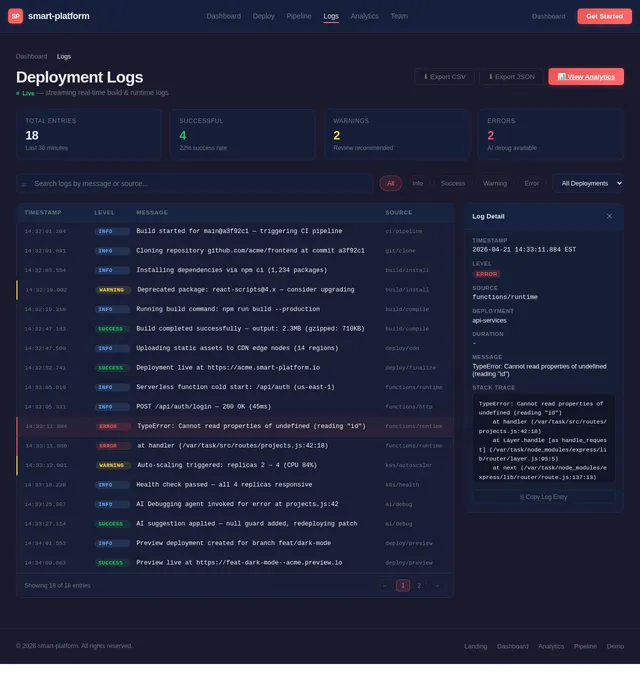
- As a User, I should be able to monitor deployment logs and analytics in real-time.
- As a User, I should be able to use AI tools for debugging and optimizing my code.
- As a User, I should be able to scale my application automatically based on traffic.
- As an Admin, I should be able to manage team members and assign role-based permissions.
- As an Admin, I should be able to configure custom domains for deployments.
- As a Guest, I should be able to explore the platform's features through a demo environment.
4. User Personas
4.1 Individual Developer
- Description: A solo developer looking for a quick and easy way to deploy projects.
- Goals: Fast deployment, minimal configuration, and access to AI debugging tools.
4.2 Startup Team
- Description: A small team working on a collaborative project.
- Goals: Team collaboration, role-based permissions, and scalable deployment options.
4.3 Enterprise Team
- Description: A large team with complex deployment needs.
- Goals: Advanced analytics, custom domains, and robust CI/CD pipelines.
4.4 Guest User
- Description: A potential user exploring the platform's capabilities.
- Goals: Access to a demo environment to evaluate features.
5. Visuals Colors and Theme
Color Palette
- Background: #1A1A2E (Deep Midnight Blue)
- Surface: #16213E (Dark Navy Blue)
- Text: #EAEAEA (Soft White)
- Accent: #F05454 (Vibrant Coral Red)
- Muted: #6C757D (Muted Gray)
This palette reflects a modern, professional aesthetic while maintaining a sense of innovation and energy.
6. Signature Design Concept
Interactive Deployment Galaxy
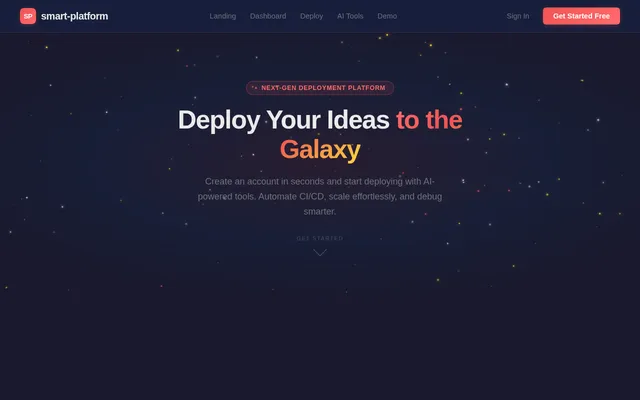
The homepage of the smart-platform will feature a 3D interactive galaxy where each "star" represents a feature or section of the platform.
-
Visuals:
Users will see a dynamic galaxy with glowing stars that pulse gently. Hovering over a star will display a tooltip with the feature name (e.g., "Deploy Frontend," "AI Debugging"). Clicking a star will zoom into that section, transitioning smoothly to the relevant page. -
Animations:
The galaxy will rotate slowly, with stars twinkling and subtle particle effects creating a sense of depth. Transitions between sections will include a "warp speed" animation, giving users the feeling of traveling through space. -
Interactions:
Users can navigate the galaxy using their mouse or touch gestures. A search bar at the top will allow users to jump directly to a feature by typing its name.
This design will make the platform instantly memorable and convey its cutting-edge, futuristic nature.
7. Non-Functional Requirements
- Performance: The platform must handle up to 1 million concurrent users with minimal latency.
- Scalability: The system should scale automatically to accommodate traffic spikes.
- Security: Implement robust security measures, including encryption, secure authentication, and regular vulnerability assessments.
- Availability: Ensure 99.9% uptime with failover mechanisms in place.
- Compliance: Adhere to US regulations, including GDPR and CCPA where applicable.
8. Tech Stack
Frontend
- React for Web
- React Native for Mobile
Backend
- Python
- FastAPI
Database
- MySQL (with Alembic for migrations)
AI Models
- GPT 5.4 for user-friendly responses
- Claude 4.6 Opas for academic or coding work
- Google Nano Banana for image generation
AI Tools
- Litellm for LLM Routing
- Langchain
Orchestration
- Docker for local orchestration
- Kubernetes for server-side orchestration
9. Assumptions and Constraints
- The platform will initially target US-based users but should be scalable for global deployment.
- Free AI tools and SDKs will be used to minimize operational costs.
- The system will rely on cloud infrastructure for scalability and reliability.
- Development will prioritize features for individual developers and startups before expanding to enterprise needs.
10. Glossary
- CI/CD: Continuous Integration and Continuous Deployment.
- SDK: Software Development Kit.
- AI Debugging: The use of artificial intelligence to identify and fix code issues.
- Role-Based Permissions: Access control based on user roles (e.g., Admin, User).
- Serverless Functions: Cloud-based functions that run in response to events without requiring server management.
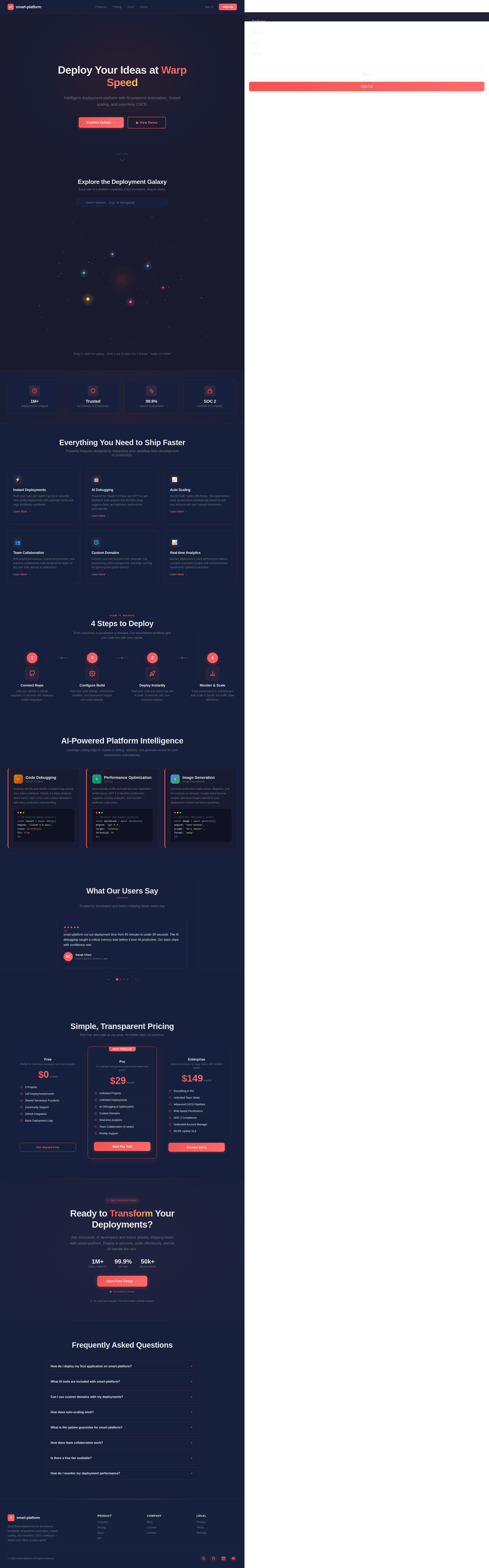
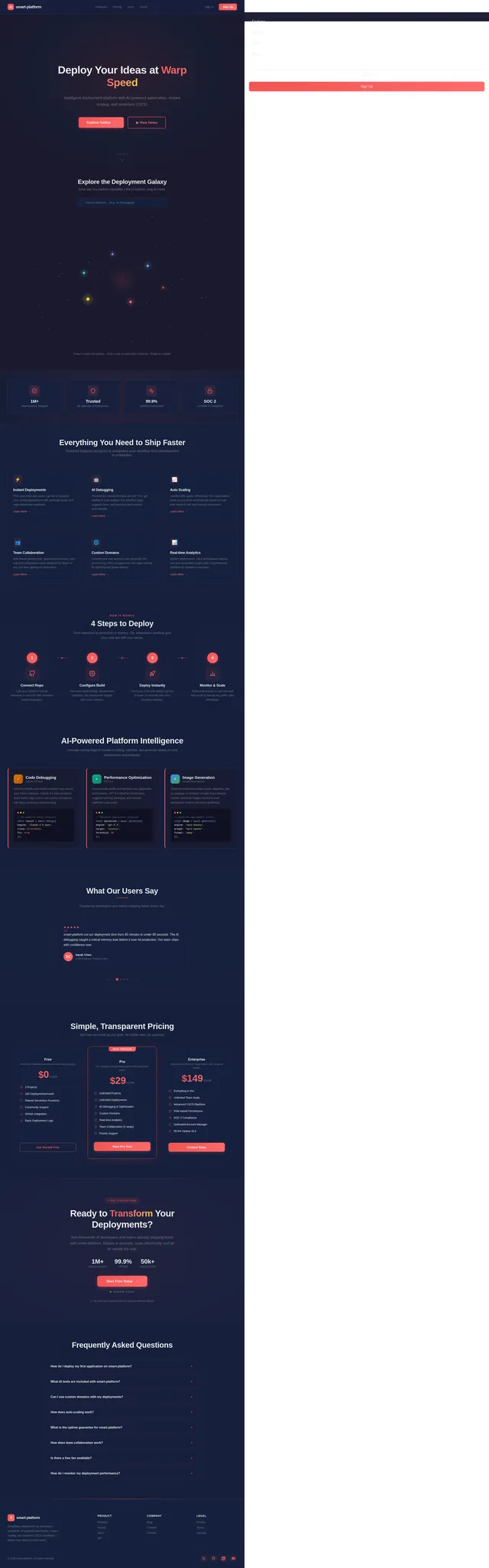
Deploy Your Ideas at Warp Speed
Intelligent deployment platform with AI-powered automation, instant scaling, and seamless CI/CD.
Explore the Deployment Galaxy
Each star is a platform capability. Click to explore, drag to rotate.
Drag to rotate the galaxy · Click a star to warp into a feature · Swipe on mobile
Everything You Need to Ship Faster
Powerful features designed to streamline your workflow from development to production.
Instant Deployments
Push your code and watch it go live in seconds. Zero-config deployments with automatic builds and edge distribution worldwide.
Learn More→AI Debugging
Powered by Claude 4.6 Opus and GPT 5.4, get intelligent code analysis that identifies bugs, suggests fixes, and optimizes performance automatically.
Learn More→Auto Scaling
Handle traffic spikes effortlessly. Your applications scale up and down automatically based on real-time demand with zero manual intervention.
Learn More→Team Collaboration
Role-based permissions, shared environments, and real-time collaboration tools designed for teams of any size from startups to enterprises.
Learn More→Custom Domains
Connect your own domains with automatic SSL provisioning, DNS management, and edge caching for lightning-fast global delivery.
Learn More→Real-time Analytics
Monitor deployments, track performance metrics, and gain actionable insights with comprehensive dashboards updated in real-time.
Learn More→4 Steps to Deploy
From repository to production in minutes. Our streamlined workflow gets your code live with zero hassle.
Connect Repo
Link your GitHub or GitLab repository in seconds with seamless OAuth integration.
Configure Build
Fine-tune build settings, environment variables, and deployment targets with smart defaults.
Deploy Instantly
Push your code and watch it go live in under 10 seconds with zero-downtime deploys.
Monitor & Scale
Track performance in real-time and auto-scale to handle any traffic spike effortlessly.
AI-Powered Platform Intelligence
Leverage cutting-edge AI models to debug, optimize, and generate assets for your deployments automatically.
Instantly identify and resolve complex bugs across your entire codebase. Claude 4.6 Opus analyzes stack traces, logic errors, and runtime exceptions with deep contextual understanding.
Automatically profile and optimize your application performance. GPT 5.4 identifies bottlenecks, suggests caching strategies, and rewrites inefficient code paths.
Generate production-ready assets, diagrams, and UI mockups on demand. Google Nano Banana creates optimized images tailored to your deployment context and brand guidelines.
What Our Users Say
Trusted by developers and teams shipping faster every day.
smart-platform cut our deployment time from 45 minutes to under 90 seconds. The AI debugging caught a critical memory leak before it ever hit production. Our team ships with confidence now.
Simple, Transparent Pricing
Start free and scale as you grow. No hidden fees, no surprises.
- ✓3 Projects
- ✓100 Deployments/month
- ✓Shared Serverless Functions
- ✓Community Support
- ✓GitHub Integration
- ✓Basic Deployment Logs
- ✓Unlimited Projects
- ✓Unlimited Deployments
- ✓AI Debugging & Optimization
- ✓Custom Domains
- ✓Real-time Analytics
- ✓Team Collaboration (5 seats)
- ✓Priority Support
- ✓Everything in Pro
- ✓Unlimited Team Seats
- ✓Advanced CI/CD Pipelines
- ✓Role-based Permissions
- ✓SOC 2 Compliance
- ✓Dedicated Account Manager
- ✓99.9% Uptime SLA
Ready to Transform Your Deployments?
Join thousands of developers and teams already shipping faster with smart-platform. Deploy in seconds, scale effortlessly, and let AI handle the rest.
Frequently Asked Questions
Simply connect your GitHub or GitLab repository, configure your build settings, and click Deploy. Our platform automatically detects your framework and handles the rest — most deployments complete in under 60 seconds.
Every plan includes access to our AI-powered debugging assistant (Claude 4.6 Opus), performance optimization suggestions (GPT 5.4), and image generation capabilities (Google Nano Banana). These tools help you ship faster and with fewer bugs.
Yes! You can configure custom domains for any deployment. We provide free SSL certificates, automatic DNS configuration, and support for both apex domains and subdomains. Custom domains are available on all plans including Free.
Our platform automatically scales your application based on incoming traffic. When demand increases, additional instances spin up within seconds. When traffic decreases, resources scale down to save costs. You only pay for what you use.
We guarantee 99.9% uptime across all paid plans, backed by our SLA. Our infrastructure is distributed across multiple regions with automatic failover. Enterprise plans include a 99.99% uptime SLA with dedicated support.
Teams can invite members with role-based permissions — Owner, Admin, Developer, or Viewer. Each role has specific access levels for deployments, settings, and billing. You can manage team members and permissions from the Team dashboard.
Yes! Our Free plan includes unlimited static site deployments, 100GB bandwidth per month, basic AI debugging tools, and community support. No credit card required to get started — upgrade to Pro or Enterprise when you need more resources.
The Analytics dashboard provides real-time metrics including response times, error rates, bandwidth usage, and visitor analytics. You can also view detailed deployment logs, set up alerts, and integrate with external monitoring tools.
No comments yet. Be the first!