silent-price
 Akash Share
I want make price comparsonhvfrom like cab and auto and bike from uber and rapido and ola
Comments (0)
Sign in to leave a comment
System Requirements
System Requirements Document (SRD)
Project Name: silent-price
1. Introduction
The silent-price project is a price comparison platform designed to help users in India, like Akash, compare ride prices for cabs, autos, and bikes across popular ride-hailing services such as Uber, Rapido, and Ola. The platform aims to provide users with a seamless experience by displaying real-time pricing options and redirecting them to the respective app with pre-filled details for booking.
This document outlines the system requirements for the silent-price project, including functional and non-functional requirements, user personas, design concepts, and technical specifications.
2. System Overview
The silent-price platform will act as an aggregator for ride-hailing services, enabling users to:
- Compare prices for cabs, autos, and bikes across multiple providers.
- View real-time pricing and availability based on their pick-up and drop-off locations.
- Redirect to the selected provider's app with all booking details pre-filled, ensuring a smooth transition for the user.
The system will leverage APIs provided by Uber, Rapido, and Ola to fetch pricing and availability data. It will also include an auto-redirect feature that ensures users are taken directly to the selected app if it is installed on their device.
Locale-specific considerations, such as currency (INR) and timezone (IST), will be implemented to cater to the Indian audience.
3. Functional Requirements
As story points:
- As a User, I should be able to enter my pick-up and drop-off locations to view ride options.
- As a User, I should be able to compare prices for cabs, autos, and bikes across Uber, Rapido, and Ola.
- As a User, I should be able to filter results by lowest cost, fastest ride, or preferred vehicle type.
- As a User, I should be able to click on a ride option and be redirected to the respective app with all details pre-filled.
- As a User, I should be notified if the selected app is not installed and be provided with an option to download it.
- As an Admin, I should be able to manage API keys and monitor API usage for Uber, Rapido, and Ola integrations.
- As an Admin, I should be able to view analytics on user preferences and app usage trends.
4. User Personas
1. Regular User
- Description: A commuter who frequently uses ride-hailing services and wants to save time and money by comparing prices.
- Goals: Quick price comparison, seamless redirection to booking apps, and access to the best deals.
2. Admin
- Description: A system administrator responsible for managing API integrations, monitoring system performance, and analyzing user data.
- Goals: Ensure smooth operation of the platform, maintain API keys, and generate insights for business decisions.
5. Visuals Colors and Theme
The silent-price platform will use a unique color palette that reflects trust, efficiency, and modernity. The colors are designed to create a clean and user-friendly interface.
- Background: #F5F9FF (Soft Sky Blue)
- Surface: #FFFFFF (Pure White)
- Text: #2C3E50 (Deep Navy)
- Accent: #FF6F61 (Vibrant Coral)
- Muted: #B0BEC5 (Cool Gray)
This palette ensures high readability and a visually appealing experience for users.
6. Signature Design Concept
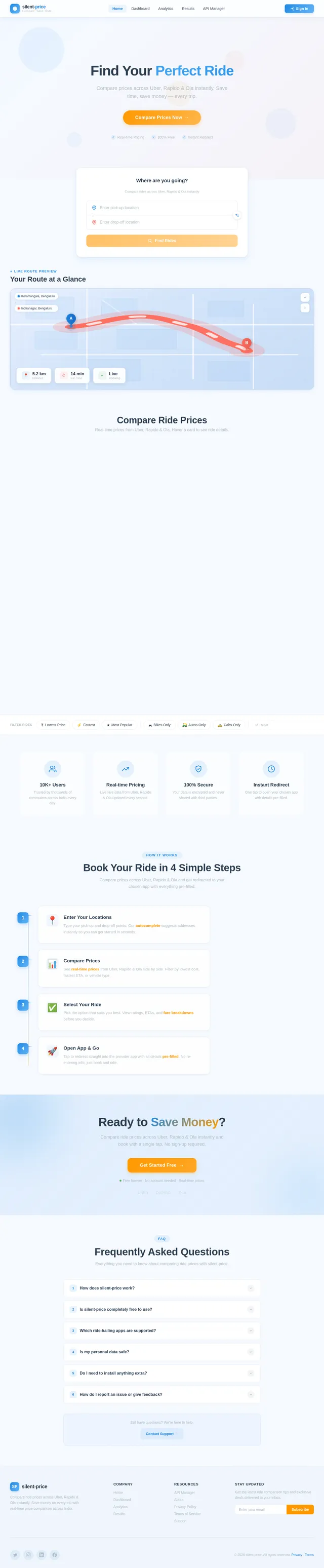
The silent-price homepage will feature an interactive map-based interface that dynamically updates as users input their pick-up and drop-off locations.
Key Features:
-
Animated Map:
- A live map that highlights the user's pick-up and drop-off points with animated markers.
- As users type their locations, the map zooms in and adjusts to show the route.
-
Floating Price Cards:
- Price options for cabs, autos, and bikes will appear as floating cards over the map.
- Cards will have a "flip" animation when users hover over them, revealing additional details like estimated time of arrival and vehicle type.
-
Seamless Transitions:
- Clicking on a price card will trigger a smooth transition effect, where the card expands to fill the screen and displays a "Redirecting to [App Name]" message.
-
Micro-Interactions:
- Subtle animations, such as pulsating markers and hover effects, will make the interface feel alive and engaging.
This design ensures that users are captivated from the moment they land on the homepage, while also providing a highly functional and intuitive experience.
7. Non-Functional Requirements
- The system should handle up to 10,000 concurrent users without performance degradation.
- API response times should not exceed 2 seconds for fetching price data.
- The platform should comply with data privacy regulations, including GDPR and India’s IT Act.
- The system should be optimized for both web and mobile platforms.
8. Tech Stack
Frontend:
- React for Web
- React Native for Mobile App
Backend:
- Python
- FastAPI
Database:
- MySQL (with Alembic for migrations)
AI Models:
- GPT 5.4 for user-friendly responses
AI Tools:
- Litellm for LLM Routing
- Langchain
Orchestration:
- Docker for local orchestration
- Kubernetes for server-side orchestration
9. Assumptions and Constraints
- Users must have the respective ride-hailing apps (Uber, Rapido, Ola) installed on their devices for the auto-redirect feature to work.
- The platform will rely on APIs provided by Uber, Rapido, and Ola, and any changes to these APIs may impact functionality.
- The system assumes that users have a stable internet connection for real-time price fetching and redirection.
10. Glossary
- API: Application Programming Interface, used for communication between the platform and ride-hailing services.
- Auto-Redirect: A feature that redirects users to the selected app with pre-filled booking details.
- Pick-Up Location: The starting point of the user's journey.
- Drop-Off Location: The destination point of the user's journey.
- LLM: Large Language Model, used for generating user-friendly responses.
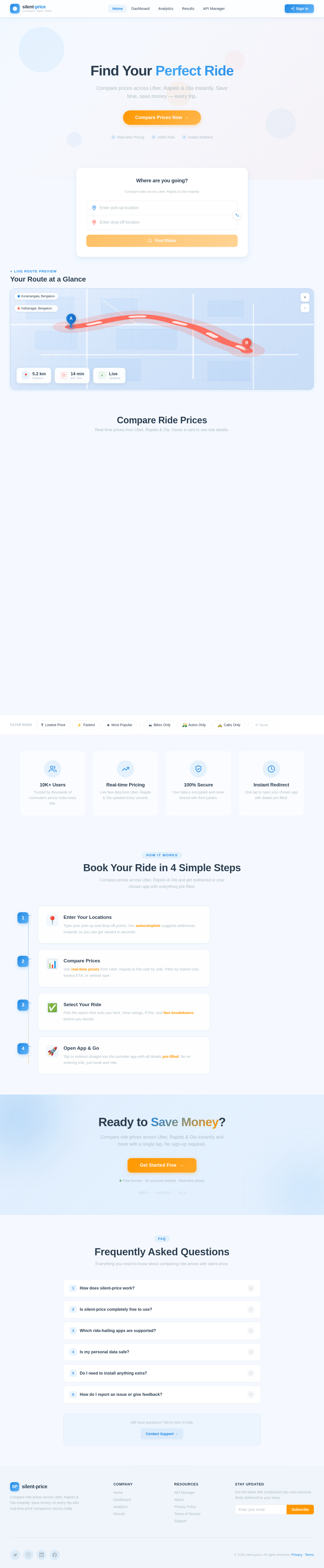
Find Your Perfect Ride
Compare prices across Uber, Rapido & Ola instantly. Save time, save money — every trip.
Where are you going?
Compare rides across Uber, Rapido & Ola instantly
Compare Ride Prices
Real-time prices from Uber, Rapido & Ola. Hover a card to see ride details.
10K+ Users
Trusted by thousands of commuters across India every day.
Real-time Pricing
Live fare data from Uber, Rapido & Ola updated every second.
100% Secure
Your data is encrypted and never shared with third parties.
Instant Redirect
One tap to open your chosen app with details pre-filled.
Book Your Ride in 4 Simple Steps
Compare prices across Uber, Rapido & Ola and get redirected to your chosen app with everything pre-filled.
Enter Your Locations
Type your pick-up and drop-off points. Our autocomplete suggests addresses instantly so you can get started in seconds.
Compare Prices
See real-time prices from Uber, Rapido & Ola side by side. Filter by lowest cost, fastest ETA, or vehicle type.
Select Your Ride
Pick the option that suits you best. View ratings, ETAs, and fare breakdowns before you decide.
Open App & Go
Tap to redirect straight into the provider app with all details pre-filled. No re-entering info, just book and ride.
Ready to Save Money?
Compare ride prices across Uber, Rapido & Ola instantly and book with a single tap. No sign-up required.
Frequently Asked Questions
Everything you need to know about comparing ride prices with silent-price.
Prices are fetched live from each provider's API, so you always see the most up-to-date fares.
We believe everyone deserves access to the best ride prices without hidden costs.
We're actively working on adding more regional providers to give you even more options.
Your location data is only used in real-time to fetch prices and is never saved on our servers.
If you don't have the app installed, we'll show you a quick link to download it.
Bug reports, feature requests, and general feedback are all welcome.
Still have questions? We're here to help.
Contact Support →
No comments yet. Be the first!