silent-healthcare
 Midhun Devadas
I need a healtcare software for medical documentation and appointment bookings
Comments (0)
Sign in to leave a comment
System Requirements
System Requirements Document (SRD)
Project Name: silent-healthcare
1. Introduction
The silent-healthcare project is a healthcare software solution designed to streamline medical documentation and appointment bookings. Developed with the needs of healthcare providers in mind, this system aims to improve efficiency, reduce errors, and enhance patient engagement.
This document outlines the system requirements for silent-healthcare, ensuring clarity and alignment with the goals set forth by Midhun Devadas, the project initiator.
The system will cater to healthcare professionals in the United Arab Emirates (AE), adhering to local standards, insurance guidelines, and ICD coding practices. It will also incorporate SMS-based appointment reminders to enhance patient communication.
2. System Overview
silent-healthcare is a comprehensive healthcare software solution designed for medical professionals, including doctors and nurses. The system will provide tools for:
- Real-time medical documentation with automated ICD coding based on insurance coverage and guidelines.
- Integration of nurse notes into patient records for comprehensive documentation.
- Appointment booking by doctors, with SMS reminders sent to patients.
- Template management for creating and using pre-built, ready-to-use documentation templates.
The system will ensure role-specific access through separate logins for doctors and nurses, maintaining data integrity and security.
3. Functional Requirements
As story points:
- As a Doctor, I should be able to dictate or type clues for medical documentation.
- As a Doctor, I should be able to see automated ICD codes generated in real-time based on insurance coverage and guidelines, with the ability to edit them later.
- As a Nurse, I should be able to enter nurse notes that automatically integrate into the patient's documentation.
- As a Doctor, I should be able to book appointments for patients, who should receive SMS reminders.
- As a User, I should be able to create and manage pre-built, ready-to-use templates for documentation.
4. User Personas
1. Doctor
- Primary user responsible for medical documentation and appointment bookings.
- Requires features like real-time ICD coding, editable documentation, and SMS appointment reminders.
2. Nurse
- Secondary user responsible for entering nurse notes that integrate into patient records.
- Requires access to documentation features but with limited permissions compared to doctors.
3. Patient
- Receives SMS reminders for appointments booked by doctors.
- No direct access to the system but interacts via notifications.
5. Visuals Colors and Theme
Color Palette:
The visual identity of silent-healthcare will reflect a professional yet calming aesthetic, suitable for a healthcare environment.
- Background: #F5F9FA (Soft Sky Blue)
- Surface: #E8F1F2 (Light Mist Gray)
- Text: #2A3D45 (Deep Charcoal)
- Accent: #3A9AD9 (Bright Azure)
- Muted Tones: #A6B8C1 (Subtle Steel Blue)
This palette ensures a clean, modern, and approachable interface that aligns with the healthcare domain.
6. Signature Design Concept
Concept: Interactive Medical Dashboard with Dynamic Templates
The homepage of silent-healthcare will feature an Interactive Medical Dashboard that combines functionality with visual appeal.
Key Features:
-
Dynamic Template Carousel:
- A rotating carousel showcasing pre-built templates for documentation.
- Templates will animate into view with a smooth sliding effect, allowing users to preview and select them effortlessly.
-
Real-Time ICD Coding Visualizer:
- A live coding assistant displayed as a sidebar widget.
- As doctors input clues, the widget dynamically updates with suggested ICD codes, highlighted in the accent color (#3A9AD9).
-
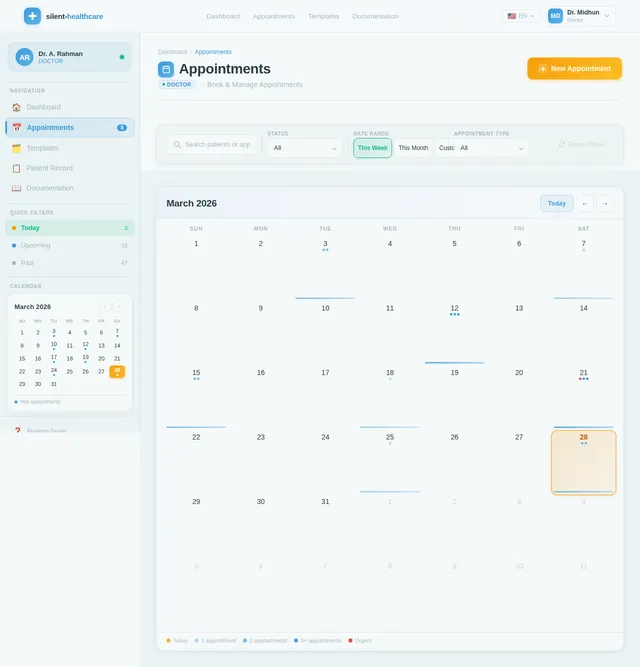
Appointment Booking Calendar:
- A visually engaging calendar with drag-and-drop functionality for scheduling appointments.
- Patients' SMS reminders will be represented as animated notifications popping up on the dashboard.
-
Micro-Interactions:
- Hover effects on buttons and icons that subtly change color and size.
- Smooth transitions between sections, creating a seamless user experience.
This design concept ensures that the homepage is not only functional but also visually captivating, leaving a lasting impression on users.
7. Non-Functional Requirements
- Performance: The system should respond to user inputs within 1 second for real-time ICD coding and documentation updates.
- Scalability: The software must support up to 10,000 concurrent users without performance degradation.
- Security: Role-based access control must be implemented to ensure data privacy and integrity.
- Localization: The system must support Arabic and English languages, adhering to UAE healthcare standards.
- Availability: The system must maintain 99.9% uptime.
8. Tech Stack
Frontend:
- React for Web
- React Native for Mobile App
Backend:
- Python
- FastAPI
Database:
- MySQL or MariaDB (preferred for RDBMS)
- MongoDB (for NoSQL requirements)
AI Models:
- GPT 5.4 for user-friendly responses
- Claude 4.6 Opas for academic or coding work
- Gemini 3.1 Pro for friendly responses
- Google Nano Banana for image generation
AI Tools:
- Litellm for LLM Routing
- Langchain
Orchestration:
- Docker and docker-compose for local orchestration
- Kubernetes for server-side orchestration
9. Assumptions and Constraints
Assumptions:
- Doctors and nurses will have access to devices capable of running the software (e.g., desktops, tablets, or smartphones).
- Patients will have mobile phones capable of receiving SMS reminders.
- The system will integrate with UAE insurance databases for ICD coding guidelines.
Constraints:
- The system must comply with UAE healthcare regulations and data protection laws.
- SMS reminders will be limited to UAE-based phone numbers.
- Real-time ICD coding may require periodic updates to insurance and coding databases.
10. Glossary
- ICD Codes: International Classification of Diseases codes used for medical documentation and insurance claims.
- SMS Reminder: A text message sent to patients to remind them of upcoming appointments.
- Template Management: A feature allowing users to create and use pre-built documentation templates.
- Role-Based Access Control: A security mechanism that restricts system access based on user roles (e.g., doctor, nurse).
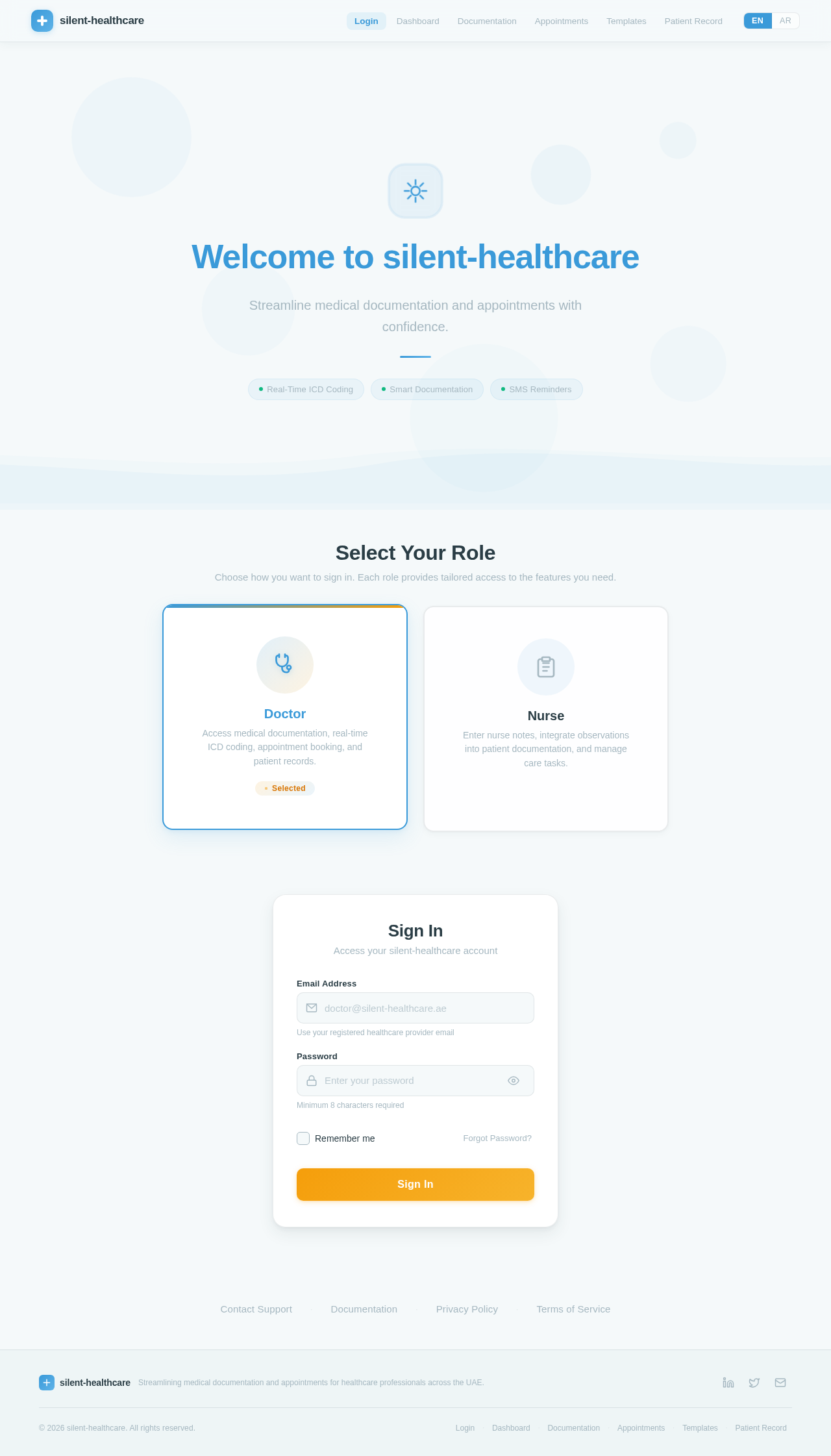
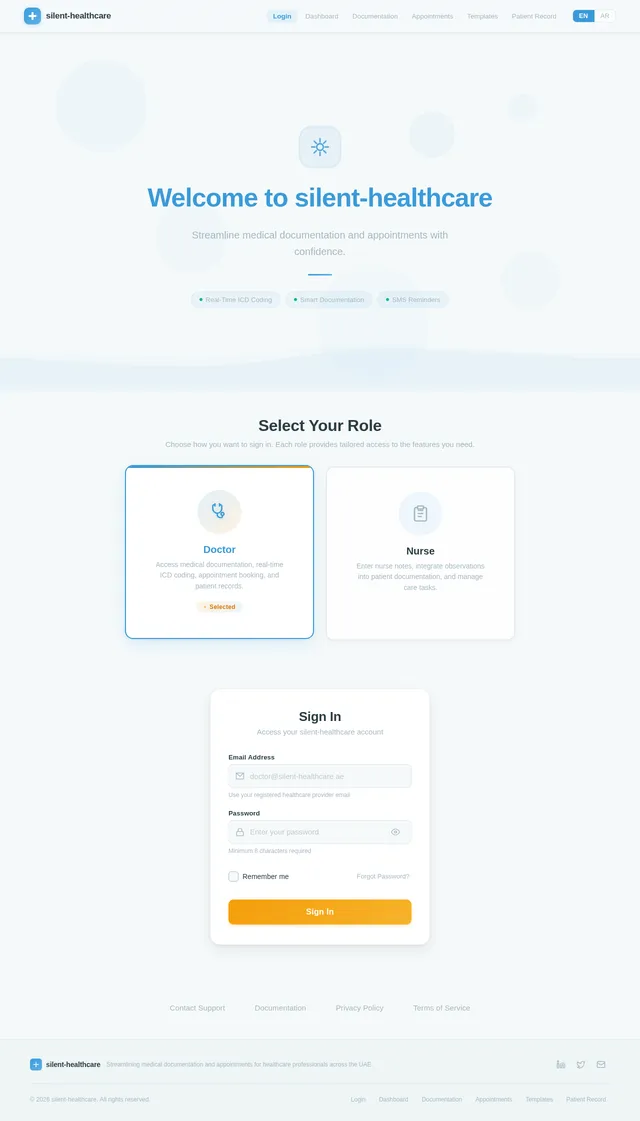
Welcome to silent-healthcare
Streamline medical documentation and appointments with confidence.
Select Your Role
Choose how you want to sign in. Each role provides tailored access to the features you need.
Access medical documentation, real-time ICD coding, appointment booking, and patient records.
Enter nurse notes, integrate observations into patient documentation, and manage care tasks.
Sign In
Access your silent-healthcare account
Use your registered healthcare provider email
Minimum 8 characters required
No comments yet. Be the first!