regal-website
 Marcelino Justo
You are an expert AI web developer and creative engineer tasked with building a website named “BrickCanvas”, a professional platform that transforms any digital painting, photograph, or artwork into a collector-quality LEGO® mosaic set. Goal: Build a responsive, visually elegant, and intuitive website that guides users through the complete process of turning 2D artworks into physical 3D LEGO mosaics. Core Features: 1. Image Upload and Processing: Users upload a digital artwork (JPEG, PNG, or TIFF). The system automatically analyzes color, depth, and contrast to generate a LEGO-compatible pixel mapping. 2. Smart Brick Mapping Engine: Convert the image into a LEGO color palette (based on LEGO’s current color catalog). Calculate mosaic dimensions, brick counts, and optimal layout for both aesthetic fidelity and buildability. 3. 3D Mosaic Visualization: Display a rotatable, interactive 3D preview (using WebGL or Three.js) that simulates the completed mosaic. 4. Instruction Book Generator: Automatically create step-by-step digital building instructions inspired by The LEGO® Builder’s Handbook – Become a Master Builder. • Include detailed layer-by-layer assembly steps. • Provide realistic part inventories per step, with part IDs. • Offer downloadable PDF instructions formatted in LEGO-style blueprints. 1. Order and Export Options: • Export digital build files in common LEGO design formats (e.g., BrickLink Studio `.io`, LDraw `.ldr`). • Generate a purchasable parts list with BrickLink or LEGO Pick-a-Brick API integration. • Option to order a custom collector’s kit (with packaging designed from the uploaded image). 1. User Dashboard: Let users save, share, and download their creations. Add social sharing for showcasing completed mosaics. Design Guidelines: • Aesthetic: Clean interface with LEGO-like playful minimalism. White background, vibrant accent colors. • Interaction Flow: Upload → Preview Mosaic → Customize Size/Colors → Generate Instructions → Export or Order Set. • Accessibility: Tooltips, visual previews, progress bar for instruction generation. • Include gamified touches such as “Master Builder Level” progress indicators. Backend & AI Components: • Use a diffusion-based color quantization model trained on LEGO color palettes. • Integrate OpenCV for image segmentation and dominant color extraction. • Utilize Three.js or Babylon.js for 3D rendering of the mosaic. • Use LangChain or similar orchestration frameworks for chaining individual AI tools (image analysis, build step generation, instruction formatting). Deliverables: • Fully functional website prototype runnable on a local server. • Auto-generated documentation describing installation, dependencies, and usage. • Sample input and output (e.g., “Starry Night” → 3D LEGO mosaic PDF instructions + 3D model preview). Tone and Presentation: Write in an inspiring and educational tone, encouraging users to “become a Master Builder.” Present instructions in a LEGO manual–style voice, friendly but technical, using visual callouts and color-coded layers. Objective: At the end, users should be able to: • Upload any artwork • Generate a collector-grade LEGO mosaic set • Follow real build steps to assemble it in the physical world • Order or share their personalized masterpiece Important: Ensure copyright compliance for uploaded artworks and include licensing acknowledgment guidelines



Comments (0)
Sign in to leave a comment
System Requirements
System Requirements Document
1. Introduction
The BrickCanvas project is a professional platform designed to transform any digital painting, photograph, or artwork into a collector-quality LEGO® mosaic set. The platform aims to empower individual LEGO enthusiasts to create complex, high-fidelity LEGO mosaics from their personal artwork, potentially attracting the interest of the LEGO company. By providing tools for image processing, 3D visualization, and professional-grade instruction generation, the website bridges the gap between personal creativity and professional LEGO design.
This document outlines the system requirements for the BrickCanvas project, ensuring it meets the needs of its target audience and delivers an exceptional user experience.
2. System Overview
The BrickCanvas platform will serve as a responsive, visually elegant, and intuitive website that guides users through the process of transforming 2D artwork into physical 3D LEGO mosaics. The system will cater to individual LEGO enthusiasts who aim to build complex sets that could potentially attract the interest of the LEGO company.
Key features include:
- Image upload and processing to convert artwork into LEGO-compatible designs.
- A smart brick mapping engine for optimal layout and aesthetic fidelity.
- Interactive 3D mosaic visualization for previewing designs.
- Automatic generation of professional-grade building instructions.
- Export and order options for digital files, parts lists, and custom kits.
- A user dashboard for saving, sharing, and showcasing creations.
- Selective re-run capability to allow users to regenerate specific outputs (e.g., updated instructions, previews, or parts lists).
The platform will focus on accessibility, gamification, and professional-grade output to inspire users to create designs worthy of official LEGO recognition.
3. Functional Requirements
- As a User, I should be able to upload digital artwork in JPEG, PNG, TIFF, or WebP formats.
- As a User, I should be able to preview my artwork as a LEGO mosaic in an interactive 3D environment.
- As a User, I should be able to customize the size and color palette of my mosaic.
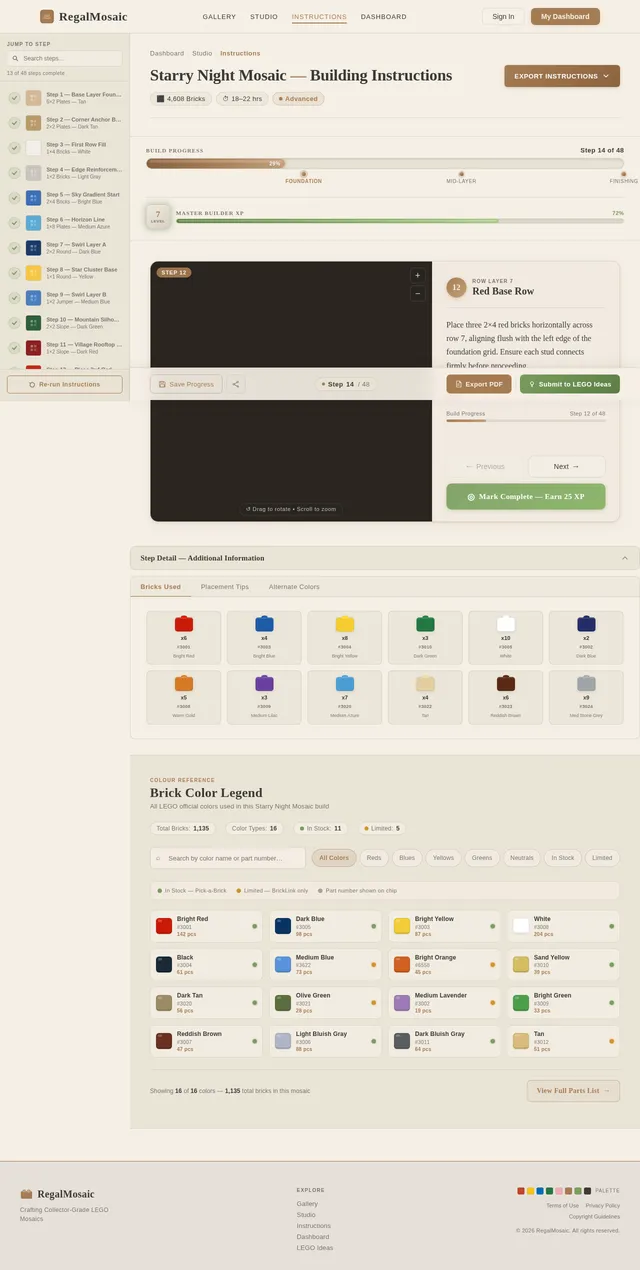
- As a User, I should be able to generate step-by-step building instructions in a LEGO-style format.
- As a User, I should be able to export digital build files in formats like
.ioor.ldr. - As a User, I should be able to generate a purchasable parts list with BrickLink or LEGO Pick-a-Brick API integration.
- As a User, I should be able to order a custom collector’s kit with packaging designed from my uploaded image.
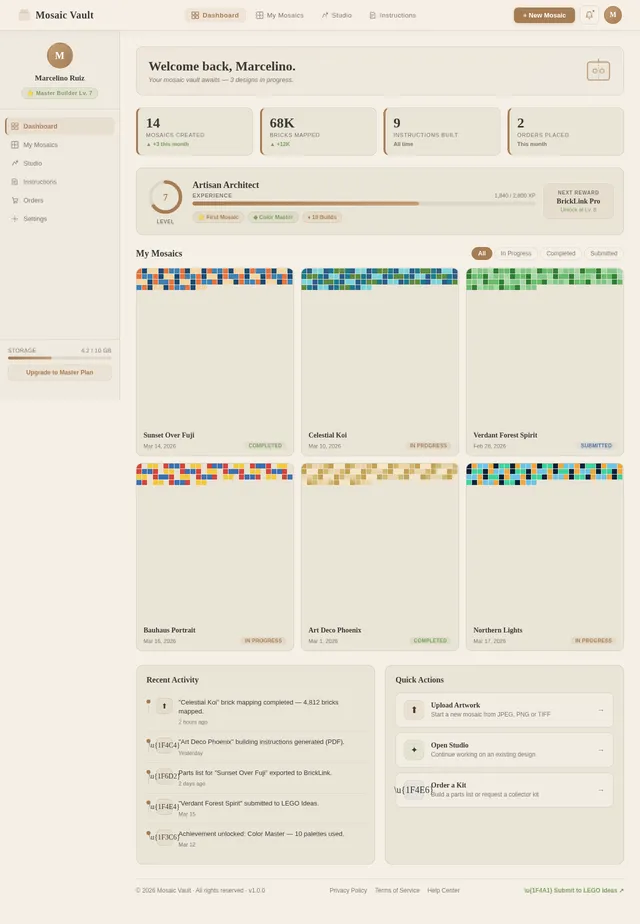
- As a User, I should be able to save, share, and download my creations from a personal dashboard.
- As a User, I should be able to track my progress with gamified elements like “Master Builder Level” indicators.
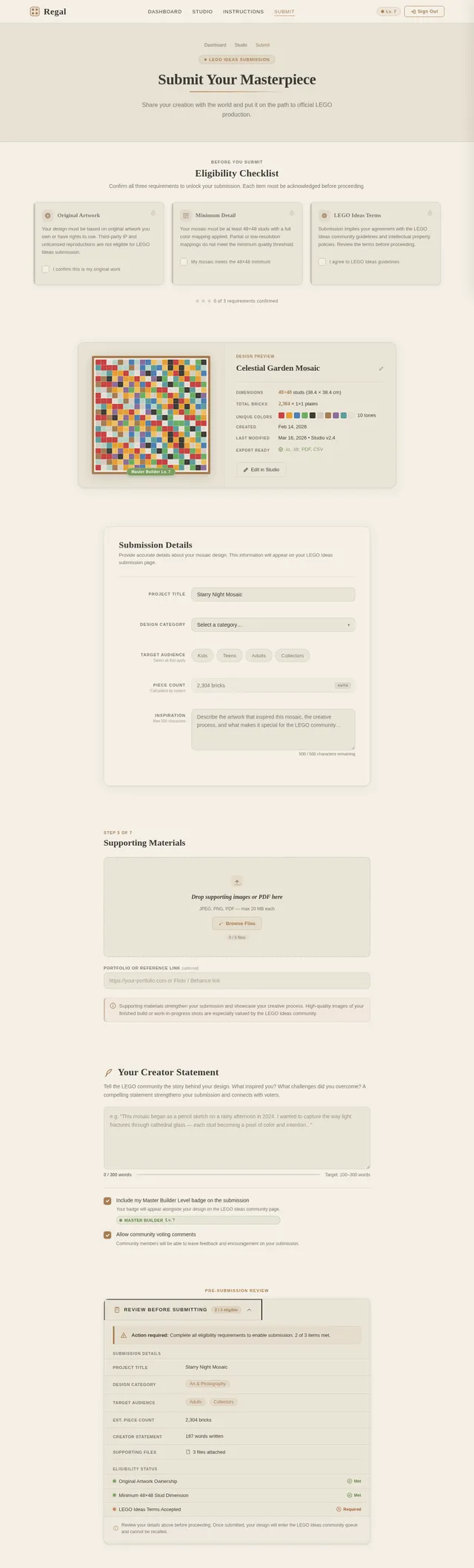
- As a User, I should be able to submit my designs to LEGO Ideas for potential recognition.
- As a User, I should be able to selectively re-run specific outputs (e.g., regenerate instructions, update 3D previews, or refresh parts lists) without starting the entire process over.
- As a User, I should be able to choose from three fixed size tiers: 32×32, 48×48, and 64×64 studs.
- As a User, I should be able to ensure my design uses only official LEGO elements from a versioned catalog snapshot.
- As a User, I should be able to view photorealistic review renders of my mosaic.
- As a User, I should be able to receive a validation report ensuring my design meets all structural and assembly constraints.
- As a User, I should be able to access a user approval workflow to select the best design candidate.
- As a User, I should be able to interact with animated layer previews to understand the build process better.
- As a User, I should be able to annotate my designs for future reference and improvements.
- As a User, I should be able to view an approved mosaic spec to ensure compliance with design standards.
- As a User, I should be able to export artifacts through a structured pipeline.
- As a User, I should be able to analyze artwork to determine the best conversion to a LEGO mosaic.
- As a User, I should be able to follow detailed assembly steps for constructing my mosaic.
- As a User, I should be able to access an authoritative structured record of my design process.
- As a User, I should be able to use axle pins with friction for enhanced structural integrity.
- As a User, I should be able to understand the backend/services architecture for better integration and troubleshooting.
- As a User, I should be able to select baseplates allowed and sizes for my mosaic.
- As a User, I should be able to follow brand voice and styling guidelines for a consistent user experience.
- As a User, I should be able to ensure my design meets build validity metrics.
- As a User, I should be able to validate the buildability of my design.
- As a User, I should be able to incorporate cheese slopes for aesthetic detailing.
- As a User, I should be able to generate a color grid from the image analyzer for accurate color mapping.
- As a User, I should be able to ensure my design adheres to the specified color scope.
- As a User, I should be able to use color-grouped strategies for efficient assembly.
- As a User, I should be able to adhere to connection constraints for structural stability.
- As a User, I should be able to enforce constraints during the design process.
- As a User, I should be able to solve constraints to ensure a feasible design.
- As a User, I should be able to set constraints and difficulty levels for my design.
- As a User, I should be able to optimize my design according to core optimization objectives.
- As a User, I should be able to use curved slopes for smooth transitions in my design.
- As a User, I should be able to incorporate curved tiles for aesthetic appeal.
- As a User, I should be able to use cut corners for design flexibility.
- As a User, I should be able to access the data/model pipeline for insights into the design process.
- As a User, I should be able to manage dataset classes for training and improvement.
- As a User, I should be able to set a depth prior for my design to ensure proper layering.
4. User Personas
-
Enthusiast Builder
- Description: A LEGO hobbyist passionate about creating complex, high-quality builds.
- Goals: To design and build mosaics that showcase their creativity and technical skill.
- Needs: Tools for precision, customization, and professional-grade output.
-
Aspiring LEGO Designer
- Description: An individual aiming to create designs that could attract the interest of the LEGO company.
- Goals: To produce designs worthy of official LEGO recognition or production.
- Needs: Features that emphasize quality, innovation, and professional presentation.
-
Collector
- Description: A LEGO fan who values unique, custom-designed sets for personal or display purposes.
- Goals: To create and own personalized LEGO mosaics.
- Needs: Seamless ordering and high-quality packaging options.
5. Core User Flows
-
Upload and Process Artwork
- User uploads artwork in supported formats.
- System processes the image to generate a LEGO-compatible design.
-
Preview and Customize Mosaic
- User previews the mosaic in a 3D environment.
- User customizes size and color palette.
-
Generate Instructions and Export
- System generates step-by-step building instructions.
- User exports digital build files and parts list.
-
Order and Share
- User orders a custom kit.
- User shares and showcases creations via the dashboard.
6. Visuals Colors and Theme
- Background: #F4F1EB (soft cream)
- Surface: #E6E0D8 (light sand)
- Text: #3C3B37 (matte dark gray)
- Accent: #B28A5E (mocha brown) and #7A9D5E (sage green)
- Muted Tones: #D5CEC3 (warm beige)
This palette reflects the timeless and sophisticated mood of the project, ensuring a professional and inviting user experience.
7. Signature Design Concept
"The Mosaic Vault"
The homepage of the BrickCanvas website will feature an interactive "Mosaic Vault" concept. Upon landing, users will see a grand, architectural vault door slowly opening, revealing a gallery of rotating LEGO mosaic masterpieces. Each mosaic will appear as a framed artwork, with subtle lighting effects highlighting its details.
Key interactions:
- Hover Effects: As users hover over a mosaic, it will animate into a 3D preview, allowing them to rotate and zoom in.
- Dynamic Background: The background will subtly shift between warm marble textures, creating a sense of depth and sophistication.
- Gamification: A “Master Builder Level” progress bar will be displayed prominently, encouraging users to unlock new features and badges.
- Call-to-Action: A glowing button labeled “Start Your Masterpiece” will guide users to upload their artwork and begin the creation process.
8. Interaction Model & Motion Direction
- Motion: Smooth and slow transitions, with effects like fade-in and gentle rise to maintain a polished aesthetic.
9. Non-Functional Requirements
- The website must be responsive and optimized for desktop and mobile devices.
- The system should process image uploads and generate previews within 5 seconds.
- The platform must comply with copyright laws and provide licensing acknowledgment guidelines.
- The website should support accessibility features, including tooltips and visual previews.
- The selective re-run feature should allow users to regenerate specific outputs without re-uploading their artwork.
10. Tech Stack
- Frontend: React.js
- Backend: Python with FastAPI
- Database: MySQL with Alembic for migrations
- 3D Rendering: Three.js for interactive previews
- AI Models:
- GPT 5.2 for user-friendly responses
- OpenCV for image segmentation and color extraction
- Orchestration: LangChain for chaining AI tools
- Containerization: Docker and Docker Compose
11. Assumptions and Constraints
- Users will upload artwork in standard formats (JPEG, PNG, TIFF, WebP).
- The system will rely on LEGO’s official color catalog for brick mapping.
- The platform will integrate with BrickLink and LEGO Pick-a-Brick APIs for parts lists.
- The website will operate in the US timezone and use USD as the default currency.
- All features will be free for users initially, with potential monetization options in the future.
12. Glossary
- LEGO Mosaic: A 2D artwork recreated using LEGO bricks.
- Brick Mapping Engine: A system that converts artwork into a LEGO-compatible design.
- Master Builder Level: A gamified progress indicator for users.
- BrickLink: An online marketplace for LEGO parts and sets.
- Selective Re-run: A feature allowing users to regenerate specific outputs without restarting the entire process.
This updated SRD ensures the BrickCanvas project aligns with its target audience and delivers a professional, engaging experience.

Transform Your Art Into a LEGO Masterpiece.
Upload your artwork, customize every brick, and generate professional building instructions — all in one elegant studio built for serious builders.
Everything You Need to Build at the Highest Level
Image Upload & Processing
Upload your artwork in JPEG, PNG, or TIFF and let our engine analyze colors, contrast, and detail for optimal mosaic translation. Advanced algorithms preserve the essence of your original piece while adapting it to the brick medium.
Smart Brick Mapping
Our intelligent mapping engine selects the ideal brick sizes and colors from the full LEGO palette to recreate your design with stunning fidelity. Fine-tune color matching and layout density to achieve collector-grade results.
3D Mosaic Preview
Visualize your mosaic in an interactive 3D environment before committing to a build. Rotate, zoom, and inspect every brick placement from any angle to ensure perfection.
Building Instructions
Generate professional step-by-step building instructions that rival official LEGO sets. Export in PDF or interactive digital formats with clear numbered stages and piece callouts.
Parts List & Ordering
Receive a detailed parts list with BrickLink and LEGO Pick-a-Brick integration for seamless ordering. Compare prices across vendors and order your custom kit with a single click.
Dashboard & Sharing
Save, organize, and showcase your mosaic creations from a personal dashboard. Share designs with the community and track your Master Builder progress with gamified milestones.
From the Vault — Community Masterpieces
Explore stunning LEGO mosaics crafted by builders around the world
Your Masterpiece in Four Steps
Upload Your Artwork
Import your JPEG, PNG, or TIFF artwork. Our engine analyzes colors, contrast, and detail to prepare the perfect mosaic foundation.
Customize Your Mosaic
Choose your grid size, color palette, and brick mapping style. Fine-tune every detail until your vision is pixel-perfect.
Generate Instructions
Receive professional LEGO-style step-by-step building instructions, complete with a full parts list and 3D preview.
Order or Export
Export your build files in .io or .ldr format, order parts via BrickLink, or request a collector-grade custom kit.
Unlock Your Master Builder Rank
Every mosaic you create brings you closer to Master Builder status. Earn XP, collect badges, and unlock exclusive tools reserved for the most dedicated builders.
- New Color PalettesUnlock exclusive brick palettes as you level up, including rare metallic and translucent tones.
- Exclusive Mosaic TemplatesAccess premium templates designed by top-ranked builders in the community.
- LEGO Ideas Submission BoostMaster Builders get priority review and enhanced visibility on LEGO Ideas submissions.
Builders Who Made It to the Vault
Marcus Reinhardt
Enthusiast Builder
The brick mapping engine is extraordinary. I uploaded a portrait of my daughter and the mosaic captured every nuance of light and shadow. The generated instructions were clearer than official LEGO sets.
Sophie Larsson
Aspiring LEGO Designer
I submitted my first mosaic design to LEGO Ideas through this platform and it gained 2,000 supporters in two weeks. The professional-grade output made all the difference in how people perceived my work.
James Takahashi
Collector
The 3D preview let me refine my mosaic before ordering a single brick. The BrickLink integration saved me hours of sourcing parts, and the collector kit packaging was a beautiful finishing touch.
Choose Your Builder Tier
From first-time builders to aspiring LEGO designers, find the plan that matches your ambition.
Free
Apprentice
Free forever
- 3 mosaic designs per month
- Basic color palette (20 colors)
- Standard 3D preview
- Download PNG snapshots
- Community gallery access
Pro
Craftsman
Billed monthly
- Unlimited mosaic designs
- Full LEGO color catalog (60+ colors)
- HD interactive 3D preview
- PDF building instructions
- BrickLink parts list export
- Master Builder progress tracking
Elite
Master
Billed monthly
- Everything in Craftsman
- Export .io and .ldr build files
- Custom collector kit ordering
- Priority image processing
- Submit to LEGO Ideas integration
- Premium packaging design
Ready to Pitch Your Design to LEGO?
Submit your mosaic creation directly to LEGO Ideas and let the community vote on your masterpiece. Designs that gain enough support have the chance to become official LEGO sets, bringing your artwork from screen to shelves worldwide.
LEGO and LEGO Ideas are trademarks of the LEGO Group, which does not sponsor, authorize, or endorse this platform. Submissions are subject to LEGO Ideas guidelines and review process.
Your Art Deserves to Be Built
Upload your artwork, customize every brick, and bring your vision to life as a collector-grade LEGO mosaic — all in minutes.
No credit card required · Free tier forever
Transform Your Art Into a LEGO Masterpiece.
Upload your artwork, customize every brick, and generate professional building instructions — all in one elegant studio built for serious builders.
Everything You Need to Build at the Highest Level
Image Upload & Processing
Upload your artwork in JPEG, PNG, or TIFF and let our engine analyze colors, contrast, and detail for optimal mosaic translation. Advanced algorithms preserve the essence of your original piece while adapting it to the brick medium.
Smart Brick Mapping
Our intelligent mapping engine selects the ideal brick sizes and colors from the full LEGO palette to recreate your design with stunning fidelity. Fine-tune color matching and layout density to achieve collector-grade results.
3D Mosaic Preview
Visualize your mosaic in an interactive 3D environment before committing to a build. Rotate, zoom, and inspect every brick placement from any angle to ensure perfection.
Building Instructions
Generate professional step-by-step building instructions that rival official LEGO sets. Export in PDF or interactive digital formats with clear numbered stages and piece callouts.
Parts List & Ordering
Receive a detailed parts list with BrickLink and LEGO Pick-a-Brick integration for seamless ordering. Compare prices across vendors and order your custom kit with a single click.
Dashboard & Sharing
Save, organize, and showcase your mosaic creations from a personal dashboard. Share designs with the community and track your Master Builder progress with gamified milestones.
From the Vault — Community Masterpieces
Explore stunning LEGO mosaics crafted by builders around the world
Your Masterpiece in Four Steps
Upload Your Artwork
Import your JPEG, PNG, or TIFF artwork. Our engine analyzes colors, contrast, and detail to prepare the perfect mosaic foundation.
Customize Your Mosaic
Choose your grid size, color palette, and brick mapping style. Fine-tune every detail until your vision is pixel-perfect.
Generate Instructions
Receive professional LEGO-style step-by-step building instructions, complete with a full parts list and 3D preview.
Order or Export
Export your build files in .io or .ldr format, order parts via BrickLink, or request a collector-grade custom kit.
Unlock Your Master Builder Rank
Every mosaic you create brings you closer to Master Builder status. Earn XP, collect badges, and unlock exclusive tools reserved for the most dedicated builders.
- New Color PalettesUnlock exclusive brick palettes as you level up, including rare metallic and translucent tones.
- Exclusive Mosaic TemplatesAccess premium templates designed by top-ranked builders in the community.
- LEGO Ideas Submission BoostMaster Builders get priority review and enhanced visibility on LEGO Ideas submissions.
Builders Who Made It to the Vault
Marcus Reinhardt
Enthusiast Builder
The brick mapping engine is extraordinary. I uploaded a portrait of my daughter and the mosaic captured every nuance of light and shadow. The generated instructions were clearer than official LEGO sets.
Sophie Larsson
Aspiring LEGO Designer
I submitted my first mosaic design to LEGO Ideas through this platform and it gained 2,000 supporters in two weeks. The professional-grade output made all the difference in how people perceived my work.
James Takahashi
Collector
The 3D preview let me refine my mosaic before ordering a single brick. The BrickLink integration saved me hours of sourcing parts, and the collector kit packaging was a beautiful finishing touch.
Choose Your Builder Tier
From first-time builders to aspiring LEGO designers, find the plan that matches your ambition.
Free
Apprentice
Free forever
- 3 mosaic designs per month
- Basic color palette (20 colors)
- Standard 3D preview
- Download PNG snapshots
- Community gallery access
Pro
Craftsman
Billed monthly
- Unlimited mosaic designs
- Full LEGO color catalog (60+ colors)
- HD interactive 3D preview
- PDF building instructions
- BrickLink parts list export
- Master Builder progress tracking
Elite
Master
Billed monthly
- Everything in Craftsman
- Export .io and .ldr build files
- Custom collector kit ordering
- Priority image processing
- Submit to LEGO Ideas integration
- Premium packaging design
Ready to Pitch Your Design to LEGO?
Submit your mosaic creation directly to LEGO Ideas and let the community vote on your masterpiece. Designs that gain enough support have the chance to become official LEGO sets, bringing your artwork from screen to shelves worldwide.
LEGO and LEGO Ideas are trademarks of the LEGO Group, which does not sponsor, authorize, or endorse this platform. Submissions are subject to LEGO Ideas guidelines and review process.
Your Art Deserves to Be Built
Upload your artwork, customize every brick, and bring your vision to life as a collector-grade LEGO mosaic — all in minutes.
No credit card required · Free tier forever
No comments yet. Be the first!