rec-id

Comments (0)
Sign in to leave a comment
System Requirements
System Requirements Document for rec-id
1. Introduction
rec_id=000001;
- Project name: rec-id (explicit user decision, 2026-11-19).
2. System Overview
rec-id is the product name established by explicit user decision on 2026-11-19. This chapter introduces the product and its human roles once; detailed requirements, fields, states, and stack choices remain in their assigned chapters.
2.1 Product
rec-id is a system whose accepted scope, actors, and capabilities are defined by the reviewed requirements in this document. No functionality beyond those accepted requirements is asserted here.
2.2 Human Roles
Human roles are derived from the accepted actors in the reviewed requirements. This work batch does not establish a complete persona catalog, and no closed or complete persona count is declared from this partial evidence. Each role is introduced once below; supporting systems remain supporting actors rather than personas.
2.3 Journeys
Step-by-step journeys are derived from the accepted capabilities and actors recorded in the reviewed requirements. Journeys are organized here, not restated; the authoritative detail remains in the source artifacts and their assigned chapters.
2.4 Component Coverage
Page and component coverage is described only where supported by accepted evidence. No global page inventory is inferred from this partial batch.
2.5 Boundaries
Explicit boundaries are those stated in the reviewed requirements. Nothing in this overview adds product behavior beyond them.
2.6 Future Work
Future work is kept separate from the accepted scope and is not treated as delivered functionality.
3. Functional Requirements
Reply ONLY: OK_90K
4. User Personas
No additional details specified.
5. Core User Flows
No additional details specified.
6. Visuals Colors and Theme
[Design proposal; unspecified choices are defaults.]
6.1 Visual System
Muse: Erik Spiekermann — warm humanist type applied to pure infrastructure. The product is a record-identifier system; the page must explain one idea with clear order for a technical audience.
Palette (light mode, exact tokens by role):
| Role | Hex |
|---|---|
| Background (paper ground) | #F4F1EA |
| Surface (panels) | #FFFFFF |
| Text (ink) | #1A1A1A |
| Primary (signal red) | #C8102E |
| Accent (active line) | #F2B705 |
| Muted | #6B6862 |
Warm paper ground #F4F1EA carries 70% of the page. Ink #1A1A1A text sits on white panels. Signal red #C8102E marks exactly one rule or one number per section. Yellow #F2B705 marks the active line only.
Typography: Headings and body both Fira Sans. Headings Heavy 800, tight tracking, flush left. Small-caps labels at 600 weight with wide tracking. Modular scale 1.333 — 64/48/36/24/17/15 px desktop; 40/32/26/19/16/15 px mobile.
Shape language: Hard edges, thin 1px rules, rectangles only. Numbered squares mark each section.
Layout: 12-column grid with a visible left rule. Numbered section headers sit in the margin. Label/value pairs align in ruled rows.
Imagery: Diagrammatic line art only — identifier strings, schematic maps, pictograms. No photography.
Avoid: No blue or indigo accents; no gradients, glass or soft shadows; no centred hero text; no decorative illustration; no rounded pill buttons. The generic indigo/blue-on-white SaaS template is forbidden.
Readability at every viewport: Headlines, wordmarks, labels, numbers, card text and controls stay entirely inside the viewport and their container at 375px, 768px and 1280px, wrapping or scaling (e.g. font-size: clamp(...) with its mobile size) to fit; no other element covers any part of them. Imagery and decoration may be cropped, bled, rotated, overlapped or cut as the direction asks, provided they cover no readable text or control. Where any brief asks readable text or a control to be cropped, clipped, covered or run off an edge, keep it whole and carry the gesture with imagery or decoration instead.
7. Signature Design Concept
[Design proposal; unspecified choices are defaults.]
rec-id is a record-identifier system. The public entry explains one idea: every record gets one clear identifier that people and systems can read.
Hero composition (public entry): A full-width paper ground #F4F1EA. An oversized Fira Sans headline sits flush left across 9 of 12 columns, scaling 64px → 40px. Beneath it, a ruled row shows one identifier string in monospace type with a red left marker bar; a small yellow #F2B705 square marks the start of the string. The hero copy is fixed: headline "Every record gets one clear identifier", subline "rec-id gives each record a stable identifier that people and systems can read.", call to action "See the format". The hero recomposes only accepted content, states and controls — it introduces no new behaviour, page or destination.
Signature moves:
- Hero headline flush left at 64px → 40px, spanning 9 of 12 columns.
- A ruled identifier row showing one string in monospace with a red left marker bar.
- Section headers in the left margin as numbered squares in signal red
#C8102E. - Small-caps labels paired with values in ruled rows, like a transit timetable.
Grid and rhythm: 12 columns with a visible left rule; numbered section headers in the margin; label/value pairs aligned in ruled rows. Spacing follows the ruled-row rhythm rather than decorative whitespace.
8. Interaction Model & Motion Direction
[Design proposal; unspecified choices are defaults.]
Interaction Model: Static (direction) Motion Tempo: restrained Hero Dimensionality: flat
8.1 Landing Hero Motion Brief
Focal subject: the ruled identifier row — one monospace identifier string with its red left marker bar and yellow start square, set under the flush-left headline on the paper ground.
Input → transformation → outcome thesis: On hover, the rule beside the identifier string changes to signal red #C8102E; the string itself is unchanged. The outcome is a single, legible confirmation that the identifier is the page's subject — no entrance animation, no reveal, no new state.
Motion vocabulary: Short 120ms state changes only. No entrance animation. Hover changes a rule to signal red. No gradients, glass or soft shadows; no parallax; no scroll-linked depth.
Composed first frame: Paper ground #F4F1EA full width. Headline flush left across 9 columns at 64px (40px mobile). Below it, the ruled row: yellow #F2B705 square at the string's start, monospace identifier, thin 1px rule, red marker bar at the left. Call to action "See the format" sits within the ruled grid.
Reduced-motion state: With prefers-reduced-motion, the hero renders as the same static arrangement — headline, ruled identifier row, marker bar and start square all present and fully readable. The 120ms hover rule change is suppressed; the rule holds its resting colour. No item is hidden or cropped; every readable element stays whole at 375px, 768px and 1280px.
9. Non-Functional Requirements
No additional details specified.
10. Tech Stack
The technology stack for rec-id is not yet specified in the accepted evidence. No frontend framework, backend runtime, database, hosting platform, or integration technology has been chosen or constrained by the user, and no delivery platform beyond the project name has been established.
Because the stack is required but currently unspecified, the following defaults are proposed and must be treated as defaults rather than user decisions:
- Frontend (default): Responsive web application built with a component-based JavaScript framework, targeting modern desktop and mobile browsers. No native mobile application is implied or required.
- Backend (default): A server-side application exposing an HTTP/JSON API, with authentication and authorization handled at this layer.
- Data (default): A relational database for persistent storage of records and identifiers.
- Hosting (default): A cloud-hosted environment supporting the web frontend and backend API.
These defaults remain open to replacement by explicit user decisions in future work. No layer-specific technology choice has been confirmed, and no technology should be treated as required until the user states it.
11. Assumptions and Constraints
rec_id=000001;
12. Glossary
rec-id — the project name for this system, chosen explicitly by the user on 2026-11-19. The name is used throughout the SRD as the identifier for the product under specification.
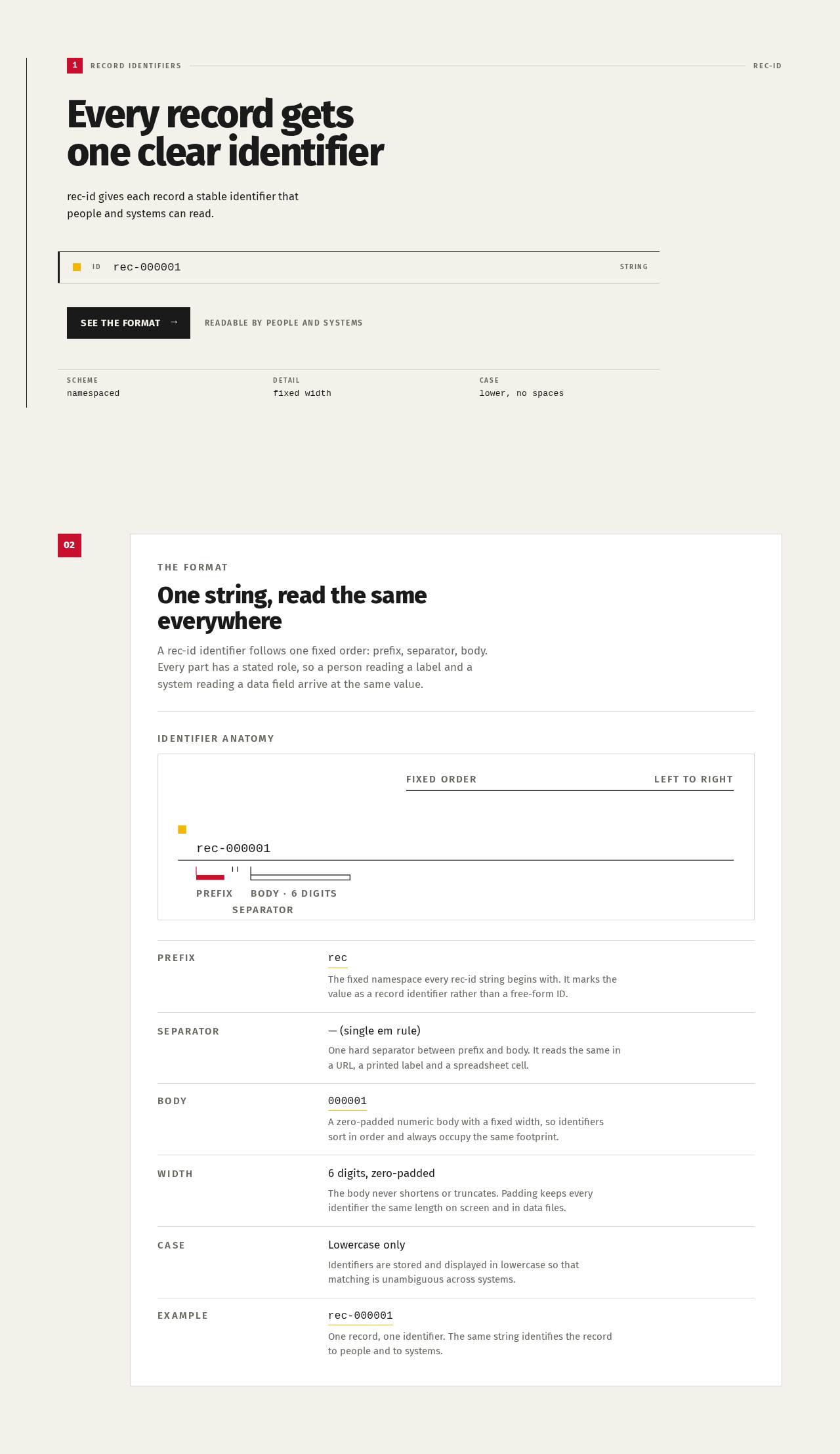
Every record gets one clear identifier
rec-id gives each record a stable identifier that people and systems can read.
rec000001Readable by people and systems
- Scheme
- namespaced
- Detail
- fixed width
- Case
- lower, no spaces
The format
One string, read the same everywhere
A rec-id identifier follows one fixed order: prefix, separator, body. Every part has a stated role, so a person reading a label and a system reading a data field arrive at the same value.
Identifier anatomy
- Prefix
- recThe fixed namespace every rec-id string begins with. It marks the value as a record identifier rather than a free-form ID.
- Separator
- — (single em rule)One hard separator between prefix and body. It reads the same in a URL, a printed label and a spreadsheet cell.
- Body
- 000001A zero-padded numeric body with a fixed width, so identifiers sort in order and always occupy the same footprint.
- Width
- 6 digits, zero-paddedThe body never shortens or truncates. Padding keeps every identifier the same length on screen and in data files.
- Case
- Lowercase onlyIdentifiers are stored and displayed in lowercase so that matching is unambiguous across systems.
- Example
- rec-000001One record, one identifier. The same string identifies the record to people and to systems.
No comments yet. Be the first!