raven-zip
 Pritesh Kumar Singh
go through this all zip file this is the frontend code of the project i just need you to carefully analyse each and every folder and files
Comments (0)
Sign in to leave a comment
Project Tasks36
Implement Theme and Structure
As a developer, I want the scaffold pages to visually match the mock-design JSX pages (Home, Login, Results, Search, Dashboard, Title, Records) so that the application has a consistent and polished appearance from the start. This task covers applying the design system tokens, layout structure, typography, spacing, and component hierarchy from all available mock-design pages into the existing scaffold. This task must be completed independently before any other frontend work begins.
Build Database Schema Migrations
As a data engineer, I want well-defined database schemas for MySQL and MongoDB covering records, title rules, legends, regions, filters, users, and preferences so that all API layers have a stable and consistent data foundation. Create migration scripts, indexes for search performance, and seed data for default regions (India default) and filter categories.
Configure API Gateway Routing
As a DevOps engineer, I want all FastAPI routes organized under versioned prefixes (/api/v1/) with CORS configured for the React frontend origin so that the frontend and backend communicate reliably in all environments. Set up the FastAPI application factory, router registration, CORS middleware, and environment-based configuration for dev, staging, and production.
Align Colors and Theme
As a UI/UX Designer, I want all scaffold and newly created pages to share a unified color palette, typography scale, and theme tokens so that the raven-zip application feels visually cohesive across every route. This includes defining CSS variables or a theme config, applying consistent primary/secondary/accent colors, dark/light mode tokens if applicable, and auditing every page for deviations.
Tech Lead Architecture Review
As a Tech Lead, I want to review the overall system architecture (frontend routing, backend API design, database schema, AI integration points, and WCAG compliance strategy) before the first integration milestone so that technical risks are identified and resolved early. Produce a review document covering potential bottlenecks, security considerations, and AI model fallback strategies.
Build Public Search API
As a guest or registered user, I want a FastAPI endpoint that accepts search queries and filter parameters (community, city, state, country, global, region) without requiring authentication so that public records can be discovered freely. Implement full-text search, filter chaining, pagination, and sorting. Integrate with MySQL/MongoDB as the data source.
Build Record Detail API
As a user viewing a record, I want a FastAPI endpoint that returns the full detail of a single record including title rules and legends so that the Record Detail page can render complete and accurate information. Implement GET /records/{id} with title rules and legends nested in the response, supporting both authenticated and unauthenticated access.
Build Region and Filters API
As a frontend developer, I want FastAPI endpoints that return all available regions (with India as the default) and the full filter taxonomy (community, city, state, country, global) so that the Search and Home pages can populate their filter controls dynamically. Implement GET /regions and GET /filters with hierarchical structure and active/inactive status.
Build Admin Records API
As an admin, I want FastAPI CRUD endpoints for managing records so that I can create, read, update, and delete records and their title rules through the Records Management page. Implement POST /admin/records, GET /admin/records, PUT /admin/records/{id}, DELETE /admin/records/{id}, and PUT /admin/records/{id}/title-rules with role-based access control.
Build Admin Filters API
As an admin, I want FastAPI CRUD endpoints for managing filter categories so that I can keep the search filter taxonomy accurate and current. Implement POST /admin/filters, GET /admin/filters, PUT /admin/filters/{id}, and DELETE /admin/filters/{id} with validation to prevent orphaned region references.
Build User Preferences API
As a registered user, I want FastAPI endpoints to fetch and persist my profile preferences (default region, saved filters, display settings) so that my personalization is stored server-side and available across devices. Implement GET /users/me/preferences and PUT /users/me/preferences with schema validation.
Build Activity Monitoring API
As an admin, I want FastAPI endpoints that surface platform activity metrics (search volume, active users, record views, error rates) so that the Dashboard Overview can display real-time and historical monitoring data. Implement GET /admin/activity with time-range filters and aggregation support.
Build Home Page UI
As a guest or registered user, I want to land on a visually engaging Home page featuring an interactive galaxy map and region-based record browsing so that I can immediately explore public records without logging in. Implement the galaxy map component, region selector (default: India), featured records carousel, and quick-search entry point exactly as specified in the Home v1 mock-design.
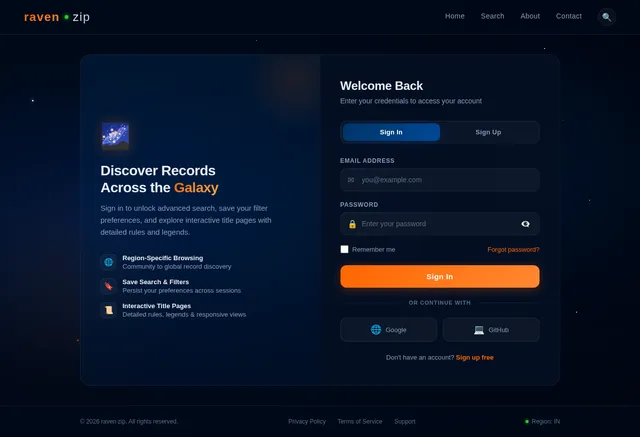
Build Login Page UI
As a registered user or admin, I want the Login page to match the Login v1 mock-design so that I can authenticate securely through a polished interface. Implement form layout, input validation states, error messaging, and navigation links (e.g., to Signup) as shown in the design. Wire up to the existing auth scaffold without recreating auth logic.
Build Signup Page UI
As a new visitor, I want the Signup page scaffold to be styled consistently with the rest of the application so that the registration experience feels native and trustworthy. Apply the theme, layout, and component patterns from the design system to the existing signup scaffold without recreating authentication logic.
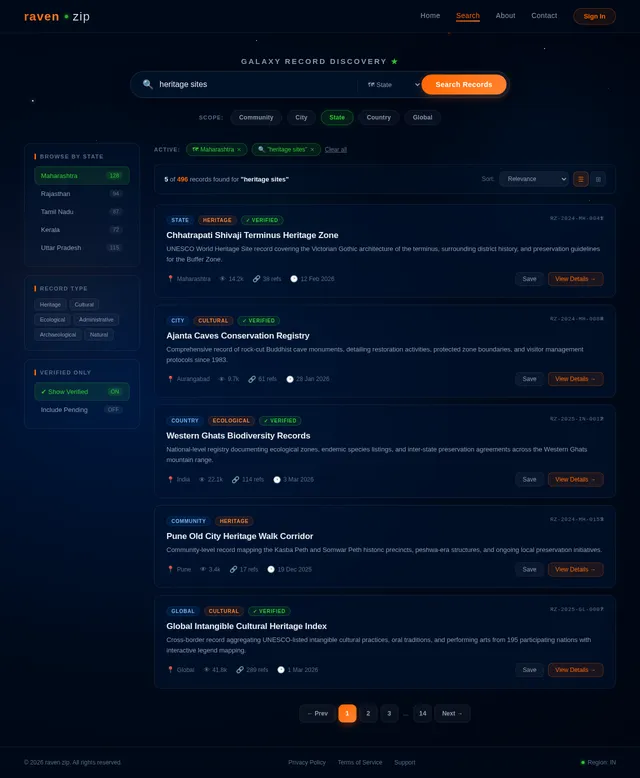
Build Search Page UI
As a guest or registered user, I want a dedicated Search page with advanced filter controls (community, city, state, country, global) so that I can narrow down public records precisely. Implement the search bar, filter panel, region selector, and submit action as defined in the Search v1 mock-design. Registered users should see additional advanced filter options.
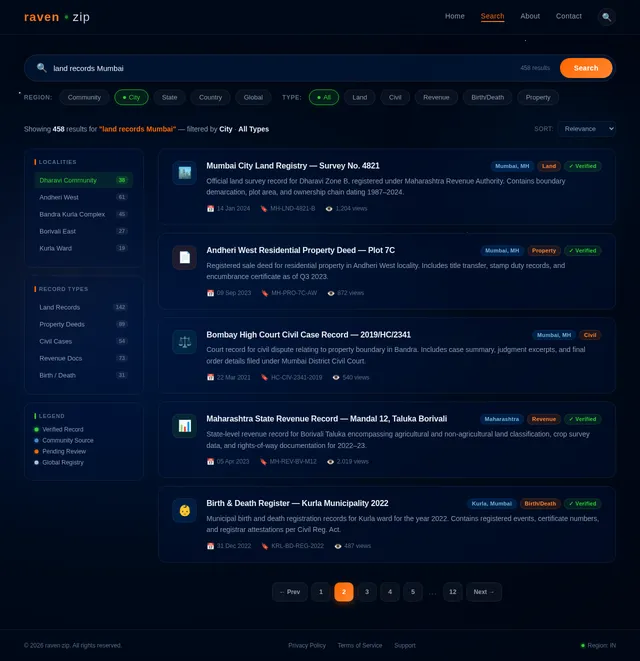
Build Results Page UI
As a user who has performed a search, I want to see a Results page displaying matching record cards with pagination so that I can browse through search outcomes efficiently. Implement result cards, sort controls, pagination, empty-state handling, and loading skeletons as specified in the Results v1 mock-design.
Build Title Record Detail UI
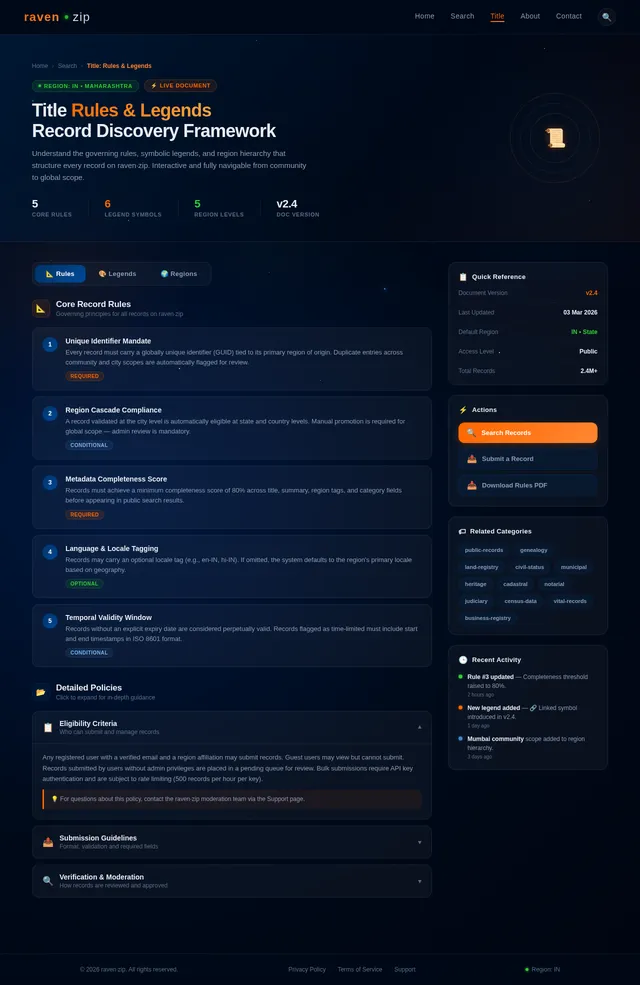
As a guest or registered user, I want to view a Record Detail page showing comprehensive title rules and legends for a specific record so that I can fully understand its context. Implement the title rules section, legends panel, breadcrumb navigation, and related metadata display as shown in the Title v1 mock-design.
Build Dashboard Overview UI
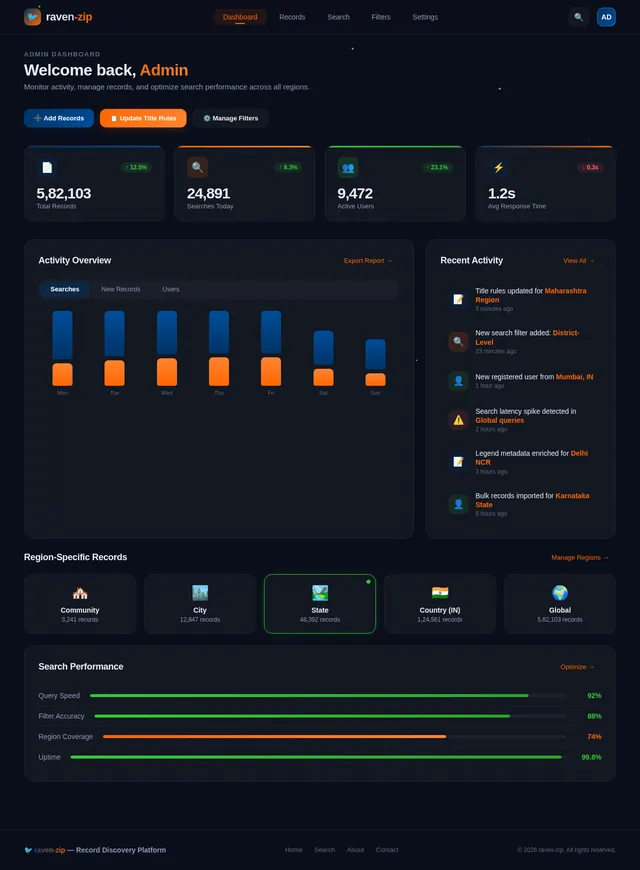
As an admin, I want the Dashboard Overview page to match the Dashboard v1 mock-design so that I can monitor platform activity, key metrics, and quick-access controls in one place. Implement metric cards, activity feed, navigation sidebar, and summary charts as defined in the design.
Build Records Management UI
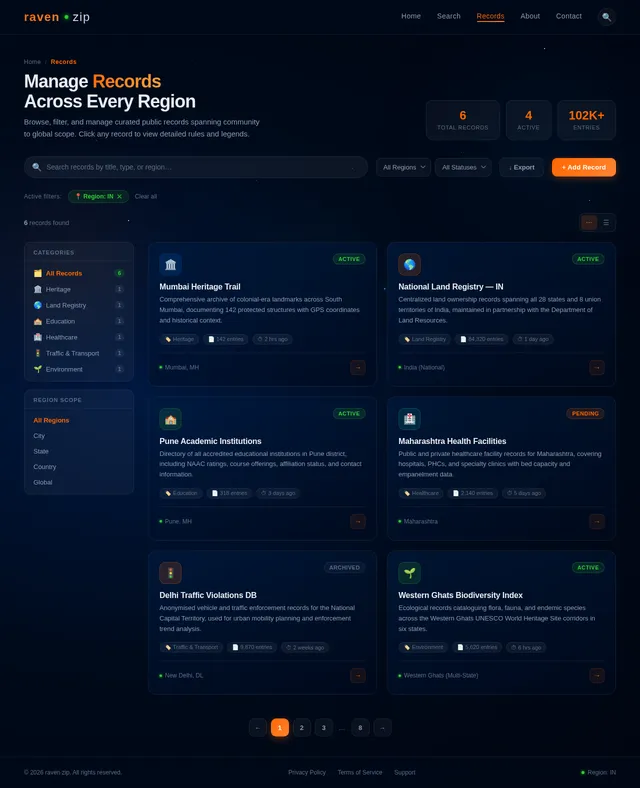
As an admin, I want a Records Management page that matches the Records v1 mock-design so that I can view, create, edit, and update title rules for all records in the system. Implement the records table, action buttons, inline editing, title rule update form, and confirmation dialogs as specified in the design.
Build Settings Page UI
As an admin, I want the Dashboard Settings page scaffold to be fully styled and functional so that I can configure platform performance optimizations (caching, AI model selection, query limits). Apply the design system to the existing dashboard/settings scaffold and implement the settings form, toggle controls, and save mechanisms.
Design Profile Page UI
As a registered user, I want a Profile page where I can view and save my browsing preferences (default region, filter presets, display settings) so that my future sessions are personalized. Since no design exists yet, create the UX wireframe and high-fidelity JSX mock following the established raven-zip design system.
Design Filters Management UI
As an admin, I want a Filters Management page where I can create, edit, and remove searchable filter categories (community, city, state, country) so that the search experience remains accurate and up to date. Since no design exists, produce a UX wireframe and high-fidelity JSX mock following the raven-zip design system.
Implement AI Search Enhancement
As a user performing a search, I want the search engine to leverage AI models (GPT, Claude, Google Nano) to improve query understanding, suggest related terms, and rank results by semantic relevance so that I can find records even with imprecise queries. Implement an AI-assisted query expansion and re-ranking layer in the backend that integrates with the Public Search API via Litellm routing.
Implement AI Title Rule Suggestions
As an admin, I want the Records Management page to offer AI-generated title rule suggestions when I create or update a record so that standardizing records is faster and more consistent. Integrate an AI model endpoint into the Admin Records API that analyzes record metadata and proposes title rules using GPT, Claude, or Google Nano via Litellm/Langchain.
Build Profile Page UI
As a registered user, I want the Profile page to be fully implemented in React so that I can update my preferences, default region, and saved filter configurations. Implement form controls, preference toggles, save/cancel actions, and success/error feedback based on the design produced in the design task.
Build Filters Management UI
As an admin, I want the Filters Management page implemented in React so that I can manage all filterable dimensions of the search index. Implement the filters table, add/edit/delete modals, region hierarchy controls, and status toggles based on the design created in the design task.
Build Galaxy Map Component
As a visitor on the Home page, I want to see an interactive galaxy map that visualizes record distribution across regions so that I can intuitively explore records geographically. Build a standalone React component using a canvas or SVG-based library, supporting hover tooltips, click-to-filter interactions, and animated transitions. Connect to the Region API for live data.
Integrate Search API Frontend
As a user on the Search or Home page, I want the frontend to call the Public Search API and display live results so that search interactions produce real data instead of mocks. Wire the Search page filters and Home page quick-search to GET /search, handle loading, error, and empty states, and pass results to the Results page.
Integrate Record Detail API
As a user on the Record Detail page, I want the frontend to fetch title rules and legends from the Record Detail API so that the page displays accurate live record data. Wire the Title/Detail page to GET /records/{id}, handle loading skeletons, error boundaries, and display all nested title rule and legend fields.
Integrate Regions Filters API
As a user browsing the Home or Search page, I want the region selector and filter dropdowns to be populated dynamically from the Region and Filters API so that available options always reflect the current data. Wire GET /regions and GET /filters to the Home page region picker, Search page filter panel, and Results page filter sidebar.
Integrate Admin Records API
As an admin, I want the Records Management page to be fully connected to the Admin Records API so that I can perform live CRUD operations and title rule updates. Wire the records table, add/edit/delete actions, and title rule form to the appropriate endpoints, with optimistic UI updates and error rollback.
Integrate Dashboard Activity API
As an admin, I want the Dashboard Overview page to display live activity metrics fetched from the Activity Monitoring API so that I can make informed operational decisions. Wire the metric cards and activity feed to GET /admin/activity with configurable time-range selectors and auto-refresh intervals.
Integrate Admin Filters API
As an admin, I want the Filters Management page to call the Admin Filters API so that filter taxonomy changes take effect immediately in the platform. Wire the filters table, add/edit/delete modals to the CRUD endpoints, with validation feedback and success notifications.
Integrate Profile Preferences API
As a registered user, I want the Profile page to load and save my preferences via the User Preferences API so that my settings persist across sessions. Wire GET /users/me/preferences on page load and PUT /users/me/preferences on form submit, with dirty-state detection and unsaved-changes warnings.
Implement WCAG Accessibility Audit
As a user with accessibility needs, I want all pages to meet WCAG 2.1 AA standards so that the raven-zip platform is usable with assistive technologies. Conduct an audit of all implemented pages (Home, Login, Search, Results, Title, Dashboard, Records, Profile, Signup, Settings, Filters), document violations, and implement fixes including ARIA labels, keyboard navigation, color contrast, and focus management.
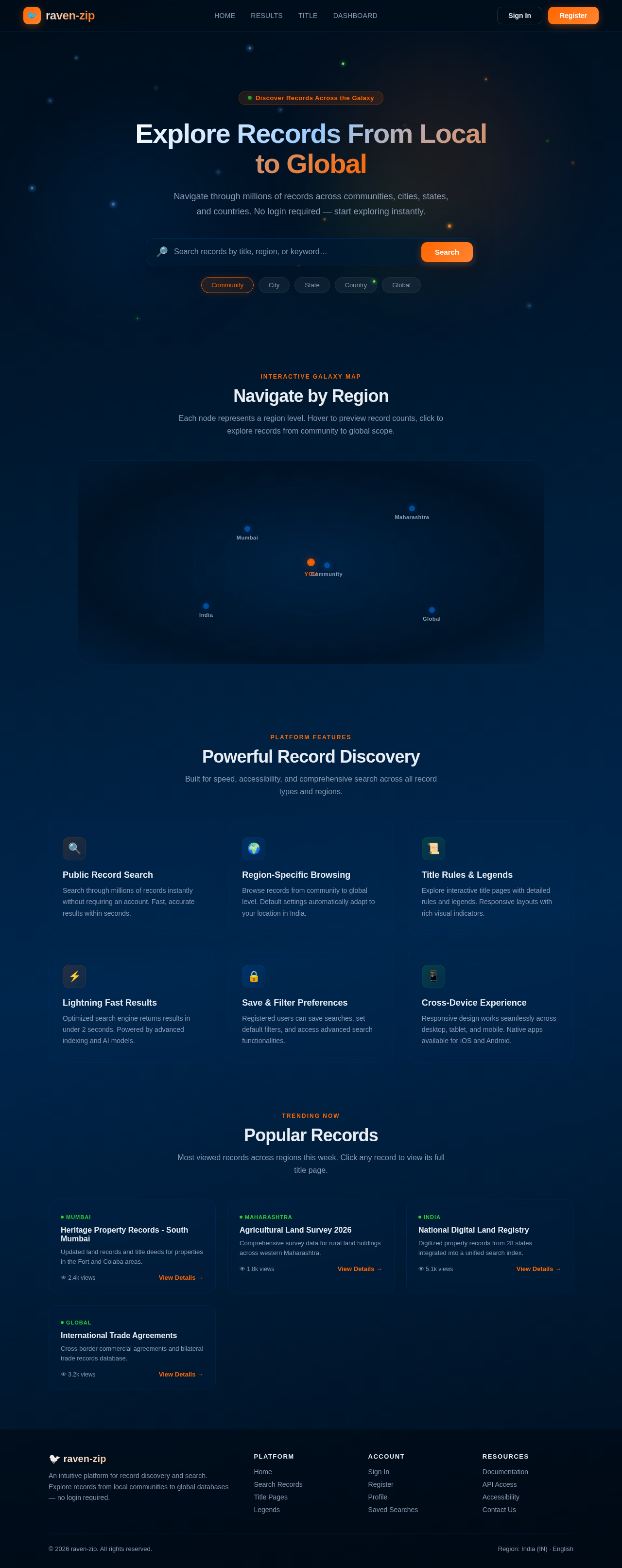
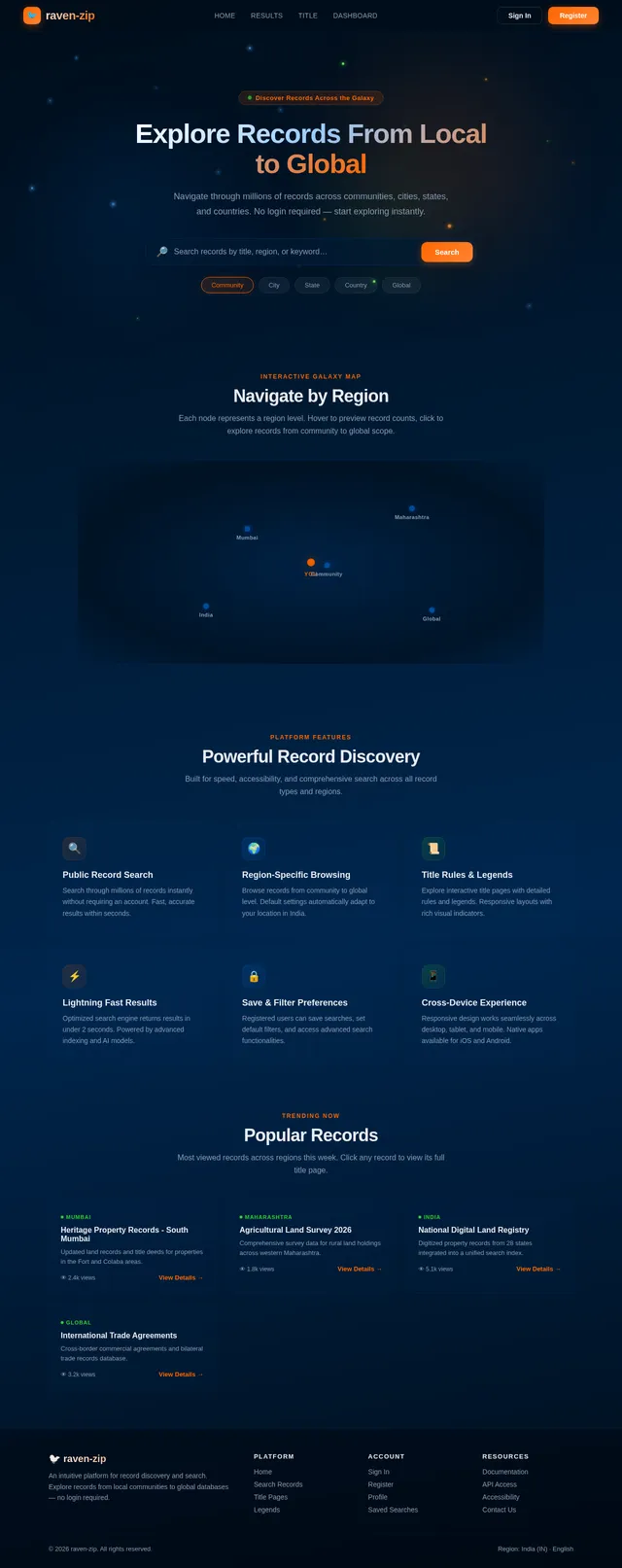
Explore Records From Local to Global
Navigate through millions of records across communities, cities, states, and countries. No login required — start exploring instantly.
Navigate by Region
Each node represents a region level. Hover to preview record counts, click to explore records from community to global scope.
Powerful Record Discovery
Built for speed, accessibility, and comprehensive search across all record types and regions.
Public Record Search
Search through millions of records instantly without requiring an account. Fast, accurate results within seconds.
Region-Specific Browsing
Browse records from community to global level. Default settings automatically adapt to your location in India.
Title Rules & Legends
Explore interactive title pages with detailed rules and legends. Responsive layouts with rich visual indicators.
Lightning Fast Results
Optimized search engine returns results in under 2 seconds. Powered by advanced indexing and AI models.
Save & Filter Preferences
Registered users can save searches, set default filters, and access advanced search functionalities.
Cross-Device Experience
Responsive design works seamlessly across desktop, tablet, and mobile. Native apps available for iOS and Android.
Popular Records
Most viewed records across regions this week. Click any record to view its full title page.
No comments yet. Be the first!