rapid-meditrack
 Sarang Rai
I want to build meditrack pwa using Mern
Comments (0)
Sign in to leave a comment
System Requirements
System Requirements Document (SRD)
Project Name: rapid-meditrack
1. Introduction
rapid-meditrack is a Progressive Web Application (PWA) designed to streamline healthcare management for both patients and doctors. Developed using the MERN stack, the application aims to provide a responsive, lightweight, and modern solution for appointment booking, health record tracking, and schedule management. This document outlines the system requirements for rapid-meditrack, incorporating the functionality pre-resolved by the API supervisor.
As Sarang Rai is based in India, the system will be tailored to local healthcare standards, timezone (IST), and currency (INR). The application will prioritize accessibility and ease of use for both user personas.
2. System Overview
rapid-meditrack is a dual-purpose healthcare management tool that serves two primary user personas: patients and doctors. The application will enable patients to book appointments, track health records, and receive notifications about upcoming consultations. Doctors will be able to manage their schedules, update patient records, and communicate with patients effectively.
The system will leverage the MERN stack (MongoDB, Express.js, React, Node.js) for its development, ensuring scalability, flexibility, and seamless integration of features. The API supervisor will pre-resolve options to optimize functionality and performance.
3. Functional Requirements
Patient Features:
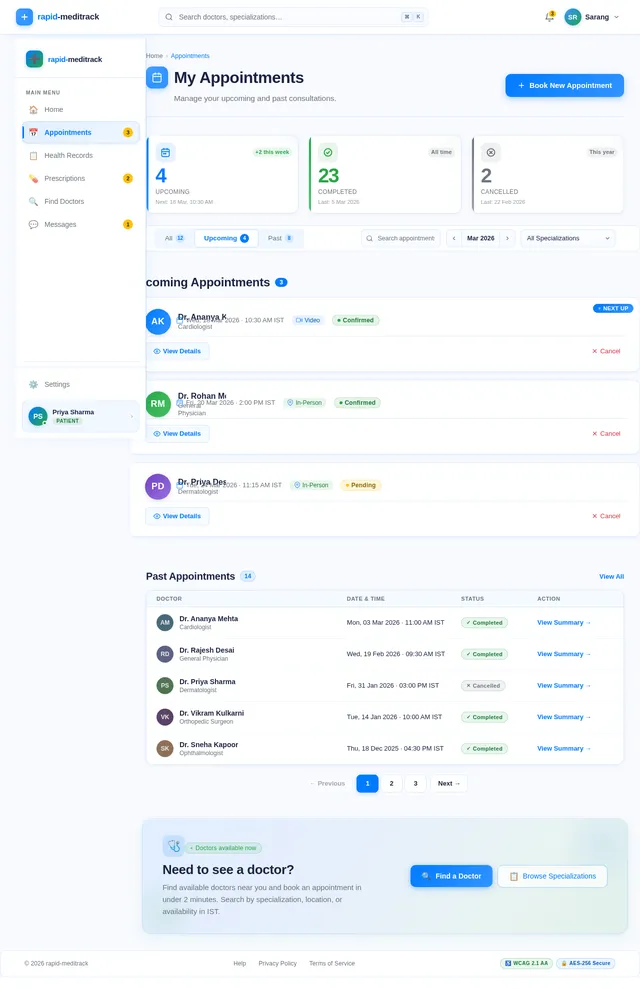
- As a Patient, I should be able to book appointments with doctors.
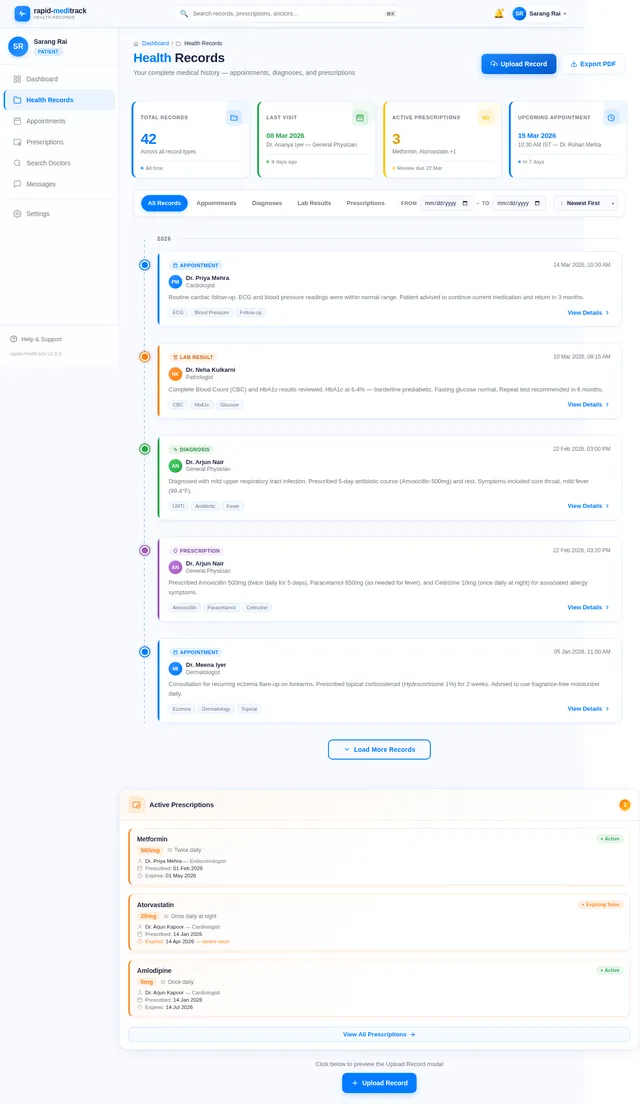
- As a Patient, I should be able to track my health records and view historical data.
- As a Patient, I should receive notifications for upcoming appointments.
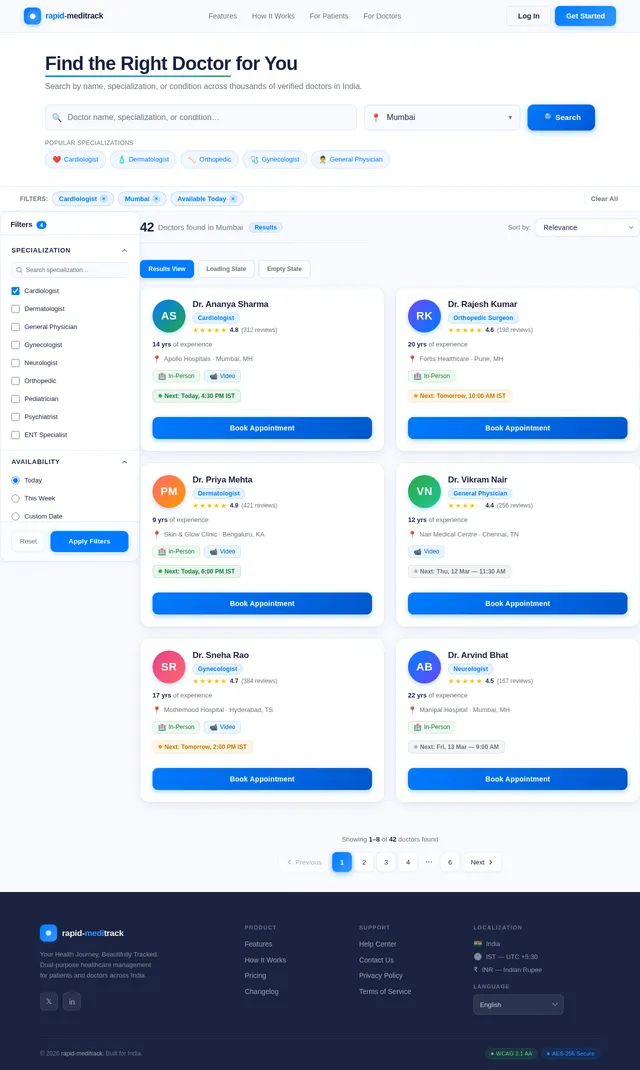
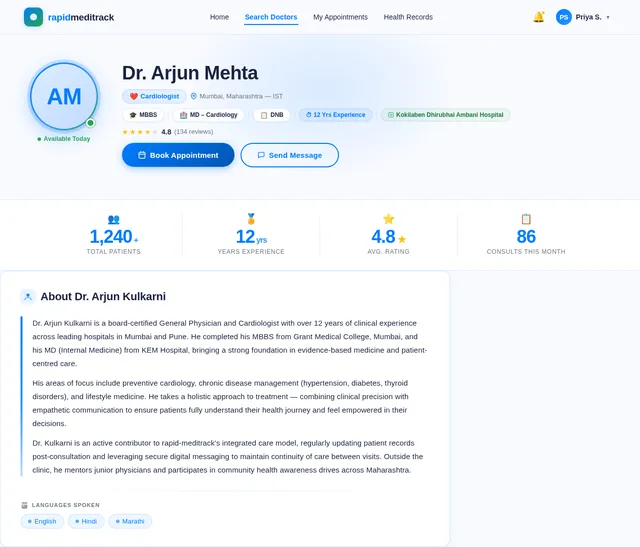
- As a Patient, I should be able to search for doctors based on specialization and location.
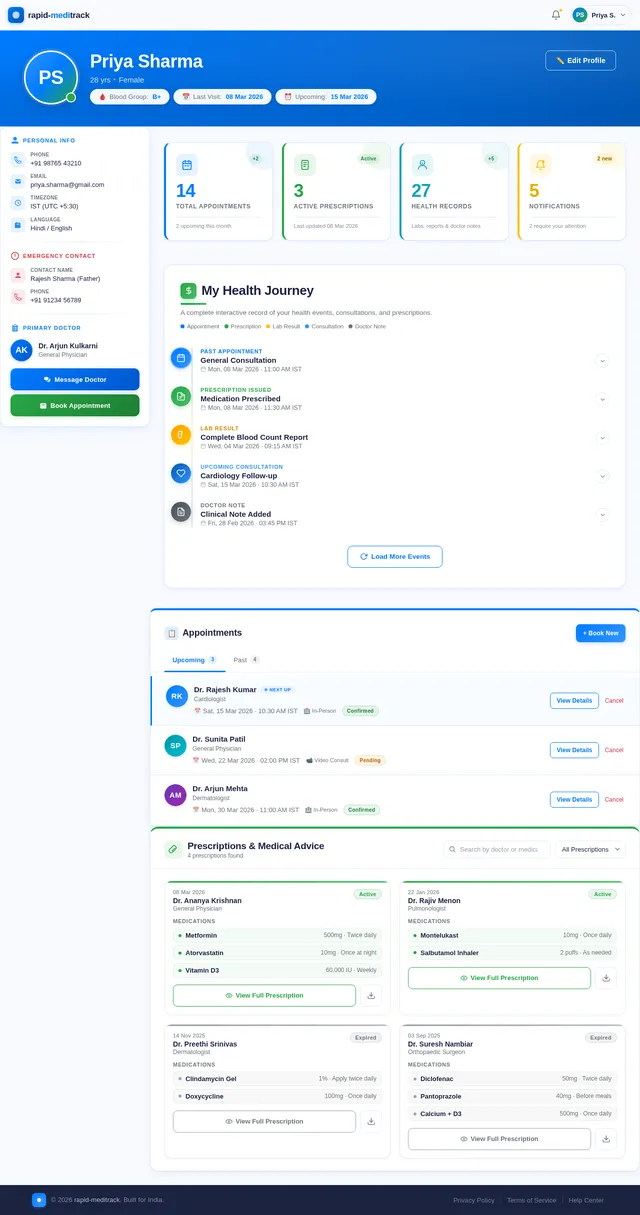
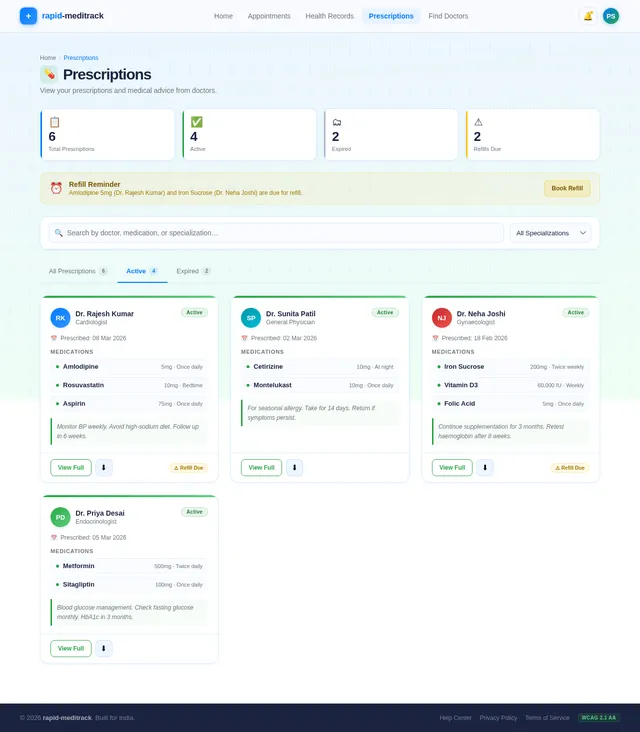
- As a Patient, I should be able to view prescriptions and medical advice provided by doctors.
Doctor Features:
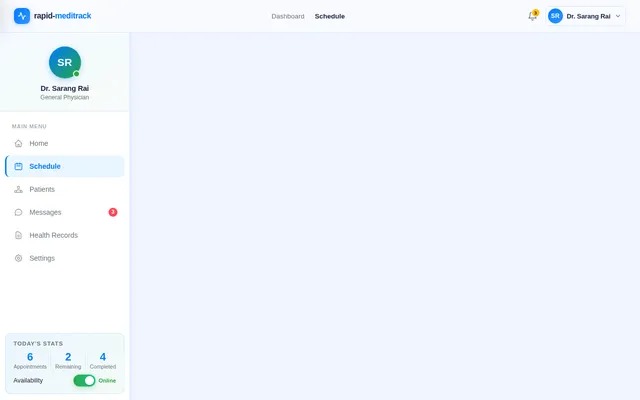
- As a Doctor, I should be able to manage my schedule and availability.
- As a Doctor, I should be able to update patient health records after consultations.
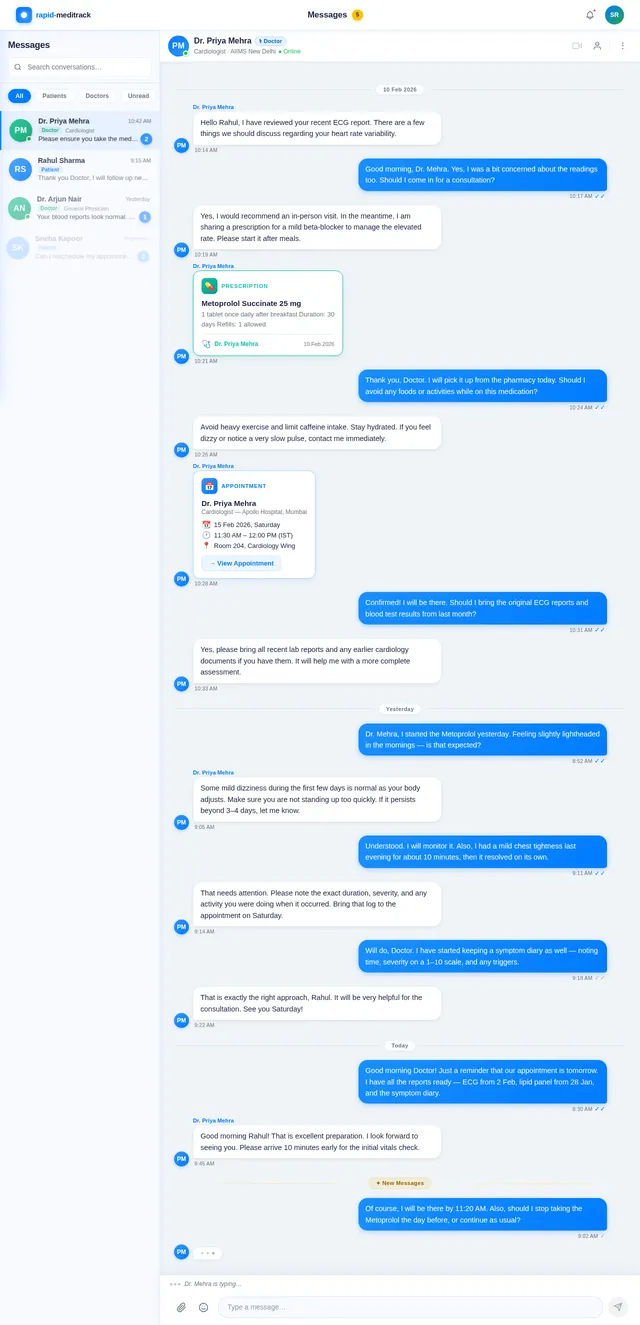
- As a Doctor, I should be able to communicate with patients through secure messaging.
- As a Doctor, I should receive notifications for upcoming appointments.
- As a Doctor, I should be able to view patient history and prescriptions.
4. User Personas
Patient:
- Description: Individuals seeking healthcare services.
- Primary Goals: Book appointments, track health records, receive notifications, and access prescriptions.
- Technical Proficiency: Basic familiarity with smartphones and web applications.
Doctor:
- Description: Healthcare professionals providing consultations and medical advice.
- Primary Goals: Manage schedules, update patient records, communicate securely, and access patient history.
- Technical Proficiency: Moderate familiarity with web applications and scheduling tools.
5. Visuals Colors and Theme
The color scheme for rapid-meditrack will focus on creating a calming and professional aesthetic suitable for healthcare applications:
- Primary Colors:
- Blue (#007BFF) for trust and reliability.
- Green (#28A745) for health and vitality.
- Secondary Colors:
- White (#FFFFFF) for cleanliness and simplicity.
- Gray (#6C757D) for neutrality and balance.
- Accent Colors:
- Orange (#FFC107) for notifications and highlights.
The theme will emphasize simplicity, clarity, and accessibility, ensuring that users can navigate the application effortlessly.
6. Signature Design Concept
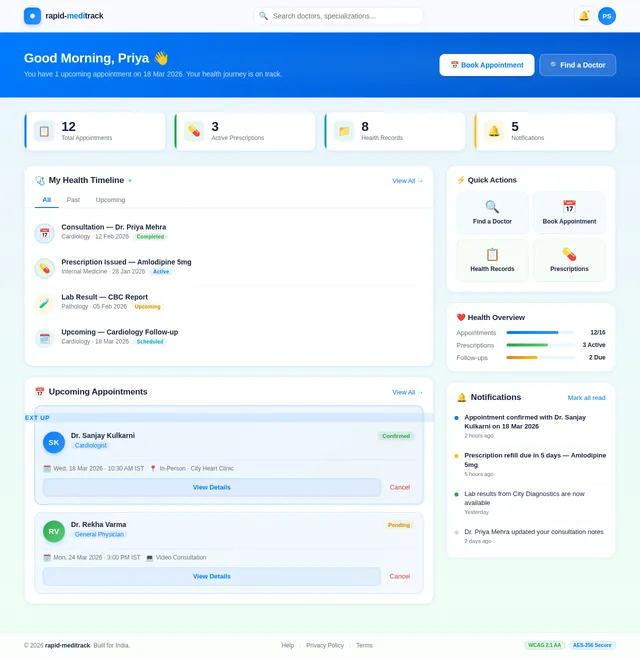
The homepage of rapid-meditrack will feature an interactive health timeline.
Concept Details:
-
Visual Design:
The homepage will display a dynamic timeline that visually represents a user's health journey. Patients will see their past appointments, prescriptions, and upcoming consultations as clickable nodes on the timeline. Doctors will see their schedule and patient interactions similarly. -
Animations:
Each node on the timeline will pulse gently to indicate interactivity. Hovering over a node will expand it to show detailed information, such as appointment time, doctor name, or prescription details. -
Transitions:
Smooth scrolling and zooming effects will allow users to navigate through the timeline effortlessly. Clicking on a node will open a modal with detailed information. -
Micro-interactions:
Notifications will appear as subtle pop-ups integrated into the timeline, ensuring users never miss an update.
This unique design will make the homepage visually engaging while providing immediate access to critical information.
7. Non-Functional Requirements
- Performance: The application must load within 2 seconds on standard devices.
- Scalability: The system should support up to 100,000 users concurrently.
- Security: All data must be encrypted using AES-256 standards.
- Accessibility: The application must comply with WCAG 2.1 Level AA standards.
- Localization: Support for Indian languages (e.g., Hindi, Marathi) and English.
8. Tech Stack
- Frontend: React for Web.
- Backend: Node.js with Express.js.
- Database: MongoDB for NoSQL storage.
- AI Models: Not applicable for this version.
- AI Tools: Not applicable for this version.
- Local Orchestration: Docker and docker-compose for containerization.
- Server-side Orchestration: Kubernetes for scalability and management.
9. Assumptions and Constraints
- The application will primarily target users in India, adhering to local healthcare regulations.
- Internet connectivity is required for full functionality.
- The system will not support offline mode in the initial version.
- The API supervisor will pre-resolve options to optimize backend functionality.
10. Glossary
- PWA: Progressive Web Application, a type of application that uses web technologies to deliver a native app-like experience.
- MERN Stack: A JavaScript-based technology stack comprising MongoDB, Express.js, React, and Node.js.
- AES-256: Advanced Encryption Standard with 256-bit keys, used for secure data encryption.
- WCAG: Web Content Accessibility Guidelines, standards for making web content accessible to people with disabilities.
End of Document
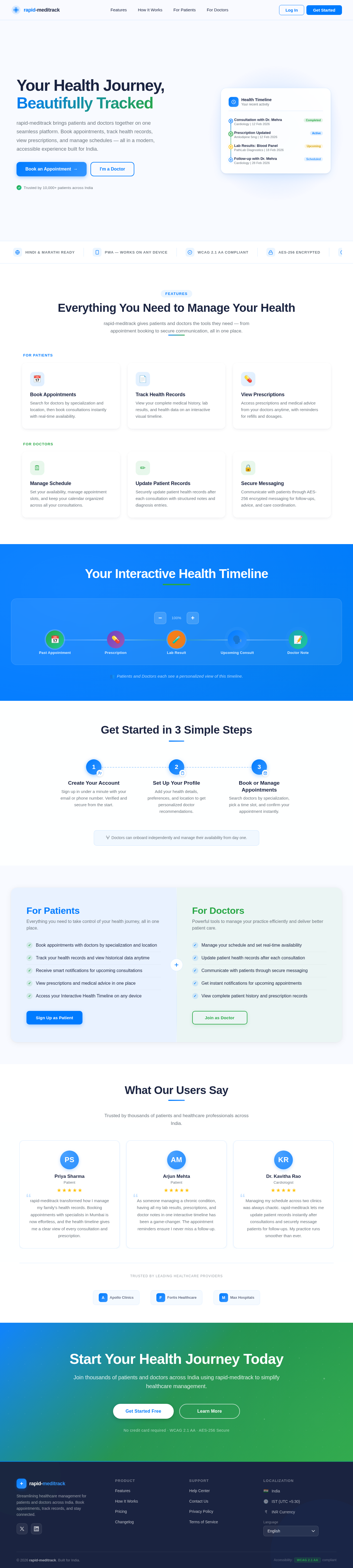
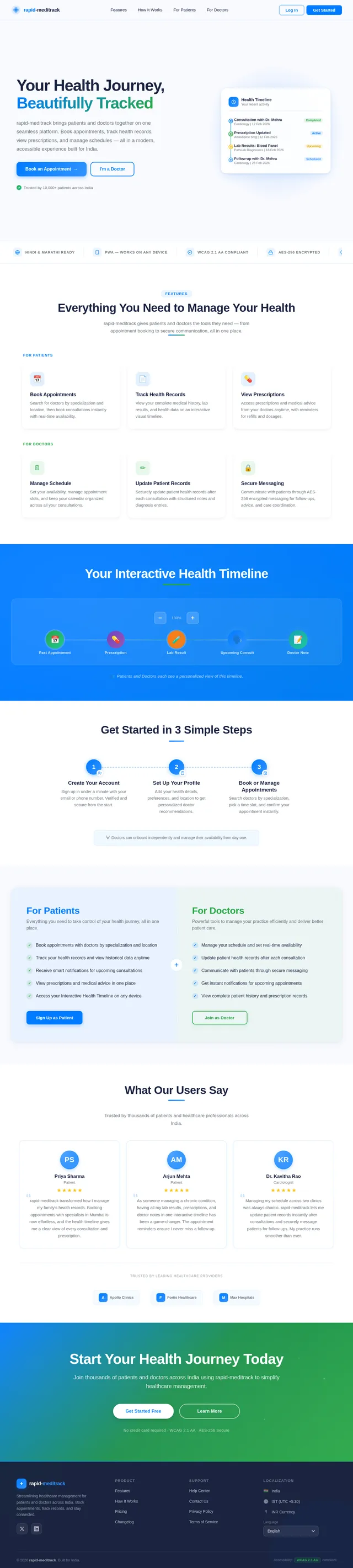
Your Health Journey, Beautifully Tracked
rapid-meditrack brings patients and doctors together on one seamless platform. Book appointments, track health records, view prescriptions, and manage schedules — all in a modern, accessible experience built for India.
Health Timeline
Your recent activity
Consultation with Dr. Mehra
Prescription Updated
Lab Results: Blood Panel
Follow-up with Dr. Mehra
Everything You Need to Manage Your Health
rapid-meditrack gives patients and doctors the tools they need — from appointment booking to secure communication, all in one place.
Book Appointments
Search for doctors by specialization and location, then book consultations instantly with real-time availability.
Track Health Records
View your complete medical history, lab results, and health data on an interactive visual timeline.
View Prescriptions
Access prescriptions and medical advice from your doctors anytime, with reminders for refills and dosages.
Manage Schedule
Set your availability, manage appointment slots, and keep your calendar organized across all your consultations.
Update Patient Records
Securely update patient health records after each consultation with structured notes and diagnosis entries.
Secure Messaging
Communicate with patients through AES-256 encrypted messaging for follow-ups, advice, and care coordination.
Your Interactive Health Timeline
General Checkup with Dr. Mehra
Routine health checkup completed. Blood pressure normal at 120/80. Follow-up recommended in 6 months.
Medication for Seasonal Allergy
Cetirizine 10mg once daily for 14 days. Nasal spray as needed. Avoid dust exposure.
Complete Blood Count (CBC)
All parameters within normal range. Hemoglobin 14.2 g/dL, WBC 7,200. No abnormalities detected.
Cardiology Consultation
Scheduled follow-up for annual heart health review. Bring previous ECG reports and current medications list.
Post-Visit Summary
Patient in good overall health. Recommended daily 30-min walks and balanced diet. Vitamin D supplementation advised.
Patients and Doctors each see a personalized view of this timeline.
Get Started in 3 Simple Steps
Create Your Account
Sign up in under a minute with your email or phone number. Verified and secure from the start.
Set Up Your Profile
Add your health details, preferences, and location to get personalized doctor recommendations.
Book or Manage Appointments
Search doctors by specialization, pick a time slot, and confirm your appointment instantly.
For Patients
Everything you need to take control of your health journey, all in one place.
- ✓Book appointments with doctors by specialization and location
- ✓Track your health records and view historical data anytime
- ✓Receive smart notifications for upcoming consultations
- ✓View prescriptions and medical advice in one place
- ✓Access your Interactive Health Timeline on any device
For Doctors
Powerful tools to manage your practice efficiently and deliver better patient care.
- ✓Manage your schedule and set real-time availability
- ✓Update patient health records after each consultation
- ✓Communicate with patients through secure messaging
- ✓Get instant notifications for upcoming appointments
- ✓View complete patient history and prescription records
What Our Users Say
Trusted by thousands of patients and healthcare professionals across India.
Priya Sharma
Patient
rapid-meditrack transformed how I manage my family's health records. Booking appointments with specialists in Mumbai is now effortless, and the health timeline gives me a clear view of every consultation and prescription.
Arjun Mehta
Patient
As someone managing a chronic condition, having all my lab results, prescriptions, and doctor notes in one interactive timeline has been a game-changer. The appointment reminders ensure I never miss a follow-up.
Dr. Kavitha Rao
Cardiologist
Managing my schedule across two clinics was always chaotic. rapid-meditrack lets me update patient records instantly after consultations and securely message patients for follow-ups. My practice runs smoother than ever.
Start Your Health Journey Today
Join thousands of patients and doctors across India using rapid-meditrack to simplify healthcare management.
No credit card required · WCAG 2.1 AA · AES-256 Secure
No comments yet. Be the first!