Browse the range
Move through the whole shelf.
Every lip, cheek, eye and nail colour sits in one place. Scroll the range and compare the shades side by side.
 Hussain Bekhushi
I want to build website for cosmetics products

Sign in to leave a comment
This document specifies a website for cosmetics products: a public storefront where shoppers browse a range of cosmetics items and inspect individual products, paired with a private workspace where the store owner curates the product catalog that shoppers see.
The product intent is a colour-driven beauty storefront with a point of view — playful, confident, saturated — rather than a clinical skincare or restrained-luxury template. The audience is twofold:
The website is delivered as a first-party web application with its own identity for the store owner, a public catalog surface for shoppers, and backend persistence for cosmetics product listings and their details.
The rapid-cosmetics website has two clearly separated halves that share one brand and one catalog of truth:
Identity is application-owned. The store owner establishes identity through self-service enrollment on Sign Up and regains access through returning verification on Login. Shoppers browse the public surfaces without an account.
Actors
Accepted behavior in scope
Narrow exclusions
The website is delivered as a first-party application. The public storefront — Landing, Products, and Product Details — is reachable anonymously and requires no account. The store-owner workspace — Catalog and Product Editor — is owned by the application and restricted to the signed-in store owner, because catalog content is durable, shared, and must remain bound to the correct owner across sessions.
Identity is application-owned and self-service: there is no provisioning or invitation boundary in the accepted scope, so the store owner establishes identity on first use through Sign Up and regains access through Login. These two access surfaces are themselves anonymously reachable, since a protected destination cannot own the interaction that establishes access to itself.
Everything described in this document is current. No future-horizon capabilities are accepted; anything not listed above is out of scope for this generation.
No reference directive in this project declares a content_source. There is no verified external factual content to inventory, and no inventory is included.
FR-1 — Public storefront for cosmetics products (explicit) As a Shopper, I should be able to visit a public website that presents a range of cosmetics products, so that I can see what the storefront offers.
FR-2 — Browse the cosmetics product range (required_inference) As a Shopper, I should be able to browse the available cosmetics products as a listing, so that I can survey the range before choosing what to look at.
FR-3 — View an individual cosmetics product and its details (required_inference) As a Shopper, I should be able to open a single cosmetics product and read its details, so that I can evaluate it before deciding what to buy.
FR-4 — Self-service enrollment for the store owner (required_inference) As a Store Owner, I should be able to enroll myself on first use, so that I can gain authorized control of the durable catalog.
FR-5 — Returning verification for the store owner (required_inference) As a Store Owner, I should be able to sign in again on a later visit, so that I can regain access to catalog management.
FR-6 — Review the durable product catalog (required_inference) As a Store Owner, I should be able to review the current catalog of cosmetics product listings, so that I can see what the storefront is presenting.
FR-7 — Add a cosmetics product listing (required_inference) As a Store Owner, I should be able to add a new cosmetics product listing with its details, so that the storefront presents an accurate and current range.
FR-8 — Update an existing cosmetics product listing (required_inference) As a Store Owner, I should be able to update an existing cosmetics product listing and its details, so that the storefront stays accurate as the range changes.
FR-9 — Durable persistence of cosmetics product listings and their details (required_inference) As the application, I should persist cosmetics product listings and their details in backend storage, so that catalog content survives across sessions and is served consistently to both the storefront and the workspace.
Product context. The Shopper arrives at the cosmetics storefront without an account and without any prior relationship to the store. They are browsing colour, texture, and finish — the material of a cosmetics range — and they judge the storefront on whether the range is legible and the products are worth a closer look.
Primary goal. Find a suitable cosmetics product to purchase by moving through the range and evaluating individual items.
Distinct accepted responsibilities.
Relevant inputs and decisions. The Shopper's inputs are their own browsing choices: which category or filter to apply, which card to open, and which product to compare next. Their decision is which product, if any, is the one they want.
Interactions with other accepted participants. The Shopper never interacts with the Store Owner directly. Their interaction is indirect and one-directional: the Shopper reads the catalog content the Store Owner has published, and the accuracy of what they read depends entirely on the Store Owner's curation. The Shopper's experience is anonymous throughout — no account, no handoff, no shared state.
Observable success. The Shopper reaches a product whose details answer their question about it, and leaves the range having identified a suitable cosmetics product.
What makes this role different. The Shopper is a read-only, anonymous participant. They never create, change, or own durable state; every action they take is a read of content someone else authored. Their success is measured by finding, not by maintaining.
Product context. The Store Owner is the person building and running the cosmetics storefront. They are the sole author of the catalog that shoppers browse, and they work in a private workspace that is unmistakably the same brand as the public storefront but calmer and more legible.
Primary goal. Keep a live, accurate storefront that shoppers can browse, by presenting the product range and keeping catalog content current.
Distinct accepted responsibilities.
Relevant inputs and decisions. The Store Owner's inputs are the product facts they author — names, imagery, prices, categories, availability statuses, descriptions, specifications, and ingredient details. Their decisions are what belongs in the range, what each listing should say, and when a listing is accurate enough to save.
Interactions with other accepted participants. The Store Owner's work is the Shopper's experience. Every listing they save becomes content a Shopper reads on the public range; every detail they leave stale is a detail a Shopper reads as current. This is the only cross-persona relationship in the product, and it is asynchronous — the Store Owner never sees the Shopper, and the Shopper never sees the Store Owner.
Observable success. The catalog reflects the real range, the public storefront shows the Store Owner's latest saved values, and shoppers can browse an accurate product range.
What makes this role different. The Store Owner is the only participant who writes durable state and the only one whose work requires identity continuity. Their responsibilities are authoring and maintenance rather than discovery, and their access is restricted precisely because the content they own must remain bound to them across sessions.
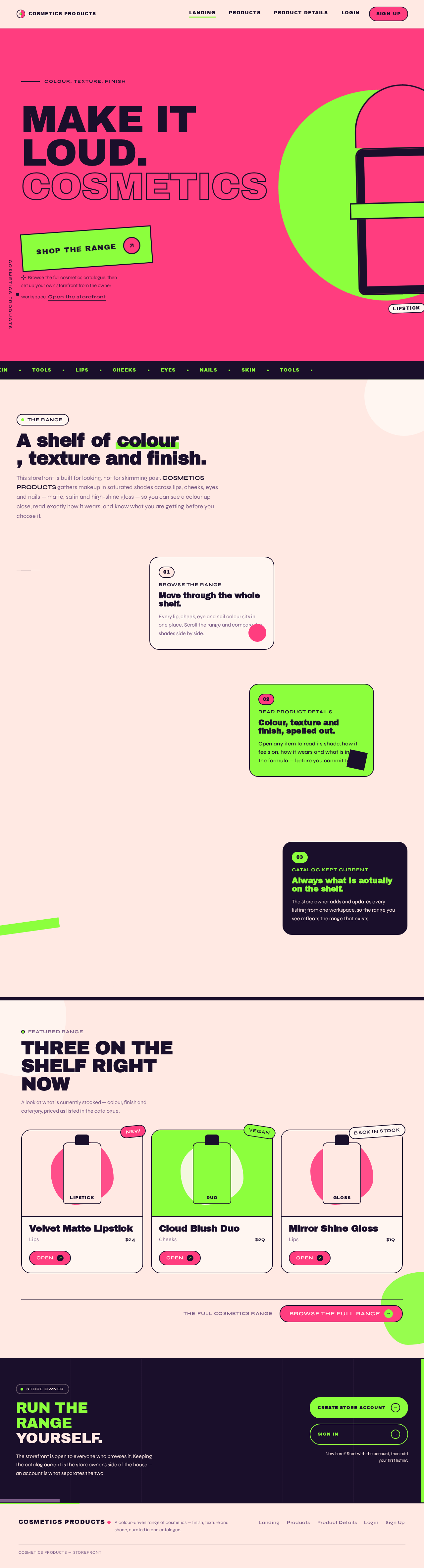
Colour, texture, finish
Browse the full cosmetics catalogue, then set up your own storefront from the owner workspace. Open the storefront
This storefront is built for looking, not for skimming past. COSMETICS PRODUCTS gathers makeup in saturated shades across lips, cheeks, eyes and nails — matte, satin and high-shine gloss — so you can see a colour up close, read exactly how it wears, and know what you are getting before you choose it.
Browse the range
Every lip, cheek, eye and nail colour sits in one place. Scroll the range and compare the shades side by side.
Read product details
Open any item to read its shade, how it feels on, how it wears and what is inside the formula — before you commit to it.
Catalog kept current
The store owner adds and updates every listing from one workspace, so the range you see reflects the range that exists.
A look at what is currently stocked — colour, finish and category, priced as listed in the catalogue.
Store owner
The storefront is open to everyone who browses it. Keeping the catalog current is the store owner’s side of the house — an account is what separates the two.
No comments yet. Be the first!