purple-ai
 Dr.Govindaraj Pandith T G
Need an AI powered electronic devise to test the soil with few inputs from the user such as geographical location, traditional crops etc suggest how soil is best suited for commercial crop and the treatment required if any.
Comments (0)
Sign in to leave a comment
System Requirements
System Requirements Document (SRD)
Project Name: purple-ai
1. Introduction
The purple-ai project aims to develop an AI-powered electronic device designed to assist individual farmers in optimizing their agricultural practices. By leveraging advanced AI technologies, this device will analyze soil samples with minimal user input, such as geographical location and traditional crops, and provide actionable insights on crop suitability and necessary treatments.
This document outlines the system requirements for the purple-ai project, ensuring the solution is tailored to the needs of farmers in India, where agriculture plays a vital role in the economy. The device will support both online and offline modes, making it accessible even in remote areas with limited connectivity.
2. System Overview
The purple-ai device is a portable, user-friendly solution for soil testing and analysis. It integrates AI capabilities to deliver real-time recommendations for commercial crop suitability and soil treatment. Key features include:
- Dual-mode operation: Online mode for advanced cloud-based analytics and offline mode for on-device AI processing.
- Built-in screen display: Provides instant feedback on soil test results.
- Printout capability: Generates a physical summary of soil test results for farmers to keep as a reference.
- User inputs: Geographical location, traditional crops, and other relevant data.
- Outputs: Crop suitability recommendations and treatment suggestions.
The device is designed to empower individual farmers by providing actionable insights, promoting sustainable farming practices, and improving crop yields.
3. Functional Requirements
As story points:
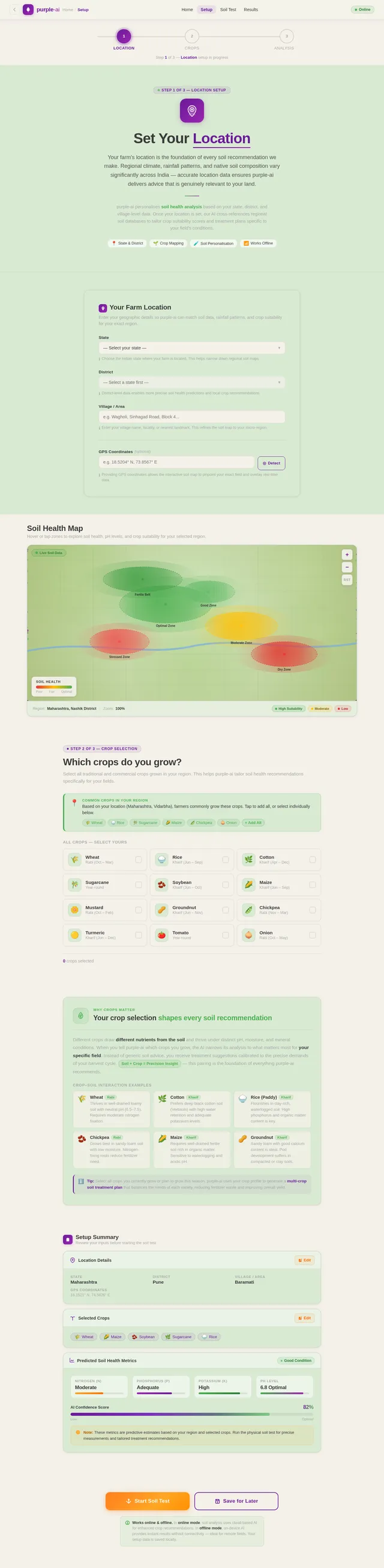
- As a Farmer, I should be able to input my geographical location into the device.
- As a Farmer, I should be able to specify traditional crops grown in my region.
- As a Farmer, I should be able to test soil using the device and receive recommendations for commercial crop suitability.
- As a Farmer, I should be able to receive suggestions for soil treatment if required.
- As a Farmer, I should be able to view soil test results on a built-in screen.
- As a Farmer, I should be able to print a physical summary of the soil test results.
- As a Farmer, I should be able to use the device in offline mode for instant results.
- As a Farmer, I should be able to use the device in online mode for advanced analytics and updates.
4. User Personas
1. Farmer
- Description: Individual farmers who rely on actionable insights to improve crop yields and soil health.
- Goals: Optimize farming practices, reduce resource waste, and increase profitability.
- Pain Points: Limited access to advanced agricultural tools, connectivity issues in remote areas, and lack of actionable data.
5. Visuals Colors and Theme
Color Palette:
The color palette for purple-ai reflects the agricultural theme while emphasizing technology and innovation.
- Background: #F4F1E9 (Soft beige, representing soil and earth)
- Surface: #D9EAD3 (Light green, symbolizing crops and growth)
- Text: #3A3A3A (Dark gray, ensuring readability)
- Accent: #6A1B9A (Deep purple, representing innovation and the project identity)
- Muted Tones: #A8A8A8 (Neutral gray, for secondary elements)
6. Signature Design Concept
Concept: Interactive Soil Map with Real-Time Analysis
The homepage of the purple-ai device interface will feature an interactive soil map. Farmers can input their geographical location, and the map will dynamically display soil health metrics, crop suitability zones, and treatment recommendations.
Key Features:
- Dynamic Animations: The soil map will feature subtle animations, such as soil particles shifting and crops sprouting, to create a visually engaging experience.
- Micro-Interactions: Hovering over different zones on the map will reveal detailed insights about soil health and crop suitability.
- Color Shifts: The map colors will change based on soil health metrics, transitioning from red (poor health) to green (optimal health).
- Print Preview: A button on the interface will allow farmers to preview and print a summary of their soil test results.
This design concept ensures the device is not only functional but also visually captivating, making the user experience memorable and intuitive.
7. Non-Functional Requirements
- Portability: The device must be lightweight and easy to carry.
- Durability: The device should withstand harsh environmental conditions, including dust and moisture.
- Battery Life: The device must operate for at least 8 hours on a single charge.
- Connectivity: Support for Wi-Fi and Bluetooth for online mode.
- Localization: The device interface should support multiple Indian languages for accessibility.
8. Tech Stack
Frontend
- React for the web interface.
Backend
- Python with FastAPI for efficient processing.
Database
- MySQL for structured data storage.
- MongoDB for unstructured data.
- WeaviateDB for vector-based AI data.
AI Models
- GPT 5.4 for user-friendly responses.
- Claude 4.6 Opas for academic or coding work.
- Gemini 3.1 Pro for friendly responses.
- Google Nano Banana for image generation.
AI Tools
- Litellm for LLM routing.
- Langchain for AI workflows.
Orchestration
- Docker and docker-compose for local orchestration.
- Kubernetes for server-side orchestration.
9. Assumptions and Constraints
Assumptions
- Farmers have basic knowledge of operating electronic devices.
- Soil testing kits will be compatible with the device.
- Internet connectivity may be intermittent in rural areas.
Constraints
- The device must be affordable for individual farmers.
- Limited screen size for portability.
- Printout feature must use compact, low-cost printing technology.
10. Glossary
- AI: Artificial Intelligence, used for analyzing soil data and providing recommendations.
- Offline Mode: Functionality allowing the device to operate without internet connectivity.
- Online Mode: Functionality allowing the device to sync with cloud-based analytics.
- Geographical Location: The user's location, used to tailor recommendations based on regional data.
- Traditional Crops: Crops historically grown in the user's region, used as input for analysis.
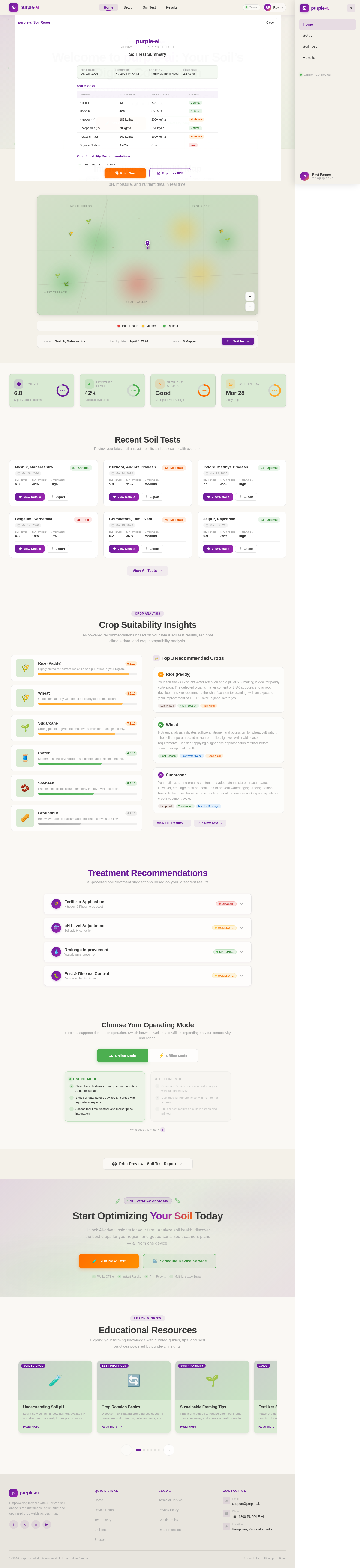
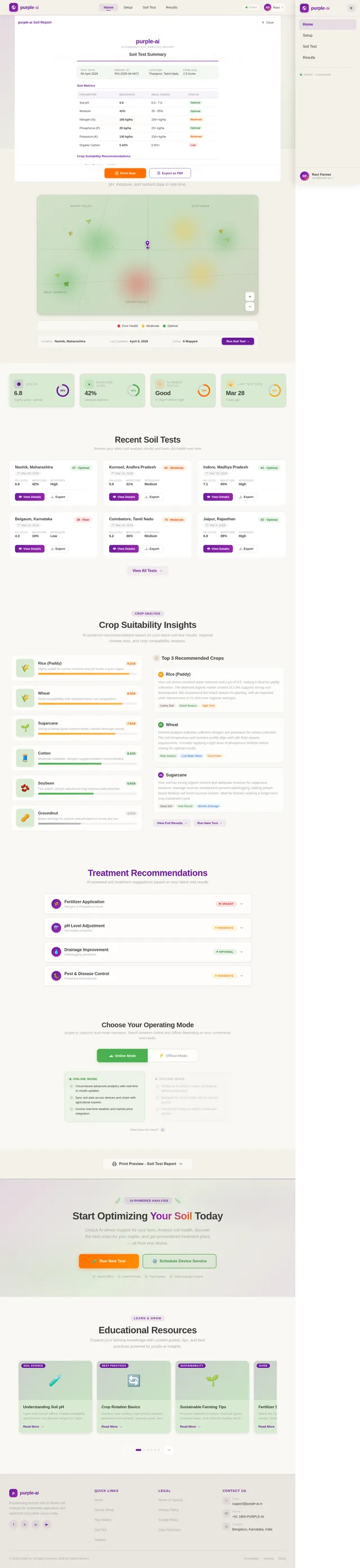
Welcome to purple-ai: Your Soil’s Digital Companion
Empowering farmers with instant soil insights, crop suitability recommendations, and actionable treatment plans — online or offline, right in the field.
Interactive Soil Health Map
Explore your farmland’s soil metrics at a glance. Hover over zones to view pH, moisture, and nutrient data in real time.
Recent Soil Tests
Review your latest soil analysis results and track soil health over time
Nashik, Maharashtra
Mar 28, 2026Kurnool, Andhra Pradesh
Mar 24, 2026Indore, Madhya Pradesh
Mar 19, 2026Belgaum, Karnataka
Mar 14, 2026Coimbatore, Tamil Nadu
Mar 10, 2026Jaipur, Rajasthan
Mar 5, 2026Crop Suitability Insights
AI-powered recommendations based on your latest soil test results, regional climate data, and crop compatibility analysis.
Highly suited for current moisture and pH levels in your region.
Good compatibility with detected loamy soil composition.
Strong potential given nutrient levels; monitor drainage closely.
Moderate suitability; nitrogen supplementation recommended.
Fair match; soil pH adjustment may improve yield potential.
Below average fit; calcium and phosphorus levels are low.
Top 3 Recommended Crops
Rice (Paddy)
Your soil shows excellent water retention and a pH of 6.5, making it ideal for paddy cultivation. The detected organic matter content of 2.8% supports strong root development. We recommend the Kharif season for planting, with an expected yield improvement of 15-20% over regional averages.
Wheat
Nutrient analysis indicates sufficient nitrogen and potassium for wheat cultivation. The soil temperature and moisture profile align well with Rabi season requirements. Consider applying a light dose of phosphorus fertilizer before sowing for optimal results.
Sugarcane
Your soil has strong organic content and adequate moisture for sugarcane. However, drainage must be monitored to prevent waterlogging. Adding potash-based fertilizer will boost sucrose content. Ideal for farmers seeking a longer-term crop investment cycle.
Treatment Recommendations
AI-powered soil treatment suggestions based on your latest test results
Diagnosis
Soil nitrogen levels are critically low at 12 kg/ha, well below the recommended 25 kg/ha for commercial crops. Phosphorus deficiency also detected.
Recommended Method
Apply DAP (Diammonium Phosphate) at 50 kg/acre followed by Urea top-dressing at 30 kg/acre after 3 weeks.
Application Timing
Immediate — before next sowing cycle. Best applied early morning or after light rain for optimal absorption.
Coverage Area
Full field coverage required. Focus extra application on north-facing plots showing severe depletion.
Estimated Cost
₹2,400 per acre
Diagnosis
Current soil pH is 5.2 (acidic). Optimal range for most commercial crops is 6.0–7.0. Lime application recommended to raise pH gradually.
Recommended Method
Apply agricultural lime (calcium carbonate) at 2 tonnes per hectare. Mix thoroughly with topsoil during tilling.
Application Timing
Within 2–3 weeks. Allow 30–45 days before planting for lime to integrate and neutralize acidity.
Coverage Area
Primarily eastern and southern plots where pH readings are lowest. Western plots are within acceptable range.
Estimated Cost
₹1,800 per hectare
Diagnosis
Moderate waterlogging risk detected in low-lying areas. Moisture retention at 78% exceeds ideal 60–70% range for the region.
Recommended Method
Install shallow French drains (30 cm depth) along field contours. Add organic mulch to improve soil structure and percolation.
Application Timing
Before monsoon season for best results. Can be scheduled during the current dry period.
Coverage Area
Low-lying southern field sections only. Approximately 0.5 acres affected.
Estimated Cost
₹3,500 per acre
Diagnosis
Early signs of root-knot nematode activity detected in soil samples. If untreated, can reduce crop yield by 20–40% in affected areas.
Recommended Method
Apply neem cake at 250 kg/hectare as a bio-pesticide. Follow up with Trichoderma culture application for fungal suppression.
Application Timing
10–14 days before next planting. Repeat Trichoderma application every 30 days during growing season.
Coverage Area
Targeted treatment for central and eastern plots. Set up monitoring traps across all field sections.
Estimated Cost
₹1,200 per hectare
Choose Your Operating Mode
purple-ai supports dual-mode operation. Switch between Online and Offline depending on your connectivity and needs.
Online Mode
- Cloud-based advanced analytics with real-time AI model updates
- Sync soil data across devices and share with agricultural experts
- Access real-time weather and market price integration
Offline Mode
- On-device AI delivers instant soil analysis without connectivity
- Designed for remote fields with no internet access
- Full soil test results on built-in screen and printout
purple-ai
AI-Powered Soil Analysis Report
Soil Test Summary
Soil Metrics
| Parameter | Measured | Ideal Range | Status |
|---|---|---|---|
| Soil pH | 6.8 | 6.0 - 7.0 | Optimal |
| Moisture | 42% | 35 - 55% | Optimal |
| Nitrogen (N) | 185 kg/ha | 200+ kg/ha | Moderate |
| Phosphorus (P) | 28 kg/ha | 25+ kg/ha | Optimal |
| Potassium (K) | 140 kg/ha | 150+ kg/ha | Moderate |
| Organic Carbon | 0.42% | 0.5%+ | Low |
Crop Suitability Recommendations
- Rice (Paddy) — 9.2/10Excellent suitability. Alluvial soil with good moisture retention is ideal for rice cultivation in this region.
- Sugarcane — 8.5/10Well-suited. pH and moisture levels are favorable. Consider additional nitrogen supplementation.
- Black Gram — 7.8/10Good suitability. Legume crop will also help fix nitrogen levels naturally in the soil.
Treatment Suggestions
- Nitrogen SupplementApply urea at 45 kg/acre in two split doses during the growing season to raise nitrogen to optimal levels.
- Organic Carbon EnhancementAdd farmyard manure (FYM) at 5 tonnes/acre or vermicompost at 2 tonnes/acre to improve organic carbon content.
- Potassium Top-upApply Muriate of Potash (MOP) at 20 kg/acre to bring potassium levels within the ideal range.
Farmer Notes
Soil collected from the eastern paddy field near the irrigation canal. Tested during pre-monsoon season. Farmer plans to cultivate rice this kharif season.
Start Optimizing Your Soil Today
Unlock AI-driven insights for your farm. Analyze soil health, discover the best crops for your region, and get personalized treatment plans — all from one device.
Educational Resources
Expand your farming knowledge with curated guides, tips, and best practices powered by purple-ai insights.
Understanding Soil pH
Learn how soil pH affects nutrient availability and discover the ideal pH ranges for major commercial crops in your region.
Read More→Crop Rotation Basics
Discover how rotating crops across seasons preserves soil nutrients, reduces pests, and boosts overall farm productivity.
Read More→Sustainable Farming Tips
Practical methods to reduce chemical inputs, conserve water, and maintain healthy soil for future growing seasons.
Read More→Fertilizer Selection Guide
Match the right fertilizers to your soil test results. Understand NPK ratios and micronutrient requirements for optimal yield.
Read More→Soil Moisture Management
Techniques for monitoring and maintaining optimal soil moisture levels to prevent over-watering and drought stress.
Read More→Integrated Pest Management
Combine biological, cultural, and chemical tools to manage pests effectively while minimizing environmental impact.
Read More→Reading Your Soil Report
A step-by-step guide to interpreting purple-ai soil test results and translating data into actionable farming decisions.
Read More→Maintaining Your Device
Keep your purple-ai device in top condition with these simple calibration, cleaning, and storage best practices.
Read More→
No comments yet. Be the first!