purple-ai
 Dr.Govindaraj Pandith T G
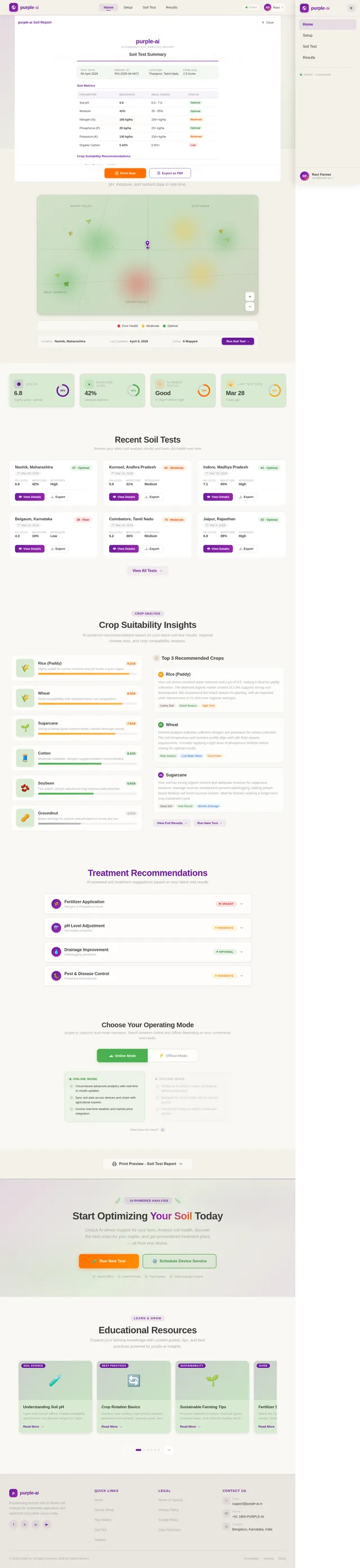
Need an AI powered electronic devise to test the soil with few inputs from the user such as geographical location, traditional crops etc suggest how soil is best suited for commercial crop and the treatment required if any.
Comments (0)
Sign in to leave a comment
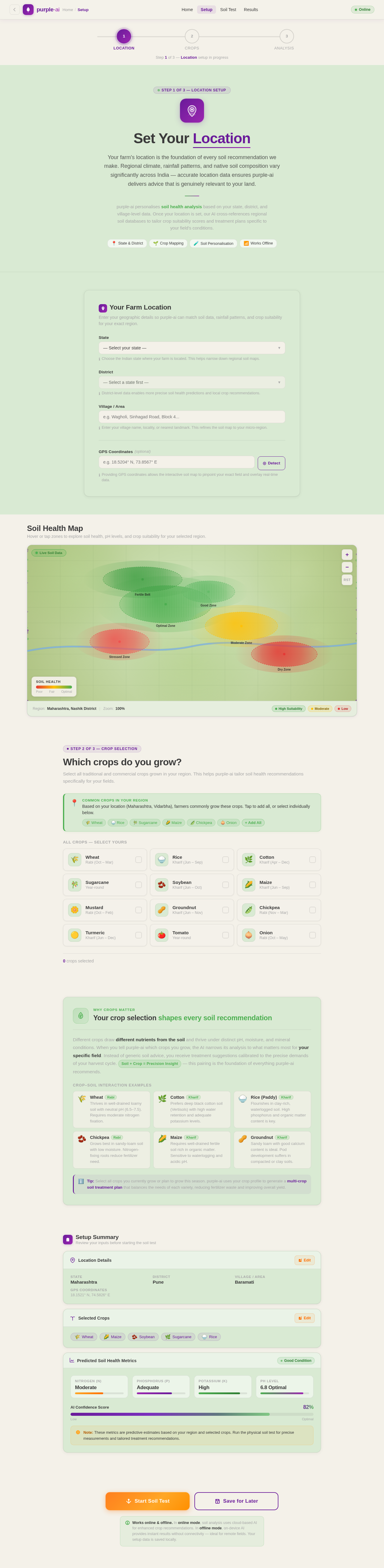
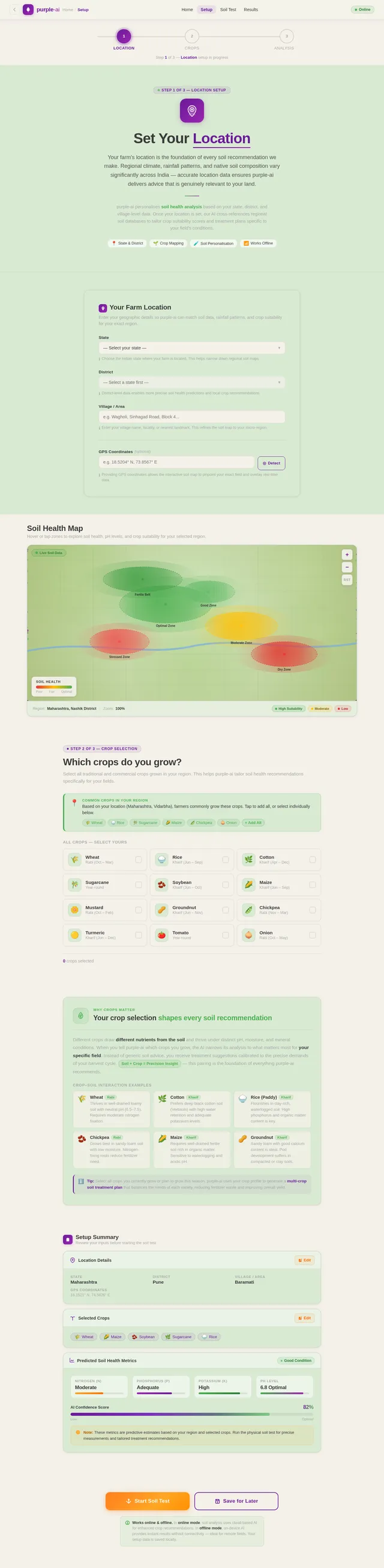
Step 1 of 3 — Location setup in progress
Set Your Location
Your farm's location is the foundation of every soil recommendation we make. Regional climate, rainfall patterns, and native soil composition vary significantly across India — accurate location data ensures purple-ai delivers advice that is genuinely relevant to your land.
purple-ai personalises soil health analysis based on your state, district, and village-level data. Once your location is set, our AI cross-references regional soil databases to tailor crop suitability scores and treatment plans specific to your field's conditions.
Your Farm Location
Enter your geographic details so purple-ai can match soil data, rainfall patterns, and crop suitability for your exact region.
Choose the Indian state where your farm is located. This helps narrow down regional soil maps.
District-level data enables more precise soil health predictions and local crop recommendations.
Enter your village name, locality, or nearest landmark. This refines the soil map to your micro-region.
Providing GPS coordinates allows the interactive soil map to pinpoint your exact field and overlay real-time data.
Soil Health Map
Hover or tap zones to explore soil health, pH levels, and crop suitability for your selected region.
Which crops do you grow?
Select all traditional and commercial crops grown in your region. This helps purple-ai tailor soil health recommendations specifically for your fields.
Common crops in your region
Based on your location (Maharashtra, Vidarbha), farmers commonly grow these crops. Tap to add all, or select individually below.
All crops — select yours
Wheat
Rabi (Oct – Mar)
Rice
Kharif (Jun – Sep)
Cotton
Kharif (Apr – Dec)
Sugarcane
Year-round
Soybean
Kharif (Jun – Oct)
Maize
Kharif (Jun – Sep)
Mustard
Rabi (Oct – Feb)
Groundnut
Kharif (Jun – Nov)
Chickpea
Rabi (Nov – Mar)
Turmeric
Kharif (Jun – Dec)
Tomato
Year-round
Onion
Rabi (Oct – May)
Why Crops Matter
Your crop selection shapes every soil recommendation
Different crops draw different nutrients from the soil and thrive under distinct pH, moisture, and mineral conditions. When you tell purple-ai which crops you grow, the AI narrows its analysis to what matters most for your specific field. Instead of generic soil advice, you receive treatment suggestions calibrated to the precise demands of your harvest cycle. Soil + Crop = Precision Insight — this pairing is the foundation of everything purple-ai recommends.
Crop–Soil interaction examples
WheatRabi
Thrives in well-drained loamy soil with neutral pH (6.5–7.5). Requires moderate nitrogen fixation.
CottonKharif
Prefers deep black cotton soil (Vertisols) with high water retention and adequate potassium levels.
Rice (Paddy)Kharif
Flourishes in clay-rich, waterlogged soil. High phosphorus and organic matter content is key.
ChickpeaRabi
Grows best in sandy-loam soil with low moisture. Nitrogen-fixing roots reduce fertilizer need.
MaizeKharif
Requires well-drained fertile soil rich in organic matter. Sensitive to waterlogging and acidic pH.
GroundnutKharif
Sandy loam with good calcium content is ideal. Pod development suffers in compacted or clay soils.
Setup Summary
Review your inputs before starting the soil test
Location Details
Selected Crops
Predicted Soil Health Metrics
Note: These metrics are predictive estimates based on your region and selected crops. Run the physical soil test for precise measurements and tailored treatment recommendations.
Works online & offline. In online mode, soil analysis uses cloud-based AI for enhanced crop recommendations. In offline mode, on-device AI provides instant results without connectivity — ideal for remote fields. Your setup data is saved locally.
No comments yet. Be the first!