project-abad1ce6

byNOUS-ONE

{core: {llm_router.py: # Smart routing between local and cloud LLMs class LLRouter: def route_query(self, query): # logic to determine routing pass, perception.py: # Perception module for transforming input into embeddings class Perception: def text_to_embeddings(self, text): # convert text to embeddings pass, reasoning.py: # Structured reasoning logic with chain-of-thought class Reasoning: def reason(self, thoughts): # structured reasoning logic pass}, memory: {working_memory.py: # Short-term memory with TTL decay class WorkingMemory: def store(self, item): # store item logic pass, long_term_memory.py: # Long-term memory storage using ChromaDB class LongTermMemory: def retrieve(self, query): # retrieve item logic pass, retrieval_loop.py: # Cycle to manage perception and memory class RetrievalLoop: def process(self): # full cycle logic pass}, agency: {environment.py: # Gymnasium environment setup class Environment: def step(self, action): # environment response to action pass, rl_trainer.py: # Reinforcement learning trainer class RLTrainer: def train(self): # training logic pass}, tools: {self_modify.py: # Self-modification safety checker class SelfModify: def execute(self, code): # execution in sandbox pass}, daemon: {cortex_daemon.py: # Persistent daemon for the cognitive organism class CortexDaemon: def run(self): # daemon run logic pass}, cli: {cortex.py: # Command-line interface for CORTEX if __name__ == '__main__': # CLI logic to execute commands pass}}

LandingModulesNOUS-ONELinkerNew MathResearch CoreVisualizerVerificationHubAEGIS
Landing

Comments (0)

No comments yet. Be the first!

System Requirements

System Requirement Document
Page 1 of 6

project-abad1ce6 System Requirements Document

1. Introduction

This document outlines the system requirements for "project-abad1ce6," also known as Chloe Tully's Ly-Algebra Hub. This project aims to create a unified research operating system that integrates various scientific domains through D₅ symmetry, connecting quantum computing, aerospace, biology, and cryptography.

2. System Overview

The Ly-Algebra Hub is a comprehensive research platform designed to facilitate cross-domain scientific exploration and validation. It leverages D₅ symmetry as a universal backbone to connect and enhance various scientific modules and frameworks. The system is equipped with advanced visualization tools, a theory validation engine, and a new math generation capability to address the limitations of existing mathematical frameworks.

2a. Source Content Inventory

  • D₅ Symmetry Visualizer: Live pentagon rotation, golden ratio scaling, and transformation matrices.
  • Active Modules: MBE Framework, AEGIS, NOUS-ONE KEM, Mars Ly-Hab, AgriSign, EquiSign, Comet 67P, SPICE.
  • Cross-Domain Linker: Computes tensor resonance between any two modules.
  • Theory Sniff-Test: Automatic crystallographic restriction detection.
  • Research Core: LaTeX/SPICE export capabilities.
  • Signal Status: Saved states and user profile management.
  • New Math Generator: Generates candidate axiom systems when new math is needed.
Page 2 of 6

3. Functional Requirements as Story Points

  • As a Researcher, I should be able to visualize D₅ symmetry with live pentagon rotation and golden ratio scaling.
  • As a Scientist, I should be able to use the MBE Framework for metabolic breathing loop analysis.
  • As a Quantum Physicist, I should be able to utilize AEGIS for Majorana braid state and topological quantum computing.
  • As a Cryptographer, I should be able to employ NOUS-ONE KEM for post-quantum cryptography.
  • As an Aerospace Engineer, I should be able to simulate Mars Ly-Hab for aerospace habitat studies.
  • As an Academic, I should be able to export research in LaTeX/SPICE format for publication.
  • As a User, I should be able to link cross-domain modules via D₅ tensor projections.
  • As a Theorist, I should be able to run a sniff-test to detect crystallographic restrictions and generate new math.
  • As a Mathematician, I should be able to generate candidate axiom systems including Deformed Kac-Moody, Aperiodic Lie Algebra, and Higher Categorical Lie 2-Algebra.
  • As a Developer, I should be able to download the complete HTML file of the Ly-Algebra Hub for offline use.
  • As a Researcher, I should be able to connect to formal verification tools like Lean 4 or Coq for proof obligation generation.
  • As a User, I should be able to drag the rotation slider to update the matrix in the D₅ Symmetry Visualizer.
  • As a User, I should be able to select different modules in the Cross-Domain Linker to view resonance formulas.
  • As a User, I should be able to type a theory in the sniff-test and run it to detect mathematical inconsistencies.
  • As a User, I should be able to generate candidate axiom systems when new math is needed.

4. User Personas

  • Researcher: Engages with the system to explore and validate scientific theories.
  • Scientist: Utilizes the platform for domain-specific research and analysis.
  • Quantum Physicist: Focuses on quantum computing and related studies.
  • Cryptographer: Specializes in cryptographic research and applications.
  • Aerospace Engineer: Works on aerospace simulations and habitat designs.
  • Academic: Publishes research findings using the system's export capabilities.
  • Theorist: Tests and validates speculative theories using the sniff-test engine.
Page 3 of 6

5. Core User Flows

  • Researcher visualizes D₅ symmetry -> adjusts pentagon rotation -> observes matrix updates.
  • Scientist selects MBE Framework -> conducts metabolic analysis -> saves results.
  • Quantum Physicist accesses AEGIS -> performs quantum computations -> reviews outcomes.
  • Cryptographer uses NOUS-ONE KEM -> encrypts data -> verifies post-quantum security.
  • Aerospace Engineer simulates Mars Ly-Hab -> tests habitat conditions -> refines designs.
  • Academic exports research -> formats in LaTeX/SPICE -> submits for publication.
  • Theorist inputs theory -> runs sniff-test -> generates new math if needed.

6. Visuals Colors and Theme

  • primary: #1E90FF (Dodger Blue)
  • primary_light: #63B8FF (Light Dodger Blue)
  • secondary: #FFD700 (Gold)
  • accent: #FF4500 (Orange Red)
  • highlight: #32CD32 (Lime Green)
  • bg: #F0F8FF (Alice Blue)
  • surface: #FFFFFF (White)
  • text: #000000 (Black)
  • text_muted: #696969 (Dim Gray)
  • border: #B0C4DE (Light Steel Blue)
Page 4 of 6

7. Signature Design Concept

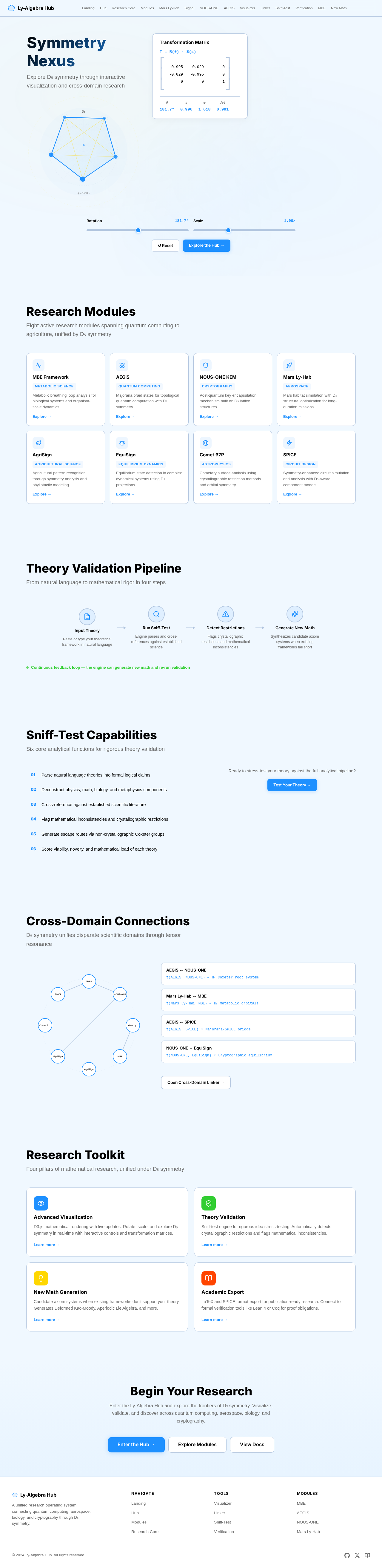
The Ly-Algebra Hub will feature an interactive "Symmetry Nexus" on the landing page. This will be a dynamic visualization of a rotating pentagon, symbolizing D₅ symmetry, with live transformation matrices displayed alongside. Users can interact with the pentagon by dragging sliders to adjust rotation and scaling, witnessing real-time updates in the mathematical representations. The background will subtly shift in color, reflecting the golden ratio's influence, creating an immersive experience. This concept will be implemented using motion/react for smooth animations and d3.js for mathematical visualizations.

LANDING HERO MOTION BRIEF

The landing hero will depict a rotating pentagon at the center, surrounded by interactive sliders. As users adjust the sliders, the pentagon rotates and scales, with transformation matrices updating in real-time. The background will transition through a spectrum of golden hues, emphasizing the golden ratio's resonance. This 6-14 second loop will continuously engage users, with optional interactions allowing them to explore different symmetry states. The reduced-motion state will maintain the pentagon's static display with accessible matrix information.

8. Interaction Model & Motion Direction

  • Intended Interaction Model: Animated
  • The landing page will feature moderate scroll-triggered reveals and hover transitions, with spring physics applied to interactive elements. This approach will enhance the feature-rich environment of the Ly-Algebra Hub, providing a polished and engaging user experience.
Page 5 of 6

9. Non-Functional Requirements

  • The system must support high-performance rendering of complex mathematical visualizations.
  • The platform should ensure data security and integrity, especially for sensitive cryptographic computations.
  • The user interface must be intuitive and accessible, catering to a diverse range of scientific users.

10. Tech Stack

  • Frontend: React with TypeScript
  • Backend: Express
  • Database: MongoDB
  • Visualization: D3.js
  • AI Models: Gemini 3.5 Flash for live model integration

11. Assumptions and Constraints

  • The system assumes users have a foundational understanding of advanced scientific concepts.
  • The platform is constrained by the current limitations of mathematical frameworks in accommodating 5-fold symmetry.
Page 6 of 6

12. Glossary

  • D₅ Symmetry: A mathematical symmetry involving five-fold rotational symmetry.
  • MBE Framework: Metabolic Breathing Loop Framework.
  • AEGIS: Majorana Braid State for topological quantum computing.
  • NOUS-ONE KEM: Post-quantum cryptographic module.
  • Mars Ly-Hab: Aerospace habitat simulation module.
  • LaTeX/SPICE: Formats for academic publication and electronic circuit simulation.
  • Cross-Domain Linker: A tool for computing tensor resonance across different scientific modules.
Landing design preview
Landing: View Nexus
Hub: View Dashboard
Research Core: Compile Research
Research Core: Export LaTeX
Research Core: Export SPICE
Research Core: Submit Publication
Landing design preview
Landing: View Nexus
Hub: View Dashboard
Research Core: Compile Research
Research Core: Export LaTeX
Research Core: Export SPICE
Research Core: Submit Publication