project-200840c5
 سيف
سيفسوي لي فيديو يتكلم عن هذا "هل تعلم كيف تتحول التفاعلات الكيميائية إلى كهرباء؟ هذه هي الخلية الجلفانية. لدينا الزنك والنحاس الزنك يفقد إلكترونات لذلك هو الأنود والنحاس يكتسب الإلكترونات لذلك هو الكاثود تتحرك الإلكترونات من الزنك إلى النحاس مما يولد تيارًا كهربائيًا الأكسدة تحدث في الزنك والاختزال يحدث في النحاس القنطرة الملحية تحافظ على توازن الشحنات وهكذا تتحول الطاقة الكيميائية إلى طاقة كهربائية مثل البطاريات" و ابي صوت معاه و ابيه الحين
Comments (0)
Sign in to leave a comment
System Requirements
System Requirements Document (SRD) for project-200840c5
1. Introduction
This document outlines the system requirements for project-200840c5, a simple and interactive educational application designed to explain the concept of the galvanic cell (خلية جلفانية). The project is intended as a school project for سيف in Qatar (QA) and focuses on delivering a straightforward, visually engaging, and educational experience.
The application will provide an easy-to-understand explanation of how chemical reactions in a galvanic cell generate electricity, using animations, audio explanations, and a simple interactive test.
2. System Overview
The primary goal of project-200840c5 is to create a basic educational application that explains the galvanic cell in a clear and engaging manner. The application will feature:
- A visual animation to demonstrate the movement of electrons between zinc (anode) and copper (cathode).
- Audio narration to explain key concepts such as oxidation, reduction, and the role of the salt bridge.
- A simple interactive quiz to reinforce learning.
- A clean and intuitive user interface tailored for students.
The application will be lightweight, accessible on both web and mobile platforms, and optimized for educational use.
3. Functional Requirements
The following are the functional requirements for project-200840c5:
- As a User, I should be able to view an animated explanation of the galvanic cell.
- As a User, I should be able to listen to an audio narration explaining the galvanic cell's components and processes.
- As a User, I should be able to interact with a simple quiz to test my understanding of the galvanic cell.
- As a User, I should be able to navigate between sections easily.
4. User Personas
4.1 Student
- Description: The primary user of the application. A student who wants to learn about the galvanic cell for a school project.
- Goals: Understand the concept of the galvanic cell through visuals and audio, and test their knowledge with a quiz.
- Technical Proficiency: Basic familiarity with mobile or web applications.
4.2 Teacher
- Description: A secondary user who may use the application to demonstrate the concept in a classroom setting.
- Goals: Use the application as a teaching aid to explain the galvanic cell.
- Technical Proficiency: Moderate familiarity with mobile or web applications.
5. Visuals Colors and Theme
The visual theme for project-200840c5 will reflect a scientific and educational aesthetic. The color palette is designed to be engaging yet professional, with a focus on clarity and readability.
Color Palette:
- Background: #F5F9FF (Soft Sky Blue)
- Surface: #FFFFFF (Pure White)
- Text: #2A2A2A (Dark Charcoal)
- Accent: #FF6F61 (Bright Coral Red)
- Muted Tones: #B0BEC5 (Soft Gray-Blue)
This palette ensures a clean and modern look, suitable for an educational application.
6. Signature Design Concept
The signature design concept for project-200840c5 is an interactive animated diagram of the galvanic cell on the homepage.
Key Features:
- Dynamic Animation: The homepage will feature a visually engaging animation of the galvanic cell. Users will see electrons moving from the zinc anode to the copper cathode, with labels appearing dynamically to explain each component (e.g., "Anode," "Cathode," "Salt Bridge").
- Interactive Elements: Users can tap or click on components (e.g., zinc, copper, salt bridge) to hear a brief audio explanation of their role in the galvanic cell.
- Audio Narration: A voiceover will play automatically, synchronized with the animation, explaining the oxidation and reduction processes in simple terms.
- Micro-Interactions: Subtle animations (e.g., glowing effect on the salt bridge when it is mentioned) will make the experience more immersive.
- Quiz Transition: At the end of the animation, a button will appear inviting users to take a short quiz to test their understanding.
This design ensures that the application is not only educational but also memorable and engaging.
7. Non-Functional Requirements
- The application must load within 3 seconds on standard mobile and desktop devices.
- The audio narration must be clear and synchronized with the animation.
- The application must be responsive and work seamlessly on both web and mobile platforms.
- The quiz functionality must store user answers temporarily for the session but not require persistent storage.
8. Tech Stack
The following technologies will be used to develop project-200840c5:
Frontend:
- React for the web interface.
- React Native for the mobile application.
Backend:
- Python with FastAPI for serving content and managing quiz logic.
Database:
- MySQL for storing quiz questions and answers (if needed).
AI Tools:
- Google Nano Banana for generating any required educational images.
Local Orchestration:
- Docker for containerization.
- docker-compose for managing local development environments.
9. Assumptions and Constraints
Assumptions:
- The target audience has access to either a smartphone or a computer.
- The application will be used primarily in an educational setting.
- Audio narration will be recorded in Arabic to cater to the local audience in Qatar.
Constraints:
- The application must be lightweight and not exceed 50 MB in size.
- Development must be completed within the timeframe of the school project.
10. Glossary
- Galvanic Cell (خلية جلفانية): A device that converts chemical energy into electrical energy through redox reactions.
- Anode: The electrode where oxidation occurs (zinc in this case).
- Cathode: The electrode where reduction occurs (copper in this case).
- Salt Bridge: A device that maintains charge balance by allowing the flow of ions.
- Oxidation: The loss of electrons.
- Reduction: The gain of electrons.
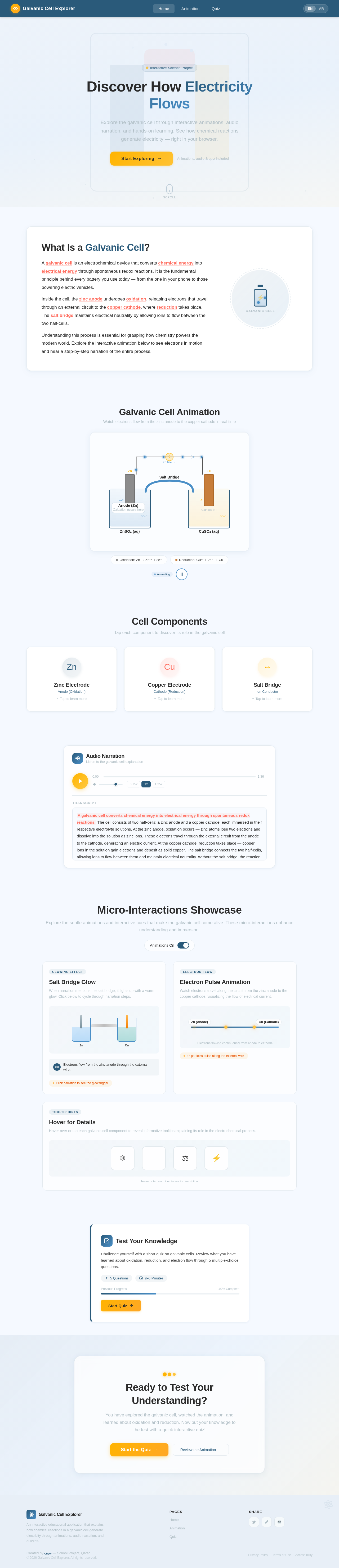
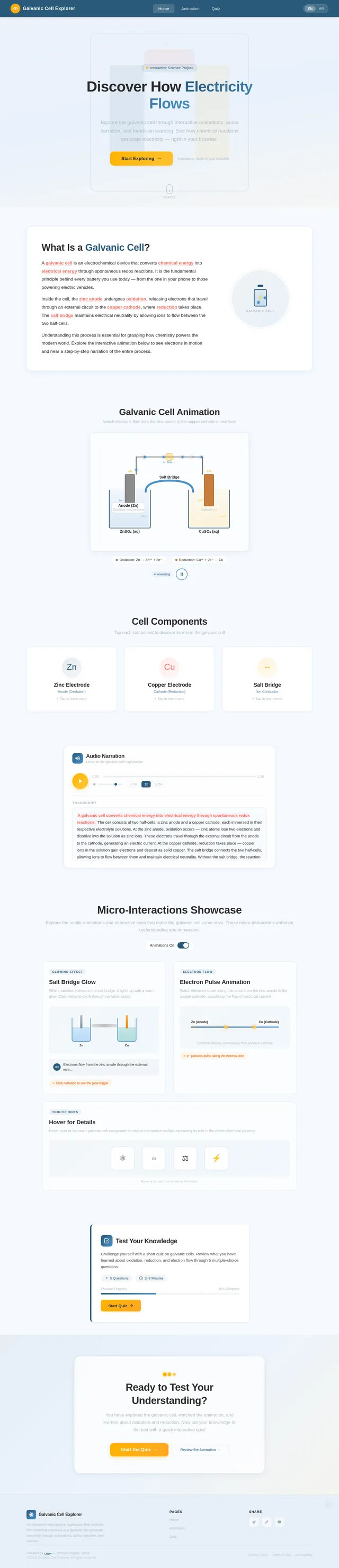
Discover How Electricity Flows
Explore the galvanic cell through interactive animations, audio narration, and hands-on learning. See how chemical reactions generate electricity — right in your browser.
What Is a Galvanic Cell?
A galvanic cell is an electrochemical device that converts chemical energy into electrical energy through spontaneous redox reactions. It is the fundamental principle behind every battery you use today — from the one in your phone to those powering electric vehicles.
Inside the cell, the zinc anode undergoes oxidation, releasing electrons that travel through an external circuit to the copper cathode, where reduction takes place. The salt bridge maintains electrical neutrality by allowing ions to flow between the two half-cells.
Understanding this process is essential for grasping how chemistry powers the modern world. Explore the interactive animation below to see electrons in motion and hear a step-by-step narration of the entire process.
Galvanic Cell Animation
Watch electrons flow from the zinc anode to the copper cathode in real time
Cell Components
Tap each component to discover its role in the galvanic cell
Zinc Electrode
Anode (Oxidation)
Tap to learn more
The zinc electrode acts as the anode, where oxidation occurs. Zinc atoms lose two electrons (Zn → Zn²⁺ + 2e⁻), releasing electrons that travel through the external circuit to generate electric current.
Copper Electrode
Cathode (Reduction)
Tap to learn more
The copper electrode serves as the cathode, where reduction takes place. Copper ions in the solution gain the electrons that traveled through the circuit (Cu²⁺ + 2e⁻ → Cu), depositing solid copper onto the electrode.
Salt Bridge
Ion Conductor
Tap to learn more
The salt bridge maintains electrical neutrality by allowing ions to flow between the two half-cells. Without it, charge would build up and the reaction would stop. It typically contains a salt solution like KNO₃ or KCl.
Audio Narration
Listen to the galvanic cell explanation
Transcript
Micro-Interactions Showcase
Explore the subtle animations and interactive cues that make the galvanic cell come alive. These micro-interactions enhance understanding and immersion.
Salt Bridge Glow
When narration mentions the salt bridge, it lights up with a warm glow. Click below to cycle through narration steps.
Electron Pulse Animation
Watch electrons travel along the circuit from the zinc anode to the copper cathode, visualizing the flow of electrical current.
Hover for Details
Hover over or tap each galvanic cell component to reveal informative tooltips explaining its role in the electrochemical process.
Hover or tap each icon to see its description
Challenge yourself with a short quiz on galvanic cells. Review what you have learned about oxidation, reduction, and electron flow through 5 multiple-choice questions.
Ready to Test Your Understanding?
You have explored the galvanic cell, watched the animation, and learned about oxidation and reduction. Now put your knowledge to the test with a quick interactive quiz!
No comments yet. Be the first!