plasma-diapositiva
 Naruto Uzumaki
Genera una diapositiva bien detallada sobre la teoría de la demanda del consumidor
Comments (0)
Sign in to leave a comment
System Requirements
System Requirements Document (SRD)
Project Name: plasma-diapositiva
1. Introduction
Welcome to the System Requirements Document (SRD) for plasma-diapositiva, an innovative educational application designed to help students understand the theory of consumer demand and related economic concepts. This project, envisioned by Naruto Uzumaki, aims to provide an interactive and engaging learning experience tailored for students in Bolivia (BO) and beyond.
The application will feature dynamic simulations, theoretical explanations, quizzes, and a progress tracking system to ensure students grasp key concepts effectively. By leveraging cutting-edge technology and creative design, plasma-diapositiva will redefine how economics is taught and learned.
2. System Overview
plasma-diapositiva is a web and mobile application focused on delivering educational content about consumer demand theory and associated topics. The system will include:
- Interactive Modules: Covering topics like elasticity, substitutes, and complementary goods.
- Dynamic Visualizations: Graphs and charts that adapt based on user input.
- Simulations: Real-world scenarios to help students apply theoretical knowledge.
- Quizzes: To reinforce learning and assess understanding.
- Progress Tracking: A system to monitor user achievements and encourage continued learning.
The application will be accessible via web browsers and mobile devices, ensuring flexibility and convenience for students.
3. Functional Requirements
Story Points:
- As a Student, I should be able to access interactive modules on consumer demand theory.
- As a Student, I should be able to view dynamic graphs and charts that adapt based on my inputs.
- As a Student, I should be able to participate in simulations to apply theoretical concepts.
- As a Student, I should be able to take quizzes to test my understanding of the material.
- As a Student, I should be able to track my progress through a personalized dashboard.
- As a Student, I should be able to earn badges for completing modules and quizzes.
- As a Student, I should be able to revisit completed modules for review.
4. User Personas
1. Student
- Description: Primary user of the application. Typically aged 16-25, enrolled in high school or university-level economics courses.
- Goals: Learn and understand consumer demand theory, improve academic performance, and track progress.
- Pain Points: Difficulty visualizing abstract concepts, lack of engaging learning tools, and limited access to interactive content.
5. Visuals Colors and Theme
Unique Color Palette:
The theme for plasma-diapositiva will reflect a modern, academic aesthetic with vibrant yet professional tones:
- Background: #F5F5F5 (Soft Light Gray)
- Surface: #FFFFFF (Pure White)
- Text: #2E2E2E (Charcoal Gray)
- Accent: #FF5733 (Vivid Orange-Red)
- Muted Tones: #B0BEC5 (Muted Blue-Gray)
This palette ensures clarity, focus, and a touch of vibrancy to keep students engaged.
6. Signature Design Concept
Interactive Economic Universe
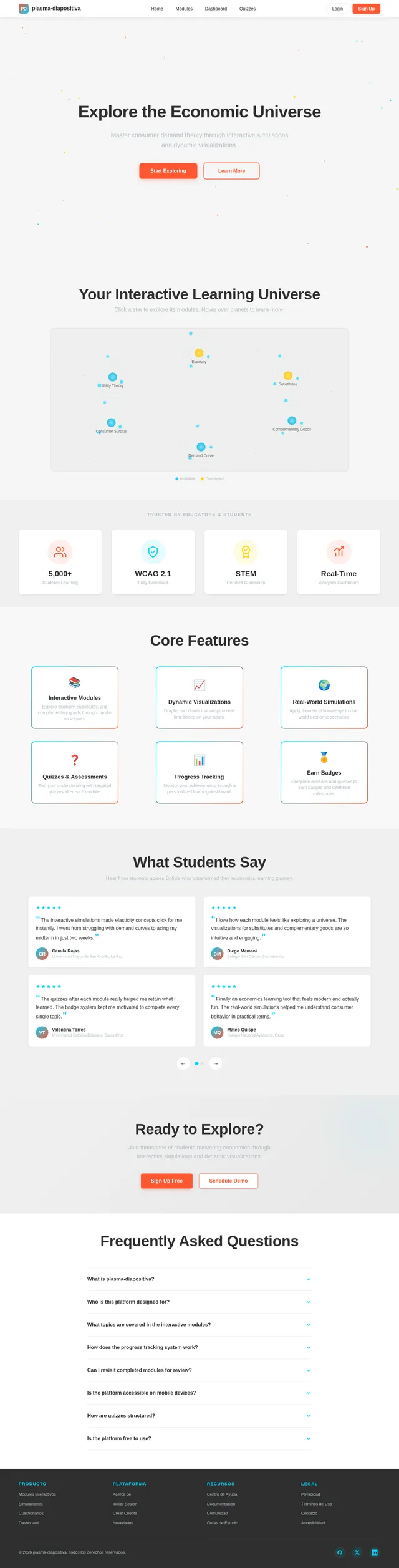
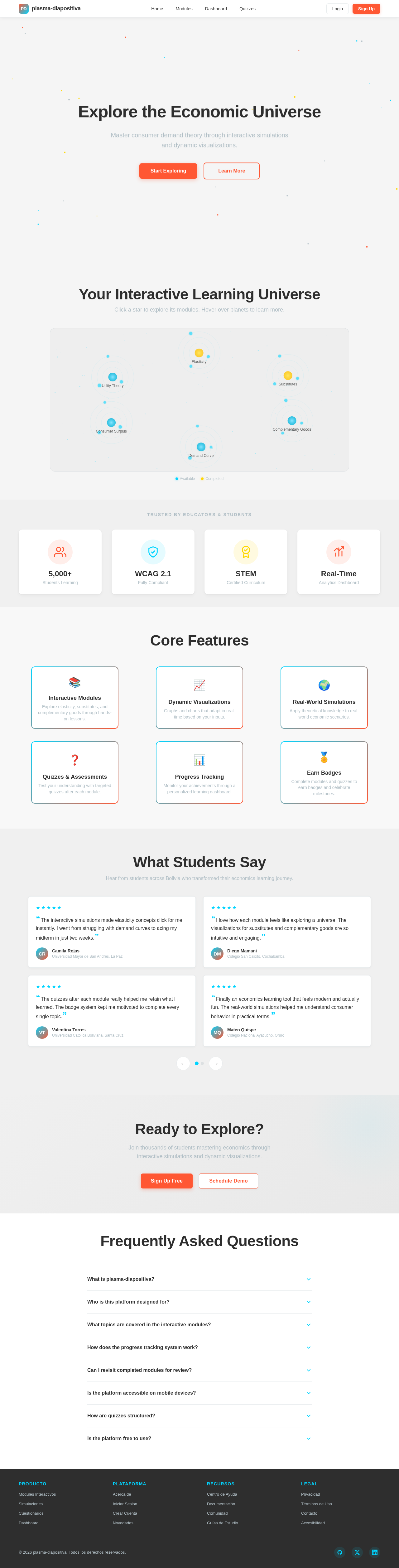
The homepage of plasma-diapositiva will feature a 3D interactive economic universe.
- Visuals: Students will see a galaxy-like interface where each star represents a module (e.g., elasticity, substitutes, complementary goods). Clicking on a star zooms into a mini solar system of related topics.
- Animations: Stars will pulse gently, and planets orbiting them will rotate dynamically. Hovering over a planet reveals its name and a brief description.
- Transitions: Smooth zoom-in and zoom-out effects as users navigate between modules.
- Micro-Interactions: Completing a module will cause its star to glow brightly, signifying progress.
- Mood: The design will evoke curiosity and exploration, making learning feel like an adventure.
This concept ensures the homepage is unforgettable and sets the tone for the rest of the application.
7. Non-Functional Requirements
- Performance: The application must load within 3 seconds on both web and mobile platforms.
- Scalability: Support up to 10,000 concurrent users without degradation in performance.
- Accessibility: Comply with WCAG 2.1 standards to ensure usability for students with disabilities.
- Localization: Default language set to Spanish (BO locale), with options for English.
- Security: Implement SSL encryption and secure authentication protocols.
8. Tech Stack
Frontend:
- React for Web
- React Native for Mobile
Backend:
- Python
- FastAPI
Database:
- MySQL (with Alembic for migrations)
AI Models:
- GPT 5.4 for user-friendly responses
- Claude 4.6 Opas for academic explanations
- Google Nano Banana for image generation
AI Tools:
- Litellm for LLM Routing
- Langchain
Orchestration:
- Docker for local development
- Kubernetes for server-side orchestration
9. Assumptions and Constraints
Assumptions:
- Students have access to internet-enabled devices.
- The application will primarily target Spanish-speaking users in Bolivia.
- Users will have basic knowledge of economics concepts.
Constraints:
- Limited budget for initial development and deployment.
- Must comply with local data protection laws in Bolivia.
10. Glossary
- Consumer Demand Theory: A branch of economics that studies how consumers decide what goods to purchase based on income, prices, and preferences.
- Elasticity: A measure of how demand changes in response to price or income changes.
- Substitutes: Goods that can replace each other in consumption.
- Complementary Goods: Goods that are consumed together, such as coffee and sugar.
- Progress Tracking: A feature that allows users to monitor their learning achievements.
End of Document
Explore the Economic Universe
Master consumer demand theory through interactive simulations and dynamic visualizations.
Your Interactive Learning Universe
Click a star to explore its modules. Hover over planets to learn more.
Trusted by Educators & Students
Core Features
What Students Say
Hear from students across Bolivia who transformed their economics learning journey.
The interactive simulations made elasticity concepts click for me instantly. I went from struggling with demand curves to acing my midterm in just two weeks.
I love how each module feels like exploring a universe. The visualizations for substitutes and complementary goods are so intuitive and engaging.
The quizzes after each module really helped me retain what I learned. The badge system kept me motivated to complete every single topic.
Finally an economics learning tool that feels modern and actually fun. The real-world simulations helped me understand consumer behavior in practical terms.
Ready to Explore?
Join thousands of students mastering economics through interactive simulations and dynamic visualizations.
Frequently Asked Questions
plasma-diapositiva is an interactive educational platform designed to help students understand consumer demand theory and related economic concepts through dynamic simulations, visualizations, and quizzes.
The platform is tailored for students aged 16-25 enrolled in high school or university-level economics courses, particularly in Bolivia and across Latin America. However, anyone interested in learning about consumer demand theory can benefit from it.
Our modules cover core economic concepts including elasticity, substitutes, complementary goods, supply and demand curves, consumer behavior, and market equilibrium. Each module features dynamic visualizations and real-world simulations.
Your personalized dashboard tracks completed modules, quiz scores, and earned badges. As you progress through the curriculum, completed modules glow in the Interactive Economic Universe, giving you a visual representation of your learning journey.
Absolutely. All completed modules remain accessible from your dashboard. You can revisit them at any time to reinforce your understanding or review specific concepts before exams.
Yes, plasma-diapositiva is fully responsive and accessible via web browsers on both desktop and mobile devices. The interactive universe adapts to a simplified grid view on smaller screens for optimal usability.
Quizzes are designed to reinforce learning after each module. They include multiple-choice and scenario-based questions that test both theoretical understanding and practical application of economic concepts.
You can sign up for free and access introductory modules at no cost. Our platform is committed to making quality economics education accessible to all students, with additional premium features available for advanced learners.
No comments yet. Be the first!