onyx-tenant
 John Guo
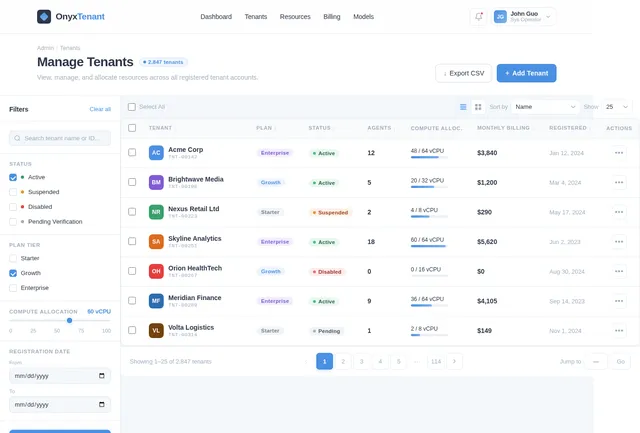
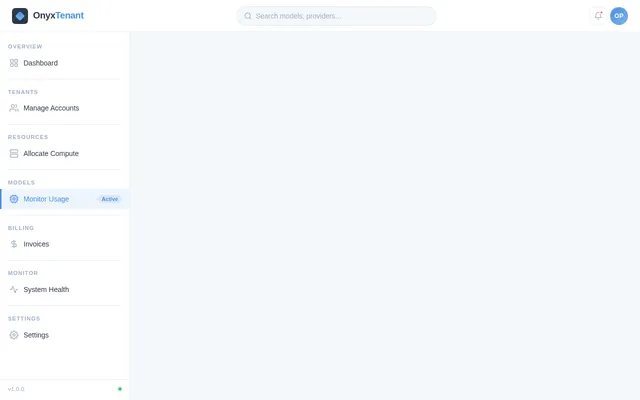
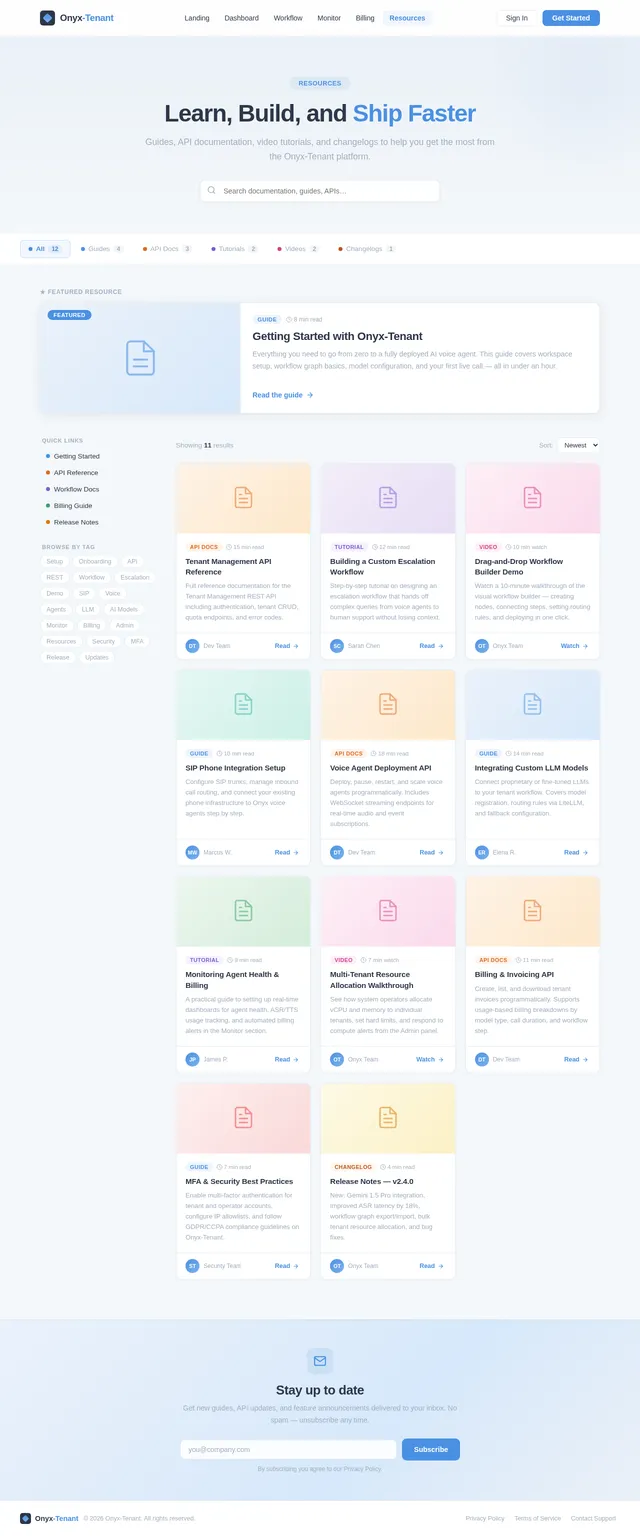
can you build a multi-tenant customer support system by building on top of https://github.com/ten-framework/ten-framework and use voice agent for tenant's customer support. it will need end user UI for text questions, or sip support for phone calls. a tenant UI so tenant can self subscribe, define workflow graph and deploy agents. Tenant can also see the usage, billing and health info of the agents. A system operator UI to disable tenant, allocate compute resources for tenants' agents and monitor ASR, LLM and TTS model usage, create tenant invoices, etc
Comments (0)
Sign in to leave a comment
System Requirements
System Requirements Document (SRD) for Onyx-Tenant
1. Introduction
The Onyx-Tenant project is a multi-tenant customer support system designed to empower tenants with advanced voice agent capabilities and intuitive workflow customization. Built on top of the Ten Framework, this system will provide a robust platform for tenants to manage their customer support operations efficiently. The system will integrate both third-party and proprietary LLM (Large Language Model) solutions, enabling seamless interaction through text and voice interfaces.
This document outlines the system requirements for Onyx-Tenant, ensuring alignment with the project's goals and John Guo's vision for a scalable, user-friendly, and feature-rich platform.
2. System Overview
The Onyx-Tenant system will cater to three primary user groups:
- End Users: Customers of the tenants who interact with the system via text-based questions or phone calls (SIP support).
- Tenants: Businesses subscribing to the platform, who can self-manage their customer support workflows, deploy agents, and monitor usage, billing, and agent health.
- System Operators: Administrators responsible for managing tenants, allocating compute resources, monitoring model usage, and generating invoices.
The system will leverage a combination of third-party and proprietary ASR (Automatic Speech Recognition), TTS (Text-to-Speech), and LLM models to deliver high-quality voice agent functionality. A visual interface for workflow graph creation will make it easy for tenants to define and customize their customer support processes.
3. Functional Requirements
-
End User Functionalities:
- As an End User, I should be able to ask questions via a text-based UI.
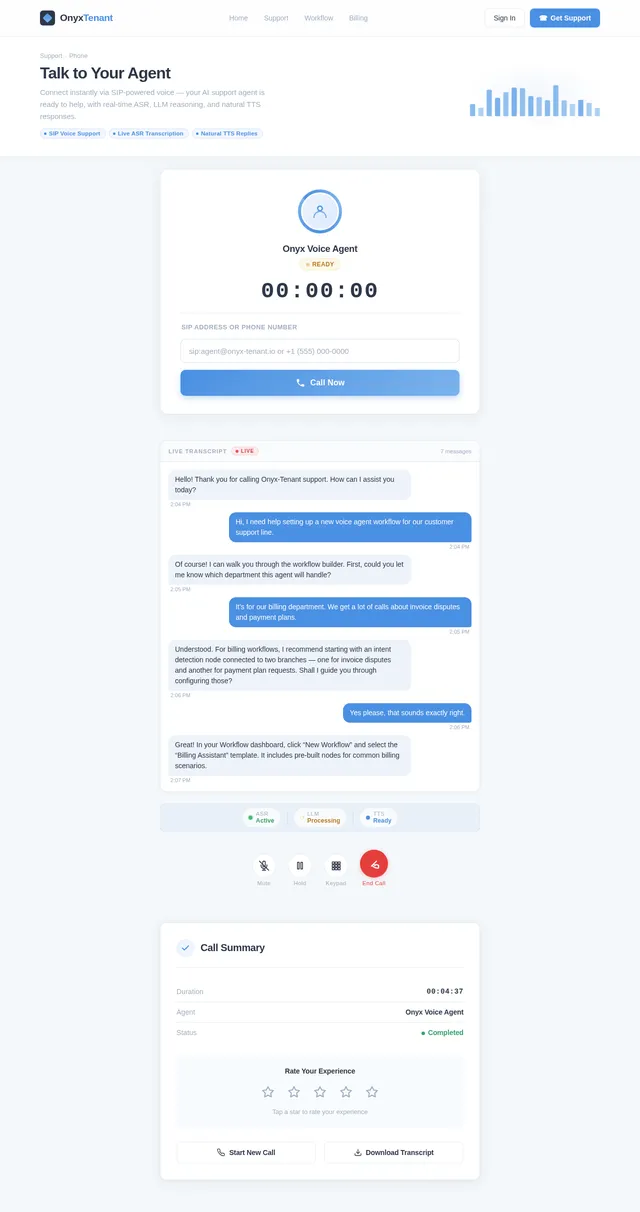
- As an End User, I should be able to interact with the system via phone calls using SIP support.
-
Tenant Functionalities:
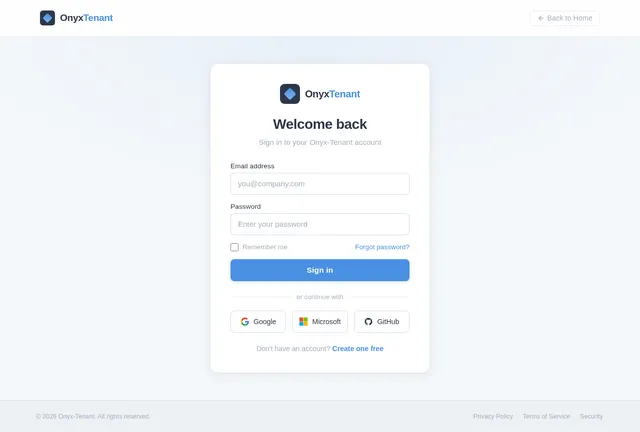
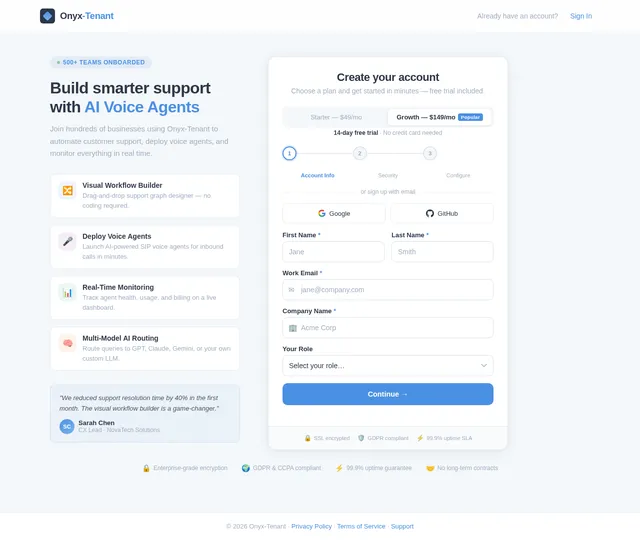
- As a Tenant, I should be able to self-subscribe to the platform.
- As a Tenant, I should be able to define workflow graphs through a visual drag-and-drop interface.
- As a Tenant, I should be able to deploy voice agents for customer support.
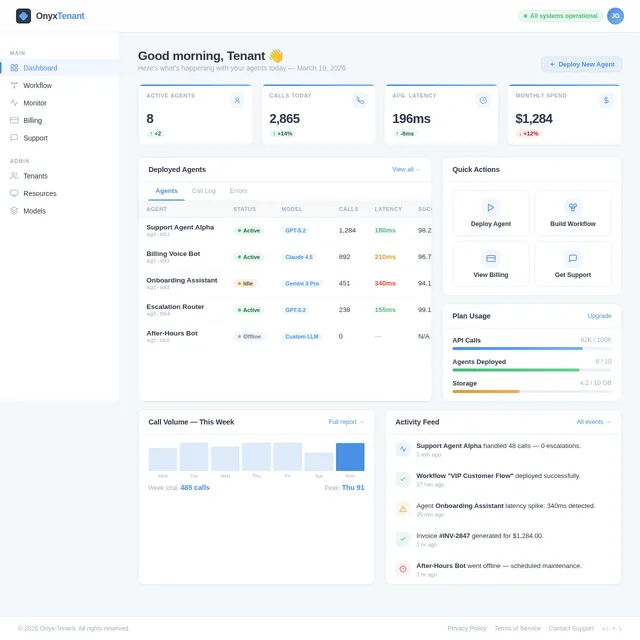
- As a Tenant, I should be able to monitor the usage, billing, and health status of my agents.
-
System Operator Functionalities:
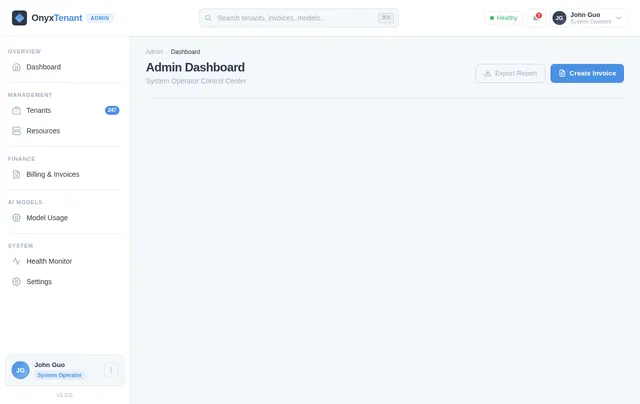
- As a System Operator, I should be able to disable a tenant's account.
- As a System Operator, I should be able to allocate compute resources for tenants' agents.
- As a System Operator, I should be able to monitor the usage of ASR, LLM, and TTS models.
- As a System Operator, I should be able to create and manage tenant invoices.
4. User Personas
4.1 End User
- Description: Customers of the tenants who interact with the system for support.
- Goals: Resolve queries quickly via text or voice.
- Technical Proficiency: Low to moderate.
4.2 Tenant
- Description: Businesses subscribing to the platform to manage their customer support operations.
- Goals: Customize workflows, deploy agents, and monitor performance.
- Technical Proficiency: Moderate to high.
4.3 System Operator
- Description: Administrators managing the platform's tenants and resources.
- Goals: Ensure smooth operation, manage resources, and oversee tenant activities.
- Technical Proficiency: High.
5. Visuals Colors and Theme
The Onyx-Tenant platform will feature a modern, professional, and approachable design. The color palette is tailored to evoke trust, innovation, and clarity.
- Background: #F4F7FA (soft light gray)
- Surface: #FFFFFF (pure white)
- Text: #2D3748 (dark slate gray)
- Accent: #4A90E2 (vivid blue)
- Muted: #A0AEC0 (cool gray)
This palette ensures readability and a clean, professional aesthetic while maintaining a touch of vibrancy through the accent color.
6. Signature Design Concept
The Onyx-Tenant homepage will feature an interactive 3D workflow graph as its centerpiece. This bold and memorable design will immediately immerse users in the platform's core functionality.
Key Features:
-
3D Workflow Graph:
- The homepage will display a dynamic, interactive 3D graph representing a sample customer support workflow.
- Nodes in the graph will represent different stages of the workflow (e.g., "Customer Query," "Agent Response," "Escalation").
- Users can click on nodes to see animations and tooltips explaining their functionality.
-
Interactive Animations:
- The graph will rotate and zoom as users hover over or click on nodes, creating a sense of depth and engagement.
- Smooth transitions will guide users through the workflow, making the system's capabilities intuitive and visually appealing.
-
Color Transitions:
- The graph's nodes will adopt the platform's accent color (#4A90E2) when active, while inactive nodes will use the muted tone (#A0AEC0).
- Background gradients will subtly shift based on user interactions, adding a dynamic and modern feel.
-
Micro-Interactions:
- Hover effects, subtle vibrations, and glowing outlines will provide feedback as users explore the graph.
This design concept will not only showcase the system's visual workflow capabilities but also leave a lasting impression on users, setting Onyx-Tenant apart from competitors.
7. Non-Functional Requirements
- Scalability: The system must support up to 10,000 tenants and 1 million end users concurrently.
- Performance: Response times for text and voice interactions must not exceed 1 second under normal load.
- Reliability: The system must maintain 99.9% uptime.
- Security: All data must be encrypted in transit and at rest. Multi-factor authentication (MFA) will be required for tenant and system operator accounts.
- Compliance: The system must comply with US regulations, including GDPR and CCPA where applicable.
8. Tech Stack
Frontend
- Web: React
- Mobile: React Native
Backend
- Language: Python
- Framework: FastAPI
Database
- RDBMS: MySQL (with Alembic for migrations)
- NoSQL: MongoDB
- VectorDB: WeaviateDB
AI Models
- Third-Party: GPT 5.2, Claude 4.5 Opas, Gemini 3 Pro
- Proprietary: Custom LLM models for tenant-specific workflows
- Image Generation: Google Nano Banana
AI Tools
- LLM Routing: Litellm
- Workflow Orchestration: Langchain
Orchestration
- Local: Docker, docker-compose
- Server-Side: Kubernetes
9. Assumptions and Constraints
- Tenants will have varying levels of technical expertise, so the visual workflow graph must be intuitive and easy to use.
- The system will rely on both third-party and proprietary AI models, requiring robust integration and fallback mechanisms.
- SIP support for phone calls will be implemented using industry-standard protocols.
- The system will initially target the US market, with potential for global expansion.
10. Glossary
- ASR: Automatic Speech Recognition.
- TTS: Text-to-Speech.
- LLM: Large Language Model.
- SIP: Session Initiation Protocol, used for managing voice calls.
- Tenant: A business subscribing to the Onyx-Tenant platform.
- End User: A customer of a tenant interacting with the system.
- System Operator: An administrator managing the platform's tenants and resources.
Build Smarter Customer Support
— Powered by AI Voice Agents
Onyx-Tenant is the multi-tenant workflow platform that lets you deploy intelligent voice agents, customize support graphs visually, and monitor everything in real time.
Everything You Need to Build
Intelligent Customer Support
A unified platform combining AI voice agents, visual workflow design, and real-time operations management for modern support teams.
Visual Workflow Builder
Design custom support workflows with an intuitive drag-and-drop graph editor. Map out every interaction path without writing a single line of code.
Voice Agent Deployment
Deploy AI-powered voice agents in minutes. Handle customer calls with natural, human-like conversations driven by cutting-edge speech models.
Multi-Tenant Management
Manage multiple business accounts from one platform. Isolate data, allocate resources, and customize experiences per tenant effortlessly.
Real-Time Monitoring
Track agent health, usage metrics, and billing in real time. Instantly identify bottlenecks and optimize your support operations.
SIP Phone Support
Connect directly to your existing phone infrastructure via SIP. Enable end users to reach AI agents through standard phone calls.
AI Model Integration
Plug in third-party or proprietary LLMs, ASR, and TTS models seamlessly. Swap providers without disrupting your live workflows.
See the Workflow in Action
Explore how Onyx-Tenant routes customer queries through AI-powered voice agents — click any step to see the workflow graph respond in real time.
Get Started in 3 Simple Steps
Subscribe & Onboard
Sign up in minutes, configure your tenant workspace, and connect your preferred AI models.
Build Your Workflow Graph
Use the visual drag-and-drop builder to design custom support workflows for your team.
Deploy & Monitor
Launch voice agents instantly and track performance, billing, and health in real time.
Built for Every Role on Your Team
From customers seeking support to admins managing the platform, Onyx-Tenant adapts to every user in your organization.
End User
Customers
Customers who interact with the support system to resolve queries quickly via text or voice channels.
- Ask questions via text-based UI
- Call support with SIP phone integration
- Get instant AI-powered responses
End User Features
- Natural language text conversations
- SIP-enabled voice call support
- Automatic query routing to best agent
- Real-time response from AI voice agents
- Seamless escalation to human support
- Multi-language interaction support
Tenant
Businesses
Businesses subscribing to the platform to manage customer support operations, deploy agents, and track performance.
- Visual drag-and-drop workflow builder
- Deploy and manage voice agents
- Monitor usage, billing & agent health
Tenant Features
- Self-subscribe and onboard instantly
- Define workflow graphs visually
- Deploy voice agents for customer support
- Real-time usage and billing dashboards
- Agent health status monitoring
- Custom workflow graph templates
System Operator
Admins
Platform administrators who manage tenants, allocate compute resources, and oversee system-wide operations.
- Manage and disable tenant accounts
- Allocate compute resources for agents
- Monitor ASR, LLM & TTS model usage
Operator Features
- Tenant account lifecycle management
- Compute resource allocation controls
- ASR, LLM, and TTS usage monitoring
- Invoice creation and management
- System-wide performance dashboards
- Security and compliance oversight
What Our Tenants Say
Trusted by support teams worldwide to deliver exceptional customer experiences with AI-powered voice agents.
Onyx-Tenant transformed our customer support. The visual workflow builder let us design complex routing in minutes, and our response times dropped by 40%.
Deploying voice agents was seamless. The SIP integration worked out of the box, and the real-time monitoring dashboard gives us full visibility into agent health.
As a system operator managing 50+ tenants, the resource allocation tools and usage analytics are indispensable. Billing and invoicing is completely automated now.
The ability to use both third-party and proprietary LLM models gives us incredible flexibility. We switched our AI routing in a day with zero downtime.
Our tenants love the drag-and-drop workflow graph. Even non-technical team members can build and modify support flows without writing any code.
We evaluated six platforms before choosing Onyx-Tenant. The multi-tenant architecture and granular permissions are exactly what our enterprise clients demand.
Simple, Transparent Pricing
Choose the plan that fits your team. Scale up anytime as your support needs grow.
Starter
Perfect for small teams getting started with AI support
per month
- Up to 3 voice agents
- 1,000 monthly interactions
- Visual workflow builder
- Text-based support UI
- Email support
Growth
For growing businesses that need full voice agent power
per month
- Up to 25 voice agents
- 25,000 monthly interactions
- Advanced workflow graphs
- SIP phone call support
- Real-time agent monitoring
- Custom LLM model integration
- Priority support
Enterprise
Custom solutions for large-scale deployments
tailored to your needs
- Unlimited voice agents
- Unlimited interactions
- Dedicated compute resources
- Multi-model AI routing
- Custom ASR/TTS models
- SSO & advanced security
- Dedicated account manager
Frequently Asked Questions
Everything you need to know about Onyx-Tenant. Can't find what you're looking for? Reach out to our support team.
Getting started is simple. Sign up for an account, and our guided onboarding wizard walks you through configuring your workspace, inviting team members, and setting up your first workflow graph. Most tenants are fully operational within 30 minutes.
Yes. Onyx-Tenant includes full SIP protocol support, allowing your end users to interact with AI voice agents via standard phone calls. You can configure SIP trunks directly from the dashboard, and our system handles call routing, queuing, and real-time transcription.
We integrate with leading third-party models including GPT, Claude, and Gemini, alongside proprietary LLM models tailored for customer support. Our LiteLLM routing layer automatically selects the best model for each query based on cost, latency, and accuracy.
Billing is usage-based and fully transparent. You can monitor real-time costs for ASR, TTS, and LLM usage from your dashboard. System operators generate detailed invoices on a monthly or custom cycle, with breakdowns by model, agent, and workflow.
All data is encrypted in transit and at rest. We support multi-factor authentication for all tenant and operator accounts and comply with GDPR, CCPA, and standard US data protection regulations. Regular security audits and penetration testing ensure ongoing compliance.
Our visual drag-and-drop workflow builder lets you design complex customer support flows without any coding. Simply drag nodes like "Customer Query," "Agent Response," and "Escalation" onto the canvas, connect them, and configure each step with rules, prompts, and routing logic.
Once your workflow graph is ready, deploying a voice agent takes a single click. From the dashboard, you can monitor agent health, view real-time call metrics, and scale compute resources up or down based on demand. Agents can be paused, restarted, or reconfigured at any time.
Absolutely. Onyx-Tenant is built from the ground up as a multi-tenant system. Each tenant operates in a fully isolated environment with dedicated data stores, separate API keys, and granular access controls. System operators manage resources and permissions across all tenants from a centralized admin console.
Ready to Transform Your Customer Support?
Join 500+ teams using AI-powered voice agents and visual workflows to deliver faster, smarter support.
No comments yet. Be the first!