omega-saas
 LHD Games
SaaS Pricing Change Monitor — The strongest business case. Customers already pay for monitoring, but there is room to differentiate with AI-driven interpretation, pricing history, feature extraction, and competitor intelligence rather than simple page-diff alerts.

Comments (0)
Sign in to leave a comment
System Requirements
omega-saas System Requirements Document
1. Introduction
The omega-saas project is designed to provide a comprehensive SaaS Pricing Change Monitor. This system aims to offer a differentiated service by incorporating AI-driven interpretation, pricing history analysis, feature extraction, and competitor intelligence, moving beyond simple page-diff alerts.
2. System Overview
The omega-saas system will serve as a robust tool for businesses to monitor and analyze changes in SaaS pricing. By leveraging advanced AI capabilities, the system will provide insights into pricing trends, feature changes, and competitive positioning, enabling businesses to make informed decisions.
3. Functional Requirements as Story Points
- As a Business User, I should be able to receive AI-driven interpretations of pricing changes to understand the implications for my business.
- As a Business User, I should be able to access a historical record of pricing changes to analyze trends over time.
- As a Business User, I should be able to extract and compare features of different SaaS offerings to evaluate their value propositions.
- As a Business User, I should be able to receive competitor intelligence reports to understand market positioning and strategies.
4. User Personas
- Business User: Typically a decision-maker or analyst in a company who needs to monitor SaaS pricing changes and interpret their impact on business strategy.
5. Core User Flows
- Business User logs into the system -> selects a SaaS product to monitor -> receives AI-driven interpretation of pricing changes -> accesses pricing history -> extracts features for comparison -> reviews competitor intelligence report.
6. Visuals Colors and Theme
[Default — not specified by user]
- primary: #1E90FF (Dodger Blue)
- primary_light: #63B8FF (Light Sky Blue)
- secondary: #FFD700 (Gold)
- accent: #FF4500 (Orange Red)
- highlight: #32CD32 (Lime Green)
- bg: #F0F8FF (Alice Blue)
- surface: #FFFFFF (White)
- text: #000000 (Black)
- text_muted: #696969 (Dim Gray)
- border: #D3D3D3 (Light Gray)
7. Signature Design Concept
Interactive Pricing Galaxy
The omega-saas landing page will feature an "Interactive Pricing Galaxy" where each star represents a different SaaS product. Users can click on a star to open a detailed card showing AI-driven insights, pricing history, and feature comparisons. Dragging the galaxy will rotate the view, allowing users to explore different products. Hovering over a star will highlight connections to similar products, providing a visual map of the competitive landscape.
Landing Hero Motion Brief
The hero section will depict a dynamic galaxy scene using @react-three/fiber and @react-three/drei. Stars representing SaaS products will orbit around a central hub. As users interact, stars will illuminate, and lines will connect related products, symbolizing market relationships. The animation will loop every 10 seconds, showing the galaxy's rotation and the emergence of new connections. In reduced-motion mode, the galaxy will remain static, with stars gently pulsing to indicate interactivity.
8. Interaction Model & Motion Direction
- Intended Interaction Model: Parallax
- The landing page will use a parallax effect to create depth, with stars and connections moving at different speeds as users scroll.
- Interactive elements will have hover transitions and spring physics to enhance engagement.
9. Non-Functional Requirements
- The system must ensure data accuracy and timely updates for all AI-driven insights and reports.
- The system should be scalable to handle a large number of SaaS products and users.
- The system must maintain high availability and reliability to support continuous monitoring.
10. Tech Stack
- Frontend: React for Web
- Backend: Python, FastAPI
- Database: MySQL or MariaDB, use Alembic for migrations
- AI Models: GPT 5.4 for user-friendly response, Claude Sonnet 5 for academic or coding work
- AI Tools: Litellm for LLM Routing, Langchain
- Local Orchestration: Docker, docker-compose
- Server-side Orchestration: Kubernetes
11. Assumptions and Constraints
- The system assumes that users have a basic understanding of SaaS pricing and features.
- The system is constrained by the need to integrate with existing SaaS platforms for data collection.
- The system must comply with data privacy regulations applicable in India.
12. Glossary
- AI-driven Interpretation: The use of artificial intelligence to analyze and explain pricing changes.
- Pricing History: A record of past pricing changes for a SaaS product.
- Feature Extraction: The process of identifying and comparing features of different SaaS offerings.
- Competitor Intelligence: Information about competitors' pricing strategies and market positioning.
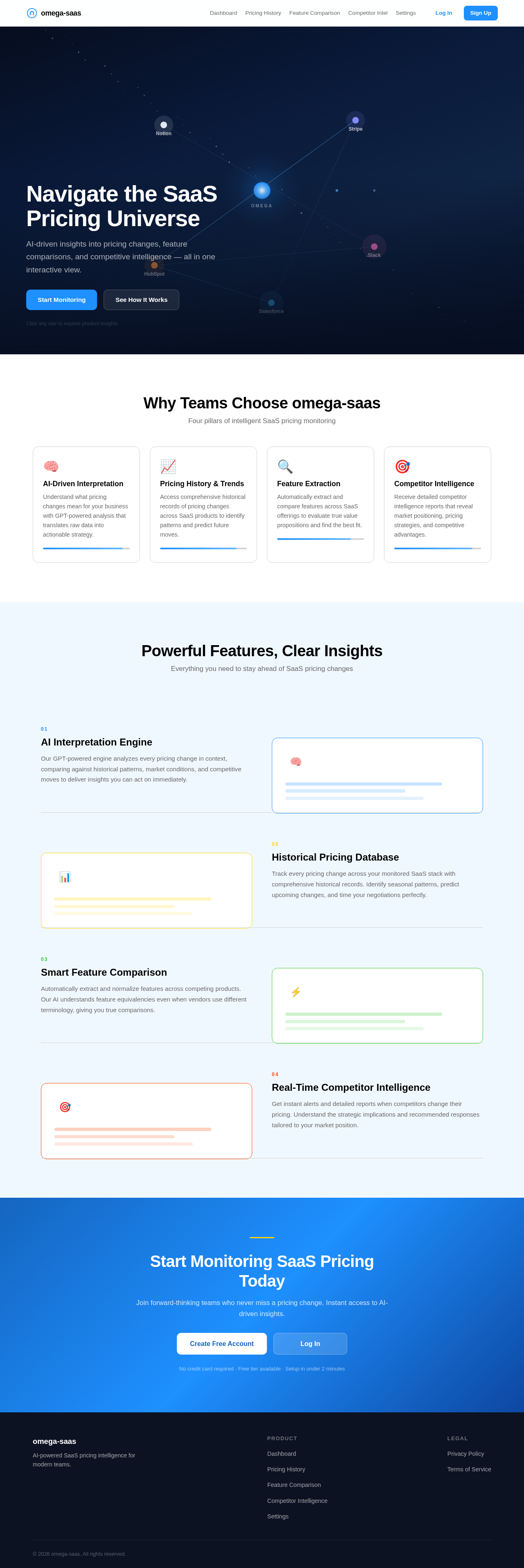
Navigate the SaaS Pricing Universe
AI-driven insights into pricing changes, feature comparisons, and competitive intelligence — all in one interactive view.
Click any star to explore product insights
Why Teams Choose omega-saas
Four pillars of intelligent SaaS pricing monitoring
AI-Driven Interpretation
Understand what pricing changes mean for your business with GPT-powered analysis that translates raw data into actionable strategy.
Pricing History & Trends
Access comprehensive historical records of pricing changes across SaaS products to identify patterns and predict future moves.
Feature Extraction
Automatically extract and compare features across SaaS offerings to evaluate true value propositions and find the best fit.
Competitor Intelligence
Receive detailed competitor intelligence reports that reveal market positioning, pricing strategies, and competitive advantages.
Powerful Features, Clear Insights
Everything you need to stay ahead of SaaS pricing changes
AI Interpretation Engine
Our GPT-powered engine analyzes every pricing change in context, comparing against historical patterns, market conditions, and competitive moves to deliver insights you can act on immediately.
Historical Pricing Database
Track every pricing change across your monitored SaaS stack with comprehensive historical records. Identify seasonal patterns, predict upcoming changes, and time your negotiations perfectly.
Smart Feature Comparison
Automatically extract and normalize features across competing products. Our AI understands feature equivalencies even when vendors use different terminology, giving you true comparisons.
Real-Time Competitor Intelligence
Get instant alerts and detailed reports when competitors change their pricing. Understand the strategic implications and recommended responses tailored to your market position.
Start Monitoring SaaS Pricing Today
Join forward-thinking teams who never miss a pricing change. Instant access to AI-driven insights.
No credit card required · Free tier available · Setup in under 2 minutes
Navigate the SaaS Pricing Universe
AI-driven insights into pricing changes, feature comparisons, and competitive intelligence — all in one interactive view.
Click any star to explore product insights
Why Teams Choose omega-saas
Four pillars of intelligent SaaS pricing monitoring
AI-Driven Interpretation
Understand what pricing changes mean for your business with GPT-powered analysis that translates raw data into actionable strategy.
Pricing History & Trends
Access comprehensive historical records of pricing changes across SaaS products to identify patterns and predict future moves.
Feature Extraction
Automatically extract and compare features across SaaS offerings to evaluate true value propositions and find the best fit.
Competitor Intelligence
Receive detailed competitor intelligence reports that reveal market positioning, pricing strategies, and competitive advantages.
Powerful Features, Clear Insights
Everything you need to stay ahead of SaaS pricing changes
AI Interpretation Engine
Our GPT-powered engine analyzes every pricing change in context, comparing against historical patterns, market conditions, and competitive moves to deliver insights you can act on immediately.
Historical Pricing Database
Track every pricing change across your monitored SaaS stack with comprehensive historical records. Identify seasonal patterns, predict upcoming changes, and time your negotiations perfectly.
Smart Feature Comparison
Automatically extract and normalize features across competing products. Our AI understands feature equivalencies even when vendors use different terminology, giving you true comparisons.
Real-Time Competitor Intelligence
Get instant alerts and detailed reports when competitors change their pricing. Understand the strategic implications and recommended responses tailored to your market position.
Start Monitoring SaaS Pricing Today
Join forward-thinking teams who never miss a pricing change. Instant access to AI-driven insights.
No credit card required · Free tier available · Setup in under 2 minutes
No comments yet. Be the first!