mint-technician
 Arhan Danawala
🏭 AI Technician Dispatch System Full Technical Scope & Logic Documentation 1. Product Overview Product Name TechDispatch AI (Working Name) Product Type Industrial Automation Platform One Line Description AI-powered technician dispatch system that automatically assigns repair technicians when machines break. 2. Core Problem When machines break: Production stops Revenue loss Manual technician search Delayed repairs Current workflow: Machine breaks ↓ Manager calls technician ↓ Technician busy ↓ Call another ↓ Delay ↓ Machine idle This causes: Downtime Lost revenue Production delays 3. System Overview Main Components 1. Factory Dashboard Used by factory managers 2. Technician Mobile App Used by technicians 3. AI Dispatch Engine Matches technician automatically 4. Analytics Engine Tracks downtime and repairs 5. Notification System Real-time alerts 4. Full System Flow Main Flow Machine breaks ↓ Operator creates ticket ↓ AI detects issue type ↓ AI finds best technician ↓ Technician notified ↓ Technician accepts ↓ Technician travels ↓ Repair completed ↓ Report generated 5. Feature List (Core Features) Feature 1 — Breakdown Ticket System Purpose Create repair request instantly Inputs Machine ID Problem description Priority Location Logic User clicks: "Machine Breakdown" System creates ticket: { "machine": "CNC Machine", "issue": "Motor not working", "priority": "High" } Feature 2 — AI Technician Matching Matching Parameters Skill required Location Availability Experience Rating Matching Logic Score Calculation score = skill_match + distance_score + availability_score + rating_score Highest score technician selected Feature 3 — Auto Dispatch System Flow Ticket created ↓ AI selects technician ↓ Send notification ↓ Technician accepts Feature 4 — Technician Mobile App Features Receive job Accept job View location Start repair Upload images Complete job Feature 5 — Live GPS Tracking Flow Technician accepts ↓ GPS tracking starts ↓ Factory sees ETA Feature 6 — Work Order System Features Job details Machine info Repair instructions Past history Example: Machine History: Last repair: 2 weeks ago Issue: motor failure Feature 7 — Offline Mode (Important) Technicians may work in: Factories Basements Low network areas System: Save data offline Sync when online Feature 8 — Notification System Send alerts: Job assigned Technician accepted Technician arrived Repair completed Feature 9 — Analytics Dashboard Track: Downtime Repair time Technician performance Machine issues Example: Machine A Downtime: 4 hours Repairs: 3 Feature 10 — Multi Technician Support If one technician unavailable: AI automatically assigns another Feature 11 — Smart Priority System Priority Types Critical High Medium Low AI dispatches: Critical → fastest technician Feature 12 — Predictive Maintenance (Future) IoT sensor detects: Temperature rise Vibration Pressure System creates ticket automatically 6. User Roles Factory Manager Create job Track technician View analytics Technician Accept job Complete repair Upload report Admin Manage system Add technicians Monitor performance 7. Database Structure Tables Factories id name location Machines id factory_id machine_name Technicians id name skills location Jobs id machine_id technician_id status 8. API Structure Create Job POST /job/create Assign Technician POST /job/assign Get Status GET /job/status 9. Tech Stack Frontend Next.js React Tailwind Backend Node.js Express Database PostgreSQL Supabase Mobile React Native Maps Google Maps API Notifications Firebase 10. AI Dispatch Logic When job created: Step 1 Find technicians with skill Step 2 Sort by distance Step 3 Sort by availability Step 4 Assign best technician 11. MVP Scope Phase 1 Job creation Technician matching Notifications Phase 2 Tracking Analytics Phase 3 Predictive maintenance 12. Why This Product Is Strong High urgency problem Factories pay quickly Real business pain Scalable SaaS 13. Future Expansion Spare parts system Technician marketplace AI diagnostics Predictive maintenance 14. Long Term Vision Become: "Uber for Industrial Technicians"

Comments (0)
Sign in to leave a comment
System Requirements
System Requirements Document (SRD) for mint-technician
1. Introduction
The mint-technician project is an AI-powered technician dispatch system designed to revolutionize industrial automation by minimizing machine downtime and optimizing technician workflows. This document outlines the system requirements for the project, tailored to address the unique challenges faced by factories in India (IN) and beyond. By automating technician assignment and integrating predictive maintenance, mint-technician aims to become the "Uber for Industrial Technicians."
2. System Overview
The mint-technician system is a comprehensive platform that connects factory managers, technicians, and AI-powered dispatch engines to ensure rapid and efficient machine repairs. The system is composed of the following key components:
- Factory Dashboard: A web-based interface for factory managers to create jobs, track technicians, and view analytics.
- Technician Mobile App: A mobile application for technicians to receive job assignments, upload reports, and work offline.
- AI Dispatch Engine: An intelligent system that matches technicians to jobs based on skills, location, availability, and other parameters.
- Analytics Engine: A tool for tracking machine downtime, repair times, and technician performance.
- Notification System: Real-time alerts for job assignments, technician updates, and repair completions.
3. Functional Requirements
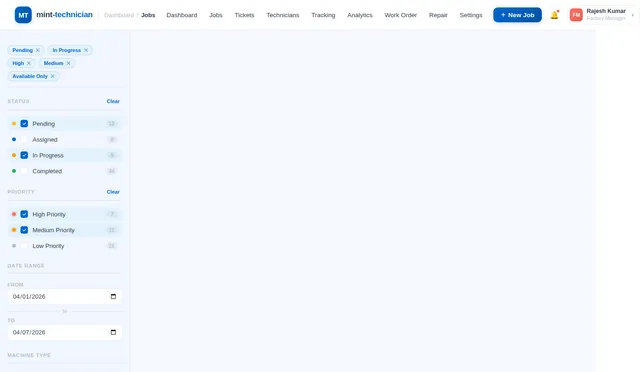
- As a Factory Manager, I should be able to create repair tickets with machine details, issue descriptions, priority levels, and locations.
- As a Factory Manager, I should be able to track the real-time location and ETA of assigned technicians.
- As a Technician, I should be able to accept or decline job assignments through the mobile app.
- As a Technician, I should be able to upload repair reports, including images and notes, after completing a job.
- As a Technician, I should be able to work offline and sync data when back online.
- As an Admin, I should be able to manage the system, add technicians, and monitor overall performance.
- As a System, I should automatically assign the best technician based on skills, location, availability, and rating.
- As a System, I should send real-time notifications for job assignments, technician arrivals, and repair completions.
- As a System, I should provide analytics on machine downtime, repair times, and technician performance.
- As a System, I should support predictive maintenance by creating tickets automatically based on IoT sensor data.
4. User Personas
1. Factory Manager
- Role: Oversees factory operations and ensures minimal downtime.
- Responsibilities: Create jobs, track technicians, and analyze repair data.
- Pain Points: Delayed repairs, lack of technician availability, and production losses.
2. Technician
- Role: Performs machine repairs and uploads reports.
- Responsibilities: Accept jobs, travel to locations, complete repairs, and sync offline data.
- Pain Points: Poor network connectivity, unclear job details, and inefficient dispatching.
3. Admin
- Role: Manages the system and ensures smooth operations.
- Responsibilities: Add technicians, monitor system performance, and resolve escalations.
- Pain Points: System downtime, inaccurate technician data, and lack of control over assignments.
5. Visuals Colors and Theme
Color Palette
- Background: #F5F9FF (Soft Sky Blue)
- Surface: #FFFFFF (Pure White)
- Text: #2C3E50 (Deep Navy Blue)
- Accent: #FF6F61 (Vibrant Coral)
- Muted Tones: #B0BEC5 (Cool Gray)
This palette reflects a professional, clean, and modern aesthetic suitable for industrial environments while maintaining a user-friendly interface.
6. Signature Design Concept
Interactive Factory Blueprint Homepage
The homepage of mint-technician will feature an interactive factory blueprint design. Users will see a dynamic, 3D-rendered blueprint of a factory floor, with clickable machine icons representing different equipment. When a machine icon is clicked, a pop-up will display its status (e.g., "Operational," "Needs Repair") and allow users to create a repair ticket instantly.
Key Features:
- Hover Animations: Machines will glow subtly when hovered over, indicating interactivity.
- Real-Time Updates: Machines needing repair will pulse in red, while operational machines will remain static.
- Smooth Transitions: Clicking a machine will zoom into its section of the blueprint, providing detailed information.
- Ambient Effects: A faint hum of machinery and occasional sparks will play in the background, immersing users in the factory environment.
This bold and immersive design will make the platform instantly memorable and engaging for users.
7. Non-Functional Requirements
- Performance: The system should handle up to 10,000 concurrent users with minimal latency.
- Scalability: The architecture must support adding new factories, machines, and technicians without significant rework.
- Reliability: Ensure 99.9% uptime for critical components like the AI Dispatch Engine.
- Security: Implement role-based access control (RBAC) and encrypt sensitive data.
- Localization: Support Indian languages (e.g., Hindi, Gujarati) and regional time zones (IST).
8. Tech Stack
Frontend
- React for Web
- React Native for Mobile App
Backend
- Python
- FastAPI
Database
- MySQL (with Alembic for migrations)
AI Models
- GPT 5.4 for user-friendly responses
- Gemini 3.1 Pro for conversational interactions
AI Tools
- LangChain
- LiteLLM for LLM Routing
Orchestration
- Docker and Docker-Compose for local development
- Kubernetes for server-side orchestration
9. Assumptions and Constraints
-
Assumptions:
- Technicians will have smartphones with GPS capabilities.
- Factory managers will have access to a stable internet connection.
- IoT sensors will be integrated into machines for predictive maintenance.
-
Constraints:
- Offline functionality must be robust due to potential network issues in factory environments.
- The system must comply with Indian data protection laws (e.g., PDP Bill).
10. Glossary
- AI Dispatch Engine: The system component responsible for matching technicians to jobs.
- IoT Sensors: Devices that monitor machine conditions (e.g., temperature, vibration) and send data to the system.
- Offline Mode: A feature allowing technicians to work without internet connectivity and sync data later.
- Predictive Maintenance: The use of IoT data to predict and prevent machine failures before they occur.
- RBAC: Role-Based Access Control, a method of restricting system access based on user roles.
End of Document

Industrial Technician
Dispatch Reimagined
Slash machine downtime by 40% with AI-driven technician assignments. Real-time tracking, predictive maintenance, and offline-ready tools — dispatching the right technician in under 2 minutes.
Avg. Assignment
< 2 min
Downtime Reduced
40%
Interactive Factory Blueprint
Monitor every machine in real time. Click any unit to view status, performance metrics, and create repair tickets instantly.
Everything You Need to Eliminate Downtime
Purpose-built tools that connect factory managers, technicians, and AI to keep your production lines running at peak efficiency.
AI-Powered Dispatch
Our intelligent engine automatically matches the best technician to every job based on skills, proximity, availability, and past performance ratings.
Real-Time Tracking
Track technician location and ETA in real time from your dashboard. Know exactly when help arrives at the factory floor.
Offline-First Technician App
Technicians can accept jobs, upload repair reports with photos, and log notes even without network connectivity. Data syncs automatically when back online.
Predictive Maintenance
Leverage IoT sensor data to predict machine failures before they happen. Auto-generated tickets keep your production line running smoothly.
Analytics Dashboard
Deep insights into machine downtime, repair durations, and technician performance. Make data-driven decisions to optimize your operations.
Seamless Notifications
Real-time alerts for job assignments, technician arrivals, and repair completions keep every stakeholder in the loop instantly.
Numbers That Speak for Themselves
Built for industrial-scale reliability, mint-technician delivers measurable results from day one.
Tailored for Every Team Member
From the factory floor to the control room, mint-technician adapts to the unique needs of each role in your operation.
Factory Manager
Oversees factory operations and ensures minimal machine downtime across the production floor.
✓Key Responsibilities
- Create and prioritize repair tickets
- Track technician location and ETA in real time
- Analyze repair data and downtime metrics
⚠Pain Points
- Delayed repairs causing production losses
- Limited visibility into technician availability
- Manual dispatching leads to inefficiency
View Manager Dashboard→
Technician
Performs on-site machine repairs and uploads detailed completion reports from the field.
✓Key Responsibilities
- Accept or decline job assignments on mobile
- Complete repairs and upload reports with photos
- Work offline and sync data when connected
⚠Pain Points
- Poor network connectivity at factory sites
- Unclear job details and machine specifications
- Inefficient routing between job locations
Download Technician App→
System Admin
Manages the platform, configures dispatch rules, and ensures smooth system-wide operations.
✓Key Responsibilities
- Add and manage technician profiles
- Monitor system performance and uptime
- Resolve escalations and override assignments
⚠Pain Points
- System downtime impacting all operations
- Inaccurate technician skill and location data
- Limited control over automated assignments
Configure System→
From Ticket to Insight in Six Steps
Our AI-powered dispatch system streamlines every stage of the repair workflow, reducing downtime and keeping your factory running at peak efficiency.
Factory Manager Creates Ticket
A manager logs a repair ticket with machine details, issue severity, and location directly from the Factory Dashboard.
AI Engine Analyzes & Dispatches
Our intelligent dispatch engine evaluates technician skills, proximity, availability, and rating to assign the optimal match.
Technician Accepts Job
The assigned technician receives a real-time notification and accepts the job through the mobile app, even offline.
Real-Time Tracking
Factory managers track the technician live location and ETA on an interactive map as they travel to the site.
Job Completion & Report Upload
Upon finishing the repair, the technician uploads a detailed report with photos, notes, and parts used.
Analytics & Insights
The Analytics Engine compiles downtime metrics, repair times, and technician performance into actionable dashboards.
Factory Manager Creates Ticket
A manager logs a repair ticket with machine details, issue severity, and location directly from the Factory Dashboard.
AI Engine Analyzes & Dispatches
Our intelligent dispatch engine evaluates technician skills, proximity, availability, and rating to assign the optimal match.
Technician Accepts Job
The assigned technician receives a real-time notification and accepts the job through the mobile app, even offline.
Real-Time Tracking
Factory managers track the technician live location and ETA on an interactive map as they travel to the site.
Job Completion & Report Upload
Upon finishing the repair, the technician uploads a detailed report with photos, notes, and parts used.
Analytics & Insights
The Analytics Engine compiles downtime metrics, repair times, and technician performance into actionable dashboards.
Trusted by Factory Teams Across India
Hear how mint-technician is transforming industrial maintenance for factory managers, technicians, and operations leaders.
Since implementing mint-technician, our average repair response time dropped from 45 minutes to under 2 minutes. The AI dispatch engine assigns the right technician every time, and our production losses have decreased by 40%.
The offline-first mobile app is a game changer. I can accept jobs, view machine details, and upload reports even in areas with poor connectivity. When I'm back online, everything syncs seamlessly.
The predictive maintenance alerts from IoT sensors have helped us prevent 3 major breakdowns this quarter alone. We went from reactive firefighting to proactive maintenance planning.
Managing 50+ technicians across multiple sites used to be chaotic. Now I have real-time tracking, performance analytics, and automated dispatching all in one dashboard. It is incredibly efficient.
The analytics engine gives us deep visibility into machine downtime patterns. We have identified recurring issues and optimized our spare parts inventory, saving over 25% on maintenance costs.
What impressed me most is the real-time notification system. Factory managers get instant updates when a technician is en route, arrives, or completes a repair. Total transparency across the board.
Simple, Transparent Pricing
Choose the plan that fits your factory. Scale as you grow with no hidden fees. All plans include a 14-day free trial.
Starter
Perfect for small factories getting started with smart dispatch.
Billed monthly
What's included
- Up to 5 technicians
- AI-powered dispatch
- Real-time notifications
- Basic analytics dashboard
- Email support
- GPS live tracking
- Predictive maintenance
- Custom integrations
Professional
For growing operations that need full visibility and automation.
Billed monthly
What's included
- Up to 50 technicians
- AI-powered dispatch
- Real-time notifications
- Advanced analytics & reports
- Priority support (24/7)
- GPS live tracking & ETA
- Offline mode sync
- Predictive maintenance
Enterprise
Unlimited scale with IoT integration and dedicated support.
Tailored to your factory needs
What's included
- Unlimited technicians
- AI dispatch + custom rules
- Real-time notifications
- Full analytics suite
- Dedicated account manager
- GPS live tracking & ETA
- Offline mode sync
- Predictive maintenance (IoT)
Ready to Transform Your Factory?
Join hundreds of factories across India that have slashed machine downtime by 40% with AI-powered technician dispatch. Get your first repair ticket resolved in under 2 minutes.
No comments yet. Be the first!