mercy-rv
 Sai Noothanapati
RV park / campground reservation systems The recreation boom left thousands of small parks booking by phone and paper calendars. They need site maps, deposits, seasonal rates, and double-booking prevention. No-code front end + Stripe + hosted DB, $10K–$30K MRR realistic, with owners signing up fast because stopping double-bookings is urgent. build me this micro saas


Comments (0)
Sign in to leave a comment
System Requirements
System Requirements Document for mercy-rv
1. Introduction
The mercy-rv project aims to develop a micro SaaS solution for RV parks and campgrounds, addressing the urgent need for modern reservation systems. The product is designed for small park operators who currently rely on phone and paper calendars. The system will provide site maps, handle deposits, manage seasonal rates, and prevent double-bookings. The solution will feature a no-code front end, Stripe integration for payments, and a hosted database, targeting a monthly recurring revenue (MRR) of $10K–$30K.
2. System Overview
The mercy-rv system will deliver a comprehensive reservation management solution for RV parks and campgrounds. It will enable park owners to manage bookings efficiently, prevent double-bookings, and handle financial transactions seamlessly. The system will be accessible via a no-code front end, ensuring ease of use for non-technical users. Stripe will be integrated for secure payment processing, and the system will utilize a hosted database for data management.
2a. Product Interpretation and Delivery Boundary
The product will be delivered as a SaaS platform with a no-code interface, allowing park owners to manage their reservations without technical expertise. The system will be accessible online, with Stripe handling payment processing. The hosted database will store all reservation data securely. The system will not include features outside the specified scope, such as advanced analytics or third-party integrations beyond Stripe.
2b. Source Content Inventory
Not applicable as no explicit content_source directive is provided.
2c. Page Content and Component Coverage
Reservation Dashboard
- Information/State: Overview of current reservations, site availability, and seasonal rates.
- Primary Actions: Create new reservation, view site map, adjust seasonal rates.
- Supporting Actions: Filter reservations by date, export reservation data.
- Components: Site map display, reservation list, seasonal rate editor.
- States: Loading, empty (no reservations), success (reservation created), error (double-booking attempt).
Payment Processing
- Information/State: Payment status, deposit amounts, transaction history.
- Primary Actions: Process payment, refund deposit.
- Supporting Actions: View transaction history, update payment details.
- Components: Stripe payment integration, deposit management.
- States: Loading, success (payment processed), error (payment failed).
Site Management
- Information/State: Site details, availability, and booking rules.
- Primary Actions: Update site details, set availability.
- Supporting Actions: View site map, manage booking rules.
- Components: Site editor, availability calendar.
- States: Loading, success (site updated), error (invalid input).
3. Functional Requirements
- As a park owner, I should be able to view and manage reservations through a no-code front end to streamline booking processes and prevent double-bookings. (explicit)
- As a park owner, I should be able to integrate Stripe for payment processing to handle deposits and transactions securely. (explicit)
- As a park owner, I should be able to configure seasonal rates to reflect pricing changes throughout the year. (explicit)
- As a park owner, I should be able to view a site map to manage site availability and bookings visually. (explicit)
- As a park owner, I should be able to prevent double-bookings to ensure accurate reservation management. (explicit)
4. User Personas
- Park Owner: Responsible for managing reservations, processing payments, configuring seasonal rates, and ensuring site availability. The park owner values reliability, ease of use, and the prevention of double-bookings.
5. Core User Flows
Park Owner Reservation Management Flow
- Access Reservation Dashboard: The park owner logs into the system and accesses the reservation dashboard.
- View Current Reservations: The dashboard displays current reservations and site availability.
- Create New Reservation: The park owner selects an available site and enters reservation details.
- Process Payment: The system integrates with Stripe to process the deposit.
- Confirm Reservation: The reservation is confirmed, and the site map is updated to reflect the booking.
- Prevent Double-Booking: The system checks for conflicts and prevents double-bookings automatically.
Park Owner Seasonal Rate Configuration Flow
- Access Site Management: The park owner navigates to the site management section.
- Adjust Seasonal Rates: The park owner updates the seasonal rates for different periods.
- Save Changes: The system saves the updated rates and applies them to future reservations.
6. Visuals Colors and Theme
- Muse: Aaron Draplin
- Palette: Background #FAF3E0, Surface #FFFFFF, Text #333333, Primary #FF8C00, Accent #2A9D8F, Muted #E0E0E0
- Typography: Headings in Alfa Slab One, Body in Fira Sans, Modular scale 1.333
- Shape Language: Bold, utilitarian shapes with thick lines
- Layout: Chunky borders, ruled panels, badge-like navigation
- Imagery: Thick-line vector icons, halftone photos
7. Signature Design Concept
The public entry page will feature a full-width hero with oversized typography in Alfa Slab One over a kraft-paper textured background. The primary call-to-action button will be in bright orange, creating a bold and inviting entry point for users. Badge-style navigation with thick lines and shadows will guide users through the system, reinforcing the sturdy and reliable feel of the platform.
8. Interaction Model & Motion Direction
- Interaction Model: Static
- Motion Tempo: Restrained
- Hero Dimensionality: Flat
- Landing Hero Motion Brief: The hero section will feature a bold headline with a snap-in transition effect, emphasizing the reliability and straightforwardness of the system. The primary CTA will appear with a stamp effect, drawing immediate attention.
9. Non-Functional Requirements
- Performance: The system must handle concurrent reservations without performance degradation.
- Security: Payment processing must comply with PCI DSS standards.
- Usability: The no-code front end must be intuitive for non-technical users.
10. Tech Stack
- Front End: No-code platform
- Payment Processing: Stripe
- Database: Hosted database solution
- Backend: Python/FastAPI
11. Assumptions and Constraints
- Assumption: Park owners have basic internet access to use the system.
- Constraint: The system will not include advanced analytics or third-party integrations beyond Stripe.
12. Glossary
- No-code: A platform that allows users to create applications without traditional programming.
- Stripe: A technology company that builds economic infrastructure for the internet, primarily known for its payment processing software.
- Double-booking: The act of booking a single site or resource for two different parties at the same time.
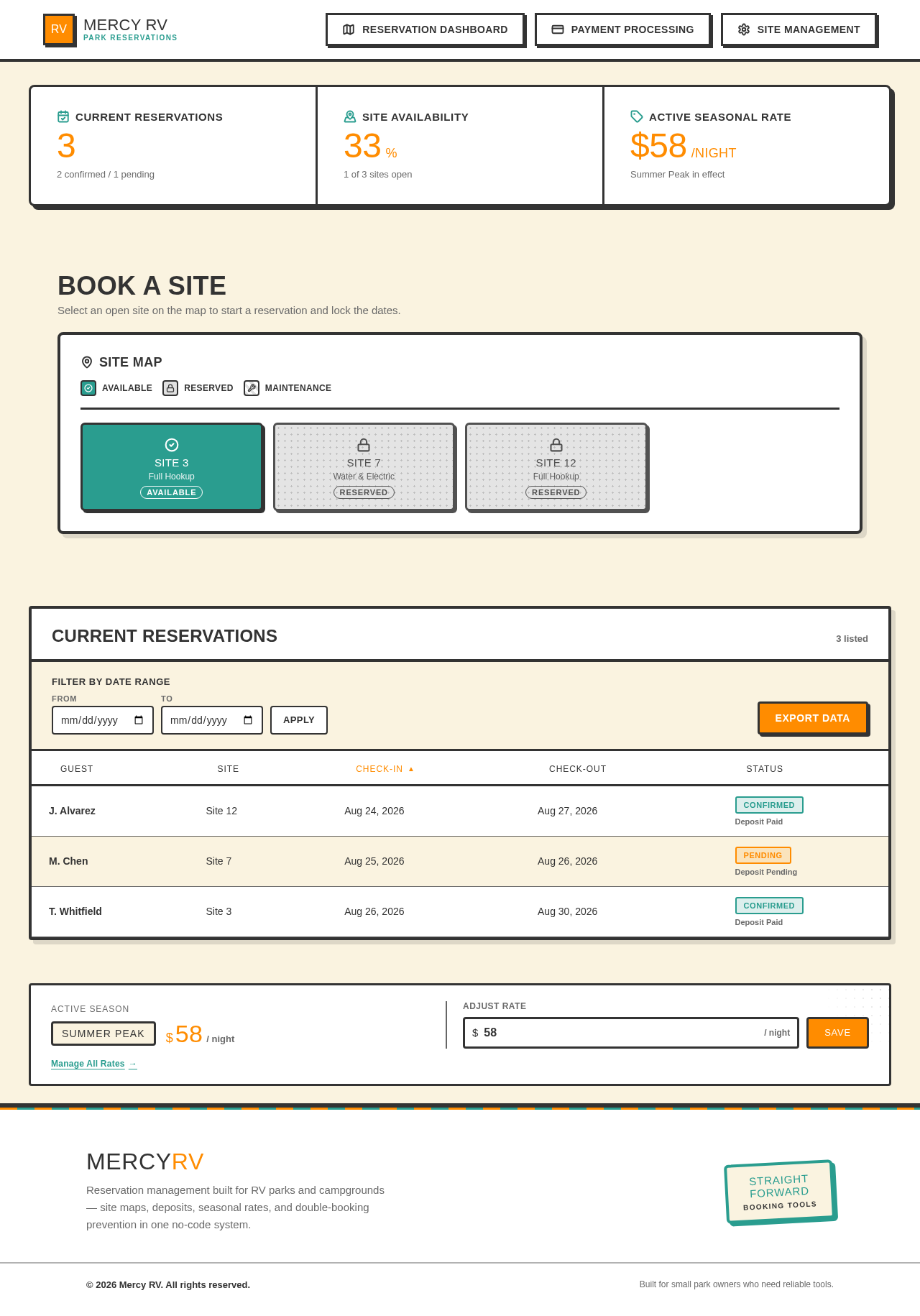
BOOK A SITE
Select an open site on the map to start a reservation and lock the dates.
Site Map
- Available
- Reserved
- Maintenance
Current Reservations
3 listed| J. Alvarez | Site 12 | Aug 24, 2026 | Aug 27, 2026 | confirmedDeposit Paid |
| M. Chen | Site 7 | Aug 25, 2026 | Aug 26, 2026 | pendingDeposit Pending |
| T. Whitfield | Site 3 | Aug 26, 2026 | Aug 30, 2026 | confirmedDeposit Paid |
BOOK A SITE
Select an open site on the map to start a reservation and lock the dates.
Site Map
- Available
- Reserved
- Maintenance
Current Reservations
3 listed| J. Alvarez | Site 12 | Aug 24, 2026 | Aug 27, 2026 | confirmedDeposit Paid |
| M. Chen | Site 7 | Aug 25, 2026 | Aug 26, 2026 | pendingDeposit Pending |
| T. Whitfield | Site 3 | Aug 26, 2026 | Aug 30, 2026 | confirmedDeposit Paid |
No comments yet. Be the first!