Page 1 of 5
System Requirements Document (SRD) for mercy-blog
1. Introduction
The mercy-blog project is a personal blogging platform designed for Bhupender Rawat, based in India. This platform will serve as a creative outlet for Bhupender to share thoughts, ideas, and experiences in a visually appealing and user-friendly manner. The document outlines the system requirements for the development of mercy-blog, focusing on its functionality, design, and technical implementation.
The blog will be developed using modern web technologies, including HTML, CSS, and JavaScript, ensuring a lightweight, responsive, and visually rich design. The platform will reflect Bhupender's unique style and cater to an Indian audience, considering locale-specific preferences such as time zones (IST) and cultural aesthetics.
Page 2 of 5
2. System Overview
The mercy-blog is a personal blogging website that enables Bhupender to create, manage, and share blog posts effortlessly. The platform will feature a clean and modern design, optimized for both desktop and mobile devices. Key features include:
- A simple and intuitive interface for creating and editing blog posts.
- A visually rich homepage showcasing recent posts.
- Categories and tags for organizing content.
- A search bar for easy navigation.
- Responsive design to ensure compatibility across devices.
- Smooth animations and transitions for an engaging user experience.
The system will be built using HTML, CSS, and JavaScript for the frontend, with the potential to scale to a more dynamic backend in future iterations.
3. Functional Requirements
- As Bhupender, I should be able to create, edit, and delete blog posts.
- As Bhupender, I should be able to categorize my posts using tags.
- As Bhupender, I should be able to upload images to my blog posts.
- As a visitor, I should be able to view all blog posts on the homepage.
- As a visitor, I should be able to search for specific posts using a search bar.
- As a visitor, I should be able to filter posts by categories or tags.
- As a visitor, I should be able to view a single blog post in detail.
4. User Personas
Page 3 of 5
4.1 Bhupender (Admin)
- Role: The sole author and administrator of the blog.
- Goals: Create and manage blog posts, organize content, and maintain the website.
- Technical Proficiency: Moderate; comfortable with basic web interfaces.
4.2 Visitor
- Role: A reader exploring the blog.
- Goals: Discover and read blog posts, navigate content easily, and enjoy a visually appealing experience.
- Technical Proficiency: Varies; includes users with minimal technical knowledge.
5. Visuals Colors and Theme
The mercy-blog will feature a unique and vibrant color palette that reflects creativity, warmth, and Bhupender's personal style. The colors are designed to create a welcoming and engaging atmosphere for readers.
- Background: #F5F3F4 (Soft Lavender Gray)
- Surface: #FFFFFF (Pure White)
- Text: #2E2E3A (Deep Slate)
- Accent: #FF7A59 (Sunset Orange)
- Muted Tones: #A6A6B0 (Muted Lilac)
This palette combines soft, warm, and neutral tones to ensure readability and aesthetic appeal while maintaining a modern and inviting look.
Page 4 of 5
6. Signature Design Concept
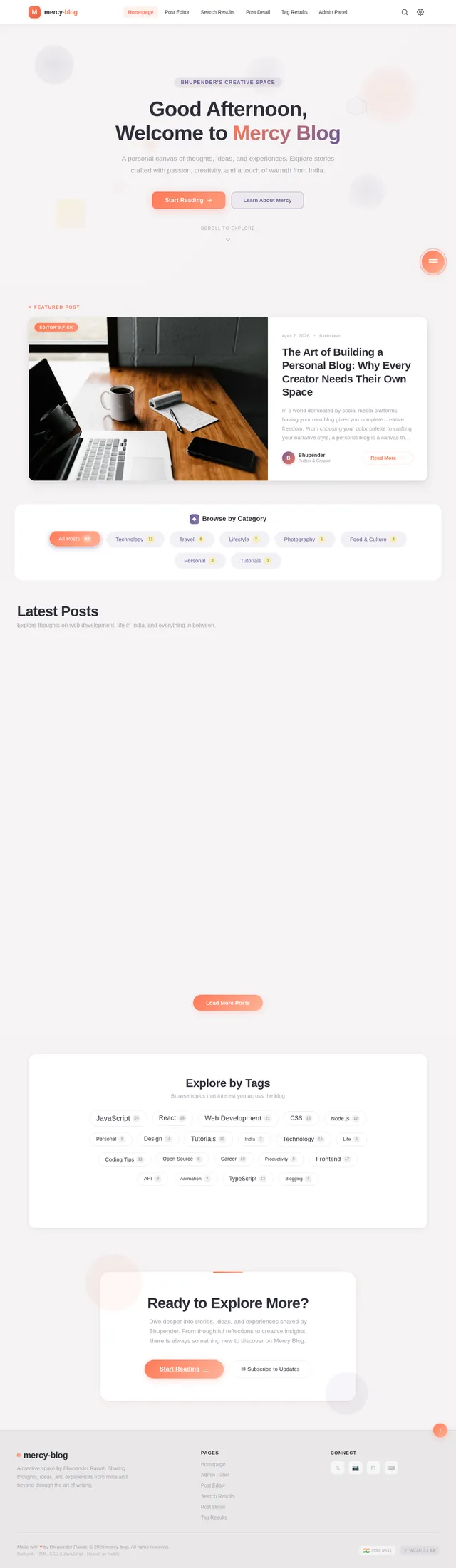
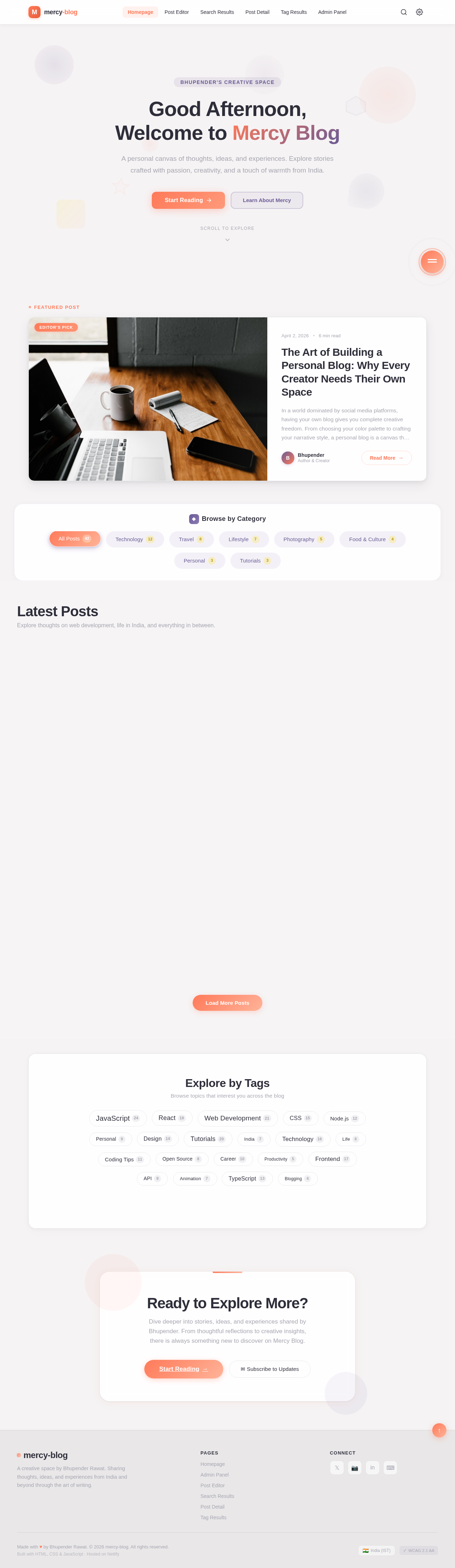
The homepage of mercy-blog will feature an interactive "Floating Canvas" design. The landing page will resemble a dynamic art canvas, where blog posts are represented as floating, animated cards that gently move in response to user interactions.
Key Features:
- Floating Card Animation: Each blog post will appear as a card that subtly "floats" and shifts when hovered over, creating a sense of depth and interactivity.
- Dynamic Background: The homepage background will feature a gradient that shifts colors based on the time of day, transitioning from a soft sunrise palette in the morning to a deep twilight gradient in the evening.
- Interactive Navigation: A circular navigation menu will expand outward when clicked, offering quick access to categories, tags, and the search bar.
- Micro-Interactions: Smooth animations for buttons, links, and hover states will enhance the user experience.
- Day/Night Mode: The website will automatically switch between light and dark themes based on the user's local time, ensuring a comfortable reading experience.
This design will make mercy-blog a visually stunning and memorable platform, offering an immersive experience for both Bhupender and his readers.
7. Non-Functional Requirements
- Performance: The website should load within 2 seconds on a standard 4G connection.
- Responsiveness: The design must adapt seamlessly to various screen sizes, including mobile, tablet, and desktop.
- Accessibility: The platform should comply with WCAG 2.1 AA standards to ensure usability for all users.
- Scalability: The system should be able to handle up to 10,000 monthly visitors without performance degradation.
- Security: Implement basic security measures to protect against common vulnerabilities (e.g., XSS, CSRF).
8. Tech Stack
Page 5 of 5
Frontend
- HTML, CSS, and JavaScript for the website's structure, styling, and interactivity.
Backend
- None required for the initial version (static site).
Hosting
- GitHub Pages or Netlify for hosting the static website.
9. Assumptions and Constraints
- The blog will be a single-author platform, with no multi-user functionality.
- The website will not require a backend or database for the initial version.
- All content (e.g., blog posts, images) will be managed manually via the HTML files.
- The platform will be optimized for Indian audiences, considering locale-specific preferences.
10. Glossary
- HTML: HyperText Markup Language, used for structuring web content.
- CSS: Cascading Style Sheets, used for styling web content.
- JavaScript: A programming language used for adding interactivity to web pages.
- WCAG: Web Content Accessibility Guidelines, a set of standards for making web content accessible.
- XSS: Cross-Site Scripting, a security vulnerability.
- CSRF: Cross-Site Request Forgery, a security vulnerability.

 Editor’s Pick


No comments yet. Be the first!