Students
Cramming for an exam, you feed in lecture notes, chapters or a topic and pull out a set of questions you can work through at speed.
 Harshal Suryavanshi
An AI-powered platform leveraging Natural Language Processing (NLP) to instantly generate high-quality Multiple Choice Questions (MCQs) from study material, notes, or topics to aid students in fast revision and educators in assessment creation.


Sign in to leave a comment
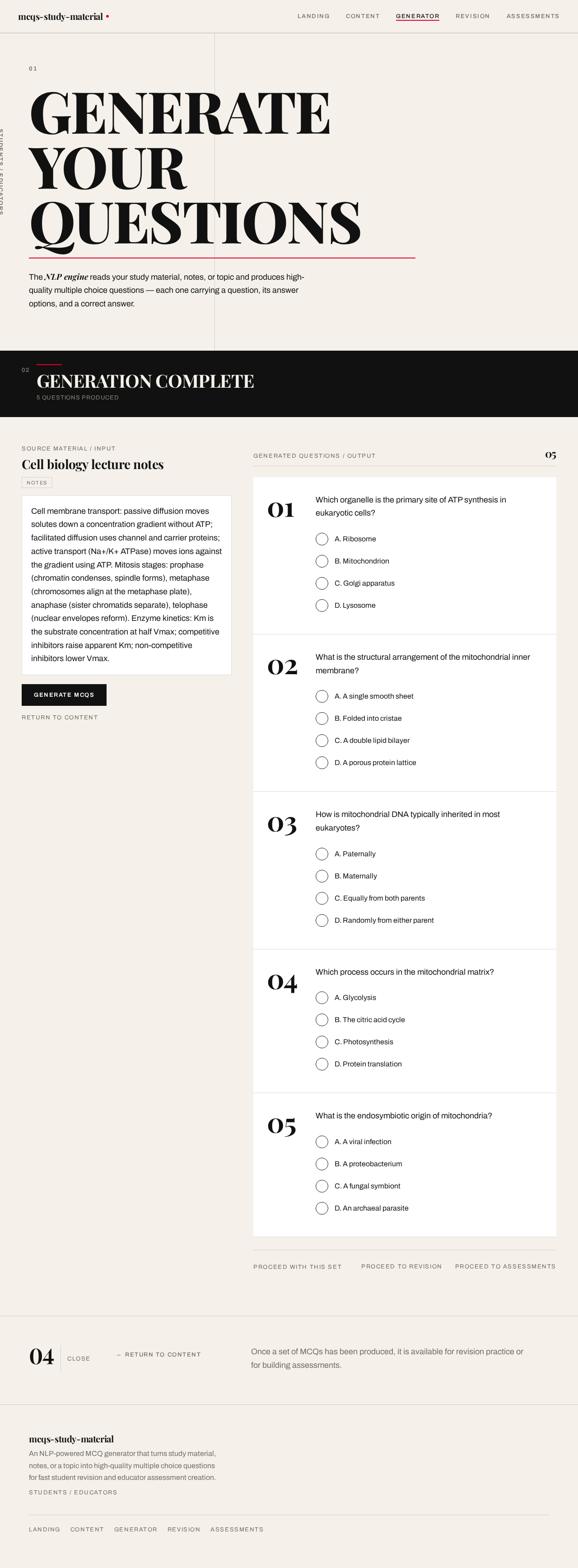
The NLP engine reads your study material, notes, or topic and produces high-quality multiple choice questions — each one carrying a question, its answer options, and a correct answer.
Source material / input
Cell membrane transport: passive diffusion moves solutes down a concentration gradient without ATP; facilitated diffusion uses channel and carrier proteins; active transport (Na+/K+ ATPase) moves ions against the gradient using ATP. Mitosis stages: prophase (chromatin condenses, spindle forms), metaphase (chromosomes align at the metaphase plate), anaphase (sister chromatids separate), telophase (nuclear envelopes reform). Enzyme kinetics: Km is the substrate concentration at half Vmax; competitive inhibitors raise apparent Km; non-competitive inhibitors lower Vmax.
Generated questions / output
05Which organelle is the primary site of ATP synthesis in eukaryotic cells?
What is the structural arrangement of the mitochondrial inner membrane?
How is mitochondrial DNA typically inherited in most eukaryotes?
Which process occurs in the mitochondrial matrix?
What is the endosymbiotic origin of mitochondria?
Proceed with this set
Once a set of MCQs has been produced, it is available for revision practice or for building assessments.
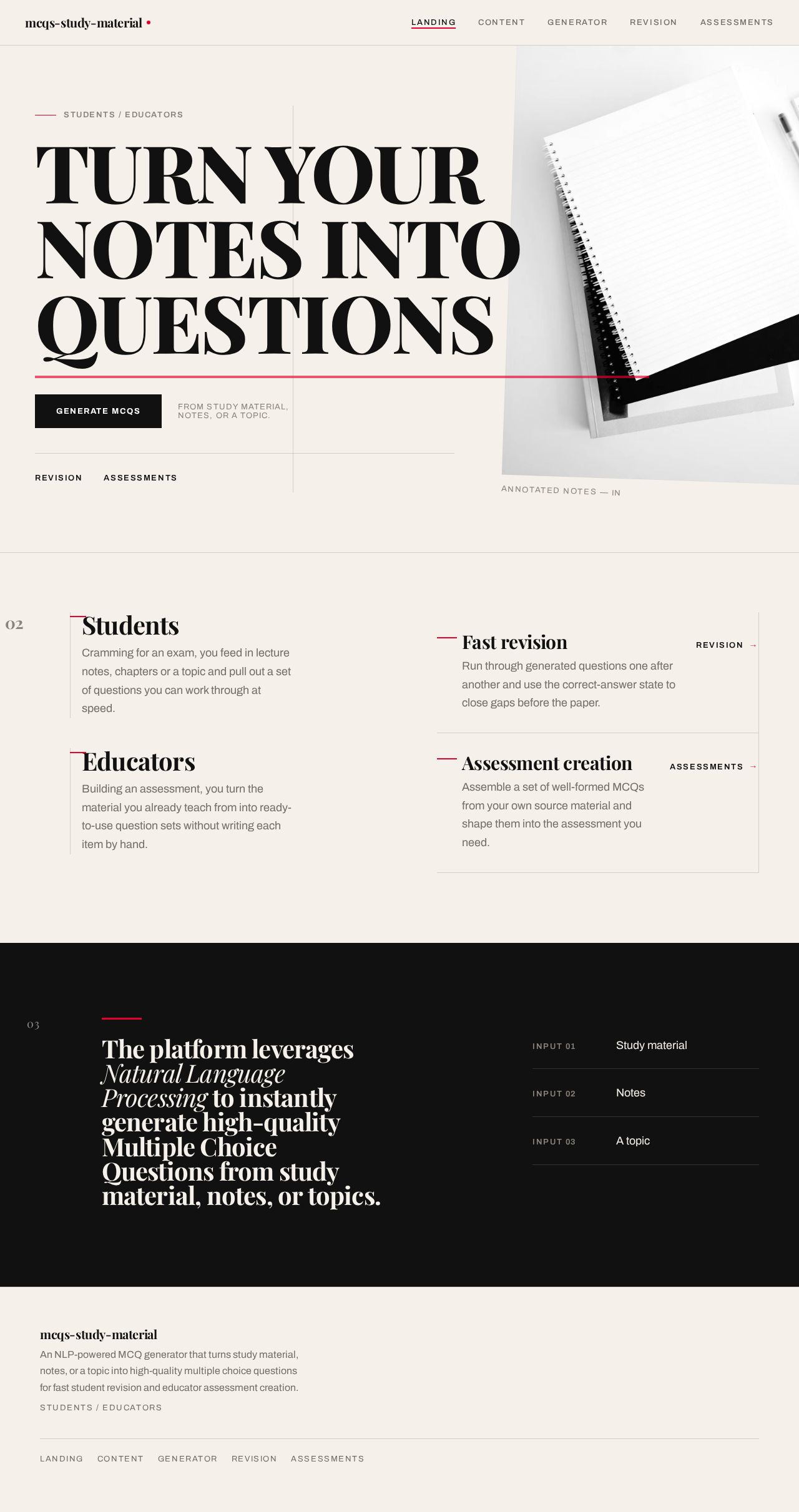

Students / Educators
From study material, notes, or a topic.
Cramming for an exam, you feed in lecture notes, chapters or a topic and pull out a set of questions you can work through at speed.
Building an assessment, you turn the material you already teach from into ready-to-use question sets without writing each item by hand.
Run through generated questions one after another and use the correct-answer state to close gaps before the paper.
Assemble a set of well-formed MCQs from your own source material and shape them into the assessment you need.
No comments yet. Be the first!