AI-Driven Predictions
XGBoost models trained on historical supply-chain signals forecast risk scores across suppliers, lanes, and shipments — surfacing the patterns analysts would otherwise have to find by hand.
Model Core Mathan A
AI Supply-Chain Risk Prediction Stack: Python + XGBoost + Time Series + AWS + FastAPI


Sign in to leave a comment
The mango-ai project is an AI-driven supply-chain risk prediction tool designed to assist supply-chain risk analysts in predicting and assessing potential risks using advanced AI models. The tool leverages Python, XGBoost, time-series methods, AWS, and FastAPI to deliver accurate and timely predictions, providing analysts with the insights needed to make informed decisions.
The mango-ai system is designed to predict supply-chain risks using AI models. It is built on a stack that includes Python, XGBoost, time-series analysis, AWS, and FastAPI. The system is intended for use by supply-chain risk analysts who will interact with the tool to review predictions and assess risks. The system includes several custom pages for user interaction, each serving a specific part of the prediction and assessment lifecycle.
The mango-ai system is delivered as a web application with custom UI components. It requires analysts to self-enroll and verify their identity to access protected prediction and assessment functionalities. The system's backend is responsible for handling data storage, prediction runs, and model outputs. The application is designed to be accessed via a secure login, ensuring that only authorized analysts can access sensitive prediction data.
Not applicable as no content_source directive was provided.
Enrollment and Login Flow:
Data Management and Prediction Flow:
Prediction Analysis Flow:
Risk Assessment Flow:
The Landing page will feature a full-bleed 3D scene with floating glass panels overlaid with dynamic data streams. Electric cyan glows will highlight interactive elements, creating an immersive experience that emphasizes the tool's advanced AI capabilities.
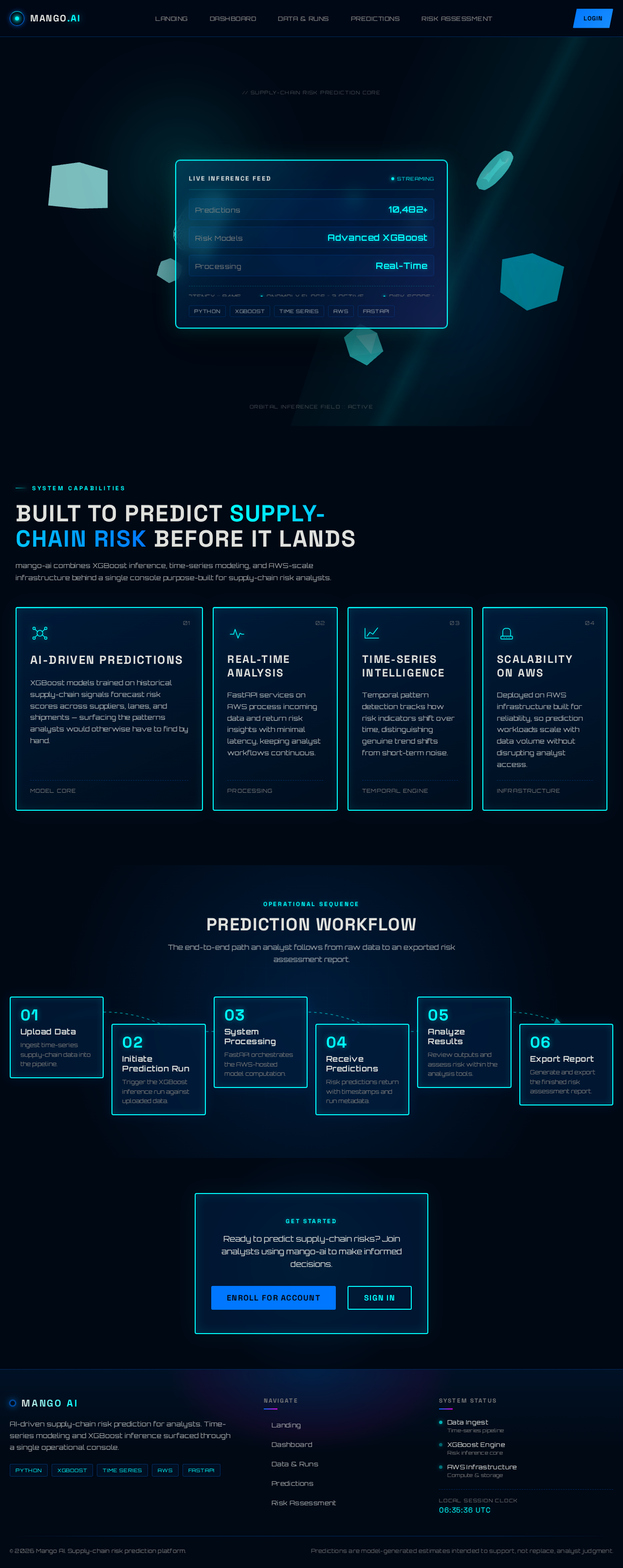
System Capabilities
mango-ai combines XGBoost inference, time-series modeling, and AWS-scale infrastructure behind a single console purpose-built for supply-chain risk analysts.
XGBoost models trained on historical supply-chain signals forecast risk scores across suppliers, lanes, and shipments — surfacing the patterns analysts would otherwise have to find by hand.
Model CoreFastAPI services on AWS process incoming data and return risk insights with minimal latency, keeping analyst workflows continuous.
ProcessingTemporal pattern detection tracks how risk indicators shift over time, distinguishing genuine trend shifts from short-term noise.
Temporal EngineDeployed on AWS infrastructure built for reliability, so prediction workloads scale with data volume without disrupting analyst access.
InfrastructureThe end-to-end path an analyst follows from raw data to an exported risk assessment report.
Upload Data
Ingest time-series supply-chain data into the pipeline.
Initiate Prediction Run
Trigger the XGBoost inference run against uploaded data.
System Processing
FastAPI orchestrates the AWS-hosted model computation.
Receive Predictions
Risk predictions return with timestamps and run metadata.
Analyze Results
Review outputs and assess risk within the analysis tools.
Export Report
Generate and export the finished risk assessment report.
Ready to predict supply-chain risks? Join analysts using mango-ai to make informed decisions.
System Capabilities
mango-ai combines XGBoost inference, time-series modeling, and AWS-scale infrastructure behind a single console purpose-built for supply-chain risk analysts.
XGBoost models trained on historical supply-chain signals forecast risk scores across suppliers, lanes, and shipments — surfacing the patterns analysts would otherwise have to find by hand.
Model CoreFastAPI services on AWS process incoming data and return risk insights with minimal latency, keeping analyst workflows continuous.
ProcessingTemporal pattern detection tracks how risk indicators shift over time, distinguishing genuine trend shifts from short-term noise.
Temporal EngineDeployed on AWS infrastructure built for reliability, so prediction workloads scale with data volume without disrupting analyst access.
InfrastructureThe end-to-end path an analyst follows from raw data to an exported risk assessment report.
Upload Data
Ingest time-series supply-chain data into the pipeline.
Initiate Prediction Run
Trigger the XGBoost inference run against uploaded data.
System Processing
FastAPI orchestrates the AWS-hosted model computation.
Receive Predictions
Risk predictions return with timestamps and run metadata.
Analyze Results
Review outputs and assess risk within the analysis tools.
Export Report
Generate and export the finished risk assessment report.
Ready to predict supply-chain risks? Join analysts using mango-ai to make informed decisions.
No comments yet. Be the first!