01STRUCTURE
Market structure, mapped in real time.
SEQHH · HLBOS1H
 Dev Kadiya
Hello

Sign in to leave a comment
FXIS.AI is an AI-driven market-analysis product for traders and technically literate visitors. Its defining claim is a Smart Money Concepts (SMC), ICT, and Fibonacci price-action engine that systematically analyzes the market and surfaces high-probability trade setups only when multiple confirmations align. The product is delivered as a website whose public entry surface, Landing, must make a visitor believe the intelligence is real, deep, and fast — a machine that sees the market more clearly than they do.
This document is the System Requirements Document for the project named lemon-hello, describing the FXIS.AI product. Its audience is the engineering and design team building the Landing experience and the shared backend that supports it, plus the product owner (Dev Kadiya, IN) reviewing scope.
The authoritative requirement thread establishes one current product commitment: the product is an app or website named FXIS.AI. The Planning Scope supplies a closed persona catalog (Visitor) and a closed, ordered page contract (Landing, anonymous access). The creative direction supplies the visual and motion language. No authenticated terminal, account system, or trading execution capability is accepted by the source; the CTA label "Open the terminal" is a visual/verbal gesture within the Landing surface, not an accepted destination.
prefers-reduced-motion, the page is fully readable and usable in a static arrangement.FXIS.AI is a single-surface public website. The current delivery consists of:
Actors. The only active human actor is the Visitor (anonymous). The backend and database are non-persona system actors supporting the Landing surface.
Accepted behavior. The Visitor arrives anonymously at Landing, reads the product proposition, observes the live market-structure visualization and ticker data, and takes the site's primary next step (the single teal-bordered CTA). The product's analytical claim (SMC/ICT/Fibonacci trade setups on multiple confirmations) is communicated on Landing; no separate analysis workspace is accepted.
Ownership. Landing is owned by the application and is anonymously reachable (access_requirement: none). No application-owned identity, session continuity, or differentiated permissions are established by the source.
Narrow exclusions. No authenticated terminal, account creation, trading execution, brokerage integration, or portfolio management is accepted. The reusable skill smc-ict-fibonacci-trading-assistant informs the product's analytical framing and the content of the instrument panels; it does not create a separate user-invoked analysis destination.
Removed from scope
FXIS.AI is delivered as a public, anonymous website. Everything a Visitor needs to understand the product and decide whether to engage is available on Landing without identity establishment. The application owns the Landing surface and the backend APIs that feed its market data; the database is application-owned persistence for that data.
The current horizon is the Landing experience only. The CTA "Open the terminal" is a visual and verbal element of the hero; because no terminal destination is accepted by the source, the CTA's primary next step is expressed within the Landing surface (for example, revealing deeper instrument-panel detail or the product's analytical proposition) rather than navigating to an unaccepted destination. Any future authenticated terminal, account system, or execution capability is explicitly out of the current boundary and is not represented in pages, requirements, or flows.
Market data displayed on Landing (ticker values, liquidity nodes, imbalance markers, Fibonacci arcs) is presented as the product's analytical output. The backend supplies these values; the frontend renders them. No provider-owned surface is accepted; all Visitor-facing interaction is first-party.
Not applicable — no reference directive with content_source was supplied.
Purpose and information/state. The anonymous public entry surface. It explains what FXIS.AI is (an AI-driven SMC/ICT/Fibonacci market-analysis engine), what it offers (high-probability trade setups surfaced only on multiple confirmations), and presents the product's analytical output as live, credible data. States: loading (market data fetching), success (hero + ticker + panels rendered with data), empty/degraded (market data unavailable — panels show a static explanatory state), error (backend unreachable — a readable inline notice replaces data values without breaking layout).
Primary action. The single teal-bordered rectangular CTA "Open the terminal" (6px radius, 1px teal border, slow inner light sweep). Because no terminal destination is accepted, activating it reveals the deeper analytical proposition within Landing (expanded instrument-panel detail / the product's confirmation logic) rather than navigating away.
Supporting actions. Hovering data chips and stat blocks (120ms teal glow); scrolling through instrument panels (camera dolly and orb resolution into Fibonacci lattice); reading the HUD ticker strip.
Domain entities. Market ticker entries (symbol, value, direction up/down); market-structure nodes (liquidity pools, imbalance gaps, Fibonacci retracement arcs); instrument-panel records (numbered label, headline, data view).
Component responsibilities.
prefers-reduced-motion.FR-1 — Anonymous Landing access As a Visitor, I should reach the FXIS.AI Landing page without any account or sign-in, so that I can immediately learn what the product offers.
required_inference (page contract, access_requirement: none).FR-2 — Product proposition comprehension As a Visitor, I should see a clear statement of what FXIS.AI is and what it offers, so that I can decide whether to engage.
explicit (product is FXIS.AI; creative direction hero copy).FR-3 — Live market-structure visualization As a Visitor, I should see a real-time market-structure visualization, so that I believe the intelligence is real, deep, and fast.
explicit (creative direction hero direction and imagery).prefers-reduced-motion it freezes to a single rendered frame.FR-4 — HUD ticker strip As a Visitor, I should see a live ticker strip of market data, so that I perceive the product as continuously analyzing the market.
explicit (creative direction signature moves).prefers-reduced-motion, items wrap into static rows, each fully readable.FR-5 — Instrument-panel analytical sections As a Visitor, I should read stacked instrument panels that explain the product's analytical dimensions (structure, liquidity, Fibonacci), so that I understand the depth of the engine.
explicit (creative direction layout and signature moves; product context SMC/ICT/Fibonacci).FR-6 — Primary CTA As a Visitor, I should have a single clear primary next step, so that I know how to engage with the product.
explicit (creative direction hero direction: single teal-bordered CTA "Open the terminal").FR-7 — Data chip hover feedback As a Visitor, I should receive immediate feedback when I hover data chips and stat blocks, so that the interface feels responsive and instrument-like.
explicit (creative direction signature moves).prefers-reduced-motion, glow is suppressed or instantaneous.FR-8 — Reduced-motion static arrangement As a Visitor who prefers reduced motion, I should receive a fully readable static arrangement, so that I can use the site without motion.
explicit (creative direction motion and readable-text rules).prefers-reduced-motion: reduce. Observable result — orb frozen to a single frame, strokes fully drawn, no parallax, ticker wrapped into static rows, all content statically readable. Continuation — Visitor reads all content.FR-9 — Market data API As the Landing frontend, I should retrieve ticker values and instrument-panel data from the shared backend, so that the page displays current analytical output.
required_inference (scaffold services; Landing data needs).Product context. A trader or technically literate person who arrives at FXIS.AI from a link, search, or referral, with no account and no prior session. They are evaluating whether this AI market-analysis product is credible and worth their attention.
Primary goal. Understand what FXIS.AI offers — an SMC/ICT/Fibonacci AI engine that surfaces high-probability trade setups only on multiple confirmations — and decide whether to engage with it.
Distinct accepted responsibilities. The Visitor is the sole active human actor. They read the hero proposition, observe the live market-structure orb and ticker, scroll through instrument panels, hover data chips, and take the single primary next step. They make no commitments, transfers, or decisions that bind another participant; there is no counterparty in the accepted scope.
Relevant inputs or decisions. The Visitor decides whether the product's claim is credible based on the visual and analytical evidence on Landing. They choose whether to activate the CTA.
Interactions with other accepted participants. None — the Visitor is anonymous and interacts only with the first-party Landing surface and its backend-fed data. No other human participant is affected by the Visitor's actions.
Observable success. The Visitor leaves Landing understanding the product's proposition and having seen live, credible market-structure data; if they activated the CTA, they saw the deeper analytical detail.
Flow A — First visit and comprehension (Visitor)
Flow B — Primary next step (Visitor)
Flow C — Reduced-motion visit (Visitor)
prefers-reduced-motion: reduce navigates to the site root.Flow D — Degraded data (Visitor)
System flow — Market data supply (backend)
Muse and headline. Gleb Kuznetsov — cinematic future tech; FXIS.AI as a dark trading intelligence instrument. Headline: "The market, resolved."
Mode. Dark only. No light mode, no white/near-white ground.
Color tokens (exact hex by role).
#05070E (deep near-black navy; ~70% of every screen)#0C1220 (panels at 60–80% opacity)#EAF2FF (body; >15:1 on #05070E)#22E0C8 (electric teal — live data strokes, single CTA fill/border, active states, the one teal headline word)#FF3D7F (magenta — exactly one per viewport: liquidity-grab marker, alert dot, or underlined headline word)#6C7C99 (labels ≥14px only; never running body copy)rgba(234,242,255,0.10) 1px bordersNo blue-indigo anywhere (#2563EB, #4F46E5, #7C3AED forbidden).
Typography.
Shape language. Full-bleed dark field with floating glass panels (radius 14–20px, 1px light borders, backdrop-blur 18px); thin 1px luminous strokes; radial dial layouts around a central orb; hairline HUD rules extending past content edges; hard-edged data chips with 2px radius. No large soft blobs, no pill buttons; CTAs are 6px-radius rectangles with 1px teal border and slow inner light sweep.
Spacing rhythm. Strict 12-column grid with 24px gutters at 1280; single column at 768 and 375.
Imagery style. One crafted real-time 3D subject (faceted rotating volumetric orb with market-structure mesh); secondary imagery generative/procedural only (particle trails, wireframe candlestick lattices, radial HUD gauges). Never stock photos, flat clip art, or people.
The public entry is a full-bleed #05070E void split asymmetrically 7/5. The left 55% stacks a 12px Space Mono uppercase micro-label "FXIS.AI · SMART MONEY ENGINE", an oversized left-aligned Space Grotesk 300 headline "The market, resolved." at clamp(48px, 9vw, 132px) with "resolved" in #22E0C8, and a single teal-bordered rectangular CTA "Open the terminal" with a slow inner light sweep. The right 45% holds a ~720px WebGL volumetric market-structure orb bleeding off the right and bottom edges — faceted, teal liquidity nodes pulsing on a 4s cycle, one magenta imbalance sliver catching the light sweep, rotating ~0.05 rpm. A hairline HUD rule runs the full viewport width at the hero baseline with Space Mono coordinates at both ends. Beneath it, a full-bleed HUD ticker strip scrolls continuously. Below that, stacked instrument panels each carry a numbered mono label, a headline, and one diagram/data view. No centred headline, no gradient blob, no blue button.
Interaction Model: Animated Motion Tempo: cinematic Hero Dimensionality: webgl
Landing Hero Motion Brief
Landing Hero 3D Scene Brief — DIRECTION-DERIVED
One crafted real-time object: a faceted, slowly rotating volumetric orb whose surface is a market-structure mesh — liquidity pools as glowing teal nodes, imbalance gaps as magenta slivers, Fibonacci retracement arcs as thin luminous rings. Rendered in WebGL/R3F, bleeding off the right and bottom edges, with a slow volumetric light sweep and a 4s node pulse. On scroll, the camera dollies in and the orb resolves into a Fibonacci lattice. Under prefers-reduced-motion, a single rendered frame is shown.
explicit, creative direction): headlines, wordmarks, labels, numbers, and controls stay entirely inside the viewport and their containers at 375px, 768px, and 1280px, wrapping or scaling (e.g., clamp(...)) to fit; no other element covers them. Imagery and motion may bleed/crop; readable text and controls may not.explicit): with prefers-reduced-motion, a usable static arrangement is provided — ticker items wrap into rows or allow horizontal scrolling so each is fully readable; orb frozen; no parallax.explicit): body text #EAF2FF on #05070E exceeds 15:1; muted #6C7C99 only on labels ≥14px, never running body copy.explicit): no blue-indigo accents, no white/near-white ground, no Inter/Roboto/Arial/Helvetica/Poppins/system-ui for headings or body.required_inference): the orb must render smoothly without blocking text readability; a static fallback frame is provided when WebGL is unavailable.required_inference): the shared FastAPI backend serves market data endpoints; frontend degrades gracefully (Flow D) when the backend is unreachable.required_inference): market data displayed on Landing is persisted in MariaDB and served by the backend.required_inference): The Landing page is the only accepted page; no authenticated terminal, account system, or execution capability is in current scope.required_inference): The CTA "Open the terminal" reveals deeper analytical detail within Landing rather than navigating to an unaccepted destination.required_inference): Market data displayed on Landing is application-owned and served by the shared backend from MariaDB; no external market-data provider is accepted by the source.required_inference): The reusable skill smc-ict-fibonacci-trading-assistant informs the product's analytical framing and instrument-panel content; it does not create a separate user-invoked analysis destination.explicit): The creative direction is authoritative for visuals, motion, and layout; user design constraints preserve the requested palette, fonts, surfaces, tone, layout, and product context.required_inference): No application-owned identity or session continuity is established; Landing is anonymous.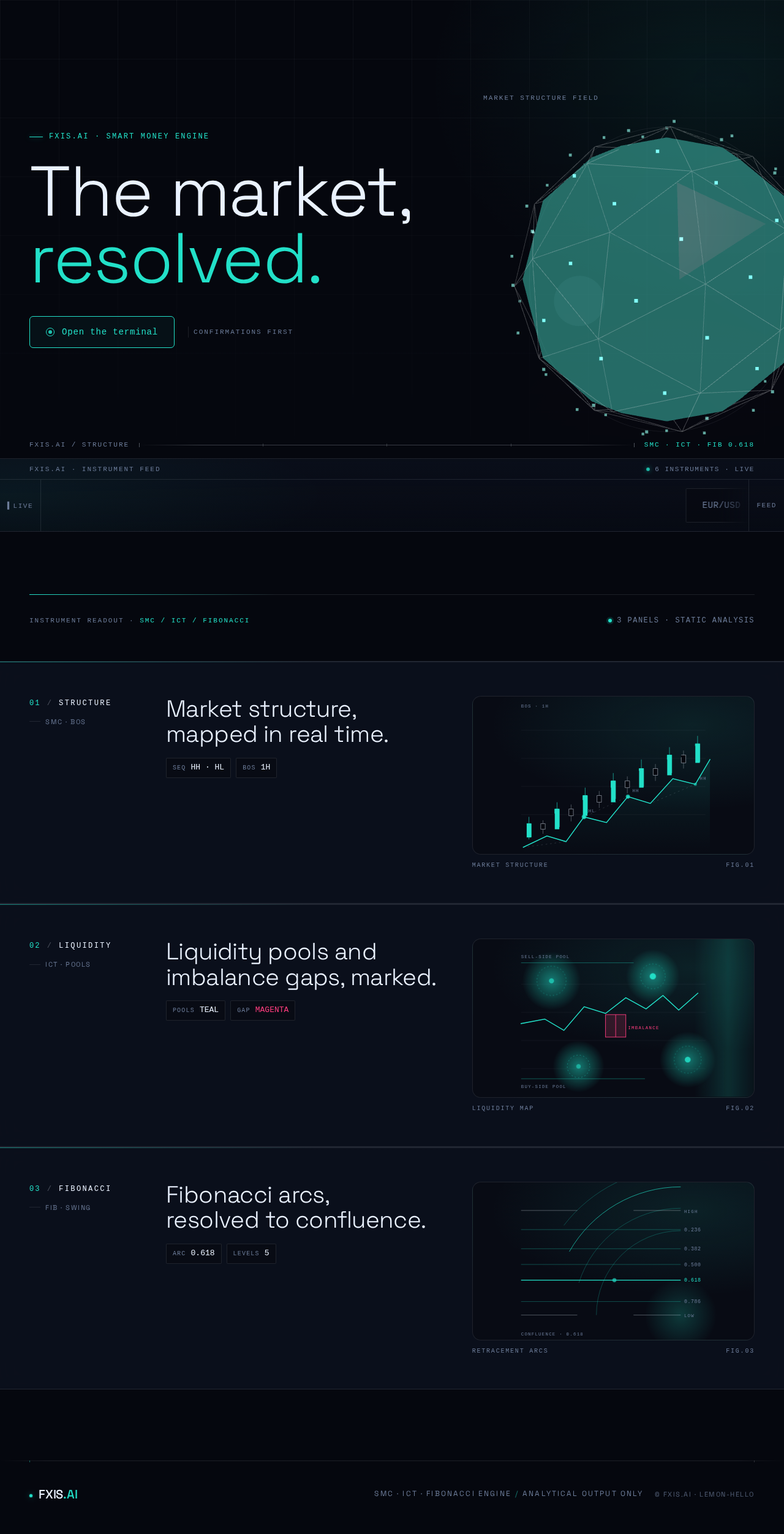
FXIS.AI · SMART MONEY ENGINE
FXIS.AI · SMART MONEY ENGINE
No comments yet. Be the first!