jungle-energy
 Midhun Kola
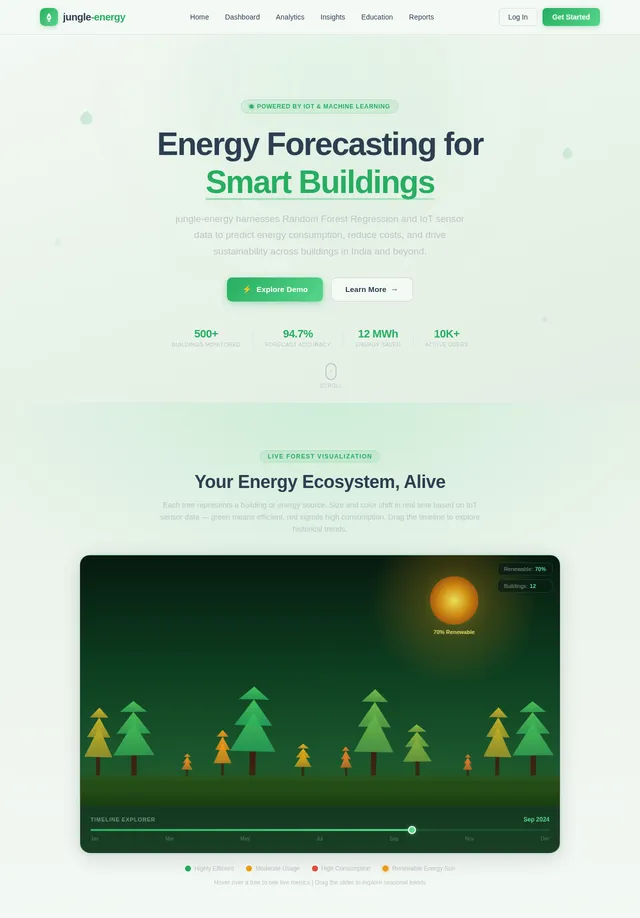
Energy consumption forecasting in smart buildings is a modern application of machine learning that helps predict future energy usage based on historical data and environmental conditions. With the integration of IoT sensors, smart buildings continuously collect data such as temperature, humidity, occupancy, and appliance usage. This data is analyzed using regression models to improve energy efficiency, reduce costs, and support sustainable development. 🔷 Objective The main objective of this project is to develop a regression model that can accurately predict energy consumption. This helps in: Optimizing energy usage Reducing electricity wastage Improving automation in smart systems Supporting eco-friendly solutions 🔷 Regression Model Used ✅ Random Forest Regression (Primary Model) 5 Random Forest Regression is the most suitable model for this project because energy consumption depends on multiple complex and non-linear factors. This model works by combining multiple decision trees to produce accurate predictions. ✔ Key Advantages: Handles non-linear relationships High prediction accuracy Reduces overfitting Works well with real-world datasets ✅ Multiple Linear Regression (Baseline Model) This model is used for comparison. It assumes a linear relationship between input variables and energy consumption. ✔ Limitation: Cannot capture complex patterns effectively 🔷 Methodology The project follows a systematic approach: Data Collection Data is collected from sensors or datasets containing temperature, humidity, occupancy, and energy usage. Data Preprocessing Missing values are handled, and data is normalized for better model performance. Feature Engineering Time-based features such as hour, day, and season are extracted. Model Training Random Forest and Linear Regression models are trained using historical data. Prediction The model predicts future energy consumption. Evaluation Performance is measured using MAE, MSE, and R² score. 🔷 Graph Explanation (Important Part) 6 The graph is used to visualize the performance of the regression model. 📊 Graph Details: X-axis: Time (hours/days) Y-axis: Energy Consumption (kWh) Two lines: Actual energy values Predicted energy values ✔ Interpretation: If both lines are close → Model is accurate If there is a gap → Prediction error This visualization helps in understanding trends such as peak usage times and seasonal variations. 🔷 Applications Smart homes and apartments Commercial buildings Smart cities HVAC and energy management systems 🔷 Conclusion Energy consumption forecasting using regression models is an effective way to improve energy efficiency in smart buildings. Among various models, Random Forest Regression provides the best performance due to its ability to handle complex and non-linear data. The inclusion of graphical analysis further enhances understanding and helps in evaluating model accuracy. This project contributes to reducing energy waste and promoting sustainable living.

Comments (0)
Sign in to leave a comment
No comments yet. Be the first!