isro-2026-scientist

byRavi

can you make 1000 quesiton and solution pdf based one what can be asked next on ISRO 2026 exam for Scientist position CSE branch from these file Extract PYQ for non-gate technical topcics like Software enginnering, AI , ML and other . YOu must predict next qeusiton and Add concepts also that can be aksed next in detail use flow diagram, digram , memeorizing best trick so i can remebr for long time . if some thing too complextconept that concpet explain with naivy example abut in concept adn theory adn numerical converyt cvompeltetopcis

Landing
Landing

Comments (0)

No comments yet. Be the first!

System Requirements

Page 1 of 29

System Requirements Document for isro-2026-scientist

1. Introduction

This SRD defines the requirements for a self-study preparation compendium delivered as a single downloadable PDF containing 1,000 predicted questions with complete solutions, targeted at the ISRO 2026 written test for the post of Scientist/Engineer 'SC' (Computer Science).

The compendium is synthesized from three uploaded source papers — the ISRO Computer Science 2023 question paper, the ISRO Computer Science 2025 question paper (Scientist/Engineer 'SC', Set A, ICRB), and the ISRO PYQ topic-wise question bank with answer keys — plus the capabilities explicitly requested by the user in chat.

The product is a static, printable, offline-readable study artifact, not a web application. It must extract prior-year questions (PYQs) for non-GATE technical topics — Software Engineering, Artificial Intelligence, Machine Learning, and the other listed non-GATE areas — predict the questions most likely to appear next, and surround every prediction with detailed concept, theory, numerical practice, flow diagrams, diagrams, memory tricks, and naive everyday examples for the hardest ideas.

Page 2 of 29

2. System Overview

The system is a study-material generation and packaging pipeline that transforms raw ISRO prior-year exam documents into a structured, exam-aligned PDF compendium.

Its operating model mirrors the actual ISRO written test structure captured in the source material:

  • Part 'A' — Area/Discipline Specific: 80 objective questions, 80 marks, each correct answer = 1 mark, wrong answer = −0.33.
  • Part 'B' — Aptitude/Ability Test: 15 objective questions, 20 marks, each question carrying a different mark value, no negative marking.
  • Each objective question is a multiple-choice question with options (a), (b), (c), (d) and exactly one correct answer.
  • Multiple answers marked for one question is treated as a wrong answer.

The compendium's content spine is a four-stage topic unit applied uniformly across every subject:

  1. PYQ Evidence — prior-year questions extracted from the uploaded papers.
  2. Prediction — the next likely question forms for that topic in ISRO 2026.
  3. Concept + Theory + Numerical — full explanation, formula derivation, and worked numericals.
  4. Memory Device — flow diagram, diagram, memorization trick, and a naive example where the concept is too complex.

Coverage spans the complete topic taxonomy observed in the source material: Algorithms; Computer Organisation & Architecture; Compiler Design; Computer Networks; Databases; Digital Logic; Discrete Mathematics (Combinatorics, Graph Theory, Mathematical Logic, Set Theory & Algebra); Engineering Mathematics (Calculus, Linear Algebra, Probability); General Aptitude / Quantitative Aptitude; Operating Systems; Programming and Data Structures; Theory of Computation; and the Non-GATE clusters: Artificial Intelligence, Computer Graphics, Computer Peripherals, Digital Image Processing, Distributed Computing, Geometry, Integrated Circuits, IS & Software Engineering, Java, Multimedia, Numerical Methods, Object Oriented Programming, Others (Binary Heap, Linked List, Neural Network, Semiconductor, Unix), and Web Technologies.

Page 3 of 29

2a. Product Interpretation and Delivery Boundary

The accepted deliverable is a single static PDF — a self-contained, print-optimised, offline-readable study volume. There is no web application, no backend service, no database, no identity system, no admin panel, and no runtime integration layer in scope. The reader opens the file, navigates by hyperlinked table of contents and internal cross-links, and studies from screen or paper.

Two accepted human roles drive the product. The ISRO 2026 Scientist/Engineer 'SC' (Computer Science) Aspirant is the reader and sole consumer of the finished volume. The Study-Guide Compiler is the build-time content role that ingests the three uploaded source papers, extracts and repairs prior-year questions, classifies them into the topic taxonomy, generates predicted variants, attaches concepts, theory, numericals, diagrams, mnemonics and naive examples, maintains the repair manifest and the verbatim source attribution index, and exports the assembled PDF.

Everything in this document is current. There is no future-horizon section: the volume is fixed at 1,000 questions, the source set is fixed at the three uploaded papers, and predictions are explicitly labelled as inferential because no official ISRO 2026 syllabus document was supplied. The compendium is a study artifact, not an exam-content guarantee.

Page 4 of 29

2b. Source Content Inventory

The three uploaded source papers are the authoritative content supply for the compendium. Their verified factual content is preserved as follows.

ISRO Computer Science 2025 question paper (Scientist/Engineer 'SC', Set A, ICRB) — Written test dated October 26, 2025, 1000 Hrs to 1200 Hrs. Structure: Part 'A' Area/Discipline Specific, 80 questions, 80 marks; Part 'B' Aptitude/Ability Test, 15 questions, 20 marks. Total pages other than the cover sheet: 43. Booklet code A. Marking: Part 'A' correct = 1 mark, no answer = 0, wrong answer = −0.33; Part 'B' has no negative marking. Multiple answers for a question are regarded as a wrong answer. Question booklets are marked A or B or C or D or E on the right-hand top corner, which must be written and bubbled on the OMR sheet or the answer sheet will not be evaluated. Candidates must use only Black/Blue ball point pen on the OMR sheet. At the end of the test the Written Test Call Letter(s) with photograph pasted and the OMR Answer Sheet must be returned to the Invigilator and must not be carried away. Candidates receive a copy of their OMR answer sheet to retain for all future references. Space in the question booklet may be used for rough work; no separate sheet is provided. Before signing the attendance sheet the candidate must write the Booklet Code on it and sign against their own name only.

Part 'A' question content verified in this paper includes: inorder tree traversal ordering; the principle on which Huffman coding works (frequencies of input symbols); matching Floyd's algorithm, multi-stage graph algorithm and Dijkstra's algorithm to their applications; properties of the Greedy algorithm (makes local optimal decisions based on the selected criterion); maximum number of parks constructible in regions enclosed by roads given 20 shopping malls each reachable by 3 roads, with only one park per region, non-crossing roads, and roads not passing through a park; chromatic number of a graph; identifying the sorting technique that yields {2, 5, 10, 16, 8, 9} after three iterations from input {10, 5, 16, 2, 8, 9}; number of keys needed for encrypted communication among 16 persons using AES assuming a unique key between any two persons; which of symmetric ciphers, message-digest generation, message-authentication-code generation and key-exchange algorithms does not use key(s); matching non-repudiation, data integrity, data confidentiality and access control to their definitions; the case in which a user is persuaded to reveal personal data by hackers/cyber criminals (phishing); which protocol/application does not facilitate data encryption (DNS using DNSSEC); number of distinct encryption keys possible for an n-bit key; what can be protected using a firewall (network scanning); which standard defines the format for Public Key Infrastructure (X.509); which is not a type of Artificial Intelligence agent (Unity based AI agent); advantages of Artificial Intelligence; what a decision tree in AI can be used for (both classification and regression tasks); which algorithm is used for reinforcement learning (Q-learning); which algorithm is used for search/optimization in AI (Hill Climbing Algorithm); what "elasticity" in cloud computing refers to (ability to scale up and scale down of compute resources); hypervisor statement matching for Type-1 and Type-2 hypervisors; which is not a characteristic of Big Data (Visualisation); the primary purpose of Hadoop Distributed File System in Big Data storage (to store large files across multiple machines); which Big Data tool is employed for real-time stream processing (Apache Flink); which is used for storing unstructured data in a Big Data environment (NOSQL database); matching structured, semi-structured and unstructured data to fixed format data, XML/JSON, and text files/images/videos; which hexadecimal constant matches the regular expression (0x[0-9A-F]+); which is true for a Virtual Machine like JVM (hardware independent); which compiler phase receives tokenized output (Parser); which tool generates a parser from BNF notation (yacc); which options are true for ambiguous grammar; which string matches the grammar S → A | B, A → aAb | c, B → bBd | e; which statement on a C++ snippet allocating int *ptr; ptr = new int[4]; may make the program crash when executed subsequently; which OSI model layer is associated with a wrong default gateway setting (Layer 3); which IPSec configuration meets full confidentiality and integrity with private IP addresses also confidential (IPSec using ESP in Tunnel mode); the system's conclusion for a received word of 01000 given valid codewords A: 00000, B: 01110, C: 11000 and Hamming-distance error correction; the value of the public key 'e' for an RSA system with p=11, q=13 and private key d=7; the effect on the TCP/IP protocol stack of a host firewall configured to block all incoming ICMP packets (Path MTU discovery fails); the ideal TCP window size for a link of bandwidth 8192000 bps and latency 32 ms; whether computers A (10.0.0.126) and B (10.0.0.131) with network mask 255.255.255.192 require a router to communicate; which is a characteristic of NoSQL databases (they support flexible schema); which statement about database views is true (views can be used to restrict access to sensitive columns); where the foreign key should reside for a one-to-many relationship from "authors" to "books" (in the "books" table); for which query the index CREATE INDEX myindex ON users(country, city, street) on users(userid, country, city, street) with 50 million users is least useful; the minimum number of tables required to represent entities A and B and relationships R1 (one-to-many from A to B) and R2 (many-to-many from A to B); which outcome will never occur for concurrent transactions T1 and T2 on bank_accounts = (account_id, balance) under REPEATABLE READ with standard locking; which normal form R = (A, B, C, D, E, P, G) with AB→CD, DE→P, C→E, P→C, B→G satisfies; the values of x and y given (0.11101)₂ = (0.90xy5)₁\xe2\x82\x80; how many 3-to-8 line decoders are required for a 1-of-32 decoder; the product of A = (11111010)₂ and B = (00001010)₂ in 2's complement stored as 1 byte; which Karnaugh map represents X′Y′Z′ + X′YZ′; how many clock pulses are required to reach state 0000 from current state 1001 in a MOD-16 ripple counter using J-K flip-flops; which option is not true for a gated D-type flip-flop; the possible inputs to obtain a low output from a given logic circuit; the determinant of a given 3×3 matrix in θ; the smallest Eigen value of a given 3×3 matrix; the value of a given triple integral; the equivalent of the logic form (p ∧ q) → r for the avionics power-on scenario; how many subsets of {1, 2, 3, 4…12} can be formed such that no two elements in the subset are consecutive; the number of different elements in Aⁿ for a set A with m elements and positive integer n; how many four-letter words can be formed using the letters of GAGANYAAN with no repetition of letter; the name for a situation where several processes access and manipulate the same data concurrently and the outcome depends on the access order (Race Condition); which statement is true when a parent process creates a new process; which process-state transition is not possible; the corresponding wait-for graph for a given resource allocation graph; average turnaround time and average waiting time using FCFS for processes P1 (arrival 6, execution 24), P2 (arrival 0, execution 3), P3 (arrival 3, execution 3); the correct mapping of Time1–Time4 to Wait Time, Run Time, Turnaround time and Response time; whether the system is in a safe state for 3 processes P0–P2 and resource types A (10 instances), B (5 instances), C (7 instances) with the given Allocation/Max/Available snapshot; the number of page faults using the Optimal page replacement algorithm with 3 frames for the reference string 6, 0, 5, 2, 0, 3, 0, 4, 2, 3, 0, 3, 2, 5, 2; what cyclomatic complexity is associated with (White Box Testing); which testing type Alpha and Beta testing relate to (Acceptance Testing); the CMM process maturity levels 1 Initial, 2 (A), 3 (B), 4 (C), 5 Optimizing; the correct order of the stages of the Risk Management process (Risk identification → Risk analysis → Risk planning → Risk monitoring); which statements about fan-in and fan-out are true; identifying (A), (B), (C), (D) in the V Model of Software Testing; the function point value for a project with 30 user inputs (weight 4), 60 user outputs (weight 5), 20 user enquiries (weight 4), 5 files (weight 10), 4 external interfaces (weight 7), assuming all complexity adjustment values are average having scale = 3; which regular expression describes the same language as (a*b)* + (b*a)*; the number of states in the minimal DFA for the language accepted by a given DFA; the language generated by the context-free grammar S → aSb | T, T → bT | b.

Part 'B' aptitude content verified in this paper includes: the day of the week on 28th May 2006; the Jessica four-children fact-inference question; the building-floors-and-lift inference question; the new volume of a cube of volume 8 cubic metres when each side is doubled; the amount of sugar solution to be added to 45 litres of a 1:2 sugar-to-salt mixture to make it 2:1; which standard probability density function applies to discrete random variables (Poisson Distribution); the weight of David given Andre+Betty = 150 pounds, Betty+Chris = 180 pounds, Andre+Chris+David = 360 pounds, and all four = 450 pounds; the books/tables/mirrors syllogism; the women-teachers-and-athletes syllogism; the number replacing the question mark in a figure series; the mirror-image option matching a given combination; the number of players who play Football or Cricket but not Basketball given 50 play Football, 40 play Cricket and 30 play Basketball; the box replacing the question mark to complete a pattern; the option best fitting a missing symbol; the figure completing a series.

ISRO Computer Science 2023 question paper (Scientist/Engineer 'SC', Set A, ICRB) — Part 'A' Area/Discipline Specific and Part 'B' Aptitude/Ability Test. Part 'B' questions carry per-question marks of 1 mark or 2 marks as printed. Verified Part 'A' content includes: minimum spanning distance and corresponding number of edges for a given graph; matching Floyd Warshall, Dijkstra, Kruskal's and Bellman-Ford to shortest-path and minimum-spanning-tree roles; time complexity to find the diameter of a binary tree with n nodes; postorder traversal given the preorder traversal (10, 5, 1, 7, 40, 50) of a binary search tree; minimum number of arithmetic operations to evaluate f(z) = 3x\xe2\x81\xb8 + z³ + 12; maximum number of simple graphs possible with n vertices; the extended regular expression corresponding to the token id for a given NFA with epsilon-transitions over [0-9] and [a-z A-Z]; whether the string id + id × id has no parse tree, only one parse tree, exactly two parse trees, or more than two parse trees under the grammar E → E + E | E × E | id; which heap memory allocation strategy best exploits spatial locality (Best Fit); the order in which compiler phases typically work (Lexical analysis, syntax analysis, semantic analysis, intermediate code generation, code optimization); what LL(1) refers to (grammars that parse the input from left to right, produce a leftmost derivation, with a lookahead of 1 symbol); the window size in packets needed for channel utilisation > 96% on a 1 Gbps link with 25 ms RTT and 1000-byte packets; the data transfer speed on a 1 km CSMA/CD cable with minimum frame size 1500 bytes, signal speed 250000 km/sec and no repeaters; the fraction of network bandwidth wasted due to headers for a 5-layer protocol hierarchy with 270-byte messages and 6-byte headers per layer; matching 802.11ac, 802.11 a/g, 802.11 ad and 802.11 b to 7 Gbps, 54 Mbps, 3.5 Gbps and 11 Mbps; which statement about Parity, CRC, Low Density Parity Check and Reed-Solomon codes is true; the Reverse Polish notation for A*B+C*D; what a vectored interrupt is; which processor architecture provides fastest execution for a given finite number of instructions; how an instruction pipeline can be implemented (FIFO buffer); what the operation executed on data stored in registers is called (Micro-operation); which method is used to detect double errors; evaluation of the prefix expression -+abc+d*ef for a=10, b=2, c=5, d=3, e=4, f=1; arranging f1(n) = 2ⁿ, f2(n) = n^(3/2), f3(n) = n log n, f4(n) = n^(log n) in increasing order of complexity; the maximum number of comparisons needed to sort 6 items using radix sort when each number is a 3-digit decimal number; the inorder predecessor of 15 in a given binary search tree; the value of p+3 for a pointer p to an array of integers (size 2 bytes) initialised to 200; where insertion and deletion can be done in a priority queue; the worst case time complexity of heap sort for n elements; the output of SELECT Y FROM T WHERE X=7 after the described 128-record insertion sequence using MX and MY; the SQL statement equivalent to select * from R, S; which SQL query deletes all tuples in the teacher relation for teachers associated with a department located in the building named CSE; what the 'Durability' property of ACID requires; what Fifth Normal Form is concerned with (Join dependency); which definitions about multiplexers, demultiplexers and encoders are true; the time delay obtained through an 8-bit serial register with a 400 MHz clock; what a full adder circuit requires (three inputs and two outputs); the logical operation of a given circuit; the logic circuit that provides a LOW output when both inputs are HIGH or both inputs are LOW; the resulting logic circuit when both inputs of NOR and NAND gates are connected together; whether det|P| is indeterminate, negative, zero, or none of the above for a given 4×4 matrix P; which statements about graph degree sums, eccentricity, girth and multigraphs are true; the number of edges in an undirected planar graph with five faces and nine vertices; the probability of not getting a white ball from a bag with 6 blue, 5 white and 4 yellow balls; the complexity of matrix multiplication of an m×n matrix A and an n×p matrix B; the number of sub-strings of all lengths that can be formed from a character string of length m; how many rows a truth table needs for n variables; which multithreading model is followed in Linux OS; the purpose of the priority inheritance protocol in synchronization mechanisms; which assigns segment numbers for various segments of a program like code segment and data segment under segmentation memory allocation; which statement about interrupts is false; the correct matching of long-term, medium-term and short-term process schedulers to their activities; the most appropriate synchronization primitive to ensure the consumer waits when the buffer is empty in the bounded-buffer problem; what results from any attempt by a process to access memory allocated to the OS or to another user's process; the regular expression defining the language accepted by a given DFA over {a, b}; the number of states in the minimal DFA for a given NFA; the language generated by the context-free grammar S → aSb | T, T → Tb | b; which statement about recursive and recursively enumerable languages is NOT true; which statement about regular and context-free language intersections and unions is FALSE; which statement about the language L(G) generated by S → aaSb | T, T → Tb | a is true; which is not a connective of First Order Logic with reference to AI; what a hybrid Bayesian network contains (both continuous and discrete variables); which scenario may not be a good fit for HDFS in the Big Data paradigm; the standard Java API for monitoring and managing applications (JMX); which clustering technique is used by the K-Means algorithm (Partitional technique); what type of data storage system Cassandra is (Distributed); the cloud infrastructure solely for a single organisation within its premises (private cloud); temporarily renting capacity to handle spikes in load (Cloud bursting); whether virtualisation facilitates multiple OS simultaneously on the same hardware and whether multiple OS can run simultaneously in dual boot; in which virtualisation technique the hypervisor modifies the guest OS (Para virtualization); the cause of the Ping of death issue related to ICMP packets (Buffer overflow); matching encryption, MAC cloning, ARP spoofing and fingerprinting to their descriptions; matching ingress filtering, egress filtering, NAT and stateful firewall to their descriptions; what asymmetric encryption is not suitable for (Prevention of Denial of Service); what CAPTCHA is used to provide protection from (Automated scripted attack); what MCDC stands for (Modified Condition Decision Coverage); what regression testing focuses on validating (software changes); what a HIPO chart is also known as (Structure chart); how McCabe's cyclomatic complexity number of a program control graph G with e edges, n nodes and p disconnected paths is defined; what the Entity Relationship model shows (Static view).

Part 'B' aptitude content verified in this paper includes: the option replacing a question mark in a figure series; the option replacing a question mark in a second figure series; the option replacing a question mark in a third figure series; the retail-clerk Saturday-shift response question; the passage-completion question about a survey of job applicants; the eight-friends-around-a-square-table seating arrangement question asking how many people are between T and Q; the option replacing a question mark in a fourth figure series; the number replacing a question mark in a fifth figure series; the option replacing a question mark in a sixth figure series; the pictures-and-storybooks fact-inference question; the exporters-and-RBI courses-of-action question; the wrong number in the series 7, 8, 18, 57, 228, 1165, 6996; the earnings-graph question asking between which two days the difference in earnings was large; the percentage increase in production of D-type toys from 1983 to 1985 given the years/toys table for A–E across 1982–1986; the maximum area of a rectangle with perimeter 620 mm.

ISRO PYQ topic-wise question bank with answer keys — a topic-indexed bank with per-topic question counts and answer keys. Verified topic counts: Algorithms (47), CO and Architecture (80), Compiler Design (36), Computer Networks (111), Databases (62), Digital Logic (99), Discrete Mathematics: Combinatory (3), Discrete Mathematics: Graph Theory (15), Discrete Mathematics: Mathematical Logic (3), Discrete Mathematics: Set Theory & Algebra (8), Engineering Mathematics: Calculus (10), Engineering Mathematics: Linear Algebra (12), Engineering Mathematics: Probability (14), General Aptitude: Quantitative Aptitude (4), Non GATE: Artificial Intelligence (1), Non GATE: Computer Graphics (6), Non GATE: Computer Peripherals (5), Non GATE: Digital Image Processing (3), Non GATE: Distributed Computing (1), Non GATE: Geometry (4), Non GATE: Integrated Circuits (4), Non GATE: IS&Software Engineering (42), Non GATE: Java (4), Non GATE: Multimedia (2), Non GATE: Numerical Methods (8), Non GATE: Object Oriented Programming (6), Non GATE: Others (7), Non GATE: Web Technologies (9), Operating System (111), Programming and DS (2), Programming and DS: DS (40), Programming and DS: Programming (48), Theory of Computation (26).

Verified sub-topic inventories within those clusters include: Algorithms — Algorithm Design Techniques, Binary Search, Breadth First Search, Dijkstras Algorithm, Graph Algorithms, Hashing, Huffman Code, Identify Function, Master Theorem, Matrix Chain Ordering, Merge Sort, P Np Npc Nph, Quick Sort, Recurrence Relation, Relations, Searching, Selection Sort, Sorting, Spanning Tree, Time Complexity, Tree Traversal. CO and Architecture — 8085 Microprocessor, Addressing Modes, Cache Memory, Co And Architecture, Direct Mapping, Disk, Instruction Format, Interrupts, Io Handling, Machine Instructions, Memory Interfacing, Memory Management, Microprogramming, Number Representation, Parallel Programming, Pipelining, Ram, Runtime Environment. Compiler Design — Assembler, Code Optimization, Compiler Tokenization, Context Free Grammar, Expression, Grammar, Lexical Analysis, Operator Grammar, Parameter Passing, Parsing, Runtime Environment, Symbol Table. Computer Networks — Application Layer Protocols, Binary Codes, Communication, Crc Polynomial, Cryptography, Csma Cd, Dns, Encoding, Error Correction, Error Detection, Ethernet, Firewall, Icmp, Ip Packet, Lan Technologies, Link State Routing, Mac Protocol, Md5, Network Addressing, Network Layering, Network Protocols, Network Security, Network Topologies, Ping, Routers Bridge Hubs Switches, Routing, Serial Communication, Sliding Window, Slotted Aloha, Subnetting, Supernetting, Tcp, Token Ring, Transport Layer, Wifi, Wimax, Wireless Networks. Databases — B Tree, Candidate Key, Database Normalization, Er Diagram, File, Indexing, Physical Storage, Raid, Referential Integrity, Relational Algebra, Relations, Sql, Transaction And Concurrency, Trigger. Digital Logic — Adder, Bcd, Binary Codes, Binary Subtractor, Boolean Algebra, Booths Algorithm, Canonical Normal Form, Circuit Output, Co And Architecture, Combinational Circuit, Decoder, Digital Circuits, Digital Counter, Excess 3, Flip Flop, Floating Point Representation, Ieee Representation, K Map, Memory Interfacing, Min No Gates, Multiplexer, Number Representation, Sequential Circuit, Tri State. Discrete Mathematics: Graph Theory — Counting, Euler Graph, Graph Coloring, Graph Connectivity, Group Theory. Discrete Mathematics: Mathematical Logic — Boolean Algebra, First Order Logic, Propositional Logic. Discrete Mathematics: Set Theory & Algebra — Equivalence Class, Functions, Group Theory, Relations, Set Theory. Engineering Mathematics: Calculus — Limits, Maxima Minima. Engineering Mathematics: Linear Algebra — Determinant, Eigen Value, Matrix. Engineering Mathematics: Probability — Conditional Probability, Mean Mode Median, Normal Distribution, Poisson Distribution, Random Variable, Standard Deviation, Statistics. General Aptitude: Quantitative Aptitude — Quantitative Aptitude, Summation. Non GATE: Computer Peripherals — Computer Peripherals, Intel8151a, Video Memory. Non GATE: Digital Image Processing — Digital Image Processing, Image Compression. Non GATE: Geometry — Circle, Geometry. Non GATE: IS&Software Engineering — Cmm Model, Cyclomatic Complexity, Is&software Engineering, Out Of Gate Syllabus, Project Cost, Software Metrics, Software Productivity, Software Reliability, Software Testing, Spiral Model, Uml. Non GATE: Numerical Methods — Interpolation, Newton Raphson, Numerical Methods, Polynomials. Non GATE: Object Oriented Programming — Object Oriented Programming, Operator Overloading, Programming In C. Non GATE: Others — Binary Heap, Linked List, Neural Network, Semiconductor, Unix. Non GATE: Web Technologies — Html, Javascript, Web Technologies, Xml. Operating System — Concurrency, Context Switch, Critical Section, Deadlock Prevention Avoidance Detection, Disk, Disk Scheduling, Fork System Call, Io Handling, Least Recently Used, Memory Management, Mutual Exclusion, Page Fault, Page Replacement, Paging, Pipes, Precedence Graph, Process, Process Scheduling, Process Synchronization, Realtime Systems, Resource Allocation, Segmentation, Semaphore, Unix, Virtual Memory, Working Set. Programming and DS: DS — Array, Avl Tree, Binary Search Tree, Binary Tree, Breadth First Search, Data Structures, Hashing, Infix Prefix, Linked List, Queue, Stack, Symbol Table, Tree, Tree Traversal. Programming and DS: Programming — Activation Record, Array, Cpp, Functions, Loop Invariants, Macros, Memory Management, Output, Parameter Passing, Pointers, Programming In C, Recursion, Semantic Analysis, Union. Theory of Computation — Closure Property, Context Free Grammar, Context Free Language, Context Sensitive, Finite Automata, Grammar, Identify Class Language, Minimal State Automata, Moore Mealy Machine, Non Determinism, Recursive And Recursively Enumerable Languages, Regular Expression, Regular Language, Turing Machine.

Verified answer-key entries include the following specific values: Algorithms 1.0.1 C, 1.1.1 B, 1.2.1 A, 1.2.2 A, 1.3.1 B, 1.3.2 C, 1.4.1 C, 1.5.1 A, 1.5.2 D, 1.6.1 B, 1.7.1 A, 1.8.1 D, 1.8.2 A, 1.8.3 B, 1.8.4 D, 1.8.5 C, 1.9.1 B, 1.10.1 B, 1.11.1 D, 1.11.2 D, 1.12.1 C, 1.13.1 C, 1.14.1 B, 1.14.2 D, 1.14.3 B, 1.14.4 C, 1.15.1 C, 1.16.1 C, 1.17.1 B, 1.18.1 B, 1.18.2 C, 1.18.3 X, 1.18.4 B, 1.18.5 D, 1.18.6 D, 1.18.7 D, 1.18.8 A, 1.18.9 B, 1.18.10 C, 1.19.1 B, 1.20.1 X, 1.20.2 A, 1.20.3 B, 1.20.4 X, 1.20.5 B, 1.20.6 X, 1.21.1 X. CO and Architecture 2.1.1 C, 2.1.2 D, 2.1.3 Q-Q, 2.1.4 Q-Q, 2.1.5 A, 2.1.6 C, 2.2.1 B, 2.2.2 C, 2.2.3 D, 2.2.4 D, 2.2.5 C, 2.2.6 B, 2.2.7 C, 2.2.8 C, 2.2.9 B, 2.3.1 B, 2.3.2 C, 2.3.3 D, 2.3.4 C, 2.3.5 A, 2.3.6 C, 2.3.7 A, 2.4.1 A, 2.4.2 D, 2.4.3 A, 2.4.4 D, 2.4.5 C, 2.4.6 C, 2.4.7 A, 2.4.8 A, 2.4.9 C, 2.4.10 Q-Q, 2.4.11 B, 2.4.12 A, 2.4.13 Q-Q, 2.4.14 Q-Q, 2.4.15 Q-Q, 2.4.16 Q-Q, 2.4.17 Q-Q, 2.4.18 D, 2.4.19 C, 2.4.20 A, 2.4.21 B, 2.4.22 A, 2.4.23 D, 2.4.24 C, 2.5.1 D, 2.6.1 C, 2.7.1 D, 2.7.2 C, 2.8.1 B, 2.9.1 B, 2.9.2 A, 2.9.3 B, 2.9.4 D, 2.9.5 C, 2.9.6 B, 2.10.1 C, 2.10.2 A, 2.11.1 B, 2.11.2 C, 2.11.3 D, 2.11.4 D, 2.11.5 C, 2.11.6 B, 2.12.1 B, 2.13.1 B, 2.14.1 D, 2.15.1 D, 2.16.1 D, 2.16.2 B, 2.16.3 C, 2.16.4 B, 2.16.5 Q-Q, 2.16.6 Q-Q, 2.16.7 A, 2.16.8 B, 2.16.9 B, 2.17.1 D, 2.18.1 A. Compiler Design 3.0.1 B, 3.0.2 C, 3.0.3 D, 3.0.4 A, 3.0.5 D, 3.0.6 C, 3.0.7 B, 3.1.1 D, 3.1.2 C, 3.2.1 C, 3.2.2 X, 3.2.3 D, 3.2.4 B, 3.2.5 D, 3.2.6 X, 3.3.1 C, 3.4.1 D, 3.5.1 B, 3.6.1 B, 3.6.2 B, 3.6.3 C, 3.6.4 D, 3.6.5 D, 3.6.6 C, 3.6.7 A, 3.7.1 C, 3.8.1 X, 3.9.1 D, 3.9.2 C, 3.10.1 A, 3.10.2 A, 3.10.3 C, 3.10.4 A, 3.10.5 C, 3.11.1 C, 3.12.1 A. Computer Networks 4.0.1 Q-Q, 4.0.2 C, 4.0.3 C, 4.0.4 Q-Q, 4.0.5 A, 4.0.6 C, 4.0.7 Q-Q, 4.0.8 D, 4.0.9 B, 4.0.10 Q-Q, 4.0.11 Q-Q, 4.0.12 B, 4.0.13 Q-Q, 4.0.14 Q-Q, 4.0.15 Q-Q, 4.0.16 C, 4.0.17 Q-Q, 4.0.18 Q-Q, 4.1.1 A, 4.2.1 A, 4.3.1 D, 4.3.2 C, 4.3.3 A, 4.3.4 C, 4.3.5 D, 4.3.6 D, 4.3.7 D, 4.4.1 B, 4.4.2 B, 4.4.3 B, 4.5.1 B, 4.5.2 C, 4.5.3 A, 4.5.4 B, 4.6.1 A, 4.6.2 C, 4.7.1 C, 4.7.2 C, 4.8.1 D, 4.9.1 C, 4.10.1 A, 4.11.1 A, 4.11.2 B, 4.11.3 D, 4.11.4 D, 4.12.1 A, 4.13.1 A, 4.14.1 B, 4.14.2 C, 4.14.3 D, 4.15.1 C, 4.16.1 B, 4.17.1 D, 4.18.1 B, 4.19.1 D, 4.20.1 B, 4.20.2 D, 4.20.3 A, 4.21.1 D, 4.21.2 C, 4.21.3 D, 4.21.4 B, 4.21.5 B, 4.21.6 A, 4.21.7 D, 4.22.1 D, 4.22.2 D, 4.22.3 B, 4.22.4 C, 4.22.5 D, 4.22.6 D, 4.22.7 A, 4.22.8 A, 4.22.9 C, 4.22.10 B, 4.22.11 A, 4.23.1 B, 4.23.2 A, 4.24.1 C, 4.25.1 B, 4.25.2 D, 4.26.1 D, 4.26.2 D, 4.27.2 C, 4.27.3 A, 4.28.1 D, 4.28.2 A, 4.28.3 B, 4.29.1 B, 4.30.1 D, 4.30.3 C, 4.30.4 C, 4.30.5 B, 4.30.6 B, 4.30.7 D, 4.30.8 A, 4.30.9 D, 4.31.1 D, 4.32.1 B, 4.32.2 B, 4.32.3 D, 4.32.4 C, 4.32.5 B;C, 4.33.1 C, 4.34.1 D, 4.35.1 B, 4.35.2 B, 4.36.1 A, 4.37.1 D. Databases 5.0.1 A, 5.0.2 D, 5.0.3 C, 5.0.4 A, 5.0.5 B, 5.0.6 B, 5.0.7 B, 5.0.8 B, 5.0.9 D, 5.0.10 B, 5.1.1 A, 5.1.2 A, 5.1.3 B, 5.1.4 B, 5.2.1 B, 5.3.1 D, 5.3.2 Q-Q, 5.3.3 B, 5.3.4 B, 5.3.5 A, 5.3.6 B, 5.3.7 C, 5.3.8 B, 5.3.9 A, 5.3.10 D, 5.3.11 C, 5.3.12 C, 5.4.1 C, 5.4.2 B, 5.4.3 B, 5.5.1 A, 5.6.1 A, 5.6.2 A, 5.6.3 C, 5.7.1 A, 5.8.1 C, 5.8.2 D, 5.9.1 B, 5.9.2 B, 5.10.1 B, 5.10.2 C, 5.10.3 A, 5.10.4 A, 5.11.1 B, 5.12.1 D, 5.12.2 B, 5.12.3 A, 5.12.4 D, 5.12.5 X, 5.12.6 D, 5.12.7 B, 5.12.8 A, 5.12.9 C, 5.12.10 A;C, 5.12.11 A, 5.13.1 D, 5.13.2 B, 5.13.3 A, 5.13.4 B, 5.13.5 B, 5.13.6 B, 5.14.1 D. Digital Logic 6.0.1 Q-Q, 6.0.2 A, 6.0.3 C, 6.0.4 B, 6.0.5 B, 6.0.6 Q-Q, 6.0.7 A, 6.0.8 Q-Q, 6.0.9 Q-Q, 6.0.10 Q-Q, 6.0.11 A, 6.0.12 Q-Q, 6.0.13 Q-Q, 6.0.14 Q-Q, 6.0.15 Q-Q, 6.0.16 Q-Q, 6.0.17 Q-Q, 6.0.18 Q-Q, 6.0.19 Q-Q, 6.0.20 C, 6.0.21 Q-Q, 6.1.1 B, 6.1.2 C, 6.1.3 D, 6.2.1 D, 6.3.1 B, 6.3.2 X, 6.3.3 C, 6.4.1 C, 6.5.1 C, 6.5.2 A, 6.5.3 A, 6.5.4 X, 6.5.5 B, 6.5.6 Q-Q, 6.5.7 C, 6.5.8 B, 6.5.9 A, 6.5.10 A, 6.5.11 A, 6.6.1 B, 6.7.1 B, 6.8.1 X, 6.8.2 A, 6.8.3 C, 6.8.4 C, 6.8.5 D, 6.8.6 A, 6.8.7 B, 6.8.8 A, 6.8.9 A, 6.9.1 Q-Q, 6.10.1 Q-Q, 6.10.2 A;D, 6.10.3 A, 6.10.4 B, 6.10.5 B, 6.10.6 D, 6.11.1 C, 6.12.1 A, 6.12.2 C, 6.12.3 X, 6.12.4 A, 6.13.1 C, 6.13.2 B, 6.14.1 A, 6.15.1 C, 6.15.2 D, 6.15.3 A, 6.15.4 C, 6.16.1 D, 6.16.2 C, 6.17.1 C, 6.17.2 C, 6.17.3 C, 6.18.1 B, 6.19.1 C, 6.19.2 A, 6.20.1 A, 6.20.2 C, 6.21.1 A, 6.21.2 B, 6.22.1 C, 6.22.2 A, 6.22.3 B, 6.22.4 C, 6.22.5 B, 6.22.6 A, 6.22.7 C, 6.22.8 B, 6.22.9 D, 6.22.10 B, 6.22.11 B, 6.22.12 D, 6.22.13 C, 6.22.14 D, 6.22.15 A, 6.23.1 A, 6.24.1 D. Discrete Mathematics: Combinatory 7.0.1 Q-Q, 7.1.1 B, 7.2.1 C. Discrete Mathematics: Graph Theory 8.0.1 C, 8.0.2 B, 8.0.3 A, 8.0.4 D, 8.0.5 D, 8.0.6 C, 8.0.7 C, 8.0.8 D, 8.2.1 B, 8.3.1 B, 8.4.1 B, 8.4.2 C, 8.4.3 D, 8.5.1 B. Discrete Mathematics: Mathematical Logic 9.1.1 B, 9.2.1 D, 9.3.1 D. Discrete Mathematics: Set Theory & Algebra 10.1.1 C, 10.2.1 A, 10.2.2 C, 10.3.1 C, 10.4.1 D, 10.5.1 A, 10.5.2 B, 10.5.3 X. Engineering Mathematics: Calculus 11.0.1 B, 11.0.2 A, 11.0.3 D, 11.0.4 Q-Q, 11.0.5 Q-Q, 11.0.6 Q-Q, 11.0.7 Q-Q, 11.1.1 C, 11.1.2 Q-Q, 11.2.1 B. Engineering Mathematics: Linear Algebra 12.0.1 Q-Q, 12.1.1 A, 12.1.2 C, 12.2.1 Q-Q, 12.3.1 C, 12.3.2 A, 12.3.3 D, 12.3.4 C, 12.3.5 C, 12.3.6 B, 12.3.7 C, 12.3.8 D. Engineering Mathematics: Probability 13.0.1 C, 13.0.2 B, 13.0.3 D, 13.0.4 Q-Q, 13.0.5 Q-Q, 13.0.6 C, 13.1.1 D, 13.1.2 C, 13.2.1 B, 13.3.1 D, 13.4.1 B, 13.5.1 C, 13.6.1 C, 13.7.1 D. General Aptitude: Quantitative Aptitude 14.1.1 B, 14.1.2 D, 14.1.3 B, 14.2.1 C. Non GATE: Artificial Intelligence 15.1.1 D. Non GATE: Computer Graphics 16.1.1 B, 16.1.2 A, 16.1.3 D, 16.1.4 Q-Q, 16.1.5 A, 16.1.6 C. Non GATE: Computer Peripherals 17.0.1 A, 17.1.1 B, 17.1.2 A, 17.2.1 A, 17.3.1 B. Non GATE: Digital Image Processing 18.1.1 D, 18.1.2 A, 18.2.1 B. Non GATE: Distributed Computing 19.1.1 A. Non GATE: Geometry 20.1.1 B, 20.2.1 A, 20.2.2 A, 20.2.3 B. Non GATE: Integrated Circuits 21.1.1 B, 21.1.2 D, 21.1.3 A, 21.1.4 B. Non GATE: IS&Software Engineering 22.0.1 A, 22.1.1 A, 22.2.1 A, 22.2.2 B, 22.2.3 C, 22.2.4 C, 22.3.1 D, 22.3.2 B, 22.3.3 A, 22.3.4 B, 22.3.5 B, 22.3.6 A, 22.3.7 B, 22.3.8 D, 22.3.9 B, 22.3.10 A, 22.3.11 D, 22.3.12 C, 22.3.13 D, 22.3.14 C, 22.3.15 B, 22.3.16 A, 22.3.17 D, 22.3.18 B, 22.3.19 D, 22.3.20 B, 22.4.1 B, 22.5.1 B, 22.6.1 C, 22.7.1 B, 22.8.1 D, 22.9.1 D, 22.9.2 B, 22.9.3 D, 22.9.4 C, 22.9.5 B, 22.9.6 C, 22.9.7 C, 22.10.1 D, 22.11.1 C, 22.11.2 C, 22.11.3 B. Non GATE: Java 23.1.1 D, 23.1.2 B, 23.1.3 D, 23.1.4 B. Non GATE: Multimedia 24.1.1 C, 24.1.2 D. Non GATE: Numerical Methods 25.0.1 A, 25.1.1 D, 25.2.1 C, 25.3.1 A, 25.3.2 Q-Q, 25.3.3 B, 25.3.4 A, 25.4.1 D. Non GATE: Object Oriented Programming 26.1.1 B, 26.1.2 D, 26.1.3 B, 26.1.4 D, 26.2.1 D, 26.3.1 C. Non GATE: Others 27.0.1 B, 27.1.1 C, 27.2.1 A, 27.2.2 A, 27.3.1 C, 27.4.1 B, 27.5.1 A. Non GATE: Web Technologies 28.1.1 D, 28.1.2 A, 28.1.3 D, 28.2.1 X, 28.3.1 C, 28.3.2 B, 28.3.3 A, 28.3.4 B, 28.4.1 C. Operating System 29.0.1 Q-Q, 29.0.2 Q-Q, 29.0.3 Q-Q, 29.0.4 Q-Q, 29.0.5 Q-Q, 29.0.6 Q-Q, 29.0.7 Q-Q, 29.0.8 Q-Q, 29.0.9 Q-Q, 29.0.10 Q-Q, 29.0.11 Q-Q, 29.0.12 Q-Q, 29.0.13 Q-Q, 29.1.1 Q-Q, 29.2.1 Q-Q, 29.2.2 Q-Q, 29.3.1 Q-Q, 29.4.1 Q-Q. Programming and DS 30.1.1 Q-Q, 30.1.2 Q-Q. Programming and DS: DS 31.0.1 Q-Q, 31.1.1 Q-Q, 31.2.1 Q-Q, 31.3.1 Q-Q, 31.4.1 Q-Q, 31.5.1 Q-Q, 31.6.1 Q-Q, 31.7.1 Q-Q, 31.8.1 Q-Q, 31.9.1 Q-Q, 31.10.1 Q-Q, 31.11.1 Q-Q, 31.12.1 Q-Q, 31.13.1 Q-Q, 31.14.1 Q-Q. Programming and DS: Programming 32.0.1 Q-Q, 32.1.1 Q-Q, 32.2.1 Q-Q, 32.3.1 Q-Q, 32.4.1 Q-Q, 32.5.1 Q-Q, 32.6.1 Q-Q, 32.7.1 Q-Q, 32.8.1 Q-Q, 32.9.1 Q-Q, 32.10.1 Q-Q, 32.11.1 Q-Q, 32.12.1 Q-Q, 32.13.1 Q-Q, 32.14.1 Q-Q. Theory of Computation 33.0.1 Q-Q, 33.1.1 Q-Q, 33.2.1 Q-Q, 33.3.1 Q-Q, 33.4.1 Q-Q, 33.5.1 Q-Q, 33.6.1 Q-Q, 33.7.1 Q-Q, 33.8.1 Q-Q, 33.9.1 Q-Q, 33.10.1 Q-Q, 33.11.1 Q-Q, 33.12.1 Q-Q, 33.13.1 Q-Q, 33.14.1 Q-Q.

The bank also carries a contributor list whose names are preserved verbatim in the source attribution index: Arjun Suresh, shekhar chauhan, Manoj Kumar, Rajarshi Sarkar, Leen Sharma, Kapil Phulwani, Pooja Palod, Akash Kanase, srestha, Gate Keeda, Akhil Nadh PC, Vikrant Singh, Anu, sanjay, Digvijay, Akash Dinkar, Amar Vashishth, Mangilal Saraswat (Mars), Desert_Warrior, minal, shivanisrivarshini, Anurag Semwal, Bhagirathi Nayak, Dhananjay Kumar Sharma, Jeet, VIPIN NARAYAN, Ankit Rokde, Sankaranarayanan P.N, Muktinath Vishwakarma, Pranabesh Ghosh, Vidhi Sethi, jayendra, Prashant Singh, Manu Thakur, neha pawar, Danish, Mithlesh Upadhyay, gate_asp, naga praveen, Rajesh Pradhan, Ravi Singh, asutosh kumar Biswal, Prasanna Ranganathan, Arpit Dhuriya, Prateek Arora, IgnitorSandeep, Shobhit, Himanshu Agarwal, kvkumar, Kalpna Bhargav, Ashwani Kumar, Vicky Bajoria, rameshbabu, Umang Raman, Sambit Kumar, sonveer tomar, anshu, "Shrowd", paradox, Prateek Dwivedi, abhishek kumar, Soumya Jain, vamsi2376, GO Editor, Satbir Singh, Kathleen Bankson, ajit, Ishrat Jahan, Rucha Shelke, Anuanu, Isha Gupta, sourav., jaiganeshcse94, jenny101, SUSHMA SINGH, gatecse, Taymiyyah Bhat, kenzou, Milicevic3306, deepthi, Lakshman Patel, Praveen Saini, soujanyareddy13, Naveen Kumar, Samujjal Das, Rahul Lalitkumar Jain, Ajay kumar soni, habedo007, Bikram, pawan sahu, Pavan Singh, Subarna Das, Manish Joshi, Tuhin Dutta, Pooja Khatri, Happy Mittal, Sourav Roy, Keith Kr, Krishanveer Gangwar, sumit kumar singh dixit, ranjan621, Ankesh Gautam, sanjeev_zerocode, Pranay Datta, gshivam63, Achintya Desai, Catalan 1920, ANKUR MAHIWAL, ponagraj, Debashish Deka, Gate_15_isHere, Mojo Jojo, REGGIE S, Jithin Jayan, shashi shekhar, vikasgate2016, saif ahmed, baila, Akhilesh Singla, saurav raghaw.

Page 5 of 29

2c. Page Content and Component Coverage

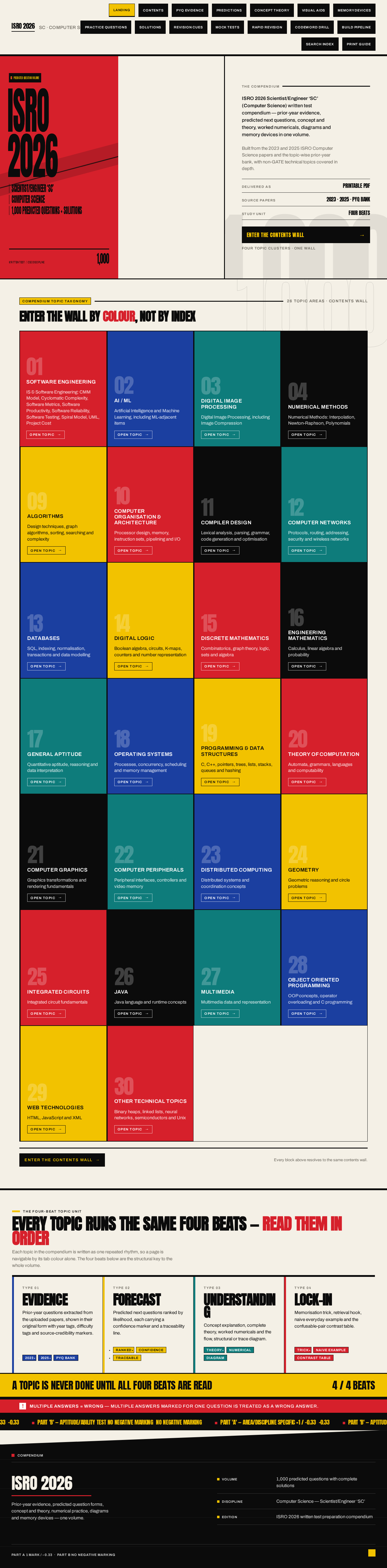
Landing

  • Information and state: the public entry poster for the compendium — product identity, target exam, target post, question volume, and the four-beat study structure. No protected state; nothing is gated.
  • Primary actions: enter the contents wall; jump directly into a named topic cluster block.
  • Supporting actions: read the Part 'A' / Part 'B' marking summary; read the multiple-answers-are-wrong warning.
  • Domain entities: compendium, exam (ISRO 2026 Scientist/Engineer 'SC' Computer Science), Part 'A', Part 'B', topic cluster, four-beat topic unit.
  • Component responsibilities: cover poster with the exam and post identity; a three-line stack naming the post, the discipline and the volume; four stacked category blocks (Software Engineering, AI/ML, Digital Image Processing, Numerical Methods) each linking into the contents wall; a marking ticker band alternating Part 'A' 1 mark / −0.33 and Part 'B' no negative marking.
  • States: loading — not applicable, the poster is static; empty — not applicable; success — the reader identifies the volume and enters the contents wall; error — a category block link that cannot resolve is reported as a broken anchor and the reader is returned to the contents wall; recovery — the contents wall remains reachable from the poster at all times.

Contents

  • Information and state: the hyperlinked table of contents mirroring the topic taxonomy, with per-cluster question counts and the Part 'A' / Part 'B' split.
  • Primary actions: jump to a subject chapter; jump to a four-beat topic unit; jump to a Part 'A' or Part 'B' block.
  • Supporting actions: return to the Landing poster; jump to the predicted topic-weight table.
  • Domain entities: subject chapter, topic cluster, topic unit, question range, Part 'A', Part 'B'.
  • Component responsibilities: colour-blocked contents wall where each topic cluster is a flat rectangle carrying the topic name in uppercase and the question count as an oversized numeral; a Part 'A' / Part 'B' divider; a link to the predicted topic-weight table.
  • States: loading — not applicable; empty — a cluster with zero extracted PYQs still appears as a concept-and-prediction unit rather than being dropped; success — every listed destination resolves; error — a broken internal anchor is flagged and the reader is returned to the contents wall; recovery — the contents wall is the universal return point.

PYQ Evidence

  • Information and state: topic-level prior-year evidence — the extracted questions in their original form, with year tag, difficulty tag, source marker and credibility marker.
  • Primary actions: read the extracted PYQs for the topic; follow the source-credibility marker back to the originating uploaded paper.
  • Supporting actions: jump to the corresponding Predictions beat; jump to the grouped answer key for the topic.
  • Domain entities: PYQ, answer key, year tag, difficulty tag, source marker, credibility marker, repair-manifest reference.
  • Component responsibilities: the EVIDENCE beat of the four-beat topic unit; a numbered question stack on white sheets; per-question tag chips; a repair marker on any reconstructed fragment; a link into the topic's grouped answer key.
  • States: loading — not applicable; empty — a topic with no extracted PYQs shows an explicit "no PYQ evidence in the uploaded sources" note and continues into the Forecast beat; success — the reader sees which question forms recur across years; error — a question whose answer key is Q-Q is shown with a flagged no-verified-key marker rather than a fabricated answer; recovery — the flagged item links to the repair manifest entry.
Page 6 of 29

Predictions

  • Information and state: the forecast questions for the topic, ranked by likelihood, each carrying a confidence level (high / medium / speculative) and a traceability note.
  • Primary actions: read the predicted questions; read the traceability rationale for each prediction.
  • Supporting actions: jump to the Concept Theory beat; jump to the Practice Questions block; jump to the predicted topic-weight table.
  • Domain entities: predicted question, confidence level, traceability rationale, topic frequency, recent-paper emphasis.
  • Component responsibilities: the FORECAST beat; a ranked prediction list; a confidence marker per prediction (filled / half-filled / hollow); a dashed-border callout for predicted-but-unasked concepts; a traceability line naming the observed PYQ pattern or the stated extrapolation.
  • States: loading — not applicable; empty — a topic with no source evidence still receives predictions derived from the topic taxonomy, each labelled speculative; success — the reader can rank predictions by confidence; error — a prediction with no traceable basis is withheld rather than shipped; recovery — the reader is directed to the Concept Theory beat for the underlying topic.

Concept Theory

  • Information and state: definitions, complete theory coverage, formula sheets, and worked numerical problems for the topic.
  • Primary actions: read the concept explanation for each predicted question; work through the embedded numericals; read the formula sheet.
  • Supporting actions: jump to the Visual Aids beat; jump to the Memory Devices beat; jump to the Practice Questions block.
  • Domain entities: concept, theory section, formula sheet, worked numerical, derivation step.
  • Component responsibilities: the UNDERSTANDING beat; a concept block per predicted question; a formula sheet strip; worked numericals with each arithmetic step shown; a declared completeness statement for the subject.
  • States: loading — not applicable; empty — a topic with no source PYQs still receives a full concept-and-theory unit; success — the reader can derive the answer rather than recall the letter; error — a formula or derivation that cannot be rendered legibly at A4 scale is flagged and re-set; recovery — the reader is directed to the Visual Aids beat for the diagrammatic form.

Visual Aids

  • Information and state: flow diagrams, structural diagrams, numerical trace diagrams and before-and-after diagrams, each placed immediately adjacent to the question or concept it explains.
  • Primary actions: read a diagram; follow its numbered callouts against the numbered explanation lines.
  • Supporting actions: jump back to the Concept Theory beat; jump forward to the Memory Devices beat.
  • Domain entities: flow diagram, structural diagram, trace diagram, before-and-after diagram, numbered callout.
  • Component responsibilities: the diagram layer of the UNDERSTANDING beat; flow diagrams for algorithmic, procedural and pipeline concepts; structural diagrams for trees, graphs, memory layouts, architecture blocks, OSI stacks, cache maps, ER diagrams and automata; trace diagrams for cache mapping, page replacement frames, pipeline stages, sorting passes and K-Map groups; before-and-after diagrams for normalisation, optimisation, encoding and table design.
  • States: loading — not applicable; empty — a concept with no diagrammatic form states that explicitly rather than shipping a decorative placeholder; success — the diagram is interpretable in grayscale at print resolution; error — a diagram that depends on subtle colour differences alone is re-drawn with outlines and glyphs; recovery — the reader is directed to the Concept Theory beat for the prose form.
Page 7 of 29

Memory Devices

  • Information and state: the memorisation trick or mnemonic for the topic, the one-line retrieval hook, the naive everyday example for concepts that are too complex, and the confusable-pair contrast tables.
  • Primary actions: read the mnemonic; read the naive example; read the contrast table; read the spaced-revision cue.
  • Supporting actions: jump back to the Concept Theory beat; jump to the Revision Cues block.
  • Domain entities: mnemonic, retrieval hook, naive example, contrast table, spaced-revision cue, confusable pair.
  • Component responsibilities: the LOCK-IN beat; a full-width memory-trick strip carrying a one-line mnemonic plus a three-step flat diagram; a retrieval hook line; a naive-example callout; a contrast table separating confusable pairs such as 3NF vs BCNF, Type-1 vs Type-2 hypervisor, TCP vs UDP, and process vs thread; a spaced-revision cue.
  • States: loading — not applicable; empty — a concept-heavy topic without a mnemonic or naive example is treated as incomplete and cannot be exported; success — the reader can recall the concept from the hook alone; error — a contrast table with fewer than two contrasted items is rejected; recovery — the reader is directed to the Concept Theory beat.

Practice Questions

  • Information and state: the predicted questions arranged for self-testing, with the solution block visually separated so the reader can attempt before revealing.
  • Primary actions: attempt a question; mark it solved or unsolved in the margin; reveal the solution block.
  • Supporting actions: jump to the Solutions block; jump to the grouped answer key for the topic.
  • Domain entities: question stem, four lettered options, number chip, solved/unsolved margin state, high-risk flag.
  • Component responsibilities: the fixed question anatomy — a black square number chip, the stem, four options in a two-column grid on wide layouts and one column on narrow layouts, and a red −0.33 stamp on any question flagged as high-risk; a Part 'A' opener carrying the marking scheme and the multiple-answers-are-wrong warning band; a Part 'B' opener carrying the variable-weight and no-negative-marking note.
  • States: loading — not applicable; empty — a topic with no predicted questions cannot be exported; success — the reader attempts the question before the solution divider; error — a question with a missing or corrupted option is withheld until repaired; recovery — the reader is directed to the repair manifest entry and the question returns once reconstructed.

Solutions

  • Information and state: step-by-step solution derivations for every question, the grouped answer keys per topic, and the common-trap and distractor analysis for tricky questions.
  • Primary actions: read the step-by-step derivation; verify against the source answer key; read the distractor analysis.
  • Supporting actions: jump back to the Practice Questions block; jump to the Memory Devices beat; jump to the repair manifest entry for a reconstructed item.
  • Domain entities: solution derivation, answer key, distractor, trap, source-key match, flagged conflict.
  • Component responsibilities: the solution strip under each question; a grouped answer-key section after each topic block; a trap-analysis block; a conflict flag where the source answer key disagrees with the derived answer.
  • States: loading — not applicable; empty — no question may ship without a solution; success — the reader can reproduce the reasoning path; error — a source answer key marked Q-Q is shown as a flagged no-verified-key item rather than silently resolved; recovery — the reader is directed to the repair manifest entry.
Page 8 of 29

Revision Cues

  • Information and state: the spaced-revision cue attached to each topic unit and the continuation links that move the reader between topic units.
  • Primary actions: record the topic on the spaced-revision cue; continue to the next topic unit.
  • Supporting actions: jump back to the Contents wall; jump to the Rapid Revision block.
  • Domain entities: spaced-revision cue, topic unit, continuation link.
  • Component responsibilities: a per-topic revision cue; a continuation link to the next topic unit; a return link to the contents wall.
  • States: loading — not applicable; empty — a topic unit without a revision cue is treated as incomplete; success — the reader knows when to revisit the topic; error — a continuation link that cannot resolve is flagged and the reader is returned to the contents wall; recovery — the contents wall is the universal return point.

Mock Tests

  • Information and state: the Part 'A' and Part 'B' timed mock blocks with their marking rules and answer review.
  • Primary actions: attempt the Part 'A' discipline block under the 1 mark / −0.33 rule; attempt the Part 'B' aptitude block under variable weights and no negative marking; review answers.
  • Supporting actions: jump to the grouped answer keys; jump to the Solutions block for a wrong question.
  • Domain entities: Part 'A' block, Part 'B' block, marking rule, attempt, answer review.
  • Component responsibilities: a Part 'A' opener carrying the marking scheme and the multiple-answers-are-wrong warning band; a Part 'B' opener carrying the variable-weight and no-negative-marking note; an answer-review block that routes each wrong question back to its solution and trap analysis.
  • States: loading — not applicable; empty — a mock block with fewer questions than the exam pattern states that explicitly; success — the reader completes the block and reviews every wrong answer; error — a mock block whose marking rule is not displayed cannot be exported; recovery — the reader is returned to the Practice Questions block.

Rapid Revision

  • Information and state: the predicted topic-weight table for ISRO 2026, the per-topic formula sheets, the retrieval hooks, the contrast tables, and the high-confidence predicted questions.
  • Primary actions: rank topics by predicted weight and personal weakness; read the retrieval hook, formula sheet and contrast table for a high-rank topic; re-attempt the high-confidence predicted questions.
  • Supporting actions: jump to the Contents wall; jump to the Predictions beat for a topic.
  • Domain entities: predicted topic-weight table, formula sheet, retrieval hook, contrast table, high-confidence predicted question.
  • Component responsibilities: the predicted topic-weight table; a per-topic rapid-revision strip carrying the retrieval hook, the formula sheet and the contrast table; a high-confidence question list.
  • States: loading — not applicable; empty — a topic with no predicted weight entry is listed explicitly rather than omitted; success — the reader can allocate revision hours from the table; error — a topic-weight entry with no traceable basis is flagged as speculative; recovery — the reader is directed to the Predictions beat.
Page 9 of 29

Codeword Drill

  • Information and state: the dedicated Hamming-distance and minimum-distance correction unit for the five-bit valid codeword set — Codeword A: 00000, Codeword B: 01110, Codeword C: 11000 — and the received word 01000.
  • Primary actions: read the valid codeword set; compute each pairwise Hamming distance; compare the manual result against the worked conclusion for the received word; apply the generalised detection and correction capability formulas to a new codeword set.
  • Supporting actions: jump to the Visual Aids beat for the distance-matrix diagram; jump to the Memory Devices beat for the contrast table.
  • Domain entities: codeword, received word, Hamming distance, minimum distance, error-detection capability, error-correction capability, distance matrix.
  • Component responsibilities: a distinct worked entry for Codeword A, Codeword B and Codeword C showing each one's Hamming distance to every other valid codeword; a worked solution determining the system's conclusion for the received word 01000; a distance-matrix diagram among all valid codewords and the received word; the generalised minimum-Hamming-distance, error-detection-capability and error-correction-capability formulas.
  • States: loading — not applicable; empty — the unit cannot ship without all three codewords and the received word; success — the reader can reproduce the correction decision and generalise it; error — a tie in minimum distance is shown as an explicit unable-to-correct outcome rather than resolved arbitrarily; recovery — the reader is directed to the generalised formulas.

Build Pipeline

  • Information and state: the compiler-facing destination for ingestion, extraction, repair, classification, prediction, attribution and PDF export, with the structured question bank, the repair manifest and the source attribution index.
  • Primary actions: ingest the three uploaded source documents; extract each question with its options, answer key and tag labels; detect and log corrupted or truncated stems and options; classify each question into the topic taxonomy with non-GATE clusters flagged separately; compute per-topic and recent-paper frequency; generate predicted variants with confidence levels; attach concepts, theory, numericals, diagrams, mnemonics and naive examples; assemble the source attribution index; assemble and export the single PDF.
  • Supporting actions: inspect the repair manifest; inspect the source attribution index; run the coverage audit before export.
  • Domain entities: source document, extracted question, structured question bank record (stem, options, key, topic tag, year tag, difficulty tag, source marker, prediction confidence, repair-manifest reference), repair manifest entry, source attribution index entry, coverage audit result.
  • Component responsibilities: the ingestion stage; the extraction stage; the repair and reconstruction stage; the classification stage; the frequency and prediction stage; the concept, theory, numerical, diagram, mnemonic and naive-example attachment stage; the attribution assembly stage; the coverage audit; the PDF export stage.
  • States: loading — the pipeline reports ingestion progress per source document; empty — a source document that yields no extractable questions halts the run rather than exporting a partial volume; success — exactly 1,000 solved questions with valid internal navigation links are exported; error — a corrupted fragment that cannot be reconstructed against an answer key is logged in the repair manifest and flagged in the document rather than guessed silently; recovery — the run resumes from the last completed stage without rebuilding the volume.

Search Index

  • Information and state: the searchable and copyable text index supporting topic discovery in the offline PDF.
  • Primary actions: search for a topic term; copy a formula or definition.
  • Supporting actions: jump to the matching topic unit; jump to the matching question.
  • Domain entities: searchable text, topic term, formula, definition, internal anchor.
  • Component responsibilities: searchable text across the whole volume; selectable mathematics; resolvable internal anchors.
  • States: loading — not applicable; empty — a term with no match returns an explicit no-match result; success — the reader locates any topic term within the document tools; error — a search result whose anchor cannot resolve is flagged; recovery — the reader is returned to the Contents wall.
Page 10 of 29

Print Guide

  • Information and state: the print-oriented page furniture and navigation guidance — subject name, question range and page number.
  • Primary actions: read the running topic tab in the outer margin; read the question range in the footer; read the page number.
  • Supporting actions: jump to the Contents wall; jump to the grouped answer key for the current topic.
  • Domain entities: running topic tab, question range, page number, subject header.
  • Component responsibilities: a thin top rule with the subject name on the left and the question range on the right; a page number centred at the foot; a running topic tab in the outer margin; a checkbox rule in the margin for solved-vs-unsolved state.
  • States: loading — not applicable; empty — a page without its subject header or question range cannot be exported; success — printed pages remain identifiable and paginate cleanly without orphaned questions; error — a diagram separated from its explanation by a page break is re-flowed; recovery — the reader is directed to the Contents wall.

3. Functional Requirements

3.1 Compilation Target and Exam Alignment

  • FR-1. As an ISRO CSE aspirant, I want a PDF containing exactly 1,000 questions with solutions, so that I have a single self-contained practice volume. (explicit; trigger: opening the delivered PDF; observable result: the volume contains exactly 1,000 solved questions; failure/recovery: a volume with fewer than 1,000 solved questions cannot be exported; continuation: the reader enters the contents wall.)
  • FR-2. As an ISRO CSE aspirant, I want every question tagged to the ISRO Scientist/Engineer 'SC' (Computer Science) 2026 syllabus scope, so that I never practise off-target material. (explicit; observable result: each question carries a syllabus-scope tag; failure/recovery: an untagged question is withheld until tagged.)
  • FR-3. As an ISRO CSE aspirant, I want questions split into Part 'A' (Area/Discipline Specific) and Part 'B' (Aptitude/Ability Test) blocks, so that the volume mirrors the real paper's sectioning. (explicit; observable result: the volume presents a Part 'A' block and a Part 'B' block.)
  • FR-4. As an ISRO CSE aspirant, I want Part 'A' discipline questions presented as four-option single-correct MCQs, so that format matches the actual test booklet. (explicit; observable result: each Part 'A' question shows options (a), (b), (c), (d) with exactly one correct answer.)
  • FR-5. As an ISRO CSE aspirant, I want each Part 'A' question annotated with the 1 mark / −0.33 negative marking consequence, so that I learn risk-calibrated attempt strategy. (explicit; observable result: the marking scheme is displayed on every Part 'A' block.)
  • FR-6. As an ISRO CSE aspirant, I want Part 'B' aptitude questions marked with variable mark weights and a no-negative-marking note, so that I plan attempt order correctly. (explicit; observable result: each Part 'B' question shows its own mark value and the block carries the no-negative-marking note.)
  • FR-7. As an ISRO CSE aspirant, I want a warning that multiple answers to one question count as wrong, so that I never double-mark. (explicit; observable result: the warning band appears on the Part 'A' opener.)
Page 11 of 29

3.2 PYQ Extraction

  • FR-8. As a study-guide compiler, I want prior-year questions extracted from the uploaded Computer Science 2025 paper, so that the most recent paper style anchors the compendium. (explicit; trigger: ingestion of the 2025 paper; observable result: extracted questions carry a 2025 source marker.)
  • FR-9. As a study-guide compiler, I want prior-year questions extracted from the uploaded Computer Science 2023 paper, so that year-over-year drift in question style is captured. (explicit; observable result: extracted questions carry a 2023 source marker.)
  • FR-10. As a study-guide compiler, I want prior-year questions extracted from the uploaded ISRO PYQ question bank, so that the full historical topic frequency is available. (explicit; observable result: extracted questions carry their original year tags such as isro2018, isro-2020.)
  • FR-11. As a study-guide compiler, I want each extracted PYQ stored with its answer key and original tag labels (e.g., isro2018, isro-2020, normal, easy), so that provenance and difficulty are traceable. (explicit; observable result: each structured question-bank record carries key, year tag and difficulty tag.)
  • FR-12. As a study-guide compiler, I want PYQs extracted specifically for non-GATE technical topics, so that the gap between GATE-syllabus and ISRO-syllabus preparation is closed. (explicit; observable result: non-GATE clusters are flagged separately in the taxonomy.)
  • FR-13. As a study-guide compiler, I want Software Engineering PYQs extracted, so that this non-GATE area is fully represented. (explicit.)
  • FR-14. As a study-guide compiler, I want Artificial Intelligence PYQs extracted, so that this non-GATE area is fully represented. (explicit.)
  • FR-15. As a study-guide compiler, I want Machine Learning PYQs and ML-adjacent items extracted, so that the AI/ML cluster is complete. (explicit.)
  • FR-16. As a study-guide compiler, I want IS & Software Engineering sub-topics extracted — CMM Model, Cyclomatic Complexity, Software Metrics, Software Productivity, Software Reliability, Software Testing, Spiral Model, UML, Project Cost, and out-of-GATE-syllabus items — so that every named sub-capability is individually covered. (explicit.)
  • FR-17. As a study-guide compiler, I want Computer Graphics PYQs extracted as a non-GATE topic. (explicit.)
  • FR-18. As a study-guide compiler, I want Computer Peripherals PYQs extracted, including Intel 8151A and Video Memory items. (explicit.)
  • FR-19. As a study-guide compiler, I want Digital Image Processing PYQs extracted, including Image Compression items. (explicit.)
  • FR-20. As a study-guide compiler, I want Distributed Computing PYQs extracted. (explicit.)
  • FR-21. As a study-guide compiler, I want Geometry PYQs extracted, including Circle items. (explicit.)
  • FR-22. As a study-guide compiler, I want Integrated Circuits PYQs extracted. (explicit.)
  • FR-23. As a study-guide compiler, I want Java PYQs extracted. (explicit.)
  • FR-24. As a study-guide compiler, I want Multimedia PYQs extracted. (explicit.)
  • FR-25. As a study-guide compiler, I want Numerical Methods PYQs extracted, including Interpolation, Newton-Raphson, and Polynomials items. (explicit.)
  • FR-26. As a study-guide compiler, I want Object Oriented Programming PYQs extracted, including Operator Overloading and Programming in C items. (explicit.)
  • FR-27. As a study-guide compiler, I want Web Technologies PYQs extracted, including HTML, JavaScript, and XML items. (explicit.)
  • FR-28. As a study-guide compiler, I want "Others" non-GATE items extracted — Binary Heap, Linked List, Neural Network, Semiconductor, and Unix — as distinct entries. (explicit.)
  • FR-29. As a study-guide compiler, I want garbled, malformed, or figure-dependent PYQs flagged for repair or reconstruction, so that no unanswered or unreadable question ships in the PDF. (explicit; observable result: each flagged item carries a repair-manifest reference; failure/recovery: an item that cannot be reconstructed is flagged in the document rather than guessed silently.)
  • FR-30. As a study-guide compiler, I want PYQ options with encoding corruption or missing option text reconstructed from answer keys, so that correct answers remain defensible. (explicit; observable result: the reconstructed option set is logged in the repair manifest with its source page and resolution.)
Page 12 of 29

3.3 Core GATE-Syllabus Coverage (A–Z Topic Sweep)

  • FR-31. As an ISRO CSE aspirant, I want Algorithms coverage — Algorithm Design Techniques, Binary Search, BFS, Dijkstra's Algorithm, Graph Algorithms, Hashing, Huffman Code, Identify-Function/Output tracing, Master Theorem, Matrix Chain Ordering, Merge Sort, P/NP/NPC/NPH, Quick Sort, Recurrence Relations, Relations, Searching, Selection Sort, Sorting, Spanning Tree, Time Complexity, and Tree Traversal. (explicit.)
  • FR-32. As an ISRO CSE aspirant, I want Computer Organisation & Architecture coverage — 8085 Microprocessor, Addressing Modes, Cache Memory, Direct Mapping, Disk, Instruction Format, Interrupts, I/O Handling, Machine Instructions, Memory Interfacing, Memory Management, Microprogramming, Number Representation, Parallel Programming, Pipelining, RAM, and Runtime Environment. (explicit.)
  • FR-33. As an ISRO CSE aspirant, I want Compiler Design coverage — Assembler, Code Optimization, Compiler Tokenization, Context-Free Grammar, Expressions, Grammar, Lexical Analysis, Operator Grammar, Parameter Passing, Parsing, Runtime Environment, and Symbol Table. (explicit.)
  • FR-34. As an ISRO CSE aspirant, I want Computer Networks coverage — Application Layer Protocols, Binary Codes, Communication, CRC Polynomial, Cryptography, CSMA/CD, DNS, Encoding, Error Correction, Error Detection, Ethernet, Firewall, ICMP, IP Packet, LAN Technologies, Link State Routing, MAC Protocol, MD5, Network Addressing, Network Layering, Network Protocols, Network Security, Network Topologies, Ping, Routers/Bridges/Hubs/Switches, Routing, Serial Communication, Sliding Window, Slotted Aloha, Subnetting, Supernetting, TCP, Token Ring, Transport Layer, Wi-Fi, WiMax, and Wireless Networks. (explicit.)
  • FR-35. As an ISRO CSE aspirant, I want Databases coverage — B-Tree, Candidate Key, Database Normalisation, ER Diagram, File organisation, Indexing, Physical Storage, RAID, Referential Integrity, Relational Algebra, Relations, SQL, Transaction & Concurrency, and Triggers. (explicit.)
  • FR-36. As an ISRO CSE aspirant, I want Digital Logic coverage — Adder, BCD, Binary Codes, Binary Subtractor, Boolean Algebra, Booth's Algorithm, Canonical Normal Form, Circuit Output, Combinational Circuit, Decoder, Digital Circuits, Digital Counter, Excess-3, Flip-Flop, Floating Point Representation, IEEE Representation, K-Map, Memory Interfacing, Minimum Number of Gates, Multiplexer, Number Representation, Sequential Circuit, and Tri-State. (explicit.)
  • FR-37. As an ISRO CSE aspirant, I want Discrete Mathematics: Combinatorics coverage, including Binary Search Tree and Recurrence Relation items. (explicit.)
  • FR-38. As an ISRO CSE aspirant, I want Discrete Mathematics: Graph Theory coverage — Counting, Euler Graph, Graph Colouring, Graph Connectivity, and Group Theory. (explicit.)
  • FR-39. As an ISRO CSE aspirant, I want Discrete Mathematics: Mathematical Logic coverage — Boolean Algebra, First Order Logic, and Propositional Logic. (explicit.)
  • FR-40. As an ISRO CSE aspirant, I want Discrete Mathematics: Set Theory & Algebra coverage — Equivalence Class, Functions, Group Theory, Relations, and Set Theory. (explicit.)
  • FR-41. As an ISRO CSE aspirant, I want Engineering Mathematics: Calculus coverage, including Limits and Maxima–Minima. (explicit.)
  • FR-42. As an ISRO CSE aspirant, I want Engineering Mathematics: Linear Algebra coverage — Determinant, Eigen Value, and Matrix. (explicit.)
  • FR-43. As an ISRO CSE aspirant, I want Engineering Mathematics: Probability coverage — Conditional Probability, Mean/Mode/Median, Normal Distribution, Poisson Distribution, Random Variable, Standard Deviation, and Statistics. (explicit.)
  • FR-44. As an ISRO CSE aspirant, I want General Aptitude / Quantitative Aptitude coverage, including Summation items. (explicit.)
  • FR-45. As an ISRO CSE aspirant, I want Operating Systems coverage — Concurrency, Context Switch, Critical Section, Deadlock Prevention/Avoidance/Detection, Disk, Disk Scheduling, Fork System Call, I/O Handling, LRU, Memory Management, Mutual Exclusion, Page Fault, Page Replacement, Paging, Pipes, Precedence Graph, Process, Process Scheduling, Process Synchronization, Real-time Systems, Resource Allocation, Segmentation, Semaphore, Unix, Virtual Memory, and Working Set. (explicit.)
  • FR-46. As an ISRO CSE aspirant, I want Programming and Data Structures coverage — Programming in C, Activation Record, Arrays, C++, Functions, Loop Invariants, Macros, Memory Management, Output tracing, Parameter Passing, Pointers, Recursion, Semantic Analysis, and Union. (explicit.)
  • FR-47. As an ISRO CSE aspirant, I want Data Structures coverage — AVL Tree, Binary Search Tree, Binary Tree, Breadth First Search, Hashing, Infix–Prefix conversion, Linked List, Queue, Stack, Symbol Table, Tree, and Tree Traversal. (explicit.)
  • FR-48. As an ISRO CSE aspirant, I want Theory of Computation coverage — Closure Property, Context-Free Grammar, Context-Free Language, Context-Sensitive, Finite Automata, Grammar, Identify Class of Language, Minimal State Automata, Moore/Mealy Machine, Non-determinism, Recursive & Recursively Enumerable Languages, Regular Expression, Regular Language, and Turing Machine. (explicit.)
Page 13 of 29

3.4 Next-Question Prediction

  • FR-49. As an ISRO CSE aspirant, I want the compendium to predict the next questions likely to be asked in ISRO 2026, so that I prepare forward, not just backward. (explicit; observable result: each topic carries a Forecast beat with predicted questions.)
  • FR-50. As an ISRO CSE aspirant, I want predictions derived from the frequency of each topic across the uploaded PYQ bank, so that high-yield areas are prioritised. (explicit; observable result: each prediction carries a traceability line naming the observed frequency.)
  • FR-51. As an ISRO CSE aspirant, I want predictions derived from recent-paper emphasis (2023 and 2025 papers), so that the most current examiner intent dominates. (explicit; observable result: recent-paper emphasis is stated in the traceability line.)
  • FR-52. As an ISRO CSE aspirant, I want predictions to include concept-level questions not previously asked, so that I am not blindsided by first-time question framings. (explicit; observable result: predicted-but-unasked concepts appear in a dashed-border callout.)
  • FR-53. As an ISRO CSE aspirant, I want predictions to include new numerical variants of recurring PYQ templates, so that I can handle changed data in familiar structures. (explicit.)
  • FR-54. As an ISRO CSE aspirant, I want predictions tagged with a confidence level (high / medium / speculative) based on source evidence weight. (explicit; observable result: each prediction carries a filled / half-filled / hollow confidence marker.)
  • FR-55. As an ISRO CSE aspirant, I want predictions for the non-GATE topics with the highest predicted weight, given their role in differentiating ISRO from GATE. (explicit.)
  • FR-56. As an ISRO CSE aspirant, I want a predicted topic-weight table for ISRO 2026 so that I can allocate revision hours. (explicit; observable result: the table appears in the Rapid Revision block.)

3.5 Concepts, Theory and Numericals

  • FR-57. As an ISRO CSE aspirant, I want detailed concept explanations for every predicted question, so that each question teaches rather than merely tests. (explicit.)
  • FR-58. As an ISRO CSE aspirant, I want complete theory coverage of each topic, not just isolated question answers. (explicit.)
  • FR-59. As an ISRO CSE aspirant, I want worked numerical problems embedded in the theory, so that quantitative topics are practised, not just read. (explicit.)
  • FR-60. As an ISRO CSE aspirant, I want step-by-step solution derivations for all 1,000 questions, so that I can see the correct reasoning path, not only the answer letter. (explicit; observable result: every question carries a derivation; failure/recovery: no question may ship without a solution.)
  • FR-61. As an ISRO CSE aspirant, I want formula sheets per topic, so that revision is fast before the exam. (explicit.)
  • FR-62. As an ISRO CSE aspirant, I want full topic coverage declared complete per subject, so that I trust nothing has been silently skipped. (explicit; observable result: each subject carries a completeness statement; failure/recovery: the coverage audit must pass before export.)
  • FR-63. As an ISRO CSE aspirant, I want common-trap and distractor analysis for tricky questions, so that I recognise examiner traps. (explicit.)
  • FR-64. As an ISRO CSE aspirant, I want every answer verified against the source answer key where one exists, so that incorrect answers are never learned. (explicit; observable result: a source-key match is recorded; failure/recovery: a conflict is flagged in the document rather than silently resolved.)

3.6 Visual Learning Aids

  • FR-65. As an ISRO CSE aspirant, I want flow diagrams for every algorithmic, procedural, or pipeline concept, so that I can visually follow the sequence. (explicit.)
  • FR-66. As an ISRO CSE aspirant, I want structural diagrams (trees, graphs, memory layouts, architecture blocks, OSI stacks, cache maps, ER diagrams, automata) for every diagram-dependent topic. (explicit.)
  • FR-67. As an ISRO CSE aspirant, I want numerical trace diagrams (e.g., cache mapping, page replacement frames, pipeline stages, sorting passes, K-Map groups) so that step-by-step arithmetic is visible. (explicit.)
  • FR-68. As an ISRO CSE aspirant, I want before-and-after diagrams for transformation topics (normalisation, optimisation, encoding, table design), so that change is visible. (explicit.)
  • FR-69. As an ISRO CSE aspirant, I want diagrams placed immediately adjacent to the question or concept they explain, so that no page-flipping is required. (explicit; observable result: the diagram sits beside its explanation; failure/recovery: a diagram separated by a page break is re-flowed.)
Page 14 of 29

3.7 Memorisation Devices

  • FR-70. As an ISRO CSE aspirant, I want a memorisation trick or mnemonic for every concept-heavy topic, so that I retain it long-term. (explicit; observable result: a memory-trick strip appears under every solution; failure/recovery: a concept-heavy topic without a mnemonic is treated as incomplete.)
  • FR-71. As an ISRO CSE aspirant, I want naive, everyday examples for any concept that is too complex, so that abstract ideas become intuition. (explicit.)
  • FR-72. As an ISRO CSE aspirant, I want a one-line "retrieval hook" per topic that triggers recall of the full concept. (explicit.)
  • FR-73. As an ISRO CSE aspirant, I want confusable-pair contrast tables (e.g., 3NF vs BCNF, Type-1 vs Type-2 hypervisor, TCP vs UDP, process vs thread), so that closely-related exam traps are separated permanently. (explicit.)
  • FR-74. As an ISRO CSE aspirant, I want a spaced-revision schedule cue attached to each topic unit, so that I know when to revisit. (explicit.)

3.8 PDF Packaging and Navigation

  • FR-75. As an ISRO CSE aspirant, I want the entire 1,000-question compendium delivered as one PDF file, so that it is a single portable artifact. (explicit.)
  • FR-76. As an ISRO CSE aspirant, I want a hyperlinked table of contents mirroring the topic taxonomy, so that I can jump to any subject. (explicit; observable result: every TOC entry resolves; failure/recovery: a broken anchor is flagged.)
  • FR-77. As an ISRO CSE aspirant, I want consistent question numbering across the whole volume, so that cross-references and revision notes are reliable. (explicit.)
  • FR-78. As an ISRO CSE aspirant, I want answer keys grouped per topic, so that I can self-test then verify. (explicit.)
  • FR-79. As an ISRO CSE aspirant, I want the PDF to be print-friendly and offline-readable, so that I can study without connectivity. (explicit; observable result: the PDF opens and renders fully without network access.)
  • FR-80. As an ISRO CSE aspirant, I want searchable text and selectable mathematics in the PDF, so that I can find terms instantly. (explicit.)
  • FR-81. As an ISRO CSE aspirant, I want page headers showing subject and question range, so that printed pages remain identifiable. (explicit.)
  • FR-82. As an ISRO CSE aspirant, I want a source-credibility marker on each extracted PYQ identifying which uploaded paper it came from, so that I can weight its importance. (explicit.)

3.9 CSMA/CD Topic Unit (Csma Cd)

  • FR-83. As an ISRO CSE aspirant, I want a dedicated Csma Cd topic unit covering the carrier-sense multiple-access-with-collision-detection mechanism, so that this networking sub-topic is studied as its own first-class requirement rather than buried in a general networks sweep. (explicit.)
  • FR-84. As an ISRO CSE aspirant, I want the Csma Cd unit to explain the special bit sequence transmitted by the media access management layer to handle a collision, so that I can answer jam-sequence questions correctly. (explicit.)
  • FR-85. As an ISRO CSE aspirant, I want the Csma Cd unit to identify which transmission media are not readily suitable for CSMA operation, so that media-versus-protocol matching questions are covered. (explicit.)
  • FR-86. As an ISRO CSE aspirant, I want a flow diagram of CSMA/CD collision handling (sense → transmit → collide → backoff → retransmit) so that the temporal sequence is visible. (explicit.)
Page 15 of 29

3.10 Error-Correction Codeword Content (Codeword A, Codeword B, Codeword C)

  • FR-87. As an ISRO CSE aspirant, I want a codeword-based error-correction question unit using the five-bit valid codeword set, so that Hamming-distance reasoning is practised in the exact form ISRO sets it. (explicit.)
  • FR-88. As an ISRO CSE aspirant, I want a distinct worked entry for Codeword B: 01110, showing its Hamming distance to each other valid codeword, so that I can compute which codeword the receiver corrects to. (explicit.)
  • FR-89. As an ISRO CSE aspirant, I want a distinct worked entry for Codeword C: 11000, showing its Hamming distance to each other valid codeword, so that the comparison is complete. (explicit.)
  • FR-90. As an ISRO CSE aspirant, I want the Codeword A: 00000 entry presented alongside Codeword B and Codeword C, so that the full valid-codeword set is visible together. (explicit.)
  • FR-91. As an ISRO CSE aspirant, I want a worked solution that determines the system's conclusion for a received word of 01000 — correct to Codeword A, correct to Codeword B, correct to Codeword C, or unable to correct — so that I learn the tie-breaking and minimum-distance decision rule. (explicit; failure/recovery: a tie in minimum distance is shown as an explicit unable-to-correct outcome rather than resolved arbitrarily.)
  • FR-92. As an ISRO CSE aspirant, I want a distance-matrix diagram among all valid codewords and the received word, so that the correction decision is visually obvious. (explicit.)
  • FR-93. As an ISRO CSE aspirant, I want the codeword unit generalised into minimum Hamming distance, error-detection capability, and error-correction capability formulas, so that I can solve variants with other codeword sets. (explicit.)

3.11 Distribution and Channel-Model Matching Content

  • FR-94. As an ISRO CSE aspirant, I want a distribution-versus-application matching unit pairing Gaussian distribution, Rayleigh distribution, Poisson distribution, and Uniform distribution to their standard applications, so that this recurring ISRO matching question is mastered. (explicit.)
  • FR-95. As an ISRO CSE aspirant, I want a distinct matching entry stating that Gaussian distribution corresponds to thermal noise, so that this pairing is locked in memory. (explicit.)
  • FR-96. As an ISRO CSE aspirant, I want a distinct matching entry stating that Rayleigh distribution corresponds to fading channel in wireless communication, so that this pairing is locked in memory. (explicit.)
  • FR-97. As an ISRO CSE aspirant, I want a distinct matching entry stating that Poisson distribution corresponds to calls on a telephone channel, so that this pairing is locked in memory. (explicit.)
  • FR-98. As an ISRO CSE aspirant, I want a distinct matching entry stating that Uniform distribution corresponds to a random number source, so that this pairing is locked in memory. (explicit.)
  • FR-99. As an ISRO CSE aspirant, I want a single contrast table collapsing all four pairings, so that the whole matching question can be recalled in one glance. (explicit.)
  • FR-100. As an ISRO CSE aspirant, I want an explicit distinction between discrete and continuous distribution applicability (Poisson applicable to discrete random variables; Gaussian, Rayleigh, and Exponential applicable to continuous random variables), so that the discrete-vs-continuous variant question is answered correctly. (explicit.)

3.12 Software Size Estimation Content

  • FR-101. As an ISRO CSE aspirant, I want a Function Point estimation question unit built from the domain-characteristic table of counts and average weight factors (number of user inputs, user outputs, user enquiries, files, external interfaces), so that the calculation is practised end-to-end. (explicit.)
  • FR-102. As an ISRO CSE aspirant, I want the unit to state and apply the exam assumption "Assume that all complexity adjustment values are average having scale = 3", so that the complexity adjustment factor is computed in exactly the form the question demands. (explicit.)
  • FR-103. As an ISRO CSE aspirant, I want the function-point calculation broken into unadjusted function points → complexity adjustment factor → adjusted function points, with each arithmetic step shown. (explicit.)
  • FR-104. As an ISRO CSE aspirant, I want a numerical trace table carrying the counts, weights, and running totals, so that I can reproduce the answer without memorising a final number. (explicit.)
  • FR-105. As an ISRO CSE aspirant, I want the same unit to include predicted variants with altered counts and altered complexity scale values, so that I am ready for a re-parameterised question in 2026. (explicit.)
Page 16 of 29

3.13 Machine-Level and Memory-Size Fragment Repair

  • FR-106. As a study-guide compiler, I want the 8085 assembly snippet containing MVIA30 H, ACI 30 H, XRA A, POP H, and the line fragment H XRA A reconstructed into a clean, readable, correctly ordered program block, so that the accumulator-contents question is answerable. (explicit; observable result: the reconstructed block is logged in the repair manifest with its source page and resolution.)
  • FR-107. As an ISRO CSE aspirant, I want a worked explanation of XRA A as the exclusive-OR of the accumulator with itself, showing why it forces a defined accumulator and flag-register state, so that the reason behind the answer is understood. (explicit.)
  • FR-108. As an ISRO CSE aspirant, I want the flag-register state after execution of the 8085 program explained flag by flag (Zero, Sign, Carry, Parity, Auxiliary Carry), so that flag-content variants are covered. (explicit.)
  • FR-109. As an ISRO CSE aspirant, I want the 8085 interrupt and register questions covered distinctly — TRAP as an unmaskable interrupt, and the register used to keep track of the memory address of the next opcode — so that the microprocessor cluster is complete. (explicit.)
  • FR-110. As a study-guide compiler, I want the truncated stem fragment "CPU is" traced to its source question and restored to a complete, unambiguous sentence, so that no half-sentence question ships in the PDF. (explicit.)
  • FR-111. As an ISRO CSE aspirant, I want the incomplete address-space question restored with its full option set, so that the CPU address-space item is answerable. (explicit.)
  • FR-112. As an ISRO CSE aspirant, I want a distinct worked entry on the address space of the 8086 CPU expressed as 1 Megabyte, so that the memory-size option set (one Megabyte, 256 Kilobytes, 1 K Megabytes, 64 Kilobytes) is anchored to a correct value. (explicit.)
  • FR-113. As an ISRO CSE aspirant, I want a memory-size unit-conversion drill covering bytes, kilobytes, megabytes, and the addressable-range calculation from n address lines, so that K Megabytes-style distractors are never confused with the correct magnitude. (explicit.)
  • FR-114. As an ISRO CSE aspirant, I want the Byte-addressable vs Word-addressable distinction explained, because address-space and memory-interfacing questions turn on it. (explicit.)
  • FR-115. As a study-guide compiler, I want every stem fragment that terminates mid-sentence or mid-option (such as CPU is, K Megabytes, H XRA A) logged in a repair manifest with its source page and resolution, so that the repair is auditable and no corrupted text silently reaches the reader. (explicit.)
Page 17 of 29

3.14 Source Provenance and Contributor Attribution

  • FR-116. As a study-guide compiler, I want a source attribution index listing every contributor credited in the uploaded ISRO PYQ bank, so that the extracted material's origin is honoured and traceable. (explicit; observable result: the index is preserved verbatim; failure/recovery: no contributor may be renamed, merged or dropped.)
  • FR-117. As a study-guide compiler, I want the contribution of Arjun Suresh preserved in the attribution index, so that this source contributor is credited. (explicit.)
  • FR-118. As a study-guide compiler, I want the contribution of ANKUR MAHIWAL preserved in the attribution index, so that this source contributor is credited. (explicit.)
  • FR-119. As a study-guide compiler, I want the contribution of Achintya Desai preserved in the attribution index, so that this source contributor is credited. (explicit.)
  • FR-120. As a study-guide compiler, I want the contribution of Ajay kumar soni preserved in the attribution index, so that this source contributor is credited. (explicit.)
  • FR-121. As a study-guide compiler, I want the contribution of Akash Dinkar preserved in the attribution index, so that this source contributor is credited. (explicit.)
  • FR-122. As a study-guide compiler, I want the contribution of Akash Kanase preserved in the attribution index, so that this source contributor is credited. (explicit.)
  • FR-123. As a study-guide compiler, I want the contribution of Akhil Nadh PC preserved in the attribution index, so that this source contributor is credited. (explicit.)
  • FR-124. As a study-guide compiler, I want the contribution of Akhilesh Singla preserved in the attribution index, so that this source contributor is credited. (explicit.)
  • FR-125. As a study-guide compiler, I want the contribution of Amar Vashishth preserved in the attribution index, so that this source contributor is credited. (explicit.)
  • FR-126. As a study-guide compiler, I want the contribution of Ankesh Gautam preserved in the attribution index, so that this source contributor is credited. (explicit.)
  • FR-127. As a study-guide compiler, I want the contribution of Ankit Rokde preserved in the attribution index, so that this source contributor is credited. (explicit.)
  • FR-128. As a study-guide compiler, I want the contribution of Anurag Semwal preserved in the attribution index, so that this source contributor is credited. (explicit.)
  • FR-129. As a study-guide compiler, I want the contribution of Arpit Dhuriya preserved in the attribution index, so that this source contributor is credited. (explicit.)
  • FR-130. As a study-guide compiler, I want the contribution of Ashwani Kumar preserved in the attribution index, so that this source contributor is credited. (explicit.)
  • FR-131. As a study-guide compiler, I want the contribution of Bhagirathi Nayak preserved in the attribution index, so that this source contributor is credited. (explicit.)
  • FR-132. As a study-guide compiler, I want the contribution of Debashish Deka preserved in the attribution index, so that this source contributor is credited. (explicit.)
  • FR-133. As a study-guide compiler, I want the contribution of Gate Keeda preserved in the attribution index, so that this source contributor is credited. (explicit.)
  • FR-134. As a study-guide compiler, I want the contribution of Himanshu Agarwal preserved in the attribution index, so that this source contributor is credited. (explicit.)
  • FR-135. As a study-guide compiler, I want the contribution of Isha Gupta preserved in the attribution index, so that this source contributor is credited. (explicit.)
  • FR-136. As a study-guide compiler, I want the contribution of Ishrat Jahan preserved in the attribution index, so that this source contributor is credited. (explicit.)
  • FR-137. As a study-guide compiler, I want the contribution of Jithin Jayan preserved in the attribution index, so that this source contributor is credited. (explicit.)

4. User Personas

Page 18 of 29

4.1 ISRO 2026 Scientist/Engineer 'SC' (Computer Science) Aspirant

Product context. An engineering graduate preparing for the ISRO Centralised Recruitment Board written test for Scientist/Engineer 'SC' (Computer Science). They already have GATE-style preparation, which is exactly why the ISRO paper is dangerous for them: the examiner adds non-GATE technical clusters — Software Engineering, Artificial Intelligence, Machine Learning, Computer Graphics, Computer Peripherals, Digital Image Processing, Distributed Computing, Geometry, Integrated Circuits, Java, Multimedia, Numerical Methods, Object Oriented Programming, Web Technologies, and the "Others" cluster — that a GATE-only syllabus never touches. They study offline, often from a printed copy, and they are working against a fixed exam date.

Primary goal. Walk into the ISRO 2026 written test able to answer both the discipline-specific Part 'A' questions and the aptitude Part 'B' questions, with the non-GATE clusters covered as deeply as the GATE ones, and with a revision path that survives the last week before the exam.

Distinct accepted responsibilities. This role does not merely read; it runs a repeatable study loop. It reads the PYQ evidence for a topic and notices which question forms recur across years. It reads the forecast and weighs each prediction by its confidence marker. It absorbs the concept, the theory and the worked numerical. It studies the flow, structural or trace diagram beside the concept. It applies the mnemonic, and where the concept is too abstract, it reads the naive everyday example. It attempts the predicted questions before revealing the solution. It compares its attempt against the step-by-step derivation and the distractor analysis. It records the topic on the spaced-revision cue. Separately, it runs timed mock simulations across a Part 'A' block under the 1 mark / −0.33 rule and a Part 'B' block under variable weights with no negative marking. Separately again, it runs last-week rapid revision from the predicted topic-weight table, the formula sheets, the retrieval hooks and the contrast tables. And separately again, it drills the codeword error-correction unit by computing Hamming distances by hand and checking them against the worked conclusion.

Relevant inputs and decisions. Inputs: the extracted PYQs with their year and difficulty tags; the predicted questions with their confidence markers; the concept and theory text; the worked numericals; the diagrams; the mnemonics and naive examples; the contrast tables; the predicted topic-weight table; the marking rules. Decisions: which topic to study next; whether a prediction is worth attempting; whether a wrong answer was a concept gap or a trap; which topics to rank highest in the final week; whether to attempt a high-risk Part 'A' question given the −0.33 penalty.

Interactions with other accepted participants. The aspirant is the sole consumer of the finished volume. The Study-Guide Compiler is the build-time role that produced it; the aspirant never interacts with the compiler directly, but every repair-manifest flag and every source-credibility marker in the volume is the compiler's trace, and the aspirant reads those traces to decide how much weight to give a given question.

Observable success. The aspirant can self-test honestly because the solution block is visually separated from the question. Every wrong answer can be traced to either a concept gap or a named trap. The volume opens and renders fully offline, prints cleanly without orphaned questions, and every internal cross-link resolves. The aspirant can locate any topic term by search and can copy a formula out of the PDF.

Page 19 of 29

4.2 Study-Guide Compiler

Product context. The build-time content role that converts the three uploaded ISRO source documents into the structured compendium. This is a content role, not an application user role: the compiler does not consume the finished volume as a reader, it produces it. Its working material is the raw, partly corrupted source: devanagari-to-Latin transcription artefacts, truncated stems such as CPU is, half-options such as K Megabytes, orphaned fragments such as H XRA A, figure-dependent items whose figures did not survive extraction, and answer keys marked Q-Q where no verified key exists.

Primary goal. Produce a single PDF containing exactly 1,000 solved questions, with every topic and sub-topic in the source taxonomy represented, every answer verified against the source key where one exists, every repair logged and auditable, and every contributor credited verbatim.

Distinct accepted responsibilities. The compiler ingests the three uploaded source documents. It extracts each question with its options, its answer key and its original tag labels. It detects corrupted or truncated stems and options, logs them in the repair manifest, and reconstructs them against answer keys. It classifies each question into the topic taxonomy, flagging the non-GATE clusters separately. It computes per-topic frequency across all years and across the 2023 and 2025 papers specifically. It generates predicted question variants and assigns confidence levels. It attaches concept notes, theory, numericals, flow, structural and trace diagrams, mnemonics and naive examples. It assembles the source attribution index across all named contributors. It runs the coverage audit. It assembles and exports the single PDF with hyperlinked table of contents, grouped answer keys and source markers.

Relevant inputs and decisions. Inputs: the three uploaded source papers; the topic taxonomy; the answer keys; the contributor list. Decisions: whether a corrupted fragment can be reconstructed against an answer key or must be flagged; whether a question belongs to a GATE cluster or a non-GATE cluster; what confidence level a prediction deserves; whether a topic with zero PYQs still needs a concept-and-prediction unit; whether a source answer key conflict should be flagged rather than resolved.

Interactions with other accepted participants. The compiler produces the artifact the aspirant reads. Its repair-manifest flags and source-credibility markers are the traces the aspirant uses to weight a question. Its attribution index is the record that honours the source contributors.

Observable success. Exactly 1,000 solved questions are exported with no placeholder or "answer unavailable" entries. The coverage audit passes. Every repaired fragment is individually logged with its source page and resolution. The attribution index is preserved exactly as named in the source material. The exported PDF has valid internal navigation links and opens fully offline.

Page 20 of 29

5. Core User Flows

5.1 Aspirant Flow — Topic-First Revision

  1. Starting context: the aspirant has the compendium PDF open, offline, on screen or in print.
  2. On the Landing poster, the aspirant reads the exam and post identity, the volume count, and the Part 'A' / Part 'B' marking summary, then enters the Contents wall.
  3. On the Contents wall, the aspirant selects a subject chapter — for example Computer Networks — and jumps to its first topic unit.
  4. In the PYQ Evidence beat, the aspirant reads the extracted prior-year questions for the topic and observes which question forms recur across years. Each question carries its year tag, difficulty tag and source-credibility marker. A question whose source key is Q-Q is shown with a flagged no-verified-key marker.
  5. In the Predictions beat, the aspirant reads the forecast questions ranked by likelihood and notes each one's confidence marker (filled / half-filled / hollow) and its traceability line.
  6. In the Concept Theory beat, the aspirant reads the concept explanation, the theory, the formula sheet and the worked numerical, following each arithmetic step.
  7. In the Visual Aids beat, the aspirant studies the flow, structural or trace diagram placed beside the concept, following its numbered callouts against the numbered explanation lines.
  8. In the Memory Devices beat, the aspirant applies the mnemonic, reads the retrieval hook, and — where the concept is too abstract — reads the naive everyday example. The aspirant also reads the confusable-pair contrast table for the topic.
  9. In the Practice Questions block, the aspirant attempts the predicted questions without scrolling past the solution divider, and marks each one solved or unsolved in the margin.
  10. In the Solutions block, the aspirant compares each attempt against the step-by-step derivation and reads the distractor and trap analysis. A wrong answer is traced to either a concept gap or a named trap.
  11. In the Revision Cues block, the aspirant records the topic on the spaced-revision cue and follows the continuation link to the next topic unit.
  12. Observable result: the topic is studied end-to-end across all four beats, every attempt is verified, and the topic is scheduled for revisit.
  13. Failure and recovery: if a diagram has been separated from its explanation by a page break, the reader is directed back to the Concept Theory beat for the prose form. If a question's option set was reconstructed, the reader is directed to the repair-manifest entry to see the original fragment and the resolution.
  14. Continuation: the aspirant moves to the next topic unit, or returns to the Contents wall to change subject.
Page 21 of 29

5.2 Aspirant Flow — Timed Mock Simulation

  1. Starting context: the aspirant has completed topic-first revision across a set of subjects and now wants to test under exam conditions.
  2. The aspirant navigates to the Mock Tests block and opens the Part 'A' discipline block. The opener displays the marking scheme — 1 mark for correct, −0.33 for wrong — and the multiple-answers-are-wrong warning band.
  3. The aspirant attempts the Part 'A' questions under exam conditions, applying the −0.33 penalty mentally to decide whether to attempt a high-risk question.
  4. The aspirant navigates to the Part 'B' aptitude block. The opener displays the variable per-question mark weights and the no-negative-marking note.
  5. The aspirant attempts the Part 'B' questions, planning attempt order around the variable weights.
  6. The aspirant verifies answers against the grouped answer keys in the Solutions block.
  7. For every wrong question, the aspirant jumps back to that question's solution and trap analysis and traces the failure to either a concept gap or a named trap.
  8. Observable result: the aspirant has a scored attempt and a list of traced failures.
  9. Failure and recovery: if a mock block displays fewer questions than the exam pattern states, the block says so explicitly rather than silently under-filling. If a marking rule is missing from a block opener, the block cannot be exported.
  10. Continuation: the aspirant returns to the Practice Questions block for the topics where failures clustered.

5.3 Aspirant Flow — Last-Week Rapid Revision

  1. Starting context: the exam is days away and the aspirant needs to prioritise rather than study exhaustively.
  2. The aspirant opens the Rapid Revision block and reads the predicted topic-weight table for ISRO 2026.
  3. The aspirant ranks topics by predicted weight combined with personal weakness.
  4. For each high-rank topic, the aspirant reads only the retrieval hook, the formula sheet and the confusable-pair contrast table.
  5. The aspirant re-attempts only the high-confidence predicted questions from the Predictions beat.
  6. The aspirant uses the contrast tables — including the distribution-to-application table pairing Gaussian with thermal noise, Rayleigh with fading channels in wireless communication, Poisson with calls on a telephone channel, and Uniform with a random number source — to lock down the most confusable pairs before the exam.
  7. Observable result: the aspirant has a ranked revision list and has re-attempted the highest-confidence predictions.
  8. Failure and recovery: a topic-weight entry with no traceable basis is flagged as speculative rather than presented as a firm ranking.
  9. Continuation: the aspirant returns to the Contents wall or to a specific topic unit for a final read of the Memory Devices beat.
Page 22 of 29

5.4 Aspirant Flow — Codeword and Distance Correction Drill

  1. Starting context: the aspirant has reached the error-correction unit and wants to practise Hamming-distance reasoning in the exact form ISRO sets it.
  2. The aspirant opens the Codeword Drill and reads the valid codeword set: Codeword A 00000, Codeword B 01110, Codeword C 11000.
  3. The aspirant studies the distance-matrix diagram among all valid codewords and the received word 01000.
  4. The aspirant computes each pairwise Hamming distance by hand — including the distinct worked entries for Codeword B and Codeword C against each other valid codeword.
  5. The aspirant compares the manual result against the worked conclusion for the received word 01000: correct to Codeword A, correct to Codeword B, correct to Codeword C, or unable to correct.
  6. The aspirant applies the generalised minimum-Hamming-distance, error-detection-capability and error-correction-capability formulas to a new codeword set.
  7. Observable result: the aspirant can reproduce the correction decision and generalise it to an unfamiliar codeword set.
  8. Failure and recovery: if the received word sits at equal minimum distance from two valid codewords, the unit shows an explicit unable-to-correct outcome rather than resolving the tie arbitrarily.
  9. Continuation: the aspirant returns to the Memory Devices beat for the contrast table, or to the Contents wall.

5.5 Compiler Flow — Build and Export

  1. Starting context: the Study-Guide Compiler has the three uploaded source documents available and opens the Build Pipeline.
  2. The compiler ingests the three uploaded source documents: the ISRO Computer Science 2023 question paper, the ISRO Computer Science 2025 question paper (Scientist/Engineer 'SC', Set A, ICRB), and the ISRO PYQ topic-wise question bank with answer keys.
  3. The compiler extracts each question with its options, its answer key and its original tag labels (for example isro2018, isro-2020, normal, easy).
  4. The compiler detects corrupted or truncated stems and options — including the 8085 assembly snippet containing MVIA30 H, ACI 30 H, XRA A, POP H and the fragment H XRA A, the truncated stem CPU is, and the half-option K Megabytes — logs each one in the repair manifest with its source page, and reconstructs it against the answer key.
  5. The compiler classifies each question into the topic taxonomy, flagging the non-GATE clusters separately: Software Engineering and IS & Software Engineering sub-topics, Artificial Intelligence, Machine Learning and ML-adjacent items, Computer Graphics, Computer Peripherals, Digital Image Processing, Distributed Computing, Geometry, Integrated Circuits, Java, Multimedia, Numerical Methods, Object Oriented Programming, Web Technologies, and the "Others" cluster.
  6. The compiler computes per-topic frequency across all years and across the 2023 and 2025 papers specifically.
  7. The compiler generates predicted question variants, assigns each a confidence level (high / medium / speculative), and records a traceability line naming the observed PYQ pattern or the stated extrapolation.
  8. The compiler attaches concept notes, theory, worked numericals, flow, structural and trace diagrams, mnemonics, retrieval hooks, naive examples and contrast tables to each topic unit.
  9. The compiler assembles the source attribution index across all named contributors, preserving each name verbatim.
  10. The compiler runs the coverage audit: every topic and sub-topic named in the source taxonomy and in this SRD must be represented, and topics with zero PYQs must still appear as concept-and-prediction units.
  11. The compiler assembles and exports the single PDF with the hyperlinked table of contents, the grouped answer keys, the source markers, the page furniture and the print-optimised layout.
  12. Observable result: exactly 1,000 solved questions are exported with valid internal navigation links, no placeholder entries, and a complete repair manifest and attribution index.
  13. Failure and recovery: a source document that yields no extractable questions halts the run rather than exporting a partial volume. A corrupted fragment that cannot be reconstructed against an answer key is logged in the repair manifest and flagged in the document rather than guessed silently. A question whose source key is Q-Q is handled as a flagged item. The run resumes from the last completed stage without rebuilding the volume.
  14. Continuation: the exported PDF is delivered to the aspirant, and the structured question bank, repair manifest and attribution index are retained so that a future ISRO paper can be added without rebuilding the volume.
Page 23 of 29

6. Visuals Colors and Theme

The creative direction is authoritative for this section. The muse is Paula Scher, and the headline is "Typography as launch vehicle — a 1,000-question ISRO compendium set like a mission poster wall." The register is national-scale seriousness with launch-day adrenaline: loud where it organises, dead calm where it teaches. The generic indigo/blue-on-white SaaS template is forbidden for this project.

Colour tokens (light mode).

RoleTokenUse
Background#F4F0E6Poster-paper off-white ground across the whole volume
Surface#FFFFFFQuestion cards only, so cards read as pasted sheets
Text#0B0B0BAll body type and rules
Primary#D6202BPart 'A' banners, section mastheads, question numbers, the negative-marking stamp
Accent#F2C200Answer keys, MEMORY TRICK callouts, the −0.33 badge
Muted#6E6A61Secondary labels and page furniture
Category chip — teal#0E7C7BSmall topic and difficulty tag chips only
Category chip — cobalt#1B3FA0Small topic and difficulty tag chips only

Proportion discipline: roughly 78% paper, 15% black type and rules, 5% red, 2% yellow, and under 1% chip colour. Teal and cobalt never appear as large fields. Blue-on-white is never the dominant palette pairing; red is the working colour and blue is only a tag.

Typography.

  • Headings: Anton, uppercase, tracking tightened to −0.02em, leading 0.88–0.94 so stacked lines lock like letterpress blocks. Headings are the largest object on any page; the section masthead spans the full measure.
  • Body and labels: Archivo at 400/500/600 with normal tracking. Question stems at 600, options at 400. Numerals are tabular for question numbering and mark arithmetic.
  • No serif anywhere; no light weights.
  • Scale: 1.333 modular — 96 / 72 / 54 / 40 / 28 / 21 / 17 / 15 px on desktop. Mobile clamp floors: 34 px display, 28 px section, 17 px body, 15 px labels. Display: clamp(34px, 7.2vw, 96px). Section masthead: clamp(28px, 4.6vw, 54px). Question stem: clamp(17px, 1.35vw, 21px). Options and labels: 15–17 px.

Shape language. Hard edges only — 0 px radius on cards, chips, buttons and image frames. Rules are 2–6 px black bars used as separators and underlines. Colour blocks are full rectangles that bleed to the container edge. Diagonal bands at 8° cut across section openers. No soft shadows: depth comes from flat overlapping colour blocks and 1 px black outlines on white cards. Chips are small solid rectangles with uppercase 11 px labels.

Layout. A visible 12-column poster grid with a 3 px black baseline rule system. The document structure mirrors the ISRO paper: a cover poster, a contents wall of colour-coded topic blocks, then Part 'A' (discipline, four-option MCQs, 1 mark / −0.33 stamp) and Part 'B' (aptitude, variable weights, no-negative-marking note). Each topic cluster opens with a full-bleed masthead in Anton on a red or black field, followed by a numbered question stack on white sheets. Every question block has a fixed anatomy: number chip, stem, four lettered options in a two-column grid on wide layouts and one column on narrow layouts, then a solution strip with a yellow MEMORY TRICK / FLOW DIAGRAM / NAIVE EXAMPLE callout. Flow diagrams are built from black rectangles, arrows and Anton labels — no clip art. Page furniture: running topic tab in the outer margin, question range in the footer, and a red MULTIPLE ANSWERS = WRONG warning band on the Part 'A' opener.

Imagery. Typography is the image. Supporting graphics are diagrammatic and flat: flow diagrams, CMM staircase blocks, spiral-model coils drawn in 3 px strokes, cyclomatic-complexity graph nodes, interpolation curves, pixel-grid DIP examples, and halftone-treated photographs of launch vehicles or ISRO mission control used as full-bleed section dividers at 20% black or 100% red duotone. High-contrast cut-out numerals (1,000, 2026) act as oversized background marks. No stock people, no 3D blobs, no gradients.

Signal convention. Single-correct option text in normal weight; the correct answer in bold plus a check glyph; predicted-but-unasked concepts in a dashed-border callout box; repaired fragments carrying an olive repair marker; predicted confidence shown by filled / half-filled / hollow markers.

Accessibility of the visual system. No meaning depends on colour alone — glyphs, weight and outlines carry the same information. Readable text and controls stay whole at 375 px, 768 px and 1280 px, wrapping or scaling to fit, and no other element covers any part of them. The poster gesture is carried by colour blocks, rules and oversized numerals, never by cropping or overlapping readable text.

Page 24 of 29

7. Signature Design Concept

"The Four-Beat Topic Unit."

Every topic in the compendium is rendered as the same rhythm, repeated without exception:

  1. EVIDENCE — the actual PYQs pulled from the uploaded papers, shown in their original form with year tags, difficulty tags and source-credibility markers.

  2. FORECAST — the predicted next questions, marked with confidence and ranked by likelihood, each carrying a traceability line.
  3. UNDERSTANDING — the concept, the theory, the numerical workout, and the flow, structural or trace diagram.
  4. LOCK-IN — the memorisation trick, the naive example for complex ideas, and the confusable-pair contrast table.

This signature makes the volume predictable to navigate under exam pressure: an aspirant always knows where in a topic they are, and a topic is never "done" until all four beats are read. The four beats are visually distinguished by a slim coloured margin tab running down the page edge — indigo → amber → teal → saffron — so the beats are locatable even when flipping quickly through a printed copy.

The signature is carried into the public entry by the cover poster: a single red field occupying the left 58% of the viewport, with ISRO 2026 set in Anton at clamp(56px, 13vw, 168px), stacked flush-left. Beneath it, in black on the same red, a three-line stack: SCIENTIST/ENGINEER SC / COMPUTER SCIENCE / 1,000 PREDICTED QUESTIONS + SOLUTIONS. The right 42% is paper #F4F0E6 carrying a vertical black rule and four stacked category blocks — SE · AI/ML · DIP · NUMERICAL METHODS — in teal, cobalt, black and yellow with white uppercase labels, each block a link into the contents wall. A black ticker band runs along the bottom edge with PART A 1 MARK / −0.33 and PART B NO NEGATIVE MARKING alternating in yellow. Nothing is centred; the composition is asymmetric and poster-flat.

The signature may only recompose accepted content, states and controls. It introduces no new behaviour, page or destination.

Page 25 of 29

8. Interaction Model & Motion Direction

Interaction Model: Animated Motion Tempo: expressive Hero Dimensionality: flat

Landing Hero Motion Brief.

  • Focal subject: the cover poster's red field and the Anton-set ISRO 2026 wordmark, with the four category blocks on the paper side and the marking ticker band along the bottom edge.
  • Input → transformation → outcome thesis: as the reader arrives, the red field wipes in from left to right as a colour block (240 ms, cubic-bezier(.2,.8,.2,1)), the Anton wordmark and the three-line stack settle into place, the four category blocks stagger in 40 ms apart, and the marking ticker band begins its alternating scroll. The outcome is that the reader immediately reads the volume as a mission poster wall — exam identity, post, discipline, volume and marking rules — and can enter the contents wall from any of the four category blocks.
  • Motion vocabulary: type-led and disciplined. Section mastheads wipe in as colour blocks from left to right. Question cards stagger in 40 ms apart on scroll. A thin marquee strip of formula keywords (for example CYCLOMATIC = E − N + 2P) runs under topic headers. Hover on a topic chip flips it to black with yellow text. No bounce, no parallax on text, no WebGL.
  • Composed first frame: the red field already occupies the left 58% with ISRO 2026 set flush-left and the three-line stack beneath it; the paper side already carries the vertical black rule and the four category blocks; the ticker band already runs along the bottom edge. The first frame is a complete poster, not a loading state.
  • Reduced-motion state: with prefers-reduced-motion, all wipes and marquees stop. The keyword strips wrap into static rows, the ticker band becomes a static two-line marking summary, and the category blocks appear in place without stagger. Every item remains fully readable.

Navigation model. Hierarchical — hyperlinked table of contents → subject chapter → four-beat topic unit → individual question. Every internal cross-reference (topic name, worked example, contrast table, distance matrix) is a live jump link, and a back-link returns to the originating beat.

Progressive disclosure on the page. Each question page reveals in reading order — question stem, options, then a visually separated solution block, then trap analysis. The reader self-tests by simply not scrolling past the solution divider.

Diagram behaviour. Diagrams are static but step-numbered; numbered callouts map to numbered lines in the accompanying explanation, so the reader can "play" the diagram step by step manually.

State cues. A topic unit's four beats are colour-tabbed; solved-vs-unsolved is indicated by a checkbox rule in the margin; predicted confidence is shown by filled / half-filled / hollow markers; repaired fragments carry an olive repair marker.

Density rhythm. Alternating dense theory spreads and lighter diagram-and-trick spreads prevent reading fatigue across a 1,000-question volume.

Access contour. Generous margins, no reliance on colour alone for meaning (glyphs and weight carry the same information), and answer keys placed after each topic block so self-testing remains honest.

Page 26 of 29

9. Non-Functional Requirements

  • NFR-1. Volume completeness. The compendium must contain exactly 1,000 questions, each with a solution, with no placeholder or "answer unavailable" entries. (explicit; rationale: the user asked for a 1,000-question-and-solution PDF.)
  • NFR-2. Topic completeness. Every topic and sub-topic named in the source taxonomy and in this SRD must be represented; a coverage audit must be run before export. (explicit.)
  • NFR-3. Answer correctness. Every question with an answer key in the source must match that key; any conflict must be flagged in the document rather than silently resolved. (explicit.)
  • NFR-4. Non-GATE fidelity. Non-GATE topic coverage must be at least as deep as GATE topic coverage, since these areas are the user's explicit reason for the compendium. (explicit.)
  • NFR-5. Prediction traceability. Every predicted question must be traceable to an observed PYQ pattern or to an explicitly stated extrapolation rationale. (explicit.)
  • NFR-6. Mathematical legibility. All formulas, matrices, integrals, determinants, and bit representations must render correctly and remain readable when printed at standard A4 scale. (explicit.)
  • NFR-7. Diagram legibility. All diagrams must remain interpretable in grayscale and at print resolution; no diagram may depend on subtle colour differences alone. (explicit.)
  • NFR-8. Source fidelity. Extracted PYQ wording must be preserved as closely as the corrupted source encoding allows, with repairs limited to encoding and missing-option reconstruction. (explicit.)
  • NFR-9. Exam authenticity. Question difficulty and phrasing must remain within the observed range of the source papers (easy, normal, and equivalent levels). (explicit.)
  • NFR-10. Offline usability. The PDF must open and render fully without network access. (explicit.)
  • NFR-11. Print usability. The PDF must paginate cleanly, avoid orphaned questions, and keep diagrams on the same page as their explanation where possible. (explicit.)
  • NFR-12. Navigation usability. The TOC and all cross-links must resolve to valid destinations; no broken internal anchors. (explicit.)
  • NFR-13. Consistency. Terminology, numbering, tagging symbols, and beat ordering must be identical across all topic groups. (explicit.)
  • NFR-14. Retrieval performance. Text must be searchable and copyable; the reader must be able to locate any topic term within the document tools. (explicit.)
  • NFR-15. Rework-free coverage. Topics with zero PYQs in the source must still be represented as concept-and-prediction units rather than dropped. (explicit.)
  • NFR-16. Memory-retention design. Every concept-heavy topic must carry at least one mnemonic and one naive example where abstraction is high. (explicit.)
  • NFR-17. Negative-marking awareness. Every Part 'A' block must display the marking scheme so attempt strategy is continuously reinforced. (explicit.)
  • NFR-18. Maintainability. Source content must be held in a structured, editable form so that future ISRO papers can be added without rebuilding the volume. (explicit.)
  • NFR-19. Repair auditability. Every repaired or reconstructed stem, option, or fragment must be individually logged with source page and resolution reference, so that no silent textual alteration occurs. (explicit.)
  • NFR-20. Attribution integrity. The source attribution index must be preserved exactly as named in the source material, with no contributor renamed, merged, or dropped. (explicit.)
Page 27 of 29

10. Tech Stack

The accepted delivery shape is a single static PDF study compendium. The stack is therefore limited to authoring, mathematics rendering, diagramming, and PDF export. No frontend application, backend service, database, identity system, admin panel, or runtime integration layer is required or included.

  • Authoring format: plain-text Markdown as the master source, so content is diffable, versionable, and editable.
  • Mathematics rendering: LaTeX math notation for all formulas, determinants, integrals, matrices, complexity expressions, and bit-level representations.
  • Diagram authoring: text-to-diagram description languages for flowcharts, graphs, automata, trees, memory maps, architecture blocks, distance matrices, and Hamming-distance visualisations, kept as source so diagrams can be regenerated.
  • Document engine: a Markdown-to-PDF typesetting pipeline with a LaTeX-class PDF renderer for high-quality mathematical and paginated output.
  • Navigation features: embedded internal hyperlinks, bookmarks/outline generation, and grouped answer-key sections.
  • Output artifact: one self-contained PDF, print-optimised, offline-readable, with searchable text.
  • Content storage: the structured question bank (stem, options, key, topic tag, year tag, difficulty tag, source marker, prediction confidence, repair-manifest reference) held in a single tabular/plain-text data file alongside the prose, plus a separate attribution and repair-manifest record.

(These layers are derived defaults for a static document deliverable; the source material specifies no technology.)

Page 28 of 29

11. Assumptions and Constraints

Assumptions

  • The ISRO 2026 written test for Scientist/Engineer 'SC' (Computer Science) will follow the pattern evidenced in the uploaded 2025 paper: Part 'A' 80 discipline-specific questions / 80 marks, Part 'B' 15 aptitude questions / 20 marks, total 95 questions and 100 marks.
  • Part 'A' will continue to carry +1 for correct and −0.33 for incorrect, with no negative marking in Part 'B'.
  • Each objective question remains a four-option, single-correct MCQ, and multiple markings remain treated as wrong.
  • The uploaded ISRO PYQ bank is representative of the examiner's topic distribution and difficulty band.
  • The non-GATE topic list observed in the PYQ bank is the correct superset from which 2026 non-GATE questions will be drawn.
  • Distribution-to-application pairings (Gaussian ↔ thermal noise, Rayleigh ↔ fading channel in wireless communication, Poisson ↔ calls on a telephone channel, Uniform ↔ random number) remain the standard examinable mapping.
  • The user is the sole consumer of the compendium and studies offline, including from printed copies.
  • Contributor names listed in the uploaded source bank are the correct attribution strings for provenance purposes.

Constraints

  • The source material consists only of the three uploaded documents; no official ISRO 2026 syllabus document was provided, so predictions are inferential and must be labelled as such.
  • The uploaded sources contain encoding corruption, truncated stems, and figure-dependent items (devanagari-to-Latin transcription artefacts, missing option text, half-sentences such as CPU is, and image-only questions), which must be repaired or explicitly flagged rather than guessed silently.
  • Some source questions are marked Q-Q in the answer keys, meaning no verified key exists; these must be handled as flagged items.
  • The volume is fixed at 1,000 questions — expansion requires a deliberate re-scoping decision.
  • Predictions are probabilistic and must never be presented as guaranteed exam content.
  • The deliverable is static; no live updating, user accounts, personalisation engine, or analytics are in scope.
  • Content must remain usable in monochrome print, which constrains diagram design.
  • Source PYQ wording is preserved for authenticity, so the compendium will contain the exam's original bilingual and technical phrasing rather than fully reworded prose.
  • Source attribution must remain verbatim per the uploaded bank; contributors cannot be collapsed into an anonymous credit.
Page 29 of 29

12. Glossary

  • ISRO — Indian Space Research Organisation.
  • ICRB — ISRO Centralised Recruitment Board, the body that conducts the recruitment written test.
  • Scientist/Engineer 'SC' — The recruitment post the compendium targets.
  • Written Test Call Letter — The admission document the candidate must carry and return at the end of the test.
  • OMR Sheet — Optical Mark Recognition answer sheet on which responses are bubbled; the test booklet is scored only if the booklet code is correctly entered and bubbled.
  • Test Booklet Code — The A/B/C/D/E marker on the booklet that must be transcribed onto the OMR sheet.
  • Part 'A' — Area/Discipline Specific section: 80 questions, 80 marks, +1 correct, −0.33 wrong.
  • Part 'B' — Aptitude/Ability Test section: 15 questions, 20 marks, variable per-question weight, no negative marking.
  • PYQ — Prior Year Question; a question that appeared in an earlier ISRO examination.
  • GATE — Graduate Aptitude Test in Engineering; used here as the reference syllabus boundary.
  • Non-GATE Topic — A subject examined by ISRO but outside the standard GATE CSE syllabus, such as Software Engineering, AI, ML, Computer Graphics, Multimedia, and others listed in Section 3.
  • CMM — Capability Maturity Model; process maturity levels referenced as Initial, Repeatable, Defined, Managed, Optimizing.
  • Cyclomatic Complexity — A software metric associated with white-box testing, referenced under Software Engineering.
  • Fan-in / Fan-out — Coupling measures describing how many functions call a function (fan-in) and how many functions it calls (fan-out).
  • Function Point — A software size metric computed from user inputs, outputs, enquiries, files, and external interfaces with complexity adjustment factors.
  • Complexity Adjustment Factor — The multiplier applied to unadjusted function points; the exam scenario fixes all adjustment values as average with scale = 3.
  • UML — Unified Modeling Language, examined under the Software Engineering non-GATE cluster.
  • Spiral Model — A software process model included in the source question bank.
  • Csma Cd — Carrier Sense Multiple Access with Collision Detection; the media-access mechanism examined under Computer Networks.
  • Jam Sequence — The special bit sequence transmitted by media access management to signal a collision in CSMA/CD.
  • Codeword — A member of the set of valid transmitted bit patterns in an error-control code (Codeword A: 00000, Codeword B: 01110, Codeword C: 11000 in the source example).
  • Hamming Distance — The number of bit positions in which two equal-length codewords differ; the basis of error detection and correction decisions.
  • Minimum Distance Decoding — The rule by which a received word is corrected to the valid codeword at the smallest Hamming distance, or declared uncorrectable on a tie.
  • Gaussian Distribution — Continuous distribution paired in the source with thermal noise.
  • Rayleigh Distribution — Continuous distribution paired in the source with fading channels in wireless communication.
  • Poisson Distribution — Discrete distribution paired in the source with calls on a telephone channel.
  • Uniform Distribution — Distribution paired in the source with random number generation.
  • 8085 Microprocessor — The 8-bit Intel microprocessor examined under Computer Organisation & Architecture; instruction mnemonics referenced include MVIA, ACI, XRA A, and POP H.
  • XRA A — The 8085 exclusive-OR-accumulator instruction, clearing the accumulator and setting its flags.
  • 8086 Address Space — The 1 Megabyte memory range addressable by the Intel 8086 CPU in real mode.
  • Repair Manifest — The log of every truncated, corrupted, or reconstructed stem, option, or fragment together with its source page and resolution.
  • Source Attribution Index — The preserved verbatim list of contributors credited in the uploaded ISRO PYQ bank.
  • Four-Beat Topic Unit — This compendium's signature structure: Evidence → Forecast → Understanding → Lock-in.
  • Prediction Confidence — The graded likelihood marker (high / medium / speculative) attached to each forecast question.
  • Naive Example — A deliberately simple everyday analogy used to make an overly complex concept graspable.
  • Retrieval Hook — A single-compressed cue phrase that triggers recall of a full concept during revision.
  • Contrast Table — A side-by-side table separating two or more commonly confused concepts.
  • Trace Diagram — A step-by-step visualisation of a numerical procedure (cache mapping, page replacement, pipeline stages, sorting passes, K-Map grouping, function-point arithmetic).
  • Distance Matrix — A table of pairwise Hamming distances among codewords and a received word, used to determine the correction outcome.
  • Confusable Pair — Two concepts that look similar under exam pressure and must be explicitly differentiated.
Landing design preview
Landing: Read exam identity and marking summary
Contents: Enter contents wall
Contents: 1. Jump to subject chapter and topic unit
PYQ Evidence: 2. Read extracted PYQs and recurring forms
Predictions: 3. Read forecast ranked by confidence
Concept Theory: 4. Read concept theory and worked numerical
Visual Aids: 5. Study flow structural trace diagram
Memory Devices: 6. Apply mnemonic and naive example
Memory Devices: 7. Read confusable-pair contrast table
Practice Questions: 8. Attempt predicted questions and mark status
Solutions: 9. Compare attempt to derivation and traps
Revision Cues: 10. Record topic on spaced-revision cue
Contents: Return to contents wall
Mock Tests: Attempt Part A under 1 mark minus 0.33
Mock Tests: Attempt Part B under variable weights
Solutions: Verify answers against grouped answer keys
Practice Questions: Re-attempt topics where failures clustered
Rapid Revision: Rank topics by predicted weight and weakness
Rapid Revision: Read hook formula sheet and contrast table
Predictions: Re-attempt high-confidence predictions
Codeword Drill: Compute pairwise Hamming distances by hand
Codeword Drill: Check against worked conclusion for 01000
Codeword Drill: Apply generalized distance formulas
Search Index: Search topic term and copy formula
Print Guide: Read running topic tab and question range
Landing design preview
Landing: Read exam identity and marking summary
Contents: Enter contents wall
Contents: 1. Jump to subject chapter and topic unit
PYQ Evidence: 2. Read extracted PYQs and recurring forms
Predictions: 3. Read forecast ranked by confidence
Concept Theory: 4. Read concept theory and worked numerical
Visual Aids: 5. Study flow structural trace diagram
Memory Devices: 6. Apply mnemonic and naive example
Memory Devices: 7. Read confusable-pair contrast table
Practice Questions: 8. Attempt predicted questions and mark status
Solutions: 9. Compare attempt to derivation and traps
Revision Cues: 10. Record topic on spaced-revision cue
Contents: Return to contents wall
Mock Tests: Attempt Part A under 1 mark minus 0.33
Mock Tests: Attempt Part B under variable weights
Solutions: Verify answers against grouped answer keys
Practice Questions: Re-attempt topics where failures clustered
Rapid Revision: Rank topics by predicted weight and weakness
Rapid Revision: Read hook formula sheet and contrast table
Predictions: Re-attempt high-confidence predictions
Codeword Drill: Compute pairwise Hamming distances by hand
Codeword Drill: Check against worked conclusion for 01000
Codeword Drill: Apply generalized distance formulas
Search Index: Search topic term and copy formula
Print Guide: Read running topic tab and question range