infini-questions
 Prabhas E
You are a thinking partner helping a full-stack web developer plan and explore a coding education platform. Your role is to help them work through design decisions, technical tradeoffs, and implementation priorities—not to build the platform itself. ## Context The developer is building a website where users submit coding questions and receive detailed, step-by-step visual explanations of solutions. The platform should make complex concepts accessible through interactive visualizations, multiple solution approaches, and real-world examples. The target audience is mixed: beginners learning to code, intermediate developers strengthening fundamentals, and advanced developers preparing for interviews. The content will span data structures and algorithms, web development (frontend/backend), machine learning and AI, system design and architecture—essentially a mix of different coding topics. ## Your Role Help the developer think through: 1. **Question Input Flow**: The platform will accept **completely free-form questions from users** rather than limiting to a curated list. Help them explore: - How should the platform handle matching free-form questions to potential pre-built explanations or generating new ones? - What does the user experience look like when someone asks an open-ended question? - Should this be a phased approach (curated first, free-form added later), or launch with free-form from day one? 2. **Skill Level Adaptation**: Help them decide how the platform should handle different developer levels: - Should users explicitly select their skill level (beginner/intermediate/advanced) before seeing explanations? - Should the platform auto-detect complexity based on question phrasing? - Should all approaches be shown with user-controlled filtering by difficulty? - Should explanations start simple and let users opt into advanced approaches? 3. **Real-World Examples Strategy**: Help them explore how examples should be contextualized: - Should examples be generic scenarios that apply broadly to most developers? - Should the platform offer a mix of domains (e-commerce, social media, finance, etc.)? - Should users select domains based on their interests? - Should there be industry-specific versions (e.g., one for finance developers, one for web developers)? 4. **Visualization Strategy**: The developer prioritizes step-by-step execution traces with state changes, algorithm complexity graphs and performance comparisons, flowcharts and decision trees, and interactive animations showing data transformation. Help them explore: - How to implement all of these effectively - Technical and UX tradeoffs across visualization types - How these serve different audience segments - Which visualizations matter most for which topics 5. **Audience-Specific Needs**: With beginners, intermediate, and advanced developers all using the platform, help them identify: - What explanations or pacing does each group need? - Should approaches be progressive (simple first, then complex), or should users choose their level? - How might visualization needs differ across audience segments? 6. **Content Scope & Prioritization**: The platform will eventually cover many topics. Help them decide: - Which topics or algorithms should be prioritized in the initial version? - How does topic complexity affect visualization strategy? - Are there topics where certain visualization types are more critical than others? 7. **Core Feature Tradeoffs**: Help them think through decisions like: - How many solution approaches should the MVP include? (The original concept suggested 3–10; what's realistic to launch with?) - Should the platform auto-generate explanations, provide curated content, or use a hybrid approach? - How interactive should visualizations be—pause/play/step-through, or animated playback? - How does responsiveness and performance scale as visualizations become more complex? 8. **Technical Direction**: Help them explore: - What tech stack best supports the visualization requirements (animations, rendering, interactivity)? - What does a realistic MVP include vs. what's phase 2? ## Expected Output Work through these questions collaboratively. Your output should help the developer: - Clarify what matters most for their first launch - Identify key unknowns and how to resolve them - Surface realistic constraints and tradeoffs - Build confidence in prioritization decisions - Think through how to scope the MVP
Comments (0)
Sign in to leave a comment
System Requirements
System Requirements Document (SRD)
Project Name: infini-questions
1. Introduction
The infini-questions platform is an innovative web and mobile application designed to make coding education accessible, engaging, and practical for users of all skill levels, especially non-coders. By leveraging interactive visualizations, step-by-step explanations, and multiple algorithmic approaches, the platform aims to demystify complex programming concepts and foster a deeper understanding of coding principles.
This document outlines the system requirements for infini-questions, including functional and non-functional requirements, user personas, design concepts, and technical considerations. The platform is tailored to meet the needs of users in India (IN) and beyond, with a focus on delivering an intuitive, visually rich learning experience.
2. System Overview
The infini-questions platform will allow users to input any coding-related question and receive detailed, step-by-step visual explanations of solutions. The system will:
- Support free-form question input, identifying the type of problem and generating relevant explanations.
- Provide multiple algorithmic solutions (3-5 approaches) for the same problem, highlighting their pros, cons, and use cases.
- Use dynamic visualizations such as time graphs, tables, maps, and animations to explain concepts.
- Cater to users of varying skill levels (beginner, intermediate, advanced) with tailored explanations.
- Focus on practical, real-world examples to enhance learning.
The platform will be available as both a web application and a mobile app, ensuring accessibility and convenience for users.
3. Functional Requirements
As a User:
- I should be able to input any coding-related question in free-form text.
- I should receive step-by-step visual explanations of the solution.
- I should see multiple algorithmic approaches (at least 3) for the same problem.
- I should be able to view visualizations such as time graphs, tables, maps, and animations.
- I should be able to adjust the complexity level of explanations (beginner, intermediate, advanced).
- I should be able to pause, play, and step through animations of algorithms.
- I should be able to filter explanations by algorithm type or visualization format.
As an Admin:
- I should be able to manage a library of curated questions and explanations.
- I should be able to monitor user activity and feedback to improve the platform.
- I should be able to update or add new algorithms and visualizations.
4. User Personas
1. Beginner
- Description: A non-coder or someone new to programming, looking for simple, practical explanations.
- Needs: Step-by-step guidance, basic terminology, and clear visualizations.
2. Intermediate Developer
- Description: A developer with some experience, aiming to strengthen their fundamentals.
- Needs: Multiple algorithmic approaches, performance comparisons, and practical examples.
3. Advanced Developer
- Description: An experienced developer preparing for interviews or tackling complex problems.
- Needs: Detailed algorithmic analysis, advanced visualizations, and optimization insights.
4. Admin
- Description: A platform manager responsible for content curation and system maintenance.
- Needs: Tools for managing content, monitoring user activity, and updating features.
5. Visuals Colors and Theme
Unique Color Palette for infini-questions:
- Background:
#F5F9FF(soft sky blue for a calm, educational atmosphere) - Surface:
#FFFFFF(clean white for content areas) - Text:
#2C3E50(dark slate for readability) - Accent:
#FF6F61(vibrant coral for interactive elements and highlights) - Muted Tones:
#B0BEC5(light gray for secondary elements and borders)
6. Signature Design Concept
Interactive Algorithm Playground
The homepage of infini-questions will feature an Interactive Algorithm Playground, a bold and unforgettable design concept that immediately immerses users in the platform's capabilities.
Key Features:
- Dynamic Visualization Hub: The homepage will display a rotating carousel of live algorithm visualizations (e.g., sorting animations, graph traversals). Users can interact with these visualizations directly—adjusting parameters like input size or complexity level to see real-time changes.
- Step-by-Step Panels: Below the carousel, a split-screen interface will show the algorithm's pseudocode on one side and a synchronized visualization on the other. Users can hover over lines of code to highlight corresponding steps in the animation.
- Interactive Animations: Animations will include micro-interactions, such as elements "lighting up" when selected or nodes in a graph pulsating to indicate traversal order.
- Color Shifts: The background subtly shifts hues based on the algorithm type (e.g., blue for sorting, green for graph traversal), creating an engaging and intuitive visual experience.
This design will captivate users from the moment they land on the platform, showcasing the power of visual learning in coding education.
7. Non-Functional Requirements
- Performance: The platform must handle up to 10,000 concurrent users with minimal latency.
- Scalability: The system should be designed to scale horizontally as user demand grows.
- Accessibility: The platform must comply with WCAG 2.1 standards to ensure usability for all users.
- Localization: Support for Indian English and other regional languages in future phases.
- Security: Implement robust authentication and data encryption to protect user information.
8. Tech Stack
Frontend:
- React for Web
- React Native for Mobile App
Backend:
- Python
- FastAPI
Database:
- MySQL (with Alembic for migrations)
AI Models:
- GPT 5.4 for user-friendly responses
- Claude 4.6 Opas for academic or coding work
- Gemini 3.1 Pro for friendly responses
AI Tools:
- Litellm for LLM Routing
- Langchain
Orchestration:
- Docker and Docker-Compose for local development
- Kubernetes for server-side orchestration
9. Assumptions and Constraints
- The platform will initially focus on algorithms and data structures, expanding to other topics in later phases.
- Visualizations will prioritize clarity and simplicity, avoiding overly complex designs that may confuse beginners.
- Free-form question input will rely on NLP models, which may require iterative improvements based on user feedback.
- The MVP will support English only, with localization planned for future updates.
10. Glossary
- NLP (Natural Language Processing): A field of AI that enables computers to understand and process human language.
- MVP (Minimum Viable Product): The simplest version of a product that can be released to users.
- Visualization: Graphical representations of data or processes, such as charts, graphs, or animations.
- Algorithm: A step-by-step procedure for solving a problem or performing a task.
- WCAG (Web Content Accessibility Guidelines): Standards for making web content accessible to people with disabilities.
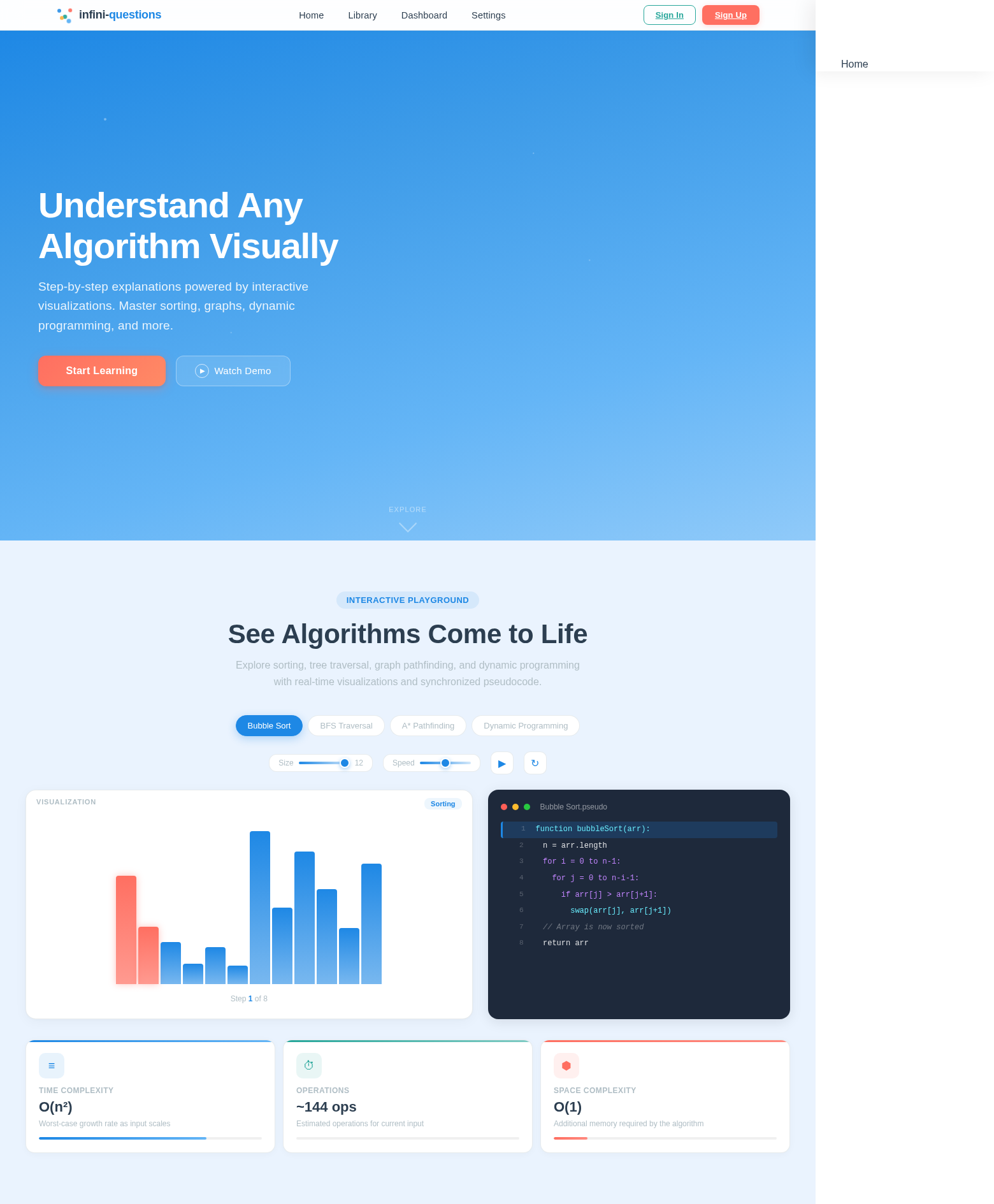
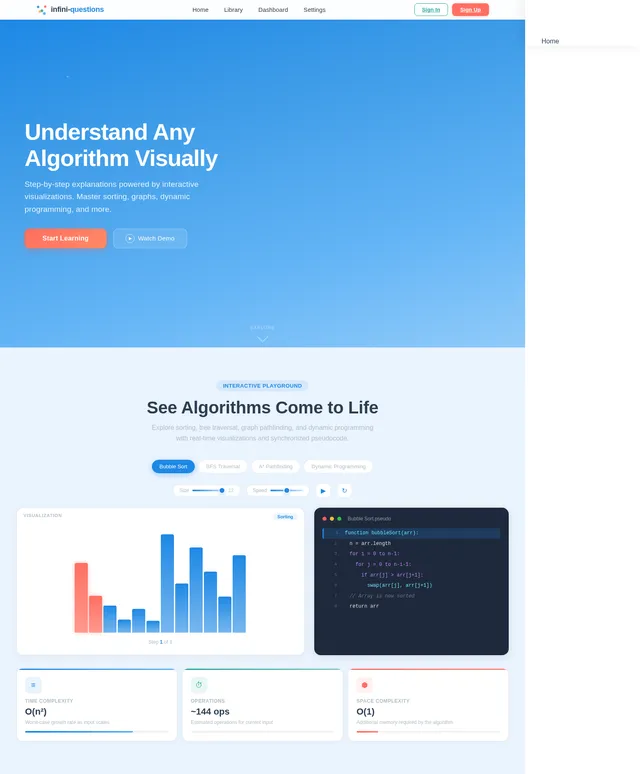
Understand Any Algorithm Visually
Step-by-step explanations powered by interactive visualizations. Master sorting, graphs, dynamic programming, and more.
See Algorithms Come to Life
Explore sorting, tree traversal, graph pathfinding, and dynamic programming with real-time visualizations and synchronized pseudocode.
No comments yet. Be the first!