incrivia-nexus-paios
 paios technologies


Comments (0)
Sign in to leave a comment
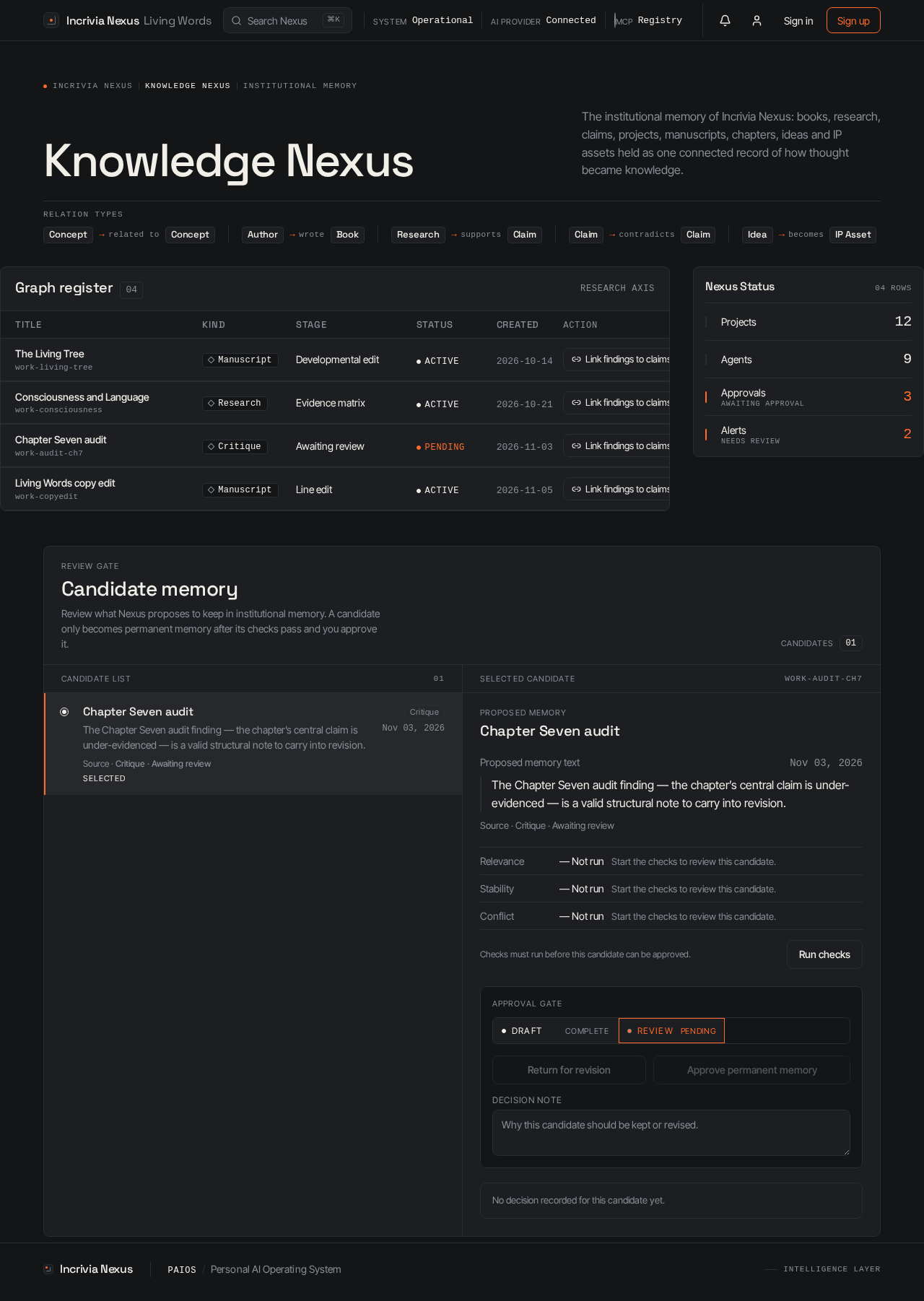
Incrivia NexusKnowledge NexusInstitutional memory
Knowledge Nexus
The institutional memory of Incrivia Nexus: books, research, claims, projects, manuscripts, chapters, ideas and IP assets held as one connected record of how thought became knowledge.
- Conceptrelated toConcept
- AuthorwroteBook
- ResearchsupportsClaim
- ClaimcontradictsClaim
- IdeabecomesIP Asset
Graph register
04| Title | Kind | Stage | Status | Created | |
|---|---|---|---|---|---|
| The Living Treework-living-tree | Manuscript | Developmental edit | active | 2026-10-14 | |
Link findings to claims for The Living Tree | |||||
| Consciousness and Languagework-consciousness | Research | Evidence matrix | active | 2026-10-21 | |
Link findings to claims for Consciousness and Language | |||||
| Chapter Seven auditwork-audit-ch7 | Critique | Awaiting review | pending | 2026-11-03 | |
Link findings to claims for Chapter Seven audit | |||||
| Living Words copy editwork-copyedit | Manuscript | Line edit | active | 2026-11-05 | |
Link findings to claims for Living Words copy edit | |||||
- The Living Treework-living-tree
- Kind
- Manuscript
- Stage
- Developmental edit
- Status
- active
- Created
- 2026-10-14
- Consciousness and Languagework-consciousness
- Kind
- Research
- Stage
- Evidence matrix
- Status
- active
- Created
- 2026-10-21
- Chapter Seven auditwork-audit-ch7
- Kind
- Critique
- Stage
- Awaiting review
- Status
- pending
- Created
- 2026-11-03
- Living Words copy editwork-copyedit
- Kind
- Manuscript
- Stage
- Line edit
- Status
- active
- Created
- 2026-11-05
Nexus Status
- Projects12
- Agents9
- ApprovalsAwaiting approval3
- AlertsNeeds review2
Candidate memory
Review what Nexus proposes to keep in institutional memory. A candidate only becomes permanent memory after its checks pass and you approve it.
Proposed memory
Chapter Seven audit
The Chapter Seven audit finding — the chapter’s central claim is under-evidenced — is a valid structural note to carry into revision.
Source · Critique · Awaiting review
- Relevance— Not runStart the checks to review this candidate.
- Stability— Not runStart the checks to review this candidate.
- Conflict— Not runStart the checks to review this candidate.
Approval gate
- DRAFTComplete
- REVIEWPending
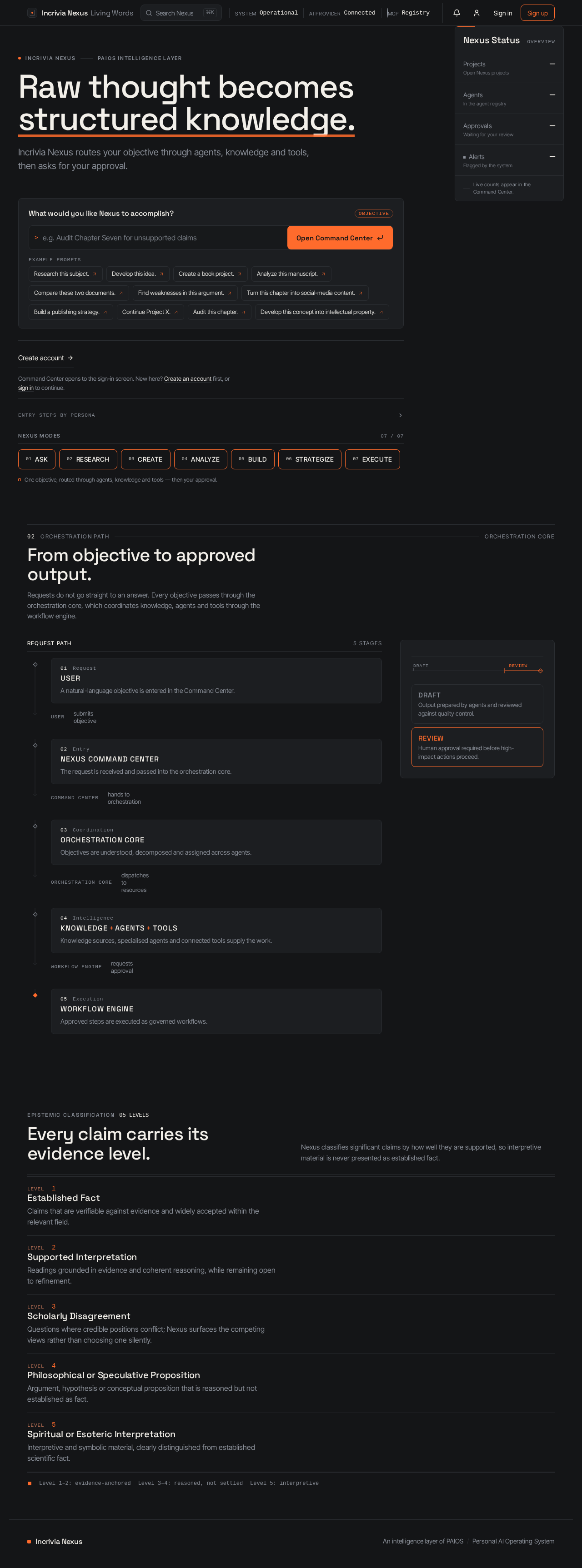
Incrivia NexusPAIOS intelligence layer
Raw thought becomes structured knowledge.
Incrivia Nexus routes your objective through agents, knowledge and tools, then asks for your approval.
Example prompts
Command Center opens to the sign-in screen. New here? Create an account first, or sign in to continue.
Entry steps by persona
- AdministratorOpen Command Centersign-in requirednew account
- AuthorOpen Command Centerauthor proceeds to sign inauthor has no account
- Copy EditorOpen Command Centernew user needs an accountexisting user proceeds to sign in
- CriticOpen Command Centeruser proceeds to sign inuser has no account
- EditorOpen Command Centernew user needs an accountexisting user opens sign-in
- Intellectual CriticOpen Command Centernew user needs an accountexisting user proceeds to sign in
- Line EditorOpen Command Centeruser proceeds to sign inuser has no account
- Project OwnerOpen Command Centerexisting accountnew account
- PublisherOpen Command Centerpublisher opens the public entry surface
- ResearcherOpen Command Centernew user needs an accountexisting user proceeds to sign in
- TrainerOpen Command Centertrainer needs an accounttrainer already has an account
Nexus modes
One objective, routed through agents, knowledge and tools — then your approval.
Nexus Status
Overview- ProjectsOpen Nexus projects
- —
- AgentsIn the agent registry
- —
- ApprovalsWaiting for your review
- —
- AlertsFlagged by the system
- —
Live counts appear in the Command Center.
From objective to approved output.
Requests do not go straight to an answer. Every objective passes through the orchestration core, which coordinates knowledge, agents and tools through the workflow engine.
- USER
A natural-language objective is entered in the Command Center.
USERsubmits objective - NEXUS COMMAND CENTER
The request is received and passed into the orchestration core.
COMMAND CENTERhands to orchestration - ORCHESTRATION CORE
Objectives are understood, decomposed and assigned across agents.
ORCHESTRATION COREdispatches to resources - KNOWLEDGE+AGENTS+TOOLS
Knowledge sources, specialised agents and connected tools supply the work.
WORKFLOW ENGINErequests approval - WORKFLOW ENGINE
Approved steps are executed as governed workflows.
Epistemic Classification05 levels
Every claim carries its evidence level.
Nexus classifies significant claims by how well they are supported, so interpretive material is never presented as established fact.
| Level | Classification |
|---|---|
| LEVEL 1 | Established FactClaims that are verifiable against evidence and widely accepted within the relevant field. |
| LEVEL 2 | Supported InterpretationReadings grounded in evidence and coherent reasoning, while remaining open to refinement. |
| LEVEL 3 | Scholarly DisagreementQuestions where credible positions conflict; Nexus surfaces the competing views rather than choosing one silently. |
| LEVEL 4 | Philosophical or Speculative PropositionArgument, hypothesis or conceptual proposition that is reasoned but not established as fact. |
| LEVEL 5 | Spiritual or Esoteric InterpretationInterpretive and symbolic material, clearly distinguished from established scientific fact. |
◼Level 1–2: evidence-anchoredLevel 3–4: reasoned, not settledLevel 5: interpretive
No comments yet. Be the first!