hyper-employee
 Sanjay Verma
Create a employee management system by using the Java full stack for final year b.texh cse student
Comments (0)
Sign in to leave a comment
System Requirements
System Requirements Document (SRD)
Project Name: hyper-employee
1. Introduction
The hyper-employee project is a comprehensive employee management system designed to streamline and optimize employee-related processes for organizations. Developed as a final-year B.Tech CSE project, this system will showcase a robust Java full-stack implementation. The system is designed to be generic, making it adaptable for various types of organizations, including corporate offices, small businesses, and more.
The primary goal of this project is to provide a practical, real-world solution for managing employee data, attendance, performance reviews, and payroll, while demonstrating advanced technical skills in full-stack development.
2. System Overview
The hyper-employee system will serve as a centralized platform for managing employee-related operations. It will include the following core modules:
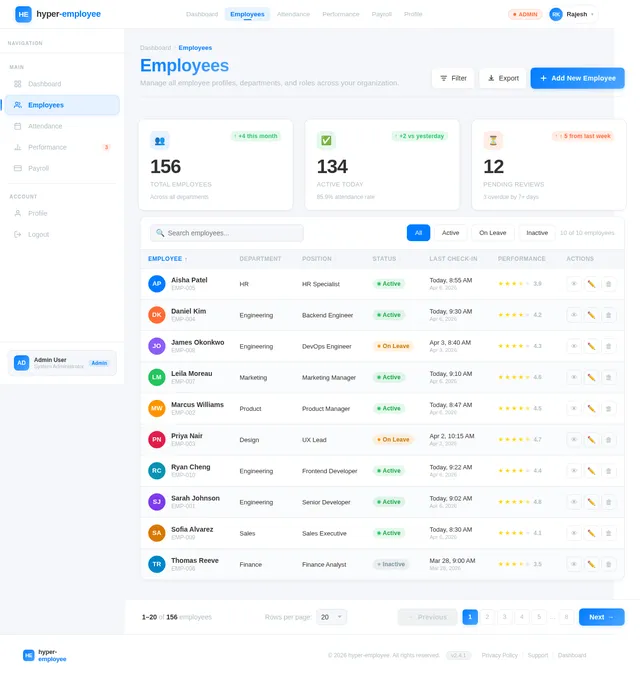
- Employee Profiles: Manage basic information, job roles, and contact details.
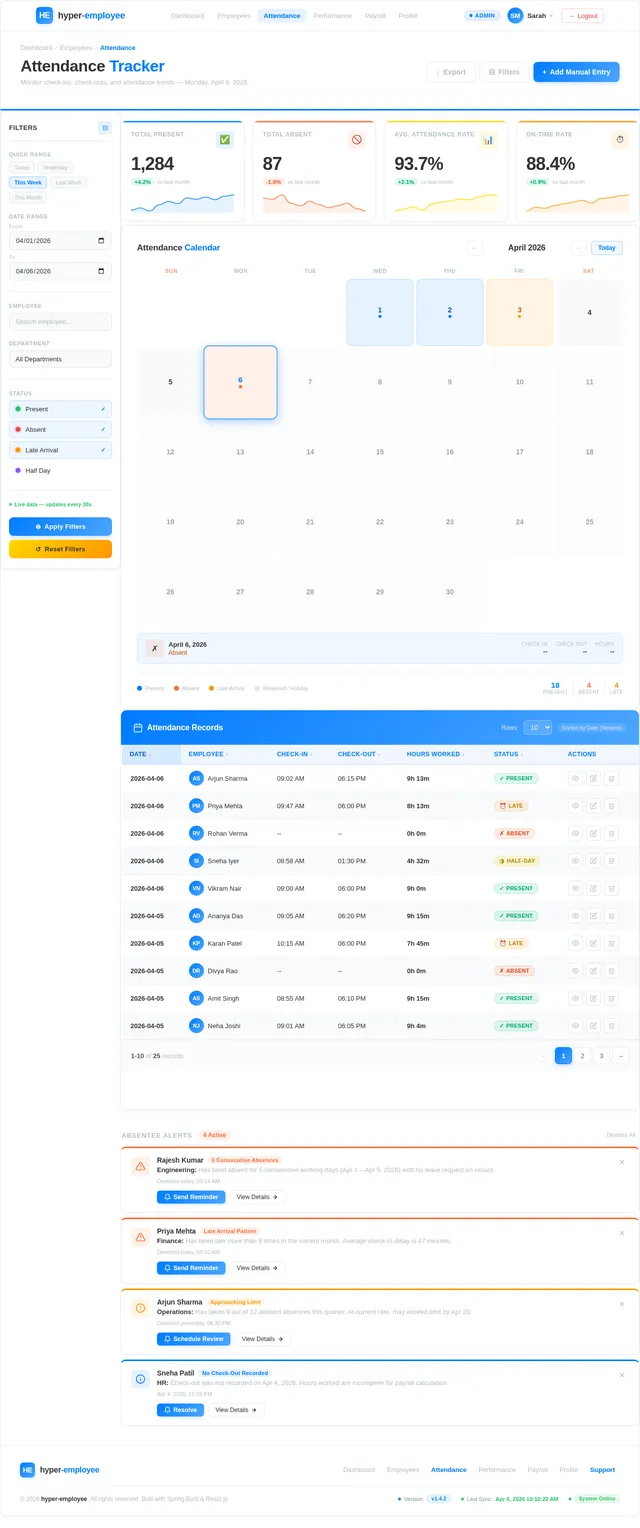
- Attendance Tracking: Record daily check-ins and check-outs for employees.
- Performance Reviews: Maintain feedback history and performance ratings.
- Payroll Management: Automate salary calculations, deductions, and bonuses.
This system will be built using a Java full-stack approach, ensuring scalability, security, and ease of use. The front-end will be developed using React.js, while the back-end will leverage Spring Boot. Data will be stored in a relational database, such as MySQL.
3. Functional Requirements
- As Admin, I should be able to create, update, and delete employee profiles.
- As Admin, I should be able to track employee attendance, including check-ins and check-outs.
- As Admin, I should be able to manage performance reviews, including adding feedback and assigning ratings.
- As Admin, I should be able to calculate and manage payroll, including salary, deductions, and bonuses.
- As Employee, I should be able to view my profile, attendance records, performance reviews, and payroll details.
4. User Personas
Admin
- Role: Manages the system and oversees all employee-related operations.
- Responsibilities:
- Create, update, and delete employee profiles.
- Monitor attendance records.
- Conduct performance reviews.
- Manage payroll processes.
Employee
- Role: Uses the system to view personal data and records.
- Responsibilities:
- Access personal profile details.
- Check attendance records.
- Review performance feedback and ratings.
- View payroll details.
5. Visuals Colors and Theme
Color Palette
The hyper-employee system will use a modern and professional color scheme to reflect its corporate utility:
- Background: #F5F7FA (Light Gray)
- Surface: #FFFFFF (White)
- Text: #333333 (Dark Gray)
- Accent: #007BFF (Bright Blue)
- Muted Tones: #B0BEC5 (Soft Gray-Blue)
6. Signature Design Concept
The hyper-employee homepage will feature an interactive dashboard interface that dynamically updates based on the user's role (Admin or Employee).
Key Features:
-
Role-Based Dashboard:
- Admins will see widgets for employee statistics, attendance summaries, and payroll alerts.
- Employees will see personalized widgets for their attendance, performance, and payroll details.
-
Animated Data Visualizations:
- Real-time charts and graphs for attendance trends, payroll breakdowns, and performance metrics.
- Smooth transitions and hover effects for interactive exploration.
-
Micro-Interactions:
- Buttons and icons will have subtle animations (e.g., color shifts, scaling effects) to enhance user engagement.
-
Responsive Design:
- The dashboard will adapt seamlessly to desktop, tablet, and mobile devices.
This design will ensure a visually appealing and user-friendly experience, making the system both functional and engaging.
7. Non-Functional Requirements
- Performance: The system should handle up to 1,000 concurrent users without performance degradation.
- Scalability: The architecture should support future expansion, including additional modules or increased user base.
- Security: Implement role-based access control (RBAC) to ensure data privacy and security.
- Usability: The interface should be intuitive and easy to navigate for both Admins and Employees.
- Availability: The system should maintain 99.9% uptime.
8. Tech Stack
Frontend
- React.js
Backend
- Spring Boot (Java)
Database
- MySQL
Local Orchestration
- Docker
- Docker Compose
Server-Side Orchestration
- Kubernetes
9. Assumptions and Constraints
Assumptions
- The system will be used by organizations with up to 500 employees.
- Internet connectivity is required for accessing the system.
- Admins will have basic technical knowledge to operate the system.
Constraints
- The system must be developed using Java full-stack technologies.
- The project must be completed within the academic timeline of the final year.
- Budget constraints may limit the use of advanced third-party tools or services.
10. Glossary
- Admin: A user with full access to the system, responsible for managing employee data and operations.
- Employee: A user with limited access, primarily to view personal records.
- RBAC: Role-Based Access Control, a method of restricting system access based on user roles.
- Payroll: The process of calculating and distributing employee salaries, including deductions and bonuses.
- Spring Boot: A Java-based framework for building back-end applications.
- React.js: A JavaScript library for building user interfaces.
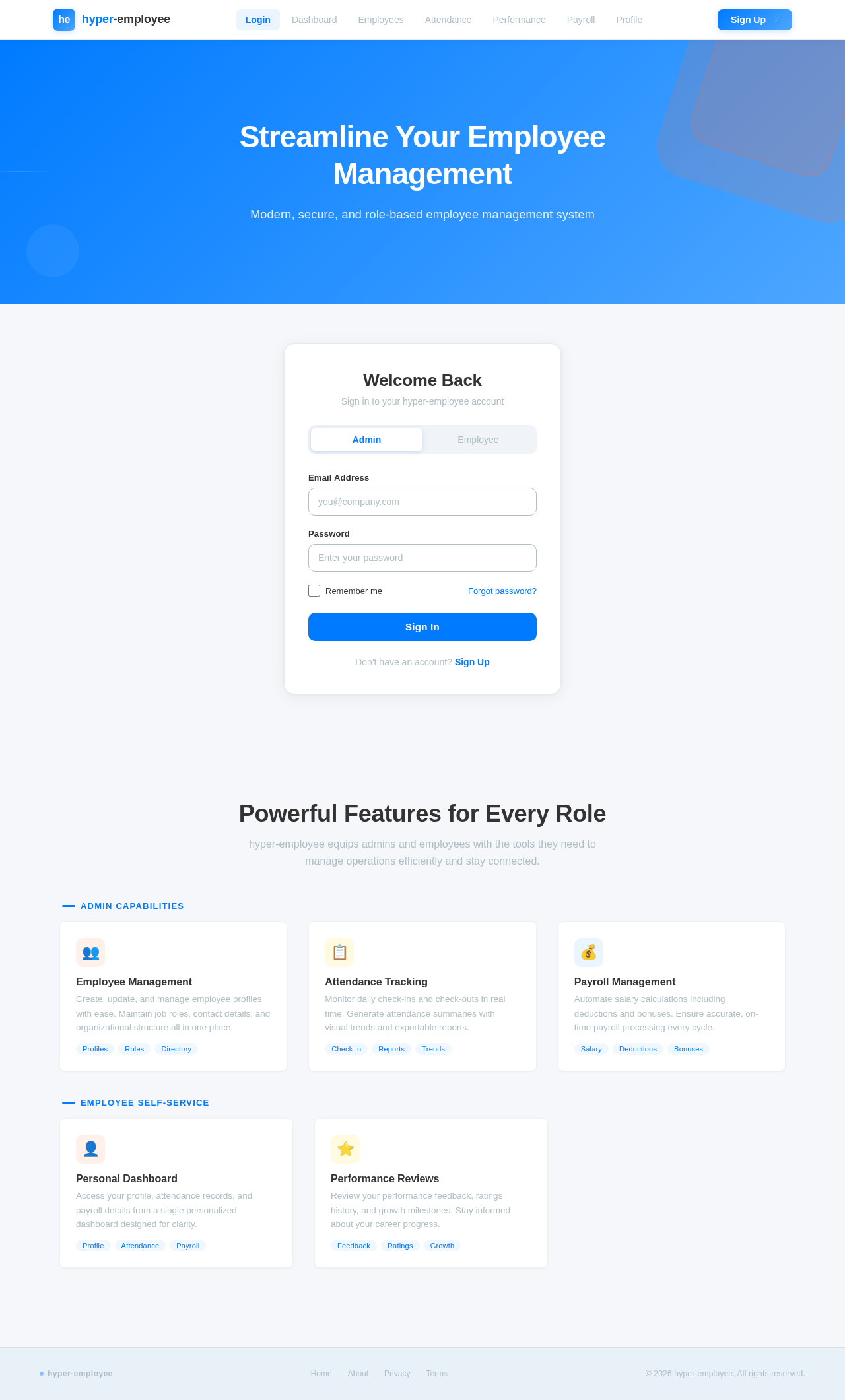
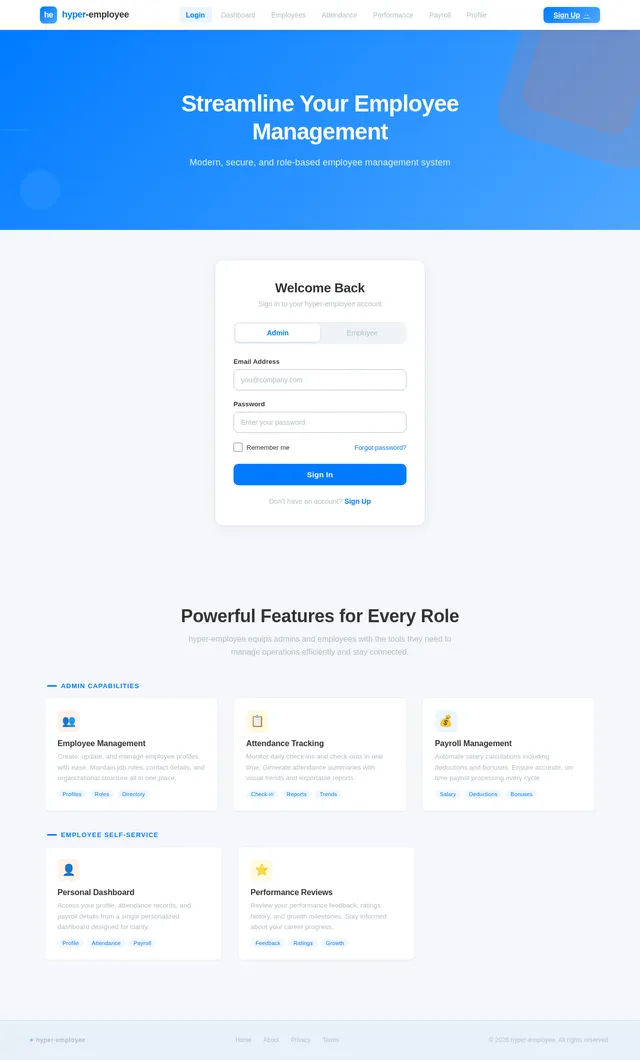
Streamline Your Employee Management
Modern, secure, and role-based employee management system
Powerful Features for Every Role
hyper-employee equips admins and employees with the tools they need to manage operations efficiently and stay connected.
Create, update, and manage employee profiles with ease. Maintain job roles, contact details, and organizational structure all in one place.
Monitor daily check-ins and check-outs in real time. Generate attendance summaries with visual trends and exportable reports.
Automate salary calculations including deductions and bonuses. Ensure accurate, on-time payroll processing every cycle.
Access your profile, attendance records, and payroll details from a single personalized dashboard designed for clarity.
Review your performance feedback, ratings history, and growth milestones. Stay informed about your career progress.
No comments yet. Be the first!