Page 1 of 4
hot
Introduction
The project "hot" is designed to cater to specific user needs and functionalities. This document outlines the system requirements necessary to develop and implement the project effectively.
System Overview
The "hot" project aims to deliver a unique user experience through a combination of innovative features and a visually appealing design. The system will be developed with a focus on user interaction, seamless navigation, and responsive design.
Functional Requirements
- As a User, I should be able to access the main features of the application easily.
- As an Admin, I should be able to manage user accounts and system settings.
- As a Guest, I should be able to explore limited features without registration.
User Personas
- User: Regular users who interact with the main features of the application.
- Admin: Users with elevated privileges to manage and configure the system.
- Guest: Visitors who can access limited features without creating an account.
Page 2 of 4
Core User Flows
- User logs in -> accesses dashboard -> interacts with features -> logs out.
- Admin logs in -> manages user accounts -> updates system settings -> logs out.
- Guest visits site -> explores available features -> prompted to register for full access.
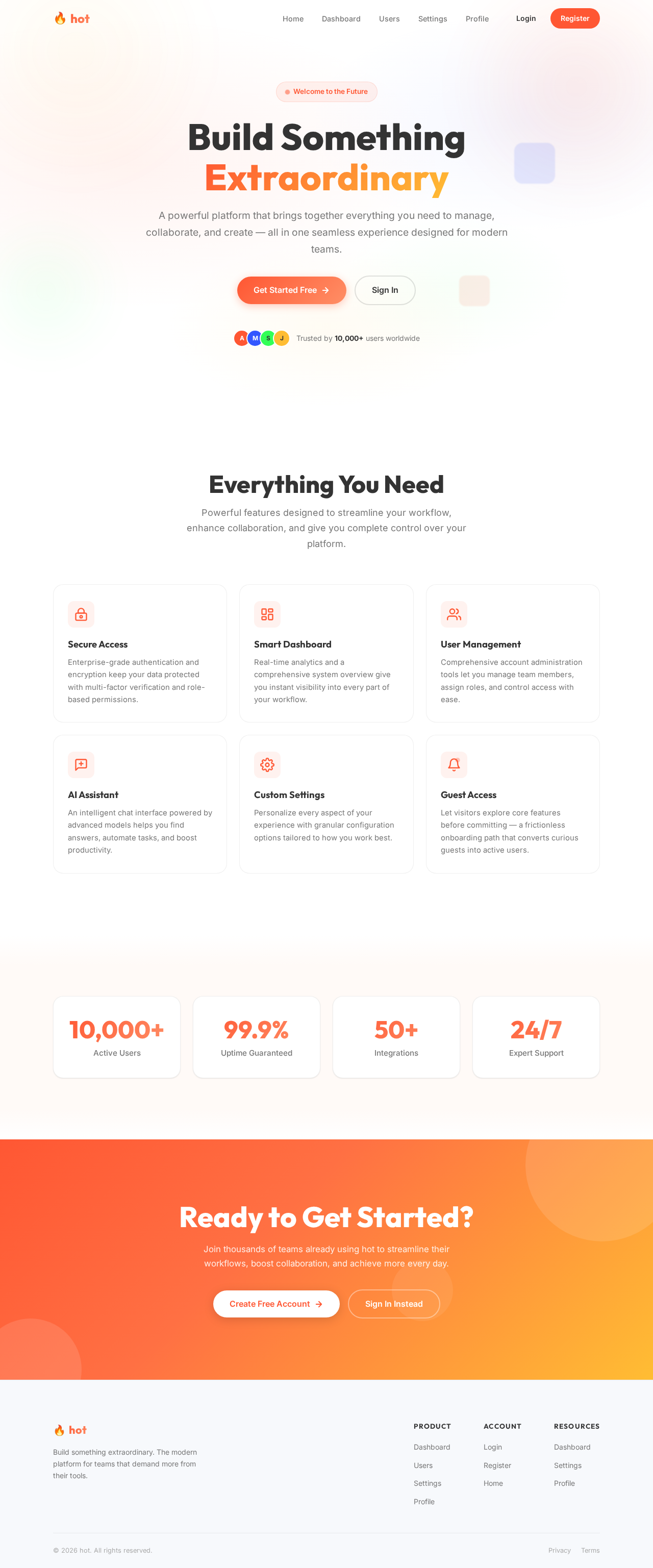
Visuals Colors and Theme
- primary: #FF5733 (a vibrant orange-red)
- primary_light: #FF8F66 (a lighter tint of the primary color)
- secondary: #33FF57 (a bright green for emphasis)
- accent: #3357FF (a striking blue for CTAs and active states)
- highlight: #FFBD33 (a warm amber for notifications)
- bg: #FFFFFF (a clean white background)
- surface: rgba(255, 255, 255, 0.9) (a slightly translucent white for panels)
- text: #333333 (a dark gray for primary text)
- text_muted: #777777 (a muted gray for secondary text)
- border: rgba(51, 51, 51, 0.1) (a subtle gray border)
Signature Design Concept
The homepage of the "hot" project will feature an interactive 3D landscape using @react-three/fiber. Users can navigate through a virtual environment where each section of the site is represented as a distinct area within the landscape. As users hover over different sections, animations will guide them to explore further, creating an engaging and immersive experience. The landscape will dynamically change based on user interactions, providing a unique journey each time.
Page 3 of 4
Interaction Model & Motion Direction
The landing page will employ a "parallax" interaction model. Layers of content will move at different speeds as users scroll, creating a sense of depth and immersion. This approach will enhance storytelling and provide a visually rich first impression. Internal pages will maintain a "static" interaction model to prioritize readability and ease of navigation.
Non-Functional Requirements
- The system should load within 3 seconds on standard broadband connections.
- The application must be accessible and usable on both desktop and mobile devices.
- Ensure data security and user privacy through encryption and secure access controls.
Tech Stack
- Frontend: React for Web
- Backend: Python with FastAPI
- Database: MySQL or MariaDB, using Alembic for migrations
- AI Models: Not applicable unless specified in future updates
- Local Orchestration: Docker and docker-compose
- Server-side Orchestration: Kubernetes
Assumptions and Constraints
- The project will be developed with a US-based audience in mind, considering local preferences and standards.
- The system will comply with relevant data protection regulations applicable in the US.
Page 4 of 4
Glossary
- CTA: Call to Action
- UI: User Interface
- UX: User Experience
- 3D: Three-Dimensional
- AI: Artificial Intelligence
This document provides a comprehensive overview of the requirements and design considerations for the "hot" project. Further updates and iterations will refine these elements as development progresses.


No comments yet. Be the first!