honest-discovercars
 jillian Winters
I NEED WORLDWIDE CUSTOMERS TO BUY FROM THIS LINK https://www.discovercars.com/?a_aid=nasa8888888888888888888888888888888

Comments (0)
Sign in to leave a comment
System Requirements
System Requirements Document for honest-discovercars
1. Introduction
honest-discovercars is a public, first-party landing page whose single product intent is to move worldwide customers from curiosity to a confident click through to the external DiscoverCars.com purchase destination at https://www.discovercars.com/?a_aid=nasa8888888888888888888888888888888, with the affiliate identifier a_aid=nasa8888888888888888888888888888888 preserved exactly and unchanged.
The audience is worldwide customers — travellers anywhere in the world who need to compare and book a rental car. The product does not own, host, or intermediate the booking or purchase workflow. DiscoverCars.com owns that workflow end to end: comparison, availability, pricing, selection, payment, confirmation, and post-booking service. honest-discovercars owns only the honest, sturdy, road-trip-flavoured presentation of that path and the outbound handoff to it.
2. System Overview
honest-discovercars is delivered as a single public custom page, Landing, reachable anonymously with no account, no sign-in, and no identity establishment of any kind. The page presents the car-rental purchase path plainly, states that the page sends travellers to DiscoverCars.com to compare and book worldwide, and makes the affiliate link the unmistakable primary action — a burnt-orange stamped button in the hero, repeated as a ruled banner after each major section, always pointing at the exact affiliate URL.
Actors:
- Worldwide Customer (accepted human persona) — arrives anonymously, reads the offer, and follows the affiliate link to the external purchase destination.
- DiscoverCars.com (external provider, non-persona) — owns the entire booking and purchase workflow reached through the affiliate link, including comparison, availability, pricing, selection, payment, confirmation, and post-booking service.
Accepted behavior in scope: anonymous arrival on Landing; clear explanation of the purchase path; trust facts presented as stamped badges; the affiliate call to action presented repeatedly and unambiguously; outbound navigation to the exact affiliate URL.
Narrow exclusions: no first-party booking, no first-party payment, no first-party search or availability results, no first-party account creation or sign-in, no first-party order history, no first-party customer support workflow, and no first-party content beyond what the Landing page presents.
2a. Product Interpretation and Delivery Boundary
Delivery is split cleanly between two owners. honest-discovercars owns one anonymous public surface: the Landing page. DiscoverCars.com owns everything that happens after the customer leaves that page through the affiliate link. The affiliate identifier is part of the destination URL itself and must survive every presentation of that link without alteration, truncation, re-encoding, or substitution.
Access is anonymous by design. The accepted journey begins with a worldwide customer reaching the public Landing page and ends with that customer continuing the booking and purchase workflow on the external provider's surface. Because no accepted behavior requires a customer to privately own, resume, or revisit durable first-party state, and because no first-party commitment, entitlement, or value transfer is created on this page, no application-owned identity is established and no protected destination exists. There is no sign-in, no sign-up, no invitation, and no provisioning step in the current product.
Current horizon: the anonymous Landing page and its outbound affiliate handoff. Future horizon: nothing is currently accepted beyond this; any additional surface would require a new accepted requirement.
2b. Source Content Inventory
Verified facts supplied by the authoritative reference for the external purchase destination:
- Domain name: DiscoverCars.com
- Function: car rental comparison & booking site serving global travelers
- Countries served: 164 countries
- Locations: 50,000+ locations worldwide
- In business since: 2013
- Audience: travelers worldwide seeking transparent car rental options
- Original name: Discover Car Hire
- Rebranded: DiscoverCars.com in 2019
- Affiliate link:
https://www.discovercars.com/?a_aid=nasa8888888888888888888888888888888 - Affiliate parameter:
a_aid=nasa8888888888888888888888888888888, which must be preserved unchanged - Usage: served as the external purchase destination for customers
- Behavior: clicking this URL directs users to DiscoverCars.com with affiliate tracking embedded
2c. Page Content and Component Coverage
Landing
Information and state presented
- Oversized all-caps display headline stacked in three lines across nearly the full viewport width, set in ink black on the kraft-cream ground, carrying the words "RENT A CAR" or "FIND YOUR RIDE" at display scale.
- A ruled ink line beneath the headline in place of a subheadline block.
- A single sentence in Barlow Condensed explaining that the page sends travellers to DiscoverCars.com to compare and book worldwide.
- Trust facts presented as stamped circular badges: "164 countries", "50,000+ locations", "since 2013".
- A thin ink-ruled ticker band of destination names across the bottom edge of the hero, and again above the footer.
- Ruled field-notes panels for the "how it works" steps, each with a numbered stamp in the corner, a thick-line vector icon, and a short plain-spoken step, separated by hard horizontal rules.
- A simple top bar with a wordmark on the left, three plain-text anchor links in the middle, and the orange CTA on the right.
- No first-party price, availability, inventory, or booking state is displayed, because none is owned by this product.
Primary action
- The affiliate call to action: a large burnt-orange stamped button with a thick ink border and hard offset shadow, labelled with the affiliate destination and a clear external-link cue, left-aligned under the headline, always linking to
https://www.discovercars.com/?a_aid=nasa8888888888888888888888888888888with the affiliate identifier preserved exactly.
Supporting actions
- Three plain-text anchor links in the top bar for in-page navigation.
- Repeated ruled CTA banners after each major section, each linking to the same exact affiliate URL.
- On mobile, the top bar collapses to a single sticky CTA bar at the bottom carrying the same affiliate link.
Domain entities
- Affiliate destination URL (with the exact
a_aididentifier). - Trust facts: countries served, locations worldwide, year in business.
- "How it works" steps.
- Destination names used in the ticker band.
Component responsibilities
- Top bar — wordmark, three anchor links, orange CTA; collapses to a sticky bottom CTA bar on mobile.
- Hero — three-line display headline, ruled ink line, single explanatory sentence, left-aligned stamped CTA, right-side vertical stack of three stamped circular badges, bottom ticker band.
- Ruled CTA banner — repeats the affiliate link after each major section.
- Field-notes "how it works" panels — numbered corner stamp, thick-line vector icon, short plain-spoken step, hard horizontal rules between panels.
- Badge cluster — double-ring ink stamps with condensed all-caps type inside.
- Ticker band — thin ink-ruled band of destination names, scrolling once slowly, above the footer as well as at the hero's bottom edge.
- Footer — closing ruled band and the repeated affiliate CTA.
States
- Loading: the page is static content; no data fetch is required to render the hero, badges, steps, or CTA. If any asset is still arriving, the kraft-cream ground and ink type render first so the headline and CTA are never blocked.
- Empty: not applicable — the page has no user-generated or fetched collection that can be empty. The trust facts, steps, and CTA are always present.
- Success: the customer activates the affiliate CTA and is taken to
https://www.discovercars.com/?a_aid=nasa8888888888888888888888888888888, where DiscoverCars.com continues the booking and purchase workflow. - Error: if the outbound navigation fails or the destination is unreachable, the customer remains on Landing with the CTA still visible and can retry; the page states plainly that booking and purchase happen on DiscoverCars.com, so the customer understands the failure is on the external destination, not a lost first-party booking.
- Recovery: the CTA is repeated in the hero, after each major section, and in the footer, and is pinned as a sticky bottom bar on mobile, so a failed or abandoned attempt is always one visible action away from retry.
3. Functional Requirements
FR-1 — Anonymous arrival on the public Landing page As a Worldwide Customer, I should reach the public Landing page without any account, sign-in, or identity step, so that I can immediately understand the car-rental purchase path.
- Provenance: required_inference
- Actor: Worldwide Customer (initiator)
- Trigger/input: navigating to the honest-discovercars Landing page from anywhere in the world.
- Observable result: the Landing page renders with the display headline, the ruled ink line, the explanatory sentence, the stamped affiliate CTA, the three trust badges, and the ticker band.
- Access state: anonymous, no identity required, no protected state.
- Failure/recovery: if the page fails to load, the customer can reload; no first-party state is lost because none is held.
- Continuation: the customer reads the offer and proceeds to the affiliate CTA.
FR-2 — Plain explanation that the page sends travellers to DiscoverCars.com As a Worldwide Customer, I should read a single plain sentence stating that this page sends travellers to DiscoverCars.com to compare and book worldwide, so that I know exactly where the purchase happens and who owns it.
- Provenance: explicit
- Actor: Worldwide Customer (reader)
- Trigger/input: reading the hero copy beneath the ruled ink line.
- Observable result: the customer understands that comparison and booking occur on DiscoverCars.com, not on this page.
- Access state: anonymous.
- Failure/recovery: not applicable — static copy.
- Continuation: the customer evaluates the trust facts and the CTA.
FR-3 — Trust facts presented as stamped badges As a Worldwide Customer, I should see "164 countries", "50,000+ locations", and "since 2013" presented as stamped circular badges, so that I can judge the scale and longevity of the destination before clicking.
- Provenance: explicit (facts from the authoritative reference; badge presentation from the creative direction)
- Actor: Worldwide Customer (reader)
- Trigger/input: viewing the hero's right-side badge column.
- Observable result: three double-ring ink stamps with condensed all-caps type are visible alongside the headline.
- Access state: anonymous.
- Failure/recovery: not applicable — static content.
- Continuation: the customer moves to the CTA with the scale story in hand.
FR-4 — Primary affiliate call to action in the hero As a Worldwide Customer, I should see a large burnt-orange stamped button with a thick ink border and hard offset shadow, labelled with the affiliate destination and a clear external-link cue, left-aligned under the headline, so that the single most important action on the page is unmistakable.
- Provenance: explicit
- Actor: Worldwide Customer (initiator)
- Trigger/input: viewing the hero.
- Observable result: the primary CTA is visible, left-aligned, and visually dominant without competing with the headline.
- Access state: anonymous.
- Failure/recovery: if the button does not respond, the customer can use the repeated CTA banners or the mobile sticky bar.
- Continuation: the customer activates the CTA.
FR-5 — Outbound navigation to the exact affiliate URL
As a Worldwide Customer, I should be taken to https://www.discovercars.com/?a_aid=nasa8888888888888888888888888888888 when I activate the CTA, so that I can continue the booking and purchase workflow on DiscoverCars.com with affiliate tracking embedded.
- Provenance: explicit
- Actor: Worldwide Customer (initiator); DiscoverCars.com (external provider, recipient)
- Trigger/input: activating the affiliate CTA.
- Observable result: the customer leaves honest-discovercars and arrives at DiscoverCars.com with the affiliate identifier
a_aid=nasa8888888888888888888888888888888intact. - Access state: anonymous; no first-party identity is transmitted or required.
- Failure/recovery: if the destination is unreachable, the customer remains on Landing with the CTA still visible and can retry from the hero, a ruled banner, or the mobile sticky bar.
- Continuation: DiscoverCars.com owns comparison, availability, pricing, selection, payment, confirmation, and post-booking service.
FR-6 — Affiliate identifier preserved exactly on every presentation
As a Worldwide Customer, I should have every presentation of the affiliate link point at the identical URL with a_aid=nasa8888888888888888888888888888888 unchanged, so that my referral is attributed correctly and I am never sent to a different destination.
- Provenance: explicit
- Actor: Worldwide Customer (initiator); DiscoverCars.com (external provider, recipient)
- Trigger/input: activating any CTA instance — hero button, ruled banner after a major section, footer CTA, or mobile sticky bar.
- Observable result: the destination URL is byte-identical across all instances, with the affiliate parameter unaltered, untruncated, and un-re-encoded.
- Access state: anonymous.
- Failure/recovery: if any instance is found to carry a modified URL, that instance is corrected to the exact URL before release.
- Continuation: the customer completes the handoff on DiscoverCars.com.
FR-7 — Repeated ruled CTA banners after each major section As a Worldwide Customer, I should encounter the affiliate CTA again as a ruled banner after each major section, so that I never have to scroll back to the hero to act.
- Provenance: explicit
- Actor: Worldwide Customer (initiator)
- Trigger/input: scrolling past a major section.
- Observable result: a ruled banner carrying the affiliate CTA appears after each major section.
- Access state: anonymous.
- Failure/recovery: the hero CTA and footer CTA remain available if a banner is missed.
- Continuation: the customer activates the nearest CTA.
FR-8 — Mobile sticky CTA bar As a Worldwide Customer on a mobile device, I should see the top bar collapse to a single sticky CTA bar at the bottom of the screen, so that the affiliate action stays reachable at every scroll position.
- Provenance: explicit
- Actor: Worldwide Customer (initiator)
- Trigger/input: viewing Landing on a narrow viewport.
- Observable result: the top bar collapses and a sticky bottom bar carrying the affiliate CTA is pinned.
- Access state: anonymous.
- Failure/recovery: if the sticky bar is dismissed or obscured, the in-page CTA banners remain available.
- Continuation: the customer activates the sticky CTA.
FR-9 — Field-notes "how it works" steps As a Worldwide Customer, I should read short plain-spoken steps in ruled field-notes panels, each with a numbered stamp in the corner and a thick-line vector icon, so that I understand the path from this page to a completed booking.
- Provenance: explicit
- Actor: Worldwide Customer (reader)
- Trigger/input: scrolling to the "how it works" section.
- Observable result: numbered ruled panels separated by hard horizontal rules present the steps.
- Access state: anonymous.
- Failure/recovery: not applicable — static content.
- Continuation: the customer follows the CTA to DiscoverCars.com.
FR-10 — Destination ticker band As a Worldwide Customer, I should see a thin ink-ruled ticker band of destination names scroll once slowly across the bottom of the hero and again above the footer, so that the worldwide reach of the destination reads as a motion signature rather than a carousel.
- Provenance: explicit
- Actor: Worldwide Customer (viewer)
- Trigger/input: viewing the hero or the area above the footer.
- Observable result: the band scrolls once slowly and does not loop as a carousel.
- Access state: anonymous.
- Failure/recovery: if motion is reduced, the band renders as a static ruled strip of destination names.
- Continuation: the customer returns attention to the CTA.
FR-11 — DiscoverCars.com owns the booking and purchase workflow As DiscoverCars.com, the external provider, I should own comparison, availability, pricing, selection, payment, confirmation, and post-booking service once the customer arrives through the affiliate link, so that no first-party booking capability is implied or built.
- Provenance: explicit
- Actor: DiscoverCars.com (external provider, owner); Worldwide Customer (recipient of the provider's workflow)
- Trigger/input: the customer's arrival at the affiliate URL.
- Observable result: the customer completes or abandons the purchase entirely on the provider's surface.
- Access state: provider-owned; honest-discovercars holds no session, order, or payment state.
- Failure/recovery: provider-owned; honest-discovercars surfaces no first-party error state for provider failures beyond keeping the CTA available for retry.
- Continuation: provider-owned.
4. User Personas
Worldwide Customer
Product context. A traveller anywhere in the world who needs a rental car and is looking for transparent options. They arrive at honest-discovercars anonymously, most likely from a link, a search result, or a share, with no prior relationship to this page and no intention of creating an account. They are evaluating whether this page is a trustworthy, honest route to a real booking, and they will decide in seconds.
Primary goal. Reach a real car-rental comparison and booking destination with confidence, and complete a purchase there.
Distinct accepted responsibilities. Arriving on the public Landing page; reading the plain explanation of where the purchase happens; reading the trust facts as stamped badges; reading the "how it works" steps; and activating the affiliate call to action to continue the booking and purchase workflow on DiscoverCars.com. The customer does not search, filter, price, select, pay, or manage a booking on this page — those responsibilities belong to the external provider.
Relevant inputs and decisions. The customer's inputs are their attention and their click. Their decision is whether the page reads as honest and sturdy enough to hand over a booking, judged from the headline, the single explanatory sentence, the three trust badges ("164 countries", "50,000+ locations", "since 2013"), the plain-spoken steps, and the clarity of the CTA.
Interactions with other accepted participants. The customer's only counterparty is DiscoverCars.com, the external provider. The handoff is one-directional and complete: the customer leaves honest-discovercars and the provider takes over comparison, availability, pricing, selection, payment, confirmation, and post-booking service. No other human participant is involved.
Observable success. The customer activates the affiliate CTA and arrives at https://www.discovercars.com/?a_aid=nasa8888888888888888888888888888888 with the affiliate identifier intact, then completes a booking on the provider's surface.
What makes this role's work different. This persona's entire job on this product is a single confident decision followed by a single click. There is no browsing, no account, no cart, no history, and no return visit to manage. The design burden falls on making that one decision easy and that one click unmistakable — which is why the CTA repeats after every major section and pins to the bottom of the screen on mobile.
5. Core User Flows
Flow 1 — Worldwide Customer arrives anonymously and continues to the purchase destination
- Starting context. A traveller anywhere in the world opens the honest-discovercars Landing page from a link, a search result, or a share. They are anonymous: no account, no sign-in, no prior session.
- Arrival. The Landing page renders. The kraft-cream ground, the oversized all-caps display headline stacked in three lines, and the ruled ink line beneath it are the first things visible. The headline and CTA are never blocked by asset loading.
- Reading the offer. The customer reads the single sentence in Barlow Condensed stating that this page sends travellers to DiscoverCars.com to compare and book worldwide. They now know exactly where the purchase happens and that this page does not own it.
- Reading the trust facts. To the right of the headline, the customer sees three stamped circular badges — "164 countries", "50,000+ locations", "since 2013" — drawn as double-ring ink stamps with condensed all-caps type. The scale story lands as a badge-and-stamp fact rather than a metric band.
- Reading the steps. Scrolling down, the customer reads the "how it works" section: ruled field-notes panels, each with a numbered stamp in the corner, a thick-line vector icon, and a short plain-spoken step, separated by hard horizontal rules rather than soft cards.
- Decision. The customer decides the page is an honest route to a real booking destination.
- Commitment. The customer activates the primary affiliate CTA — the large burnt-orange stamped button with a thick ink border and hard offset shadow, left-aligned under the headline, labelled with the affiliate destination and a clear external-link cue.
- Handoff. The browser navigates to
https://www.discovercars.com/?a_aid=nasa8888888888888888888888888888888. The affiliate identifiera_aid=nasa8888888888888888888888888888888is preserved exactly and unchanged. DiscoverCars.com receives the customer with affiliate tracking embedded. - Provider-owned continuation. On DiscoverCars.com, the customer compares rental options, checks availability and pricing, selects a car, pays, and receives confirmation. Post-booking service is also provider-owned. honest-discovercars holds no session, order, or payment state.
- Failure and recovery. If the outbound navigation fails or the destination is unreachable, the customer remains on Landing. The CTA is still visible in the hero, repeated as a ruled banner after each major section, and pinned as a sticky bottom bar on mobile, so retry is always one visible action away. Because booking and purchase happen on DiscoverCars.com, the customer understands the failure is on the external destination, not a lost first-party booking.
- Continuation. If the customer does not complete a booking on the first visit, they can return to Landing at any time and activate the same exact affiliate URL again. No first-party state needs to be resumed, because none is held.
Flow 2 — Worldwide Customer on a mobile device
- Starting context. A traveller opens the Landing page on a narrow viewport.
- Arrival. The hero renders with the three-line display headline, the ruled ink line, the explanatory sentence, and the stamped CTA. The top bar collapses.
- Persistent action. A single sticky CTA bar carrying the affiliate link is pinned to the bottom of the screen, so the affiliate action stays reachable at every scroll position.
- Reading. The customer scrolls through the badge cluster, the field-notes steps, and the ruled CTA banners, each carrying the same exact affiliate URL.
- Commitment. The customer activates the sticky CTA or any in-page CTA.
- Handoff. The browser navigates to
https://www.discovercars.com/?a_aid=nasa8888888888888888888888888888888with the affiliate identifier preserved exactly. - Failure and recovery. If the destination is unreachable, the sticky bar and the in-page banners remain available for retry.
- Continuation. DiscoverCars.com owns the remainder of the booking and purchase workflow.
Flow 3 — Reduced-motion visitor
- Starting context. A traveller whose device or browser requests reduced motion opens the Landing page.
- Arrival. The hero renders with the display headline, ruled ink line, explanatory sentence, stamped CTA, and badge cluster. Section reveals and the stamp-press hover scale are suppressed.
- Ticker band. The destination ticker band renders as a static ruled strip of destination names at the bottom of the hero and above the footer, rather than scrolling.
- Commitment. The customer activates the affiliate CTA.
- Handoff. The browser navigates to the exact affiliate URL with the identifier preserved.
- Continuation. DiscoverCars.com owns the booking and purchase workflow.
6. Visuals Colors and Theme
Muse and headline. Aaron Draplin — bold, honest, hand-built road-trip Americana for a worldwide car-rental affiliate landing page. The headline idea: a field-notes poster, not a SaaS banner.
Mode. Light mode only.
Colour tokens by role
| Role | Hex | Use |
|---|---|---|
| Background | #F2E9D8 | Kraft-paper cream ground for the whole page |
| Surface | #E8DCC3 | Slightly darker ruled-panel surface so sections read like field-notes pages |
| Text | #1A1713 | Ink black for all body and headline type |
| Primary | #1A1713 | Ink black as the primary structural colour — borders, rules, dividers |
| Accent | #D96B1E | Burnt orange, the single hot accent: affiliate CTA, badge stamps, active rules only |
| Muted | #6B5E4B | Secondary labels, captions, disabled states |
| Support | #2F4A32 | Forest green, permitted only inside badges and small icon fills |
The accent never becomes a decorative wash. No blue, no indigo, no violet, no gradients, no white ground.
Typography
- Headings: Alfa Slab One — display headlines at very large sizes with tight tracking and all-caps or sentence-case stamp energy; headline scale intentionally oversized and poster-like.
- Body: Barlow Condensed at 400/500 with comfortable line-height so the condensed face stays readable at paragraph length.
- Labels, badges, data rows: Barlow Condensed at 500/600 with wide uppercase tracking for micro-labels.
- Type scale: 1.25 modular — 80 / 64 / 48 / 32 / 24 / 18 / 16, with display sizes allowed to break the scale for hero and section openers.
- Forbidden for headings and body: Inter, Roboto, Arial, Helvetica, Open Sans, Lato, Poppins, system-ui.
Shape language
- Thick 3–4px ink borders on cards and panels.
- Hard square corners, 0–4px radius maximum.
- Stamped circular badges with double-ring outlines.
- Ruled horizontal dividers between sections.
- Chunky offset shadows that read as printed-layered paper rather than soft UI elevation.
- Thick-line 2–3px vector icons with flat fills and no gradients.
- Buttons are rectangular with a heavy border and a small hard shadow, like a rubber stamp pressed onto the page.
Spacing rhythm. A visible 12-column grid with hard rules between sections; a left-aligned measure for copy; a right-side stamp/badge column for trust facts. Poster-like single-column landing structure: full-bleed hero, then alternating ruled panels and badge clusters.
Imagery style. Thick-line vector illustrations of cars, road signs, maps, keys, and luggage in the workwear palette; halftone-treated photography of
honest-discovercars · field notes
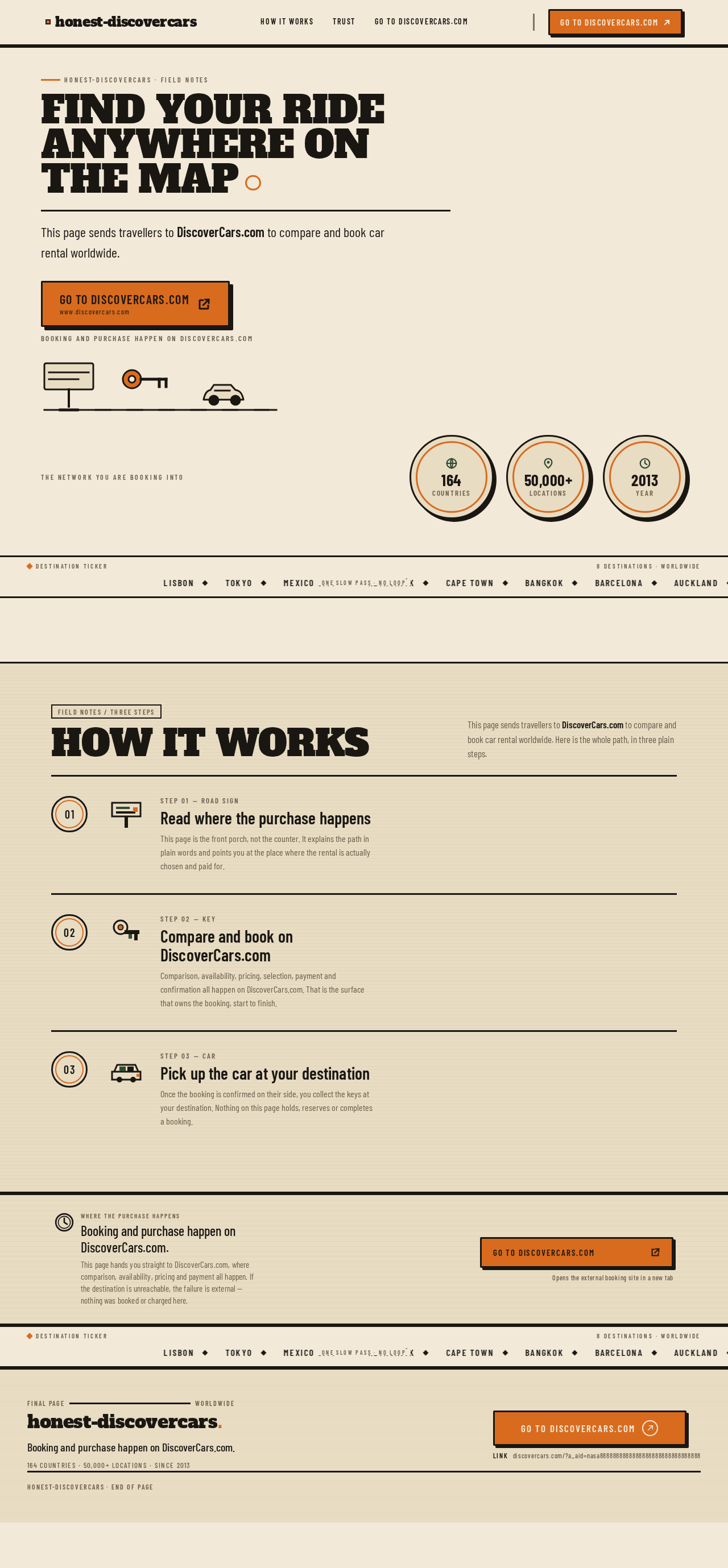
Find your rideanywhere onthe map
This page sends travellers to DiscoverCars.com to compare and book car rental worldwide.
The network you are booking into
How it works
This page sends travellers to DiscoverCars.com to compare and book car rental worldwide. Here is the whole path, in three plain steps.
- Step 01 — Road sign
Read where the purchase happens
This page is the front porch, not the counter. It explains the path in plain words and points you at the place where the rental is actually chosen and paid for.
- Step 02 — Key
Compare and book on DiscoverCars.com
Comparison, availability, pricing, selection, payment and confirmation all happen on DiscoverCars.com. That is the surface that owns the booking, start to finish.
- Step 03 — Car
Pick up the car at your destination
Once the booking is confirmed on their side, you collect the keys at your destination. Nothing on this page holds, reserves or completes a booking.
honest-discovercars · field notes
Find your rideanywhere onthe map
This page sends travellers to DiscoverCars.com to compare and book car rental worldwide.
The network you are booking into
How it works
This page sends travellers to DiscoverCars.com to compare and book car rental worldwide. Here is the whole path, in three plain steps.
- Step 01 — Road sign
Read where the purchase happens
This page is the front porch, not the counter. It explains the path in plain words and points you at the place where the rental is actually chosen and paid for.
- Step 02 — Key
Compare and book on DiscoverCars.com
Comparison, availability, pricing, selection, payment and confirmation all happen on DiscoverCars.com. That is the surface that owns the booking, start to finish.
- Step 03 — Car
Pick up the car at your destination
Once the booking is confirmed on their side, you collect the keys at your destination. Nothing on this page holds, reserves or completes a booking.
No comments yet. Be the first!