green-scp81
 Arvind Kumar
Write a for complete explanation of scp81


Comments (0)
Sign in to leave a comment
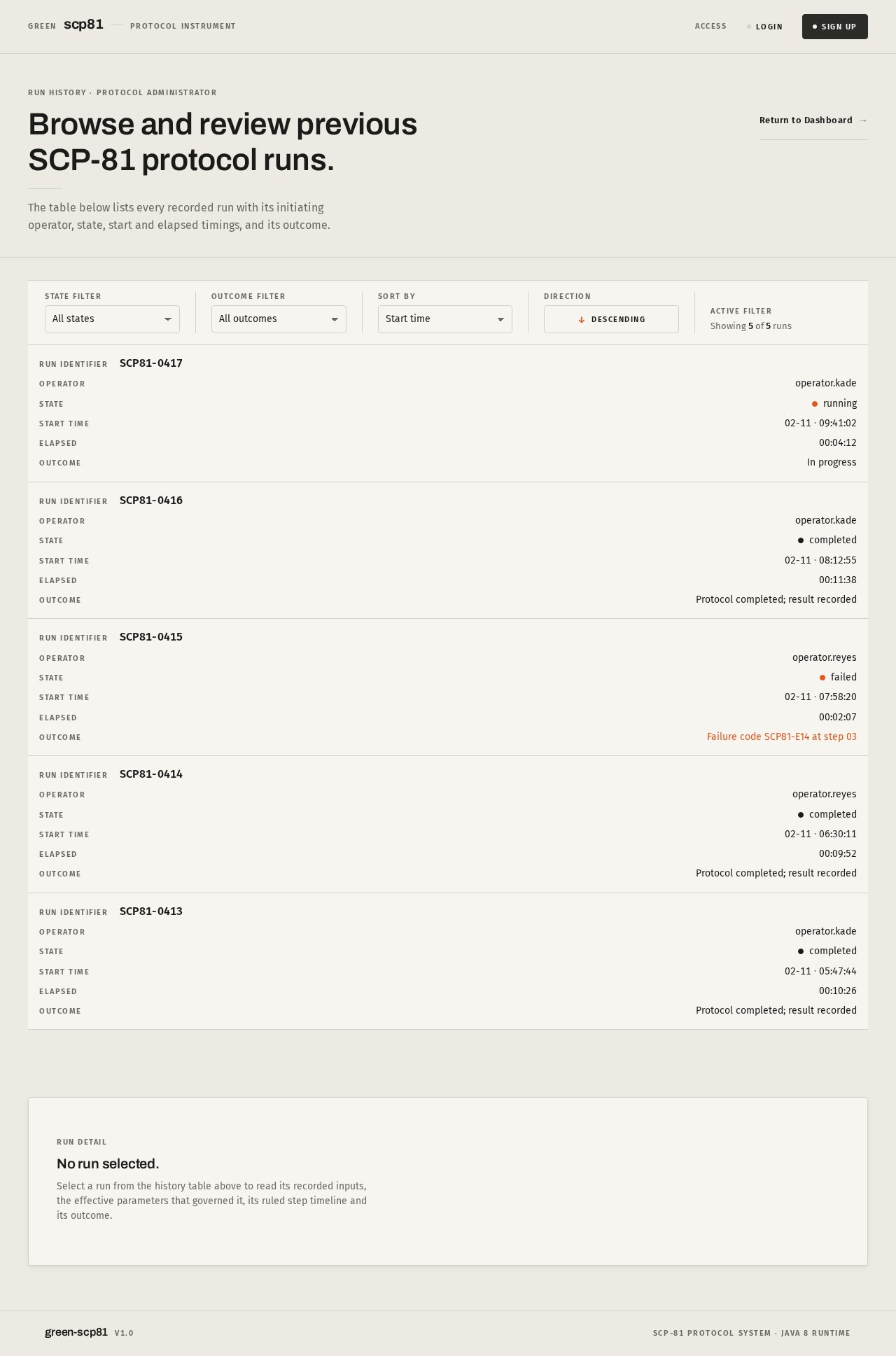
Run History · Protocol Administrator
Browse and review previous SCP-81 protocol runs.
The table below lists every recorded run with its initiating operator, state, start and elapsed timings, and its outcome.
| Run identifier | Operator | State | Start time | Elapsed | Outcome |
|---|---|---|---|---|---|
| operator.kade | running | 02-11 · 09:41:02 | 00:04:12 | In progress | |
| operator.kade | completed | 02-11 · 08:12:55 | 00:11:38 | Protocol completed; result recorded | |
| operator.reyes | failed | 02-11 · 07:58:20 | 00:02:07 | Failure code SCP81-E14 at step 03 | |
| operator.reyes | completed | 02-11 · 06:30:11 | 00:09:52 | Protocol completed; result recorded | |
| operator.kade | completed | 02-11 · 05:47:44 | 00:10:26 | Protocol completed; result recorded |
Run detail
No run selected.
Select a run from the history table above to read its recorded inputs, the effective parameters that governed it, its ruled step timeline and its outcome.
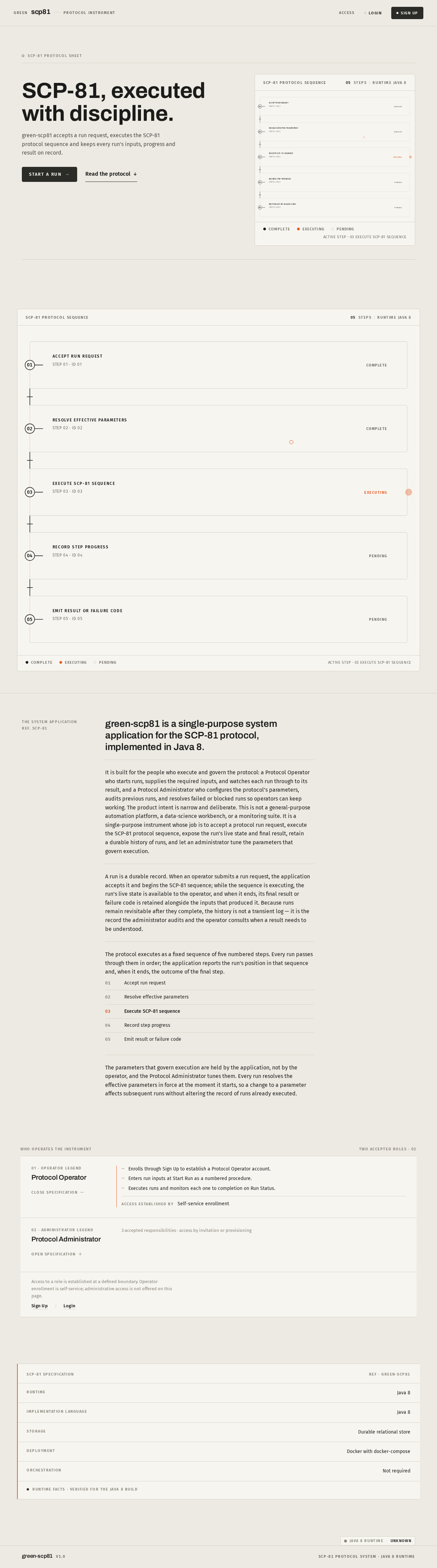
SCP-81, executed with discipline.
green-scp81 accepts a run request, executes the SCP-81 protocol sequence and keeps every run’s inputs, progress and result on record.
SCP-81 protocol sequence
SCP-81 protocol sequence
The system application
Ref. SCP-81green-scp81 is a single-purpose system application for the SCP-81 protocol, implemented in Java 8.
It is built for the people who execute and govern the protocol: a Protocol Operator who starts runs, supplies the required inputs, and watches each run through to its result, and a Protocol Administrator who configures the protocol’s parameters, audits previous runs, and resolves failed or blocked runs so operators can keep working. The product intent is narrow and deliberate. This is not a general-purpose automation platform, a data-science workbench, or a monitoring suite. It is a single-purpose instrument whose job is to accept a protocol run request, execute the SCP-81 protocol sequence, expose the run’s live state and final result, retain a durable history of runs, and let an administrator tune the parameters that govern execution.
A run is a durable record. When an operator submits a run request, the application accepts it and begins the SCP-81 sequence; while the sequence is executing, the run’s live state is available to the operator, and when it ends, its final result or failure code is retained alongside the inputs that produced it. Because runs remain revisitable after they complete, the history is not a transient log — it is the record the administrator audits and the operator consults when a result needs to be understood.
The protocol executes as a fixed sequence of five numbered steps. Every run passes through them in order; the application reports the run’s position in that sequence and, when it ends, the outcome of the final step.
- 01Accept run request
- 02Resolve effective parameters
- 03Execute SCP-81 sequence
- 04Record step progress
- 05Emit result or failure code
The parameters that govern execution are held by the application, not by the operator, and the Protocol Administrator tunes them. Every run resolves the effective parameters in force at the moment it starts, so a change to a parameter affects subsequent runs without altering the record of runs already executed.
Who operates the instrument
Protocol Operator
- Enrolls through Sign Up to establish a Protocol Operator account.
- Enters run inputs at Start Run as a numbered procedure.
- Executes runs and monitors each one to completion on Run Status.
Protocol Administrator
3 accepted responsibilities · access by invitation or provisioning
SCP-81 specification
Ref · green-scp81| Runtime | Java 8 |
|---|---|
| Implementation language | Java 8 |
| Storage | Durable relational store |
| Deployment | Docker with docker-compose |
| Orchestration | Not required |
No comments yet. Be the first!