grand-website
 Balachandra 04
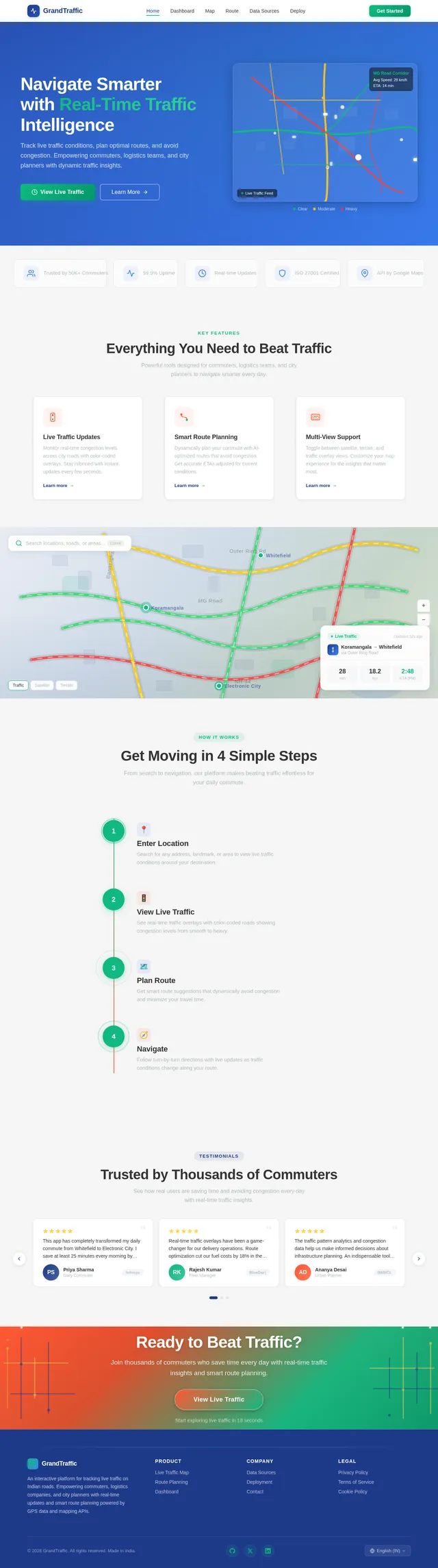
Build an interactive website to track the live traffic on roads which i can directly deploy live
Comments (0)
Sign in to leave a comment
System Requirements
System Requirements Document (SRD)
Project Name: grand-website
1. Introduction
The grand-website project aims to create an interactive website for tracking live traffic on roads, providing users with real-time updates and navigation functionality. Inspired by Google Maps, this platform will empower commuters, logistics companies, and city planners to make informed decisions based on dynamic traffic patterns.
This document outlines the system requirements for the grand-website, ensuring clarity and alignment with Balachandra's vision. The project will be tailored to the Indian context, considering local traffic patterns, timezone (IST), and user preferences.
2. System Overview
The grand-website will serve as a public-facing tool, offering live traffic updates and navigation features similar to Google Maps. It will leverage GPS data and external APIs (e.g., OpenStreetMap or Google Maps API) to provide accurate, real-time traffic information.
Key features include:
- Interactive maps with live traffic overlays.
- Navigation functionality for route planning and congestion avoidance.
- User-friendly interface optimized for desktop and mobile devices.
- Deployment-ready architecture for immediate live use.
3. Functional Requirements
Story Points:
- As a User, I should be able to view live traffic updates on an interactive map.
- As a User, I should be able to plan routes dynamically based on traffic conditions.
- As a User, I should be able to zoom in/out and pan across the map for detailed exploration.
- As a User, I should be able to search for specific locations or addresses.
- As a User, I should be able to see estimated travel times for selected routes.
- As a User, I should be able to toggle between different map views (e.g., satellite, terrain, traffic overlay).
- As Admin, I should be able to monitor API usage and system performance.
- As Admin, I should be able to update traffic data sources or APIs as needed.
- As Admin, I should be able to deploy the website live with minimal downtime.
- As Guest, I should be able to access basic traffic updates without logging in.
4. User Personas
1. User (Commuter)
- Primary audience.
- Uses the website to plan daily commutes and avoid traffic congestion.
2. Admin
- Responsible for managing the website, monitoring API usage, and ensuring system performance.
3. Guest
- Casual visitor who accesses basic traffic updates without creating an account.
5. Visuals Colors and Theme
Color Palette:
The grand-website will feature a modern, vibrant color scheme inspired by urban landscapes and road networks.
- Background: #F5F5F5 (Light Gray)
- Surface: #FFFFFF (White)
- Text: #333333 (Dark Charcoal)
- Accent: #FF5733 (Traffic Orange)
- Muted Tones: #B2BABB (Soft Blue-Gray)
This palette ensures readability, aesthetic appeal, and a professional look suitable for traffic-related applications.
6. Signature Design Concept
Interactive Traffic Flow Animation
The homepage will feature a live animated map that showcases traffic flow in real-time. Users will see roads light up with dynamic colors representing congestion levels (e.g., green for smooth traffic, yellow for moderate congestion, and red for heavy traffic).
Key elements:
- Hover Interactions: Users can hover over roads to see detailed traffic stats (e.g., speed, congestion percentage).
- Smooth Transitions: Map animations will update seamlessly every few seconds to reflect real-time changes.
- Micro-Interactions: Clicking on a road segment will display a pop-up with route suggestions and estimated travel times.
- Customizable View: Users can toggle between day/night modes, with the map adapting its colors accordingly.
This bold design ensures the website is visually engaging and functionally intuitive, leaving a lasting impression on users.
7. Non-Functional Requirements
- Performance: The website must handle at least 10,000 concurrent users without lag.
- Scalability: The system should be scalable to accommodate future growth in traffic data and user base.
- Security: Ensure secure API integrations and protect user data.
- Localization: Optimize for Indian traffic patterns and include support for regional languages.
- Accessibility: Adhere to WCAG standards for accessibility.
8. Tech Stack
Frontend:
- React for Web
Backend:
- Python
- FastAPI
Database:
- MySQL or MariaDB (preferred for RDBMS)
- MongoDB (for NoSQL data storage)
AI Models:
- GPT 5.4 for user-friendly responses
- Google Nano Banana for image generation
AI Tools:
- Litellm for LLM Routing
- Langchain
Orchestration:
- Docker and docker-compose for local orchestration
- Kubernetes for server-side orchestration
9. Assumptions and Constraints
Assumptions:
- External APIs (e.g., Google Maps or OpenStreetMap) will provide reliable traffic data.
- Users will primarily access the website via desktop and mobile browsers.
Constraints:
- Real-time traffic updates depend on the availability and accuracy of external APIs.
- Deployment must comply with Indian data privacy regulations.
10. Glossary
- API: Application Programming Interface, used for integrating external services.
- GPS: Global Positioning System, used for location tracking.
- WCAG: Web Content Accessibility Guidelines, standards for accessible web design.
- Concurrency: The ability of the system to handle multiple users simultaneously.
This document provides a comprehensive overview of the requirements for the grand-website project. Balachandra, feel free to share additional inputs or clarifications to refine the vision further!
No comments yet. Be the first!