grand-chatbot
 Yash Kumar
I want to create a ai chatbit with auto reply no frontend backend login pls give me all details and ai should powerfull and beautiful than chatgpt and transitions and animations

Comments (0)
Sign in to leave a comment
System Requirements
System Requirements Document (SRD)
Project Name: grand-chatbot
1. Introduction
The grand-chatbot project, envisioned by Yash Kumar, is an ambitious AI chatbot system designed to outperform existing solutions like ChatGPT in intelligence, responsiveness, and user engagement. The focus is exclusively on backend AI logic, with no frontend interface or login system, ensuring that all resources are dedicated to creating a powerful, seamless conversational experience.
This document outlines the system requirements for the grand-chatbot, including functional and non-functional specifications, user personas, design concepts, and technical constraints.
2. System Overview
The grand-chatbot is an advanced AI-powered conversational agent designed to deliver auto-replies with exceptional intelligence, context awareness, and aesthetic appeal. By leveraging state-of-the-art AI models and tools, the chatbot will provide multi-turn conversational capabilities, ensuring it remembers context across interactions.
Key features include:
- Cutting-edge AI models for natural language understanding and generation.
- Backend-only architecture focused entirely on AI logic and auto-reply functionality.
- Smooth transitions and animations in the chatbot's responses, even in backend testing environments.
- High scalability and performance to handle complex queries and large datasets.
The system will prioritize intelligence, beauty, and responsiveness, aiming to deliver an experience that surpasses existing solutions like ChatGPT.
3. Functional Requirements
As User:
- I should be able to interact with the chatbot and receive auto-replies powered by advanced AI models.
- I should experience smooth transitions and animations in the chatbot's responses.
- I should be able to engage in multi-turn conversations where the chatbot remembers context across messages.
- I should receive responses that are more intelligent and beautiful than ChatGPT.
4. User Personas
Persona 1: AI User
- Description: Individuals or systems interacting with the chatbot for intelligent responses.
- Goals: Obtain accurate, context-aware, and visually appealing replies.
- Pain Points: Frustration with generic or context-lacking responses from existing chatbots.
Persona 2: Developer/Tester
- Description: Developers or testers evaluating the chatbot's backend logic and performance.
- Goals: Ensure the chatbot's AI logic meets functional and non-functional requirements.
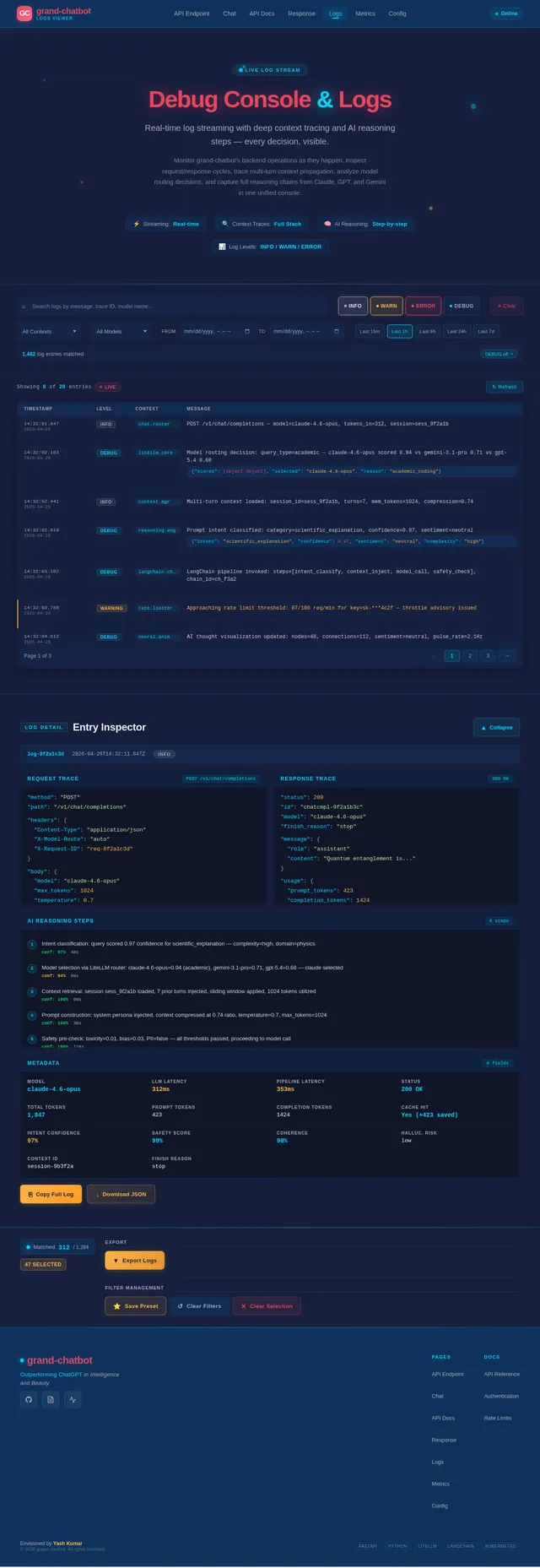
- Pain Points: Difficulty in debugging or testing complex AI systems without clear backend feedback.
5. Visuals Colors and Theme
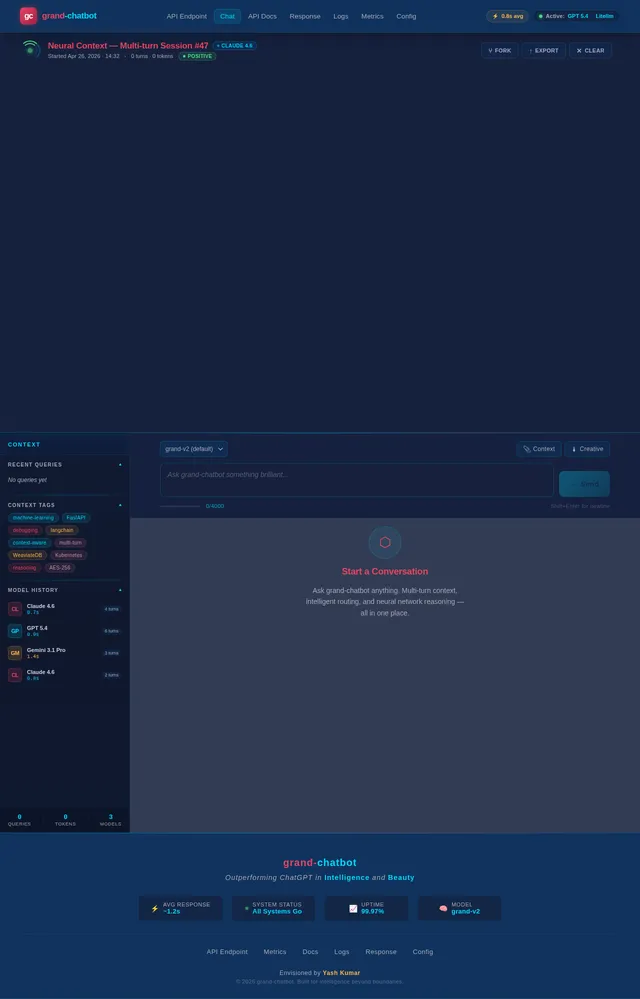
Although the project does not include a frontend interface, the backend testing environment will incorporate a visually appealing theme to showcase the chatbot's animations and transitions.
Color Palette:
- Background:
#0D1B2A(Dark Navy Blue) - Surface:
#1B263B(Steel Blue) - Text:
#E0E1DD(Soft Pearl White) - Accent:
#778DA9(Muted Sky Blue) - Muted Tones:
#415A77(Slate Gray)
This palette reflects sophistication, intelligence, and modernity, aligning with the project's goal of creating a chatbot that is both powerful and beautiful.
6. Signature Design Concept
Concept: Dynamic AI Thought Visualization
The backend testing environment will feature a dynamic AI thought visualization that reacts to user inputs.
- Visuals: A 3D holographic sphere representing the chatbot's "mind," with glowing nodes and connections that shift and pulse based on user queries.
- Animations: When a user sends a query, the sphere expands and contracts, with nodes lighting up to simulate the AI's thought process.
- Micro-interactions: Hovering over nodes reveals snippets of the AI's reasoning process, providing transparency into how responses are generated.
- Color Shifts: The sphere's colors subtly change based on the sentiment of the user's query (e.g., warm tones for positive sentiment, cool tones for neutral or negative sentiment).
- Transitions: Smooth animations between states, ensuring the visualization feels alive and responsive.
This concept ensures that even in a backend-only environment, the chatbot delivers a visually stunning and engaging experience, making the AI logic feel tangible and interactive.
7. Non-Functional Requirements
- Performance: The chatbot must respond to queries within 1 second for standard inputs and within 3 seconds for complex queries.
- Scalability: The system should handle up to 10,000 concurrent users without degradation in performance.
- Reliability: The chatbot must maintain 99.9% uptime.
- Security: All data processed by the chatbot must be encrypted using AES-256 standards.
- Maintainability: The system should be modular, allowing for easy updates to AI models and logic.
8. Tech Stack
Backend:
- Python
- FastAPI
Database:
- RDBMS: MySQL (with Alembic for migrations)
- VectorDB: WeaviateDB
AI Models:
- GPT 5.4 for user-friendly responses.
- Claude 4.6 Opas for academic or coding work.
- Gemini 3.1 Pro for friendly and engaging responses.
- Google Nano Banana for image generation.
AI Tools:
- Litellm for LLM routing.
- Langchain for advanced AI workflows.
Orchestration:
- Local: Docker, docker-compose.
- Server-side: Kubernetes.
9. Assumptions and Constraints
Assumptions:
- The chatbot will operate in an English-speaking environment by default, with potential for multilingual support in future iterations.
- Users will primarily interact with the chatbot via API calls.
Constraints:
- No frontend or login system will be developed for this project.
- The system must adhere to strict performance and scalability requirements.
10. Glossary
- AI: Artificial Intelligence.
- Auto-reply: Automated responses generated by the chatbot.
- Multi-turn Conversations: Conversations where the chatbot remembers context across multiple user messages.
- AES-256: Advanced Encryption Standard with a 256-bit key, used for data encryption.
- LLM: Large Language Model, a type of AI model designed for natural language processing.

No comments yet. Be the first!