garnet-agents
 t nani
Autonomous AI Agents for Code Repository Management Develop an Agentic AI-based system that autonomously manages and monitors software development repositories such as GitHub or GitLab. The system should include intelligent AI agents capable of reviewing pull requests, analyzing source code for vulnerabilities, identifying code smells, and suggesting improvements based on best coding practices and security standards. The agents should collaborate to perform tasks such as automated code review, bug detection, documentation verification, and dependency vulnerability scanning. Additionally, the system should provide developers with actionable feedback, generate improvement suggestions, and maintain overall repository health by ensuring high code quality, consistency, and compliance with development guidelines. This solution aims to enhance developer productivity, reduce manual review efforts, and improve the reliability and security of software projects in modern DevOps environments
Comments (0)
Sign in to leave a comment
System Requirements
System Requirements Document (SRD)
Project Name: garnet-agents
1. Introduction
The garnet-agents project aims to develop an autonomous AI-driven system to manage and monitor software development repositories, specifically targeting Python repositories initially. The system will leverage intelligent AI agents to automate tasks such as pull request reviews, vulnerability detection, code smell identification, and actionable feedback generation. By focusing on automation, garnet-agents will enhance developer productivity, reduce manual review efforts, and improve the reliability and security of software projects in modern DevOps environments.
This document outlines the system requirements for garnet-agents, ensuring clarity and alignment with the project's goals.
2. System Overview
The garnet-agents system is designed to autonomously manage software repositories, starting with Python-based projects. It will integrate seamlessly with platforms like GitHub and GitLab, using webhooks or direct API integrations to monitor and analyze repositories. The system will feature modular architecture, enabling future support for additional programming languages through language-specific analysis modules.
Key features include:
- Automated code reviews with actionable feedback.
- Identification of code smells and vulnerabilities.
- Suggestions for code improvements based on best practices and security standards.
- Collaboration among AI agents to ensure repository health and compliance with development guidelines.
The system will prioritize scalability, flexibility, and ease of integration into existing DevOps workflows.
3. Functional Requirements
- As a User, I should be able to integrate garnet-agents with my GitHub or GitLab repositories.
- As a User, I should be able to receive automated pull request reviews with actionable feedback.
- As a User, I should be able to view reports on code smells, vulnerabilities, and improvement suggestions.
- As a User, I should be able to configure the system to focus on specific areas (e.g., security, code quality).
- As a User, I should be able to access a dashboard summarizing repository health and compliance metrics.
- As a Developer, I should be able to receive detailed suggestions for improving code based on Python best practices.
- As an Admin, I should be able to add support for additional programming languages via language-specific analysis modules.
- As an Admin, I should be able to configure and manage AI agent collaboration settings.
- As a Guest, I should be able to view public reports generated by the system for open-source repositories.
4. User Personas
-
User (Developer)
- Primary user of the system.
- Integrates repositories and receives actionable feedback.
- Focused on improving code quality and security.
-
Admin
- Manages system configurations and adds support for new programming languages.
- Oversees AI agent collaboration and ensures system scalability.
-
Guest
- Limited access to public reports for open-source repositories.
- Interested in observing repository health metrics and insights.
5. Visuals Colors and Theme
The visual design for garnet-agents will reflect professionalism and modernity, with a focus on clarity and usability. The proposed color palette includes:
- Primary Color: Garnet Red (#8B0000) — representing strength and reliability.
- Secondary Color: Deep Gray (#2F4F4F) — for a sleek, modern look.
- Accent Color: Emerald Green (#50C878) — symbolizing growth and improvement.
- Background Color: Light Gray (#F5F5F5) — ensuring readability and a clean interface.
The theme will incorporate a minimalist design with intuitive navigation, ensuring users can quickly access key features and insights.
6. Signature Design Concept
Interactive Repository Galaxy
The homepage will feature an interactive galaxy map where each repository is represented as a star. Users can navigate through the galaxy, zooming in on individual stars to explore repository-specific insights.
- Animation: Stars will twinkle subtly, and constellations will form dynamically based on repository relationships (e.g., shared contributors, dependencies).
- Interaction: Hovering over a star will display a tooltip with repository details (e.g., name, health score, recent activity). Clicking on a star will open a detailed dashboard for that repository.
- Transitions: Smooth zoom-in and zoom-out animations will create a seamless exploration experience.
- Micro-interactions: Repository health scores will be color-coded (green for healthy, yellow for warnings, red for critical issues), and stars will pulse gently to indicate recent activity.
This unique design will make garnet-agents visually captivating and memorable, while also providing an intuitive way to navigate repository data.
7. Non-Functional Requirements
- The system must support integration with GitHub and GitLab via APIs or webhooks.
- The system must process pull requests and generate feedback within 5 minutes of submission.
- The system must handle up to 10,000 repositories concurrently without performance degradation.
- The system must ensure data security and comply with relevant privacy regulations.
- The system must be scalable to support additional programming languages in the future.
8. Tech Stack
- Frontend: React for the web interface.
- Backend: Python with FastAPI for API development.
- Database (RDBMS): MySQL with Alembic for migrations.
- Database (NoSQL): MongoDB for storing unstructured data.
- AI Models:
- GPT 5.2 for user-friendly responses.
- Claude 4.5 Opas for academic or coding work.
- Google Nano Banana for image generation (e.g., visualizing repository health).
- AI Tools: Langchain and Litellm for LLM routing.
- Orchestration: Docker and Kubernetes for deployment and scalability.
9. Assumptions and Constraints
- The system will initially support Python repositories only.
- The modular architecture will allow additional language support through language-specific analysis modules.
- The system will rely on GitHub and GitLab APIs for repository integration.
- The system will operate in the IST (Indian Standard Time) timezone by default.
- The system will prioritize open-source repositories but will also support private repositories with appropriate permissions.
10. Glossary
- AI Agent: An autonomous software entity that performs specific tasks using artificial intelligence.
- Code Smell: A characteristic in the source code that indicates a deeper problem.
- Dependency Vulnerability: A security flaw in a library or framework that a project depends on.
- DevOps: A set of practices that combines software development (Dev) and IT operations (Ops).
- Webhook: A method of augmenting or altering the behavior of a web page or application with custom callbacks.
This updated SRD ensures that garnet-agents is well-positioned to meet its goals while remaining scalable and adaptable for future enhancements. Let me know if you'd like further refinements, t!
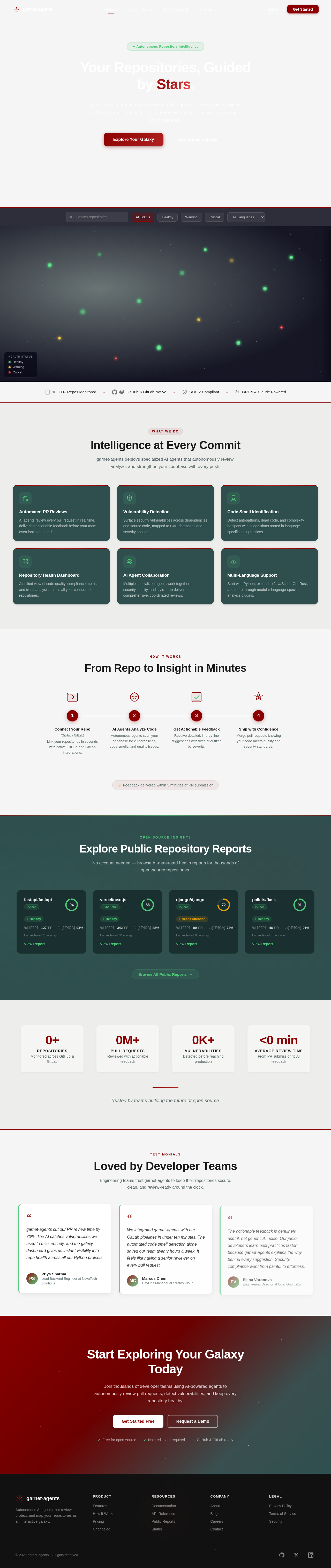
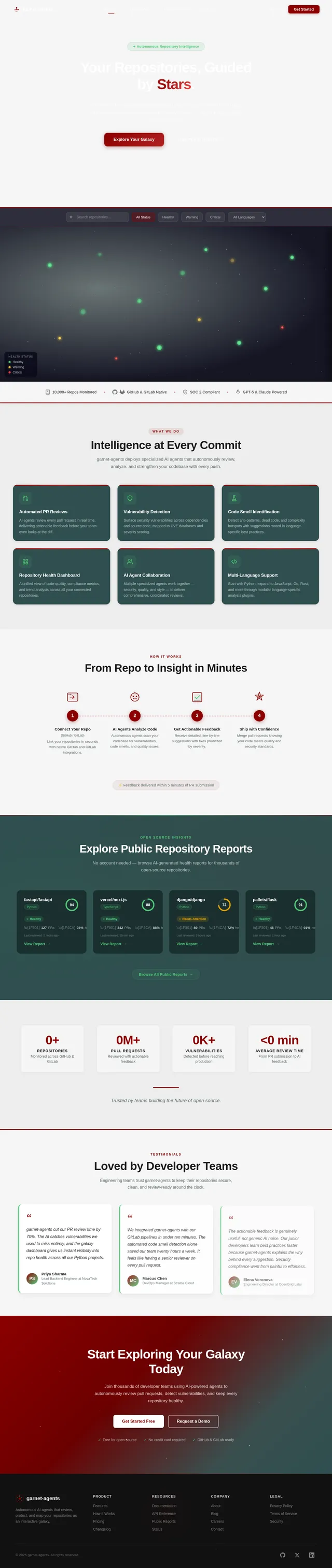
Your Repositories, Guided by Stars.
garnet-agents autonomously reviews pull requests, detects vulnerabilities, and maps your codebase as an interactive galaxy — so your team ships with confidence.
Intelligence at Every Commit
garnet-agents deploys specialized AI agents that autonomously review, analyze, and strengthen your codebase with every push.
Automated PR Reviews
AI agents review every pull request in real time, delivering actionable feedback before your team even looks at the diff.
Vulnerability Detection
Surface security vulnerabilities across dependencies and source code, mapped to CVE databases and severity scoring.
Code Smell Identification
Detect anti-patterns, dead code, and complexity hotspots with suggestions rooted in language-specific best practices.
Repository Health Dashboard
A unified view of code quality, compliance metrics, and trend analysis across all your connected repositories.
AI Agent Collaboration
Multiple specialized agents work together — security, quality, and style — to deliver comprehensive, coordinated reviews.
Multi-Language Support
Start with Python, expand to JavaScript, Go, Rust, and more through modular language-specific analysis plugins.
From Repo to Insight in Minutes
OPEN SOURCE INSIGHTS
Explore Public Repository Reports
No account needed — browse AI-generated health reports for thousands of open-source repositories.
Trusted by teams building the future of open source.
Testimonials
Loved by Developer Teams
Engineering teams trust garnet-agents to keep their repositories secure, clean, and review-ready around the clock.
garnet-agents cut our PR review time by 70%. The AI catches vulnerabilities we used to miss entirely, and the galaxy dashboard gives us instant visibility into repo health across all our Python projects.
We integrated garnet-agents with our GitLab pipelines in under ten minutes. The automated code smell detection alone saved our team twenty hours a week. It feels like having a senior reviewer on every pull request.
The actionable feedback is genuinely useful, not generic AI noise. Our junior developers learn best practices faster because garnet-agents explains the why behind every suggestion. Security compliance went from painful to effortless.
Start Exploring Your Galaxy Today
Join thousands of developer teams using AI-powered agents to autonomously review pull requests, detect vulnerabilities, and keep every repository healthy.
No comments yet. Be the first!