

frosty-project

byNetfotech Team AI

πŸ“˜ Business Requirements Document (BRD) AI Agentic Project Management System (APMS) A Multi Agent, Emotionally Intelligent, Predictive, and Fully Integrated Project Management AI 1. Executive Summary The AI Agentic Project Management System (APMS) is an advanced, multi agent AI ecosystem designed to automate, optimize, and elevate project management across modern enterprises. It integrates seamlessly with leading project management platforms (Jira, Trello, Asana, Monday, MS Project), collaboration tools (Slack, SharePoint, Confluence), and IoT devices to deliver end to end project intelligence. APMS transforms raw project data into actionable insights, automates scheduling and resource allocation, predicts risks, balances workloads, and enhances team morale through emotionally intelligent interventions. It also includes Agile driven multi agent collaboration for software development, enabling autonomous sprint planning, code dependency mapping, and smart task assignment. This system reduces manual overhead, prevents burnout, accelerates delivery, and strengthens organizational decision making. 2. Business Objectives Primary Goals β€’ Automate project planning, scheduling, and resource allocation. β€’ Reduce project delays through predictive analytics and early risk detection. β€’ Improve team productivity and morale using emotionally intelligent AI. β€’ Enhance collaboration across tools and departments. β€’ Enable autonomous Agile software development through multi agent coordination. β€’ Provide real time insights, alerts, and recommendations to project managers. β€’ Minimize manual updates and administrative overhead. Strategic Impact β€’ Faster project delivery β€’ Higher team satisfaction β€’ Reduced operational costs β€’ Improved accuracy in planning and forecasting β€’ Stronger alignment between business goals and execution 3. Scope β€’ AI driven project scheduling, resource allocation, and risk management β€’ Multi agent Agile system (Product Manager, Developer, Tester agents) β€’ Integration with Jira, Trello, Asana, Monday, MS Project β€’ Integration with Confluence, SharePoint, Slack β€’ Predictive analytics for workload balancing and delay prediction β€’ Emotionally intelligent team morale assessment β€’ IoT based project monitoring β€’ Automated reporting, approvals, and progress tracking β€’ Code dependency graph generation and smart code modification suggestion 4. Functional Requirements 4.1 AI Project Manager Agent β€’ Automates project scheduling based on priorities, dependencies, and team availability β€’ Allocates resources dynamically β€’ Generates risk assessments and mitigation plans β€’ Converts raw data into actionable insights β€’ Sends alerts for delays, bottlenecks, and pending tasks β€’ Automates approvals and reporting workflows 4.2 Multi Agent Agile System - Agents & Responsibilities Product Manager Agent β€’ Converts user inputs into epics, stories, and acceptance criteria β€’ Prioritizes backlog using business value scoring β€’ Plans sprints and defines release timelines Developer Agent β€’ Generates code suggestions β€’ Creates and updates code dependency graphs β€’ Suggests modifications based on new requirements β€’ Collaborates with Tester agent for quality assurance Tester Agent β€’ Generates test cases automatically β€’ Executes automated tests where possible β€’ Flags defects and suggests fixes Collaboration Features β€’ Agents communicate autonomously β€’ Sprint planning and retrospectives automated β€’ Smart task assignment based on skill, workload, and past performance 4.3 Predictive Analytics Engine β€’ Predicts project delays using historical and real time data β€’ Balances workloads to prevent burnout β€’ Forecasts resource shortages β€’ Recommends optimal sprint lengths and team compositions β€’ Detects inefficiencies and suggests process improvements 4.4 Emotionally Intelligent AI β€’ Monitors team morale through sentiment analysis (Slack, emails, stand ups) β€’ Detects stress, burnout signals, and communication breakdowns β€’ Suggests interventions (breaks, workload redistribution, recognition prompts) β€’ Provides morale dashboards for managers 4.5 Hyper Personalization Engine β€’ Tailors Agile workflows to individual strengths β€’ Recommends tasks based on skill, preference, and performance patterns β€’ Adjusts sprint velocity predictions per team member β€’ Creates personalized learning and improvement suggestions 4.6 IoT Integration Layer [PHASE 2] β€’ Connects with IoT devices for real time project monitoring β€’ Tracks environmental conditions (manufacturing, construction, hardware labs) β€’ Alerts managers about anomalies affecting project timelines β€’ Enables automated logging of physical progress 4.7 AI Driven Innovation Engine β€’ Scans market trends, competitor movements, and emerging technologies β€’ Suggests new features, improvements, and innovation opportunities β€’ Helps leadership stay ahead of industry shifts 4.8 Integrations Project Management Tools β€’ Jira [Phase 1] β€’ Trello β€’ Asana [Phase 1] β€’ Monday β€’ Microsoft Project [Phase 1] Collaboration Tools β€’ Slack β€’ Microsoft Teams [Phase 1] β€’ Confluence [Phase 1] Development Tools β€’ GitHub β€’ GitLab β€’ Bitbucket 5. Non Functional Requirements 5.1 Performance β€’ Real time insights with β€’ Scalable to 10,000+ concurrent users 5.2 Security β€’ Role based access control β€’ Data encryption (in transit & at rest) β€’ Compliance with GDPR, SOC2, ISO 27001 5.3 Reliability β€’ 99.9% uptime β€’ Automated failover and redundancy 5.4 Usability β€’ Intuitive dashboards β€’ Natural language interface β€’ Multi device accessibility 6. User Stories Project Manager β€’ β€œAs a PM, I want automated scheduling so I can reduce manual planning time.” β€’ β€œAs a PM, I want risk predictions so I can prevent delays.” Developer β€’ β€œAs a developer, I want AI generated code suggestions to speed up development.” Tester β€’ β€œAs a tester, I want automated test case generation to improve coverage.” Leadership β€’ β€œAs a CEO, I want predictive insights to make informed decisions.” 7. Future Enhancements β€’ Autonomous project execution β€’ Voice driven project management β€’ Cross company multi agent collaboration β€’ Digital twin simulations for project forecasting Workflow diagrams 1.1 High-level end-to-end workflow Actors: β€’ User / Project Manager β€’ AI Project Manager Agent β€’ Product Manager Agent β€’ Developer Agent β€’ Tester Agent β€’ Predictive Analytics Engine β€’ Emotion AI Engine β€’ Integrations Layer (Jira, Trello, Asana, Monday, MS Project, Confluence, SharePoint, Slack, IoT, Git, etc.) Diagram (logical flow – text description) β€’ User / PM initiates interaction o Input: Natural language (chat/voice) or via PM tools (Jira, Trello, etc.). o Examples: β€œCreate a project plan”, β€œPlan next sprint”, β€œShow risks for Release 2”. β€’ AI Project Manager Agent interprets request o Parses intent, scope, constraints, deadlines. o Queries Integrations Layer for current project data (tasks, epics, resources, statuses). β€’ Data aggregation & context building o Pulls from: ο‚§ Jira/Trello/Asana/Monday/MS Project (tasks, timelines, dependencies). ο‚§ Confluence/SharePoint (requirements, docs). ο‚§ Slack/Teams (communication patterns). ο‚§ Git/GitLab/Bitbucket (code activity). ο‚§ IoT feeds (where relevant). β€’ Delegation to specialized agents o Product Manager Agent: backlog refinement, epic/story creation, prioritization. o Developer Agent: code dependency graph, implementation suggestions, impact analysis. o Tester Agent: test case generation, coverage planning, defect risk estimation. β€’ Predictive Analytics Engine runs o Predicts: ο‚§ Delays ο‚§ Bottlenecks ο‚§ Resource overload ο‚§ Sprint success probability β€’ Emotion AI Engine evaluates team morale o Analyzes: ο‚§ Slack/Teams sentiment ο‚§ Meeting notes ο‚§ Velocity trends vs. communication tone. o Flags: ο‚§ Burnout risk ο‚§ Frustration ο‚§ Communication breakdowns. o Suggests: ο‚§ Workload redistribution ο‚§ Recognition prompts ο‚§ Process tweaks. β€’ Hyper-personalization layer adjusts plan o Tailors: ο‚§ Task assignments to strengths/preferences. ο‚§ Sprint load per individual. ο‚§ Learning recommendations. β€’ User / PM review & approval ο‚§ Approves, edits, or rejects suggestions. ο‚§ Human-in-the-loop for critical changes. β€’ Execution & continuous monitoring ο‚§ Agents continuously: ο‚§ Track progress ο‚§ Update tools (Jira, etc.) ο‚§ Recalculate risks ο‚§ Alert on deviations ο‚§ Adjust assignments. 1.2 Sprint planning & execution workflow (multi-agent) Flow 1. PM/User: β€œPlan next sprint for Project X with focus on Feature Y.” 2. AI PM Agent: o Fetches backlog, priorities, team capacity. 3. Product Manager Agent: o Selects stories for sprint. o Breaks down tasks if needed. 4. Developer Agent: o Builds/updates code dependency graph. o Estimates complexity. o Suggests implementation order. 5. Tester Agent: o Generates test cases for selected stories. o Plans test execution. 6. Predictive Analytics Engine: o Validates sprint feasibility. o Predicts risk of spillover. 7. Emotion AI Engine: o Checks current team load & morale. o Suggests adjustments if burnout risk is high. Updates Jira/Trello/etc. 8. AI PM Agent: o Finalizes sprint plan. o Updates Jira/Trello/etc. 9. During sprint: o Agents monitor: ο‚§ Task progress ο‚§ Code changes ο‚§ Test results ο‚§ Communication signals. o Trigger: ο‚§ Alerts ο‚§ Reassignments ο‚§ Risk updates. 10. End of sprint: o Auto-generated: ο‚§ Sprint report ο‚§ Retrospective insights ο‚§ Improvement suggestions.

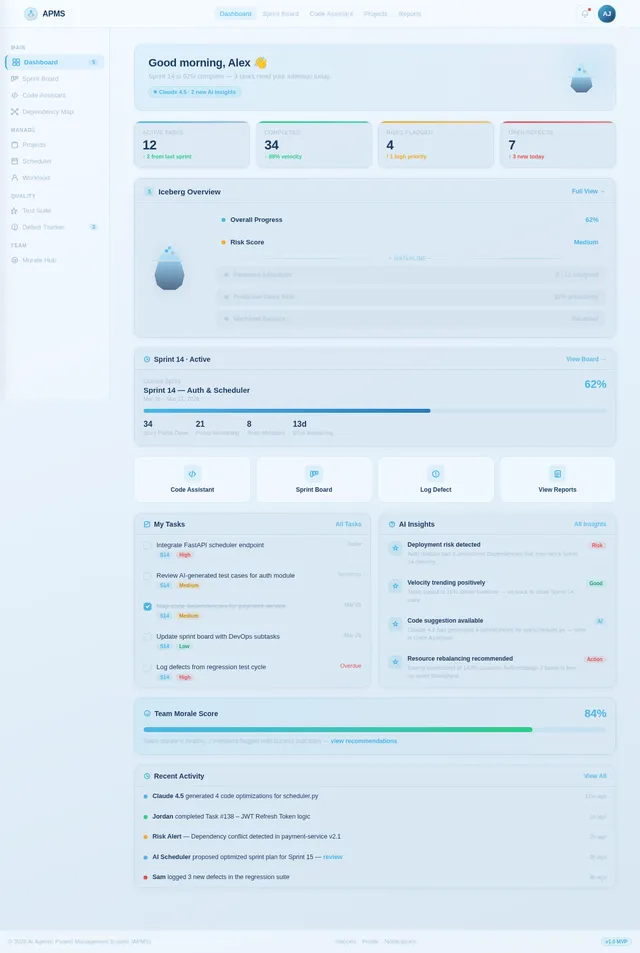
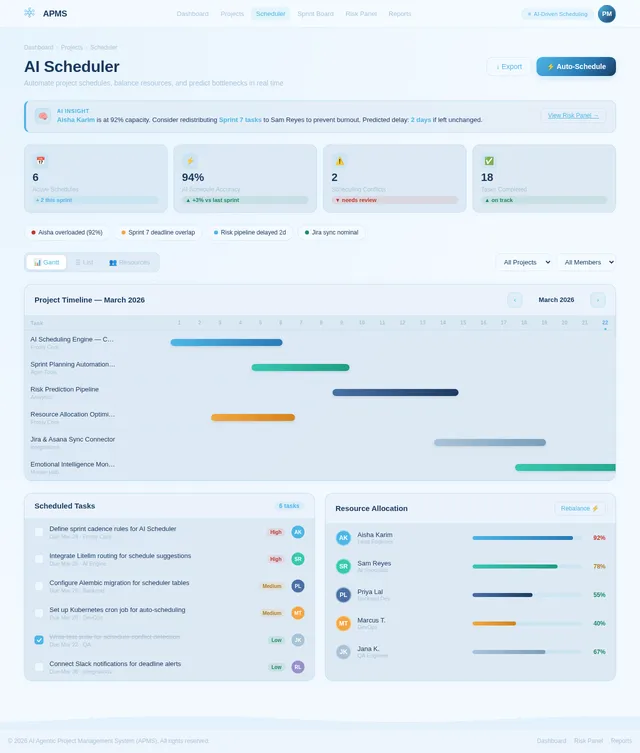
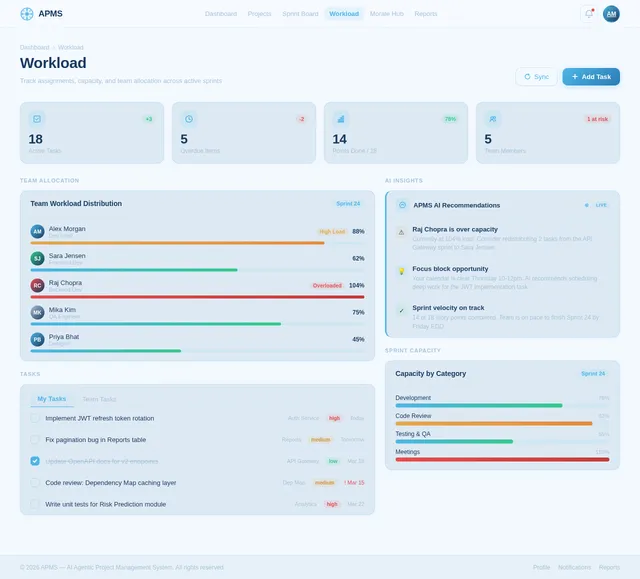
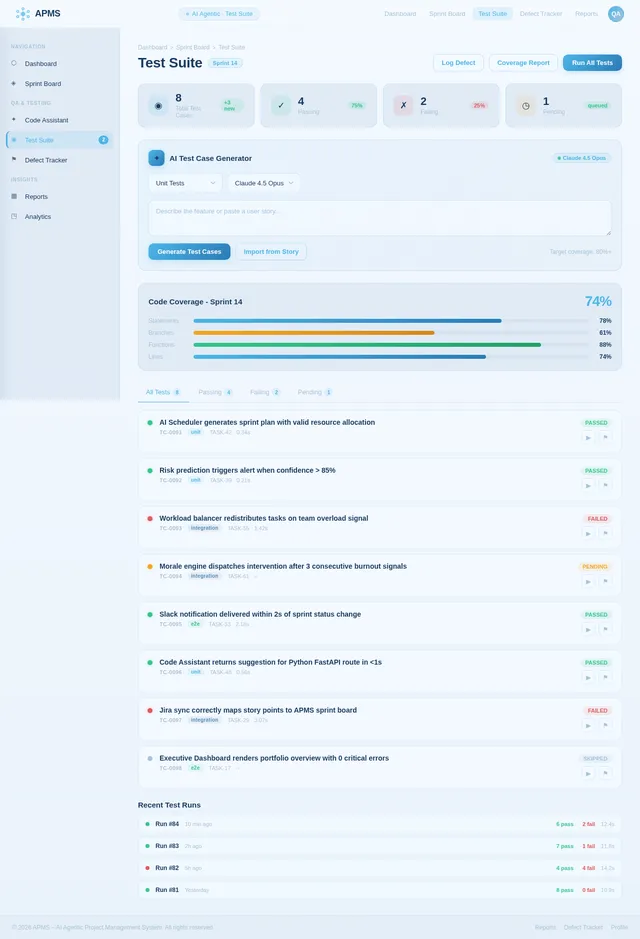
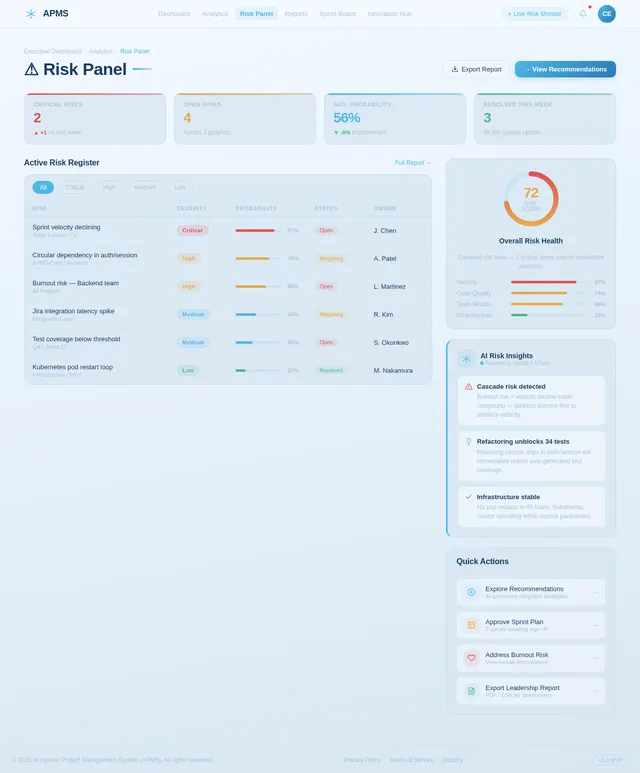
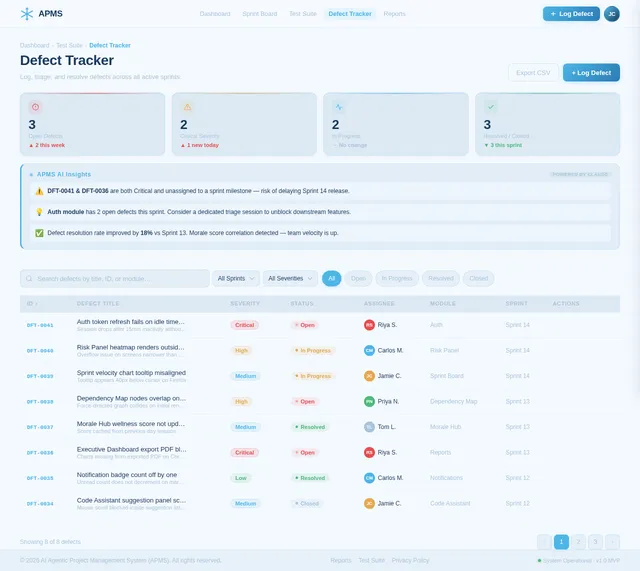
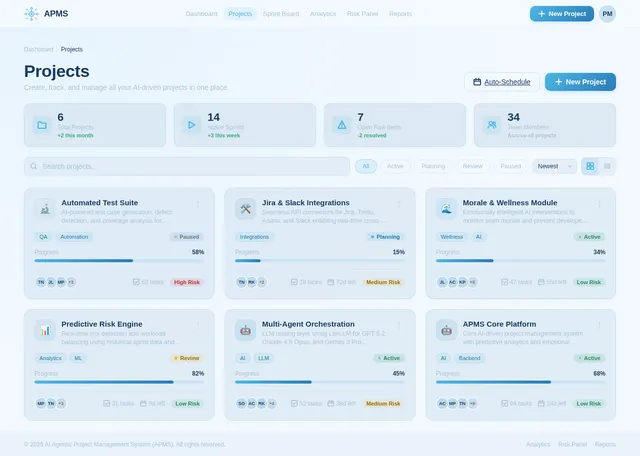
LoginReportsCode AssistantDependency MapInnovation HubSprint BoardDashboardSchedulerProfileWorkloadTest SuiteRisk PanelDefect TrackerAnalyticsProjectsNotificationsMorale HubExecutive Dashboard
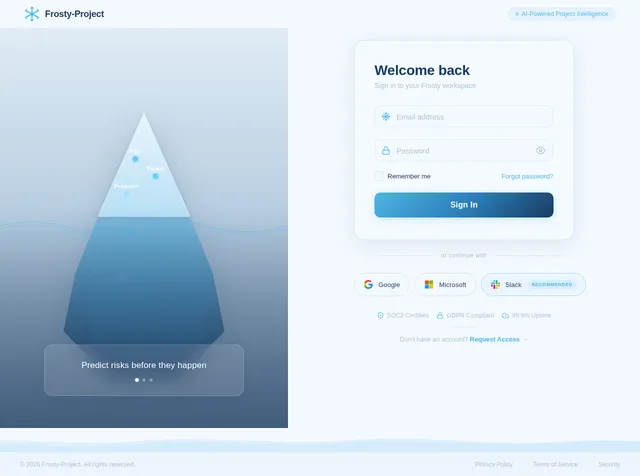
Login

Comments (0)

No comments yet. Be the first!

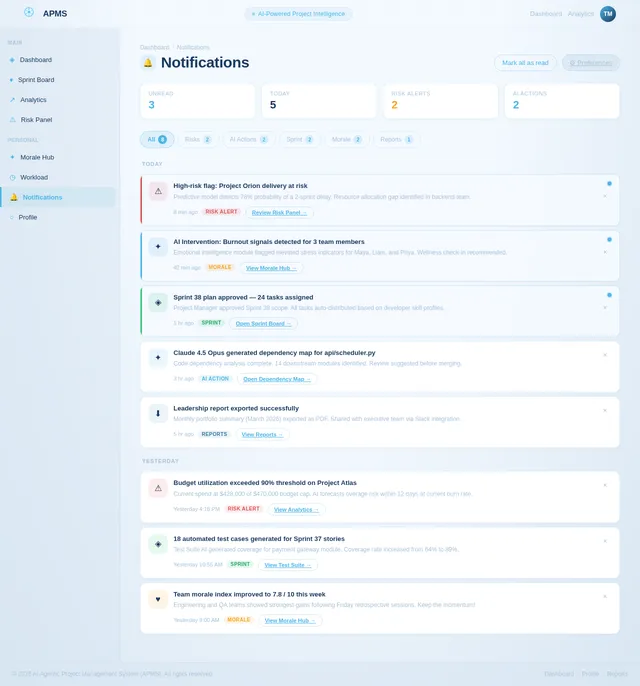
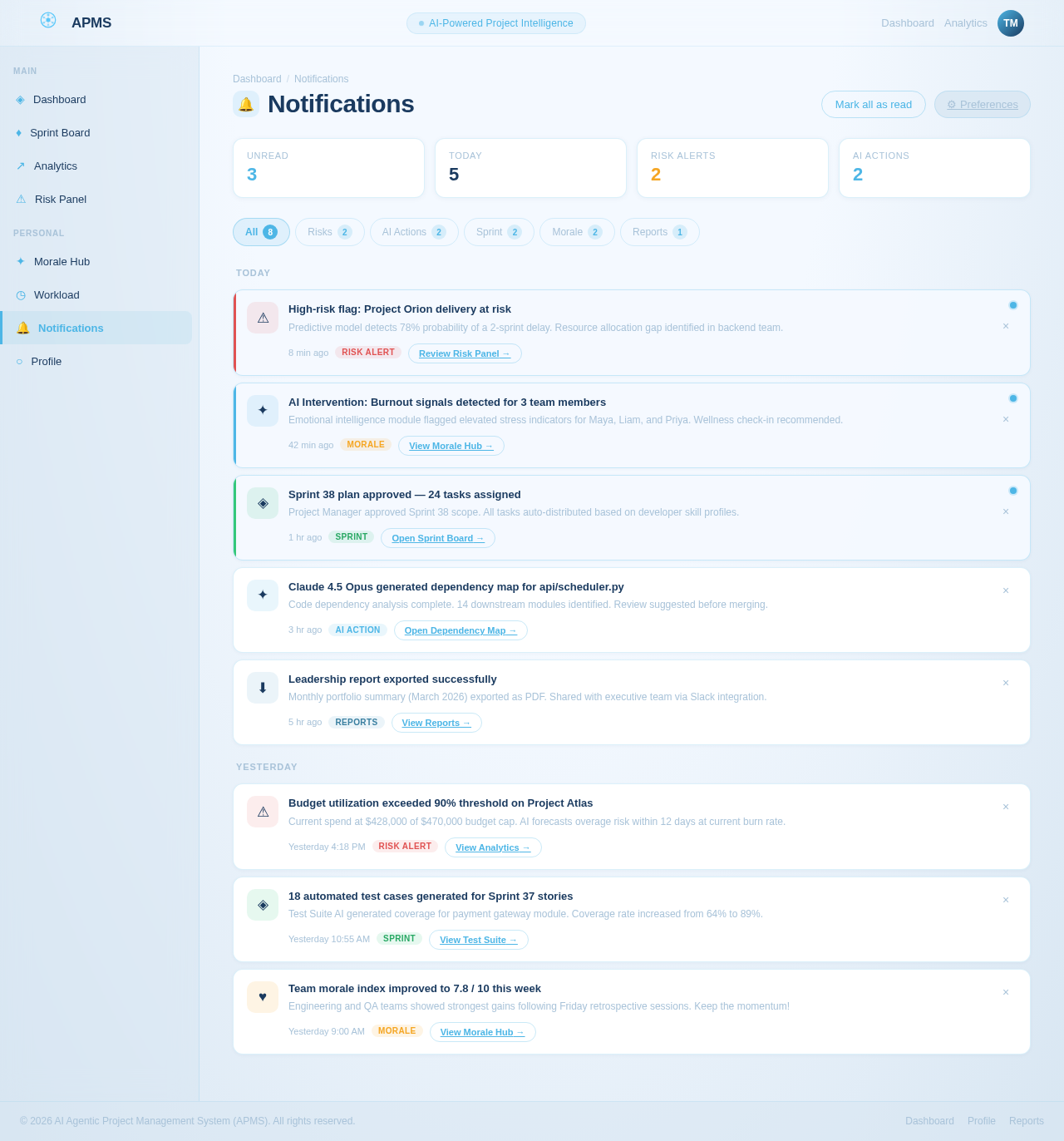
Notifications design preview
Login: Sign In
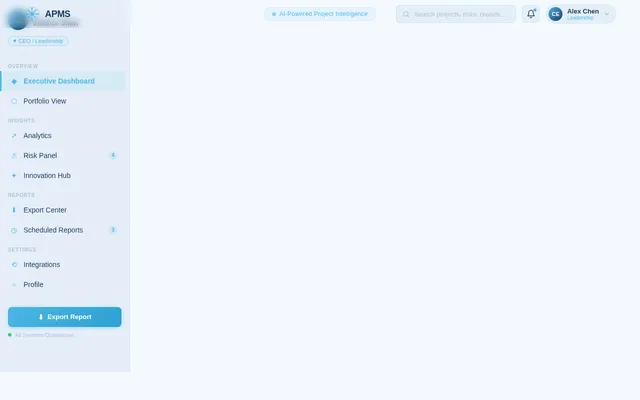
Executive Dashboard: View Portfolio
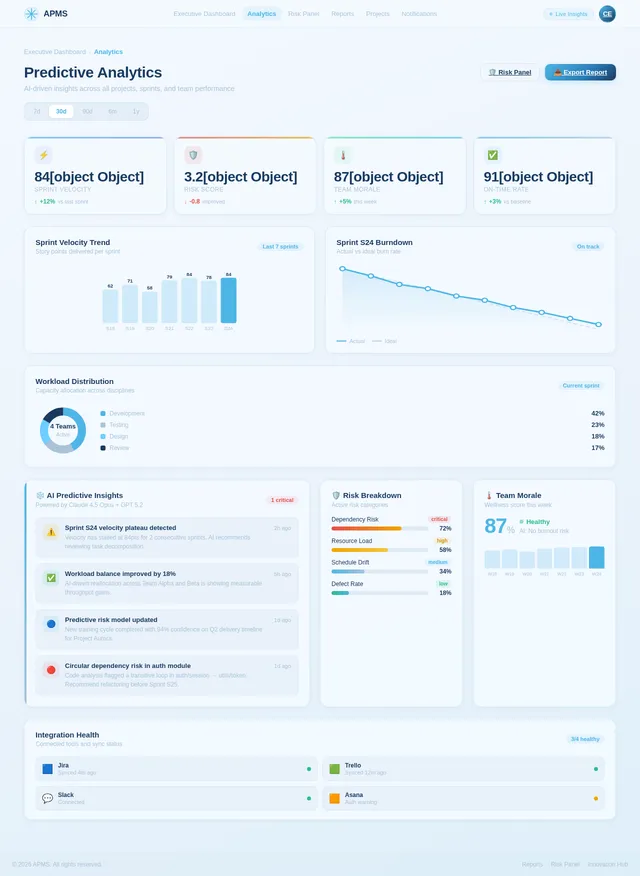
Analytics: View Predictive Insights
Risk Panel: Review Risk Reports
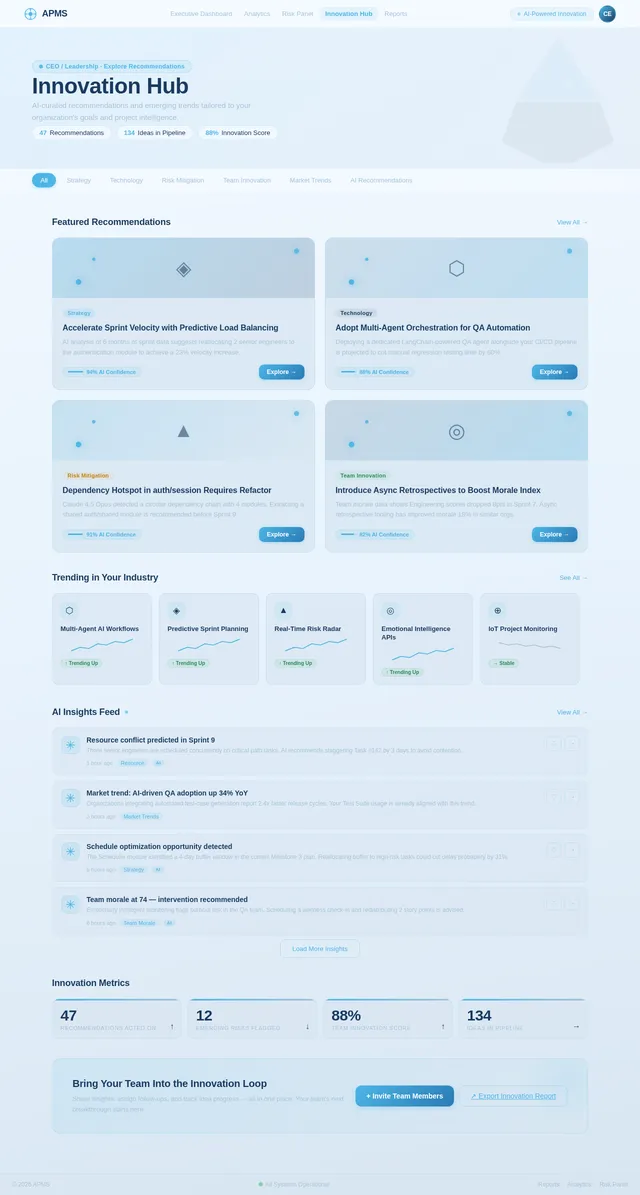
Innovation Hub: Explore Recommendations
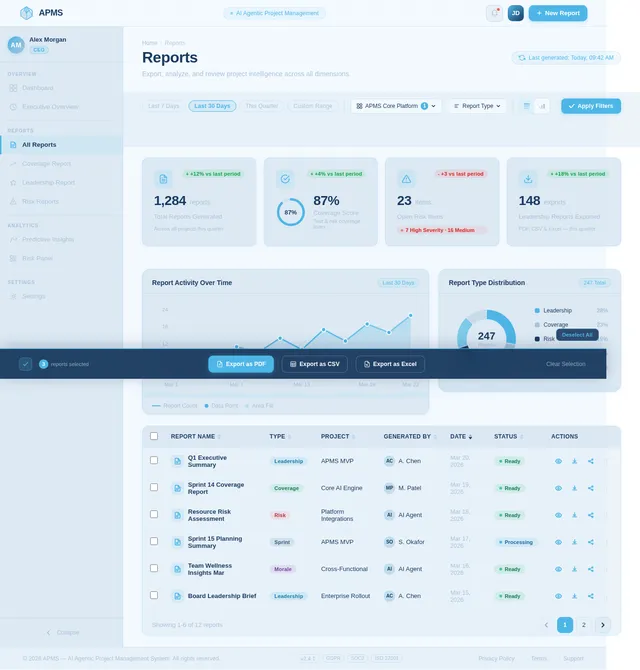
Reports: Export Leadership Report