
01
You name who you want to be
Capture the identity traits you’re reaching for, alongside your goals, lifestyle, available time and obstacles.
 Khanya Vikilahle
**AI Prompt: FRGD — Identity Operating System** FRGD is an AI-assisted Identity Operating System designed to help people become the person they aspire to be. Its core purpose is to turn personal goals and desired identity traits into realistic, structured daily actions. FRGD considers a user's goals, traits, lifestyle, available time, obstacles, and behavioural history to create personalised plans. Its adaptation system is intended to respond to changing daily circumstances while keeping the user's long-term direction in focus. Unlike a conventional habit tracker or productivity app, FRGD aims to reduce decision fatigue, help users follow through on their intentions, and learn from their actual behaviour over time. Its guiding principle is: **“Become who you’ve said you’d be.”**


Sign in to leave a comment
FRGD is an AI-assisted Identity Operating System designed to help people become the person they aspire to be. Its core purpose is to turn personal goals and desired identity traits into realistic, structured daily actions. FRGD considers a user's goals, traits, lifestyle, available time, obstacles, and behavioural history to create personalised plans, and its adaptation system responds to changing daily circumstances while keeping the user's long-term direction in focus.
Unlike a conventional habit tracker or productivity app, FRGD aims to reduce decision fatigue, help users follow through on their intentions, and learn from their actual behaviour over time. Its guiding principle is: "Become who you've said you'd be."
The audience is adults undertaking personal, long-horizon self-work who want to close the gap between intention and follow-through. The product is delivered as a first-party web application with application-owned identity, a durable personalised plan, and a daily action surface that records actual behaviour so the system can learn over time. The visual direction is dark and futuristic: near-black surfaces, high-contrast accents, subtle depth and glow, dark-only with no light mode toggle.
FRGD is a custom-UI web application backed by a first-party service that owns identity, profile, plan, and behavioural history. Two accepted human personas use it: the Identity Builder, who defines the desired identity traits and goals and receives a personalised plan, and the Daily Practitioner, who executes the plan on a given day, reports what actually happened, and notes changed circumstances so the plan can adapt.
Current accepted behaviour:
Narrow exclusions: FRGD is not a conventional habit tracker or productivity app; it does not present gamified streaks, confetti-style reward mechanics, or dense data-table admin surfaces. These are presentation and positioning boundaries, not prohibitions on recording behaviour or showing progress.
FRGD is delivered as a first-party application. Identity is application-owned and self-service: a person establishes access through enrollment on Sign Up and returns through verification on Login, because the durable identity profile, personalised plan, and behavioural history must remain bound to the correct person and be resumable across sessions. Landing, Sign Up, and Login are anonymously reachable; Identity Profile, Plan, and Today require a verified session. Enrollment and returning verification are the only access interactions — no adjacent account-management capabilities (password reset flows, social sign-in, role administration) are in scope.
The current horizon covers the full loop of defining an identity, receiving a personalised plan, executing a day's actions, recording what actually happened, and having the plan adapt. The dark futuristic visual direction applies to all six pages as a current commitment. No future-horizon capability set is established by the source; all accepted requirements are current.
Not applicable — no reference directive declares a content_source.
FR-1 — Identity Operating System purpose (explicit) As an Identity Builder, I should have FRGD turn my personal goals and desired identity traits into realistic, structured daily actions, so that my aspirations become concrete daily work. Lifecycle: initiator — Identity Builder; input — goals and desired identity traits; observable result — a structured set of daily actions derived from them; access — verified session; failure/recovery — if no plan can be produced, the profile is preserved and generation can be retried; continuation — the resulting actions appear on Plan and Today. Acceptance: given captured goals and traits, the system produces structured daily actions traceable to them.
FR-2 — Personalisation inputs (explicit) As an Identity Builder, I should have the system consider my goals, traits, lifestyle, available time, obstacles, and behavioural history when creating my personalised plan, so that the plan fits my actual life rather than an idealised one. Lifecycle: initiator — Identity Builder supplying profile inputs; participant — the system consuming recorded behavioural history; observable result — a plan whose actions reflect the supplied inputs; access — verified session; failure/recovery — missing inputs are surfaced on Identity Profile before generation; continuation — the plan can be regenerated as inputs change. Acceptance: the generated plan demonstrably reflects each supplied input category, including behavioural history once it exists.
FR-3 — Adaptation to changing circumstances (explicit) As a Daily Practitioner, I should have the adaptation system respond to my changing daily circumstances while keeping my long-term direction in focus, so that a disrupted day does not derail the longer arc. Lifecycle: initiator — Daily Practitioner noting changed circumstances; participant — the system reordering and adapting the day's actions; observable result — an adapted set of actions with the long-horizon direction unchanged; access — verified session; failure/recovery — if adaptation fails, the prior actions remain and the note is preserved for retry; continuation — the adapted actions are visible on Today and Plan. Acceptance: after a circumstance is noted, the day's actions change while the long-horizon direction remains as before.
FR-4 — Reduced decision fatigue (explicit) As a Daily Practitioner, I should be presented with the day's structured actions and one clear primary action per moment, so that I do not have to re-decide what to do. Lifecycle: initiator — Daily Practitioner opening Today; observable result — the day's actions presented in order with exactly one primary control each; access — verified session; failure/recovery — if the day cannot be loaded, an error with retry is shown; continuation — the practitioner acts on the presented action. Acceptance: each action panel carries exactly one primary control and the day's order is presented without requiring the user to choose among competing options.
FR-5 — Follow-through on intentions (explicit) As a Daily Practitioner, I should be able to record what actually happened against each of the day's structured actions, so that I follow through on my intentions and the record is truthful. Lifecycle: initiator — Daily Practitioner recording an outcome; observable result — the action reflects the recorded behaviour; access — verified session; failure/recovery — if recording fails, the action's prior state is preserved and the record can be retried; continuation — the record feeds the learning loop and the next day's plan. Acceptance: a recorded outcome is persisted and visible on the action it belongs to.
FR-6 — Learning from actual behaviour over time (explicit) As an Identity Builder, I should have the system learn from my actual behaviour over time, so that my plan becomes better matched to what I really do. Lifecycle: initiator — accumulated behavioural records from Daily Practitioner activity; observable result — subsequent plan generation and adaptation reflect that history; access — verified session; failure/recovery — if history is unavailable, generation proceeds from profile inputs and states that history was not used; continuation — history continues to accumulate. Acceptance: behavioural history is an input to plan generation and adaptation, and its use is observable in the resulting plan.
FR-7 — Self-service enrollment (required_inference) As a prospective user, I should be able to enroll myself on Sign Up, so that I can begin building my identity profile and durable plan without waiting on anyone else. Lifecycle: initiator — prospective user; observable result — an established session bound to that person; access — anonymous entry on Sign Up; failure/recovery — invalid or already-used credentials produce inline errors with the form preserved; continuation — redirect to Identity Profile. Acceptance: a completed valid enrollment establishes a session and reaches Identity Profile.
FR-8 — Returning verification (required_inference) As a returning user, I should verify on Login to reach my durable profile, plan, and behavioural history, so that my personal state remains mine and resumable. Lifecycle: initiator — returning user; observable result — a verified session reaching durable state; access — anonymous entry on Login; failure/recovery — unrecognised or incorrect credentials produce an inline error with the form preserved; continuation — redirect to Today. Acceptance: valid verification reaches the person's own profile, plan, and history; invalid verification does not.
FR-9 — Capture of identity inputs before generation (required_inference) As an Identity Builder, I should capture my identity traits, goals, lifestyle, available time, and obstacles on Identity Profile before a plan is generated, so that generation has the inputs it requires. Lifecycle: initiator — Identity Builder; observable result — a saved profile with the required inputs; access — verified session; failure/recovery — save failure preserves entered content and allows retry; continuation — plan generation is requested from the saved profile. Acceptance: generation is available only once the required inputs are captured, and each captured input is editable afterwards.
FR-10 — AI-generated personalised plan before daily actions (required_inference) As an Identity Builder, I should receive an AI-generated personalised plan before daily actions are presented, so that Today always reflects a plan built from my profile and history. Lifecycle: initiator — Identity Builder requesting generation; participant — the AI generation service; observable result — a plan of structured daily actions on Plan; access — verified session; failure/recovery — generation failure shows an error and retains the profile and any prior plan; continuation — the plan is available on Plan and drives Today. Acceptance: Today presents actions only from a generated plan; without a plan, Today routes the user to Plan.
FR-11 — Dark futuristic theme across all pages (explicit) As an Identity Builder or Daily Practitioner, I should see every page — Landing, Sign Up, Login, Identity Profile, Plan, and Today — rendered in a dark futuristic theme with near-black surfaces, high-contrast accents, and subtle depth and glow, so that the product feels coherent and current. Lifecycle: initiator — any visitor or signed-in user opening any of the six pages; observable result — the page renders in the dark futuristic theme; access — theme applies on anonymous and verified pages alike; failure/recovery — not applicable to a static presentation commitment; continuation — the theme persists across navigation. Acceptance: all six pages render dark-only with no light mode toggle, and existing layout and content structure remain intact.
FR-12 — Preserved information hierarchy (explicit) As an Identity Builder or Daily Practitioner, I should find dashboard-style pages keeping their current information hierarchy after the theme refresh, so that the dark theme does not disrupt how I read my profile, plan, or day. Lifecycle: initiator — signed-in user opening Identity Profile, Plan, or Today; observable result — the same information hierarchy as before the theme refresh; access — verified session; failure/recovery — not applicable to a presentation commitment; continuation — the hierarchy holds across revisits. Acceptance: Identity Profile, Plan, and Today retain their established information hierarchy under the dark theme.
Product context: The Identity Builder is the person who defines the identity traits and personal goals they aspire to and receives a personalised plan built from those traits, their lifestyle, available time, and obstacles. They hold the long-horizon view: the direction the plan must keep in focus even as daily circumstances change.
Primary goal: To close the gap between who they have said they would be and who they actually are, by turning aspiration into a realistic, structured plan they can follow.
Distinct accepted responsibilities: Capturing desired identity traits, personal goals, lifestyle, available time, and obstacles on Identity Profile; requesting and reviewing the personalised plan on Plan; keeping the long-horizon direction intact while the adaptable week changes; relying on the system learning from actual behaviour over time to improve the plan; regenerating the plan as their profile or accumulated behavioural history changes.
Relevant inputs and decisions: What identity they are building toward; which goals matter; how much time they realistically have; which obstacles they face; whether the generated plan is faithful to their direction; when to regenerate after their profile changes.
Interactions with other accepted participants: The Identity Builder supplies the inputs the Daily Practitioner's day is built from, and receives the benefit of the behavioural history the Daily Practitioner records. The AI generation service is the non-persona participant that produces the plan from these inputs.
Observable success: A saved profile that reflects their stated identity and constraints, and a plan whose long-horizon direction they recognise as their own while its daily actions fit their real life.
Product context: The Daily Practitioner is the person executing the plan on a given day: reviewing the day's structured actions, reporting what actually happened, and noting changed circumstances so the plan can adapt. Their recurring follow-through is what the system learns from.
Primary goal: To complete the day's intended actions without re-deciding what to do, and to have the plan respond when the day does not go as planned.
Distinct accepted responsibilities: Opening Today and reading the day's actions in order; acting on the single primary control each action presents; recording what actually happened; noting changed circumstances so the adaptation system can respond while long-term direction stays in focus.
Relevant inputs and decisions: Whether each action was done as intended; what changed in the day; whether to note a circumstance rather than abandon the day.
Interactions with other accepted participants: The Daily Practitioner works from the plan the Identity Builder's inputs produced, and their recorded behaviour becomes the history the Identity Builder's future plans learn from. The adaptation system is the non-persona participant that reorders the day in response.
Observable success: A day whose actions were presented without decision fatigue, whose outcomes were truthfully recorded, and whose adapted remainder still points at the same long-term direction.
Muse and headline: Charles & Ray Eames — Warm modernism for becoming who you said you'd be. Honest materials, joy inside order, nothing decorative that is not also useful. The user's explicit refinement — dark and futuristic — governs the surface treatment: near-black grounds, high-contrast accents, subtle depth and glow, dark-only with no light mode toggle. The Eames warmth survives in the typography, the gallery-room rhythm, the unequal panels, and the offset-card shadow, now rendered as luminous cards on a dark field.
Mode: Dark only. No light mode toggle.
Colour tokens by role:
| Role | Hex | Use |
|---|---|---|
| Background (field) | #0E0D0B | Near-black warm ground |
| Surface (panel) | #1A1815 | Raised panel laid on the field |
| Surface elevated | #242019 | Hovered or active panel |
| Text | #F2EBDD | Body and heading text on #0E0D0B (passes AA) |
| Text muted | #A99C86 | Secondary metadata, captions |
| Primary (structural) | #6E9C93 | Luminous teal — headers, active states, the plan's spine |
| Accent (hot) | #FF6A4D | Bright tomato — only the one action that matters today, emphasis rules, the CTA |
| Mustard | #E8B84B | Small coded category chips (traits, goals, obstacles), progress marks, the "said" underline |
| Walnut rule | #6B4A2F | Hairline rules and tabular numerals |
| Glow | #6E9C93 at 18% | Subtle depth and glow behind active panels and the hero |
Mustard and teal-light never appear as large fills. No indigo, no blue-on-white, no gradient blobs, no glassmorphism.
Typography:
-0.02em, sentence case, generous optical size. The guiding principle line is set at 700 with a mustard underline stroke.+0.14em tracking, like exhibition captions.clamp(40px, 8vw, 112px) for the hero principle; H1 clamp(32px, 5vw, 56px); H2 clamp(26px, 3.4vw, 40px); captions 13px Jost.Shape language: Organic-modern — soft rounded panels with 14–20px radii, capsule chips for traits and categories, thin 1px walnut rules as panel separators. Modular panels of unequal size arranged like an exhibition wall: a tall portrait panel beside two stacked square panels. Flat fills with honest edges; one subtle 2px offset shadow in near-black at 40% opacity plus a faint teal glow, suggesting a luminous card laid on a dark field. No blobs, no glossy gradients.
Spacing rhythm: 8-pt scale; 24px gutters at 375px, 64–96px at 1280px.
Imagery style: Warm, honest, material — close-cropped photography of hands, notebooks, a morning cup, walking shoes by a door, a desk in natural light; softly lit, film-grain, mid-century colour grading in walnut, cream, and mustard, graded to sit on the dark field. Playful geometric Eames dot-and-line pattern used sparingly as a section opener band. Small hand-drawn accent marks (an arrow, a check, a circled date) as UI flourishes. No stock corporate people, no 3D blobs, no abstract gradient art.
Readability constraint: Headlines, wordmarks, labels, numbers, card text, and controls stay entirely inside the viewport and their container at 375px, 768px, and 1280px, wrapping or scaling to fit, with no element covering any part of them. Imagery and decoration may crop, bleed, rotate, or overlap freely as long as they cover no readable text or control.
The exhibition wall of a life being built — after dark.
The public entry is a full-bleed near-black field split asymmetrically. The left seven columns hold the guiding principle set enormous in Jost 700 — "Become who you've said you'd be." — stacked across three lines, with the word said underlined in mustard and be. dropped alone onto its own line in luminous teal. Beneath it sits one sentence of Literata body copy and a solid bright-tomato capsule CTA, Build your identity plan. The right five columns are a tall portrait photographic panel: a hand writing in a notebook in natural morning light, grain visible, cropped so the notebook runs off the bottom edge, its warm tones glowing against the dark. Overlapping its lower-left corner is a small raised surface card carrying a real sample day — 7:10 Walk 20 min · 12:30 One hard thing · 21:00 Reflect — each row a museum-label line with walnut tabular numerals. A thin walnut rule runs the full viewport width beneath the hero, carrying three uppercase Jost captions: TRAITS → PLAN → DAY.
Below, the page continues as gallery rooms rather than a card grid: a principle room, a how-it-works room built as three unequal panels (one tall portrait beside two stacked squares), and a plan-preview room where a real day's actions are laid out like a museum label. Every panel carries the offset shadow and faint teal glow, so the interface reads as luminous printed cards laid on a dark field. The headline is the hero, not the image. No centred stack, no gradient, no floating glass.
Interaction Model: Animated Motion Tempo: restrained Hero Dimensionality: layered_2d
Landing Hero Motion Brief
TRAITS → PLAN → DAY, and reached the bright-tomato CTA.TRAITS → PLAN → DAY captions beneath. Nothing animates before the first reveal.prefers-reduced-motion, reveals become instant state and the adaptation crossfade becomes a content swap, with a usable static arrangement. Rationale: stated design constraint.#F2EBDD on #0E0D0B passes AA. Rationale: stated design constraint.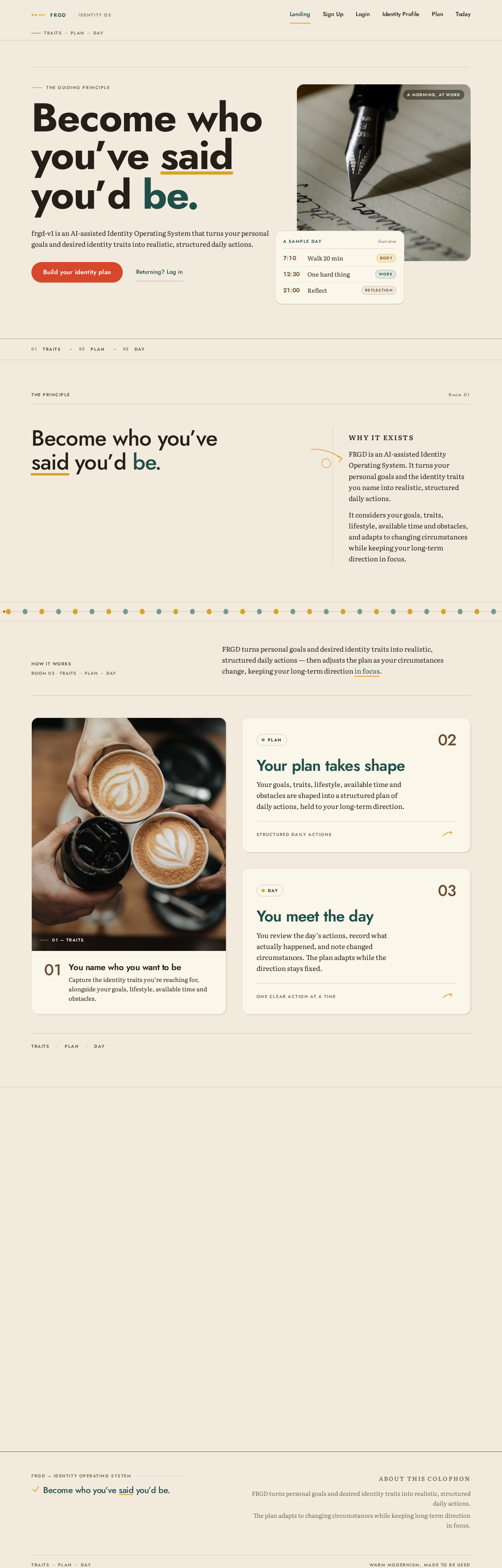
The guiding principle
frgd-v1 is an AI-assisted Identity Operating System that turns your personal goals and desired identity traits into realistic, structured daily actions.
 A morning, at work
Why it exists
FRGD is an AI-assisted Identity Operating System. It turns your personal goals and the identity traits you name into realistic, structured daily actions.
It considers your goals, traits, lifestyle, available time and obstacles, and adapts to changing circumstances while keeping your long-term direction in focus.
How it worksRoom 03 · Traits → Plan → Day
FRGD turns personal goals and desired identity traits into realistic, structured daily actions — then adjusts the plan as your circumstances change, keeping your long-term direction in focus.
Capture the identity traits you’re reaching for, alongside your goals, lifestyle, available time and obstacles.
Your goals, traits, lifestyle, available time and obstacles are shaped into a structured plan of daily actions, held to your long-term direction.
You review the day’s actions, record what actually happened, and note changed circumstances. The plan adapts while the direction stays fixed.
TraitsPlanDay
Room 04
FRGD turns your goals and desired identity traits into realistic, structured daily actions. Here is an illustrative sample day — a handful of actions, each with its category and one clear next step.
Illustrative sample · not your data
Your day starts with your traits, goals and obstacles — then one clear action at a time.
Build your identity planThe guiding principle
frgd-v1 is an AI-assisted Identity Operating System that turns your personal goals and desired identity traits into realistic, structured daily actions.
A morning, at workWhy it exists
FRGD is an AI-assisted Identity Operating System. It turns your personal goals and the identity traits you name into realistic, structured daily actions.
It considers your goals, traits, lifestyle, available time and obstacles, and adapts to changing circumstances while keeping your long-term direction in focus.
How it worksRoom 03 · Traits → Plan → Day
FRGD turns personal goals and desired identity traits into realistic, structured daily actions — then adjusts the plan as your circumstances change, keeping your long-term direction in focus.
Capture the identity traits you’re reaching for, alongside your goals, lifestyle, available time and obstacles.
Your goals, traits, lifestyle, available time and obstacles are shaped into a structured plan of daily actions, held to your long-term direction.
You review the day’s actions, record what actually happened, and note changed circumstances. The plan adapts while the direction stays fixed.
TraitsPlanDay
Room 04
FRGD turns your goals and desired identity traits into realistic, structured daily actions. Here is an illustrative sample day — a handful of actions, each with its category and one clear next step.
Illustrative sample · not your data
Your day starts with your traits, goals and obstacles — then one clear action at a time.
Build your identity plan
No comments yet. Be the first!