fiery-rumor
 46_SE-C_Prathamesh Vishwakarma
Role: Lead Full-Stack Engineer & AI Architect. Project Name: VerifyAlert — An AI-driven crisis rumor verification engine. Tech Stack Requirements: Frontend: HTML5, CSS3 (modern, responsive UI), and Vanilla JavaScript. Backend: Python 3.11+ with Flask. Database: SQLite for storing request history, results, and confidence scores. Core AI Stack: Google Gemini (google-genai): For Stage 1 (Translation and Entity Extraction). Use gemini-3-flash-preview. NewsData.io API: For Stage 2 (Live News Retrieval). Groq (groq SDK): For Stage 3 (Final Verification using Llama 3 70B/8B). The 3-Stage Pipeline Logic: Stage 1 (Gemini - Process): Accept user input. Use Gemini to: Detect the source language. Translate to English if needed. Extract structured JSON: {"event": str, "location": str, "date": str, "keywords": list}. Stage 2 (NewsData.io - Retrieve): Use the extracted event and location as query parameters for the newsdata.io/api/1/news endpoint to fetch the top 3 related articles. Stage 3 (Groq - Analyze): Provide Groq with the translated rumor + the text snippets from the news articles. Instruct Groq to return: Verdict: (TRUE / FAKE / UNVERIFIED) Confidence: (0-100%) AI Summary: A 2-sentence explanation of the logic. UI/UX Branding: Navbar: "VerifyAlert" with a clean, high-tech logo. Input Area: Centered "Paste Rumor" box. Dashboard View: Results page must show the "Transparency List" (clickable news source titles and URLs) below the verdict card. Development Instructions: Please provide the app.py script using the new google.genai Client, the HTML templates (index.html and result.html), and a clear .env example for the three API keys.
Comments (0)
Sign in to leave a comment
System Requirements
System Requirements Document (SRD)
Project Name: fiery-rumor
1. Introduction
The fiery-rumor project is an AI-driven crisis rumor verification engine designed to help users verify the authenticity of rumors during critical events. By leveraging advanced AI models and APIs, fiery-rumor processes user-submitted rumors, retrieves relevant news articles, and provides a verdict on the rumor's authenticity. The system is designed to be user-friendly, transparent, and efficient, catering to the needs of users in India (IN) and beyond.
This document outlines the system requirements for fiery-rumor, including functional and non-functional requirements, user personas, design concepts, and technical specifications.
2. System Overview
The fiery-rumor system operates through a 3-stage pipeline:
-
Stage 1: Translation and Entity Extraction
- Accepts user input (rumor text).
- Detects the source language and translates it to English if necessary.
- Extracts structured information such as event, location, date, and keywords.
-
Stage 2: Live News Retrieval
- Uses the extracted information to query a live news API (e.g., NewsData.io).
- Retrieves the top 3 related articles based on the rumor's context.
-
Stage 3: Final Verification
- Analyzes the rumor and retrieved articles using an AI model.
- Provides a verdict (TRUE, FAKE, or UNVERIFIED), a confidence score, and a brief summary.
The system ensures transparency by displaying a "Transparency List" of clickable news sources and URLs.
3. Functional Requirements
- As a User, I should be able to paste a rumor into the input box.
- As a User, I should be able to view the system's verdict (TRUE, FAKE, or UNVERIFIED) along with a confidence score.
- As a User, I should be able to see a brief AI-generated summary explaining the verdict.
- As a User, I should be able to view a "Transparency List" of related news articles with clickable titles and URLs.
- As a User, I should be able to see the system handle rumors in multiple languages.
- As a User, I should be able to view a clean and responsive UI on both desktop and mobile devices.
- As a User, I should be able to selectively re-run the verification process for a previously submitted rumor to regenerate the results.
4. User Personas
4.1 General User
- Description: Individuals seeking to verify the authenticity of rumors during crises or critical events.
- Goals:
- Quickly verify rumors.
- Access reliable sources of information.
- Understand the reasoning behind the system's verdict.
4.2 Admin
- Description: System administrators responsible for maintaining the fiery-rumor platform.
- Goals:
- Monitor system performance.
- Manage API keys and configurations.
- Ensure data security and compliance.
5. Visuals Colors and Theme
The fiery-rumor project will use a unique color palette inspired by the urgency and reliability associated with crisis verification.
- Background:
#1A1A2E(Deep Midnight Blue) - Surface:
#16213E(Dark Navy Blue) - Text:
#EAEAEA(Soft White) - Accent:
#F05454(Fiery Red) - Muted Tones:
#6C757D(Muted Gray)
This palette conveys a sense of trust, urgency, and professionalism, aligning with the project's purpose.
6. Signature Design Concept
Interactive Crisis Map Landing Page
The fiery-rumor homepage will feature an interactive crisis map as its centerpiece.
-
Design Details:
- A dynamic world map with glowing red hotspots indicating regions with active rumors.
- Users can hover over a hotspot to see a tooltip with a brief description of the rumor (e.g., "Flood in Mumbai, India").
- Clicking on a hotspot will auto-fill the rumor input box with the selected rumor for verification.
-
Animations and Transitions:
- The map will have a subtle pulsing animation for active hotspots.
- Smooth zoom-in and zoom-out transitions when users interact with the map.
-
Micro-Interactions:
- When hovering over a hotspot, the tooltip will fade in with a slight bounce effect.
- Clicking on a hotspot will trigger a ripple effect on the map.
This design concept ensures an engaging and memorable first impression while providing users with immediate value.
7. Non-Functional Requirements
- The system must respond to user queries within 5 seconds.
- The system must support at least 10,000 concurrent users.
- The system must comply with data privacy regulations (e.g., GDPR, Indian IT Act).
- The system must be accessible on both desktop and mobile devices.
- The system must store API keys securely in a
.envfile. - The system must allow selective re-runs of the verification process for previously submitted rumors.
8. Tech Stack
Frontend
- HTML5, CSS3 (modern, responsive UI)
- Vanilla JavaScript
Backend
- Python 3.11+
- Flask
Database
- SQLite for storing request history, results, and confidence scores
AI Models
- Google Gemini (gemini-3-flash-preview) for translation and entity extraction
- Groq SDK for final verification using Llama 3 70B/8B
APIs
- NewsData.io API for live news retrieval
AI Tools
- LangChain
- LiteLLM for LLM routing
Orchestration
- Docker and docker-compose for local orchestration
9. Assumptions and Constraints
- The system assumes that users will provide rumors in text format.
- The system assumes that API keys for external services (e.g., NewsData.io) will be manually added to the
.envfile by the admin. - The system is constrained by the rate limits of external APIs.
- The system assumes a stable internet connection for accessing external APIs.
- The selective re-run capability assumes that previously submitted rumors and their results are stored in the SQLite database.
10. Glossary
- Rumor: A piece of unverified information submitted by the user for verification.
- Transparency List: A list of related news articles retrieved during the verification process.
- Verdict: The system's determination of whether a rumor is TRUE, FAKE, or UNVERIFIED.
- Confidence Score: A numerical representation (0-100%) of the system's confidence in its verdict.
- Hotspot: A region on the interactive map with active rumors.
- Selective Re-Run: A feature allowing users to re-trigger the verification process for a previously submitted rumor.
This concludes the updated System Requirements Document for the fiery-rumor project. Let me know if you need further refinements, Prathamesh!
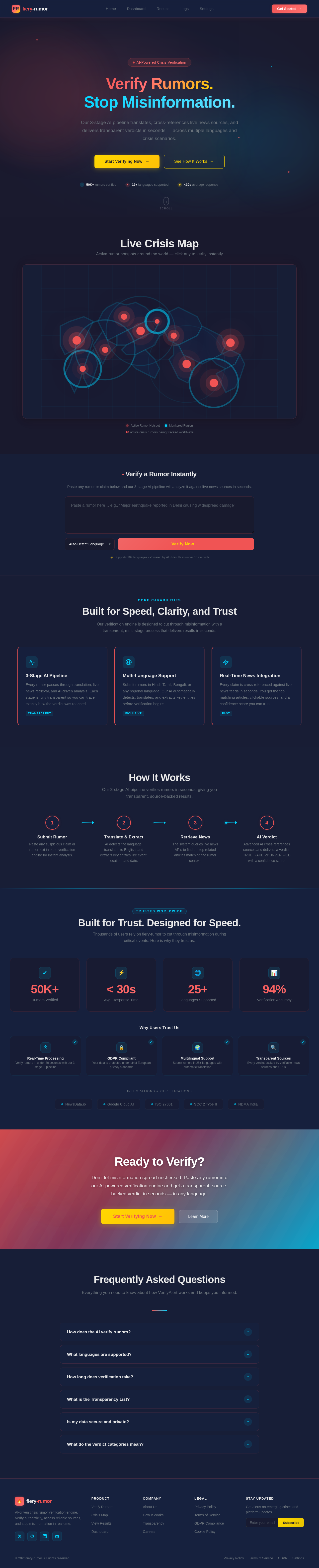
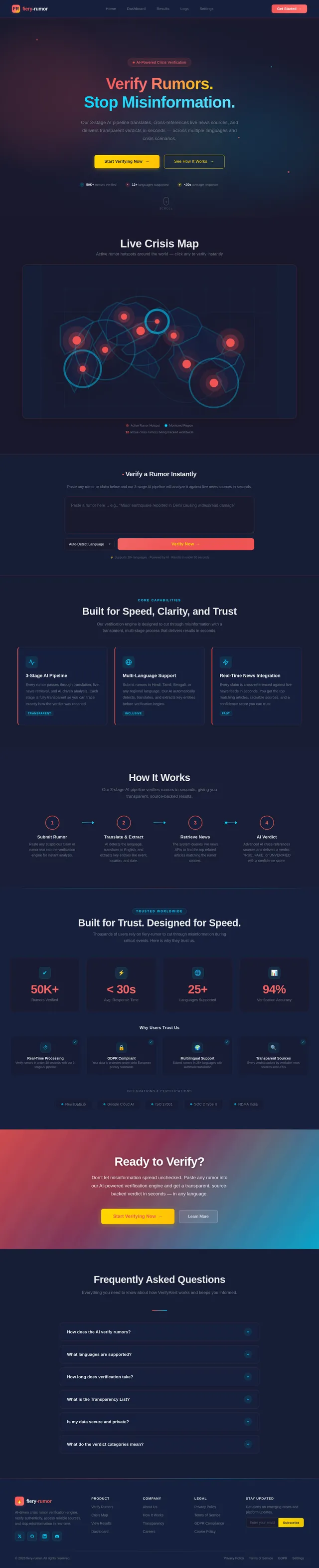
Verify Rumors.
Stop Misinformation.
Our 3-stage AI pipeline translates, cross-references live news sources, and delivers transparent verdicts in seconds — across multiple languages and crisis scenarios.
Live Crisis Map
Active rumor hotspots around the world — click any to verify instantly
10 active crisis rumors being tracked worldwide
Verify a Rumor Instantly
Paste any rumor or claim below and our 3-stage AI pipeline will analyze it against live news sources in seconds.
Supports 10+ languages · Powered by AI · Results in under 30 seconds
Built for Speed, Clarity, and Trust
Our verification engine is designed to cut through misinformation with a transparent, multi-stage process that delivers results in seconds.
3-Stage AI Pipeline
Every rumor passes through translation, live news retrieval, and AI-driven analysis. Each stage is fully transparent so you can trace exactly how the verdict was reached.
TransparentMulti-Language Support
Submit rumors in Hindi, Tamil, Bengali, or any regional language. Our AI automatically detects, translates, and extracts key entities before verification begins.
InclusiveReal-Time News Integration
Every claim is cross-referenced against live news feeds in seconds. You get the top matching articles, clickable sources, and a confidence score you can trust.
FastHow It Works
Our 3-stage AI pipeline verifies rumors in seconds, giving you transparent, source-backed results.
Submit Rumor
Paste any suspicious claim or rumor text into the verification engine for instant analysis.
Translate & Extract
AI detects the language, translates to English, and extracts key entities like event, location, and date.
Retrieve News
The system queries live news APIs to find the top related articles matching the rumor context.
AI Verdict
Advanced AI cross-references sources and delivers a verdict: TRUE, FAKE, or UNVERIFIED with a confidence score.
Built for Trust. Designed for Speed.
Thousands of users rely on fiery-rumor to cut through misinformation during critical events. Here is why they trust us.
Ready to Verify?
Don’t let misinformation spread unchecked. Paste any rumor into our AI-powered verification engine and get a transparent, source-backed verdict in seconds — in any language.
Frequently Asked Questions
Everything you need to know about how VerifyAlert works and keeps you informed.
No comments yet. Be the first!