executive-ai-platform
 Chintan Radadiya
build after analyzing attached document


Comments (0)
Sign in to leave a comment
System Requirements
System Requirements Document for executive-ai-platform
Introduction
This document outlines the system requirements for the Executive AI Platform, an AI-powered solution designed to manage company/entity information, analyze documents and financial data, conduct research, and automatically produce high-quality executive reports and presentations.
System Overview
The Executive AI Platform is intended to create a persistent intelligence environment for each entity, allowing users to configure an entity once and repeatedly use that information for analysis and report generation. The platform integrates entity management, document understanding, financial analysis, research, and executive insight generation into a cohesive workflow.
Product Interpretation and Delivery Boundary
The platform is designed to be deployed in a secure, controlled cloud environment, ensuring data security and privacy with encryption in transit and at rest. It supports large data volumes and concurrent users, with a model-agnostic AI layer that allows for model selection without requiring platform rebuilds. The platform's visual direction is professional and neutral, suitable for executive presentations, with a responsive design that includes smooth transitions and animations.
Page Content and Component Coverage
Landing
- Purpose: Provide an anonymous first impression explaining the Executive AI Platform, its business-professional users, and its entity intelligence, analysis, research, and executive-output capabilities.
- Components:
- Overview of platform capabilities
- Introduction to user personas (Business Analyst, Administrator)
- Call-to-action for login or more information
Login
- Purpose: Allow returning users to verify identity for accessing protected entity, analysis, generation, and administration state.
- Components:
- Username and password fields
- Password recovery option
- Authentication feedback
Dashboard
- Purpose: Serve as a protected continuation hub for selecting an entity and entering recurring analysis, research, insight, generation, and administration work.
- Components:
- Entity selection
- Quick access to recent activities
- Notifications and alerts
Entities
- Purpose: Manage creation, selection, management, and configuration of persistent business entity workspaces.
- Components:
- Entity creation form
- Entity list and search
- Entity configuration options
Materials
- Purpose: Manage upload and management of entity documents, presentation assets, templates, branding, and other reusable business materials.
- Components:
- Upload interface with drag-and-drop
- File status and categorization
- Asset preview and management
Knowledge
- Purpose: Provide revisitable retrieval of processed document metadata and indexed content for entity work.
- Components:
- Document metadata search
- Indexed content access
- Knowledge base management
AI Models
- Purpose: Provide model selection for task-specific AI analysis and generation without platform rebuilds.
- Components:
- Model selection interface
- Task-specific model recommendations
- Model configuration options
Document Analysis
- Purpose: Own AI processing of business documents to extract information and insights.
- Components:
- Document processing status
- Extracted insights display
- Analysis configuration
Financial Analysis
- Purpose: Own financial analysis, KPI calculation, and peer and industry benchmark comparison.
- Components:
- Financial data input
- KPI calculation results
- Benchmark comparison tools
Research
- Purpose: Own external-source research and summarization for incorporation into executive work.
- Components:
- Research query input
- External source integration
- Research summary display
Insights
- Purpose: Own generation of executive insights and storylines from entity knowledge and analytical inputs.
- Components:
- Insight generation tools
- Storyline development interface
- Insight review and approval
Reports
- Purpose: Own generation of executive reports and presentations with entity-specific templates and branding, including approved-output download.
- Components:
- Report generation wizard
- Template selection
- Downloadable output
Review
- Purpose: Own review, feedback, and regeneration of selected generated report or presentation sections.
- Components:
- Content review interface
- Feedback submission
- Regeneration options
Versions
- Purpose: Own output version history, reverting, and approval and locking of official final versions.
- Components:
- Version history display
- Revert to previous version
- Final version approval
Tasks
- Purpose: Own optional integrated email and task management when that functionality is enabled.
- Components:
- Task creation and management
- Email integration (optional)
- Task status tracking
Administration
- Purpose: Own administrator management of user accounts, entity access, and permissions.
- Components:
- User account management
- Entity access control
- Permission configuration
Functional Requirements
Entity Management
- As a Business Analyst, I should be able to create and manage entities to maintain a persistent workspace for each business context. (explicit)
- As a Business Analyst, I should be able to upload and configure entity-specific documents, templates, and branding for reuse. (explicit)
Document and Knowledge Management
- As a Business Analyst, I should be able to upload various business documents and presentation assets for processing and indexing. (explicit)
- As a Business Analyst, I should be able to retrieve efficiently indexed metadata from uploaded documents. (explicit)
AI-Powered Document Understanding
- As a Business Analyst, I should be able to use AI to understand and process documents to extract relevant information and insights. (explicit)
- As a Business Analyst, I should be able to select different AI models for various tasks. (explicit)
Financial and Banking Analysis
- As a Business Analyst, I should be able to analyze financial information and calculate KPIs to gain insights into financial performance. (explicit)
- As a Business Analyst, I should be able to compare financial data with peers and industry benchmarks. (explicit)
Research
- As a Business Analyst, I should be able to conduct research using external sources to supplement internal knowledge. (explicit)
- As a Business Analyst, I should be able to summarize and present research findings for easy incorporation into reports and presentations. (explicit)
Executive Insight Generation
- As a Business Analyst, I should be able to generate executive insights and storylines for compelling narratives in reports and presentations. (explicit)
Report and Presentation Generation
- As a Business Analyst, I should be able to generate executive reports and presentations using AI for high-quality outputs. (explicit)
- As a Business Analyst, I should be able to use entity-specific templates and branding for presentations. (explicit)
Review and Feedback
- As a Business Analyst, I should be able to review generated content and provide feedback to ensure accuracy and relevance. (explicit)
- As a Business Analyst, I should be able to regenerate selected sections of reports or presentations based on feedback. (explicit)
Version Management
- As a Business Analyst, I should be able to maintain versions of generated outputs to track changes and revert if necessary. (explicit)
- As a Business Analyst, I should be able to approve a final version of a report or presentation to lock it as the official output. (explicit)
Security and Access Management
- As a user, I should have secure access to the platform with authentication and authorization controls. (explicit)
Optional Email & Tasks Functionality
- As a Business Analyst, I should have the option to manage emails and tasks within the platform for integrated communication and task management. (explicit)
Major Architecture Layers
- As a user, I want the platform to be built with a shared infrastructure across major architecture layers for cohesive operation. (explicit)
User Personas
- Business Analyst: Uses the platform to manage entity context, upload and reuse business materials, analyze financial data, conduct research, generate executive insights, reports, and presentations, and review, revise, version, and approve outputs.
- Administrator: Manages user accounts, entities, and access permissions within the platform.
Core User Flows
Entity Creation and Configuration
- Business Analyst logs into the platform.
- Selects "Create Entity."
- Enters entity information and uploads relevant documents and branding assets.
- System processes and indexes the uploaded materials.
- Configures additional settings as needed.
Report and Presentation Generation
- Business Analyst selects an entity and objective (e.g., financial analysis, report generation).
- System identifies relevant documents and data.
- AI processes the information and generates insights.
- Business Analyst reviews the generated report or presentation.
- Provides feedback and requests changes if necessary.
- System regenerates content based on feedback.
- Business Analyst approves the final version and downloads the output.
Visuals Colors and Theme
- Muse: Jony Ive
- Palette: Light mode with background #F5F5F5, surface #FFFFFF, text #333333, primary #B0B0B0, accent #FF9500, muted #D8D8D8.
- Typography: Headings in Inter Tight — Light weights, very large scale, tight tracking; body in Georama; scale 1.414 modular, 60/42/28/20/16.
- Shape Language: Soft continuous-curve radii, wide margins, single-column focus.
- Layout: Generous whitespace, single-column layouts, product-first hero.
- Motion: Slow, physical easing; reveal-on-scroll of one subject.
- Imagery: Studio-lit renders and macro details on plain grounds.
- Hero Direction: A product-first hero on a light background with a single perfectly lit render of the AI's interface, surrounded by generous whitespace and subtle accents.
Signature Design Concept
The platform should have a clean, intuitive interface that emphasizes ease of use and accessibility for business professionals. A full-page hero with a single high-fidelity interface render, large, light-weight headlines with tight tracking spanning across sections, and subtle accent color used sparingly for key interactions are signature moves.
Interaction Model & Motion Direction
- Interaction Model: Static
- Motion Tempo: Restrained
- Hero Dimensionality: Layered 2D
- Landing Hero Motion Brief: A composed hero with a single high-fidelity interface render, using slow, physical easing and reveal-on-scroll of one subject.
Non-Functional Requirements
- The platform must ensure data security and privacy, with encryption for data in transit and at rest.
- The system should be scalable to handle large volumes of data and concurrent users.
Tech Stack
- Frontend: React/Next.js or equivalent enterprise-grade frontend technology.
- Backend: A robust API layer for authentication, data processing, and AI orchestration.
- AI Layer: Model-agnostic architecture supporting multiple AI models.
- Data Layer: Secure storage for user data, documents, and metadata.
- File/Object Storage: Separate storage for large files with metadata references.
Assumptions and Constraints
- The platform will be deployed in a secure, controlled cloud environment.
- The AI layer must support model selection without requiring platform rebuilds.
Glossary
- Entity: A business context or profile within the platform.
- KPI: Key Performance Indicator, a measurable value that demonstrates how effectively a company is achieving key business objectives.
- LLM: Large Language Model, an AI model used for understanding and generating human language.
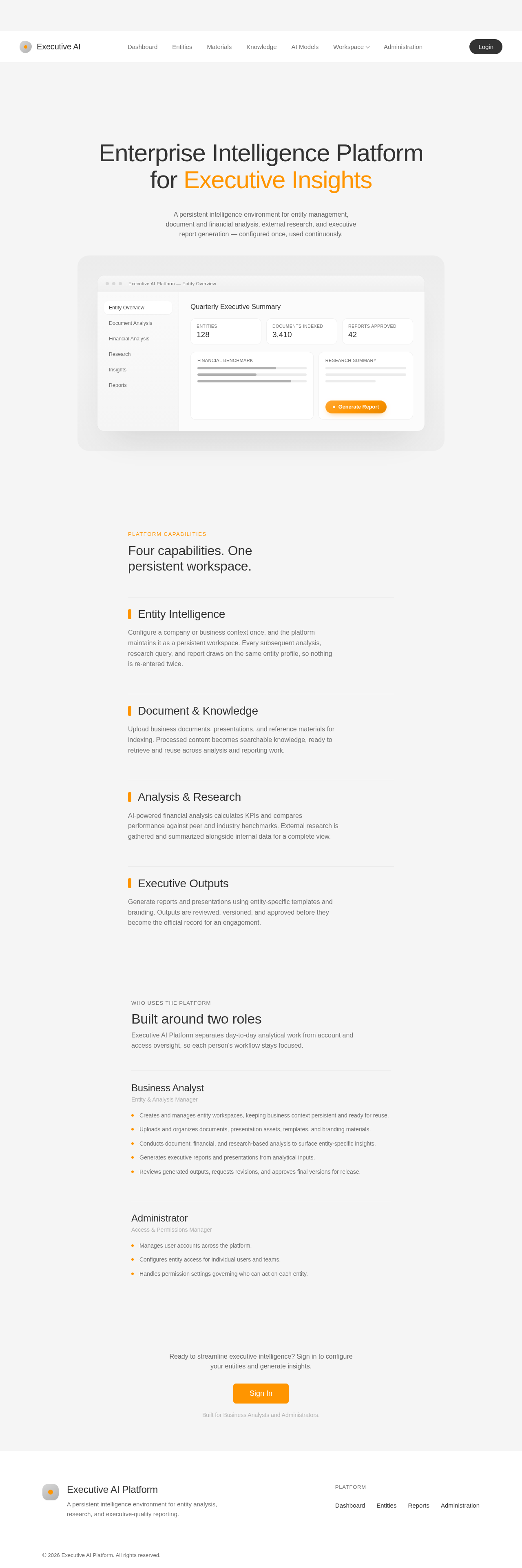
Enterprise Intelligence Platform for Executive Insights
A persistent intelligence environment for entity management, document and financial analysis, external research, and executive report generation — configured once, used continuously.
Platform Capabilities
Four capabilities. One persistent workspace.
Entity Intelligence
Configure a company or business context once, and the platform maintains it as a persistent workspace. Every subsequent analysis, research query, and report draws on the same entity profile, so nothing is re-entered twice.
Document & Knowledge
Upload business documents, presentations, and reference materials for indexing. Processed content becomes searchable knowledge, ready to retrieve and reuse across analysis and reporting work.
Analysis & Research
AI-powered financial analysis calculates KPIs and compares performance against peer and industry benchmarks. External research is gathered and summarized alongside internal data for a complete view.
Executive Outputs
Generate reports and presentations using entity-specific templates and branding. Outputs are reviewed, versioned, and approved before they become the official record for an engagement.
Who Uses The Platform
Built around two roles
Executive AI Platform separates day-to-day analytical work from account and access oversight, so each person's workflow stays focused.
Business Analyst
Entity & Analysis Manager
- Creates and manages entity workspaces, keeping business context persistent and ready for reuse.
- Uploads and organizes documents, presentation assets, templates, and branding materials.
- Conducts document, financial, and research-based analysis to surface entity-specific insights.
- Generates executive reports and presentations from analytical inputs.
- Reviews generated outputs, requests revisions, and approves final versions for release.
Administrator
Access & Permissions Manager
- Manages user accounts across the platform.
- Configures entity access for individual users and teams.
- Handles permission settings governing who can act on each entity.
Ready to streamline executive intelligence? Sign in to configure your entities and generate insights.
Sign InBuilt for Business Analysts and Administrators.
Enterprise Intelligence Platform for Executive Insights
A persistent intelligence environment for entity management, document and financial analysis, external research, and executive report generation — configured once, used continuously.
Platform Capabilities
Four capabilities. One persistent workspace.
Entity Intelligence
Configure a company or business context once, and the platform maintains it as a persistent workspace. Every subsequent analysis, research query, and report draws on the same entity profile, so nothing is re-entered twice.
Document & Knowledge
Upload business documents, presentations, and reference materials for indexing. Processed content becomes searchable knowledge, ready to retrieve and reuse across analysis and reporting work.
Analysis & Research
AI-powered financial analysis calculates KPIs and compares performance against peer and industry benchmarks. External research is gathered and summarized alongside internal data for a complete view.
Executive Outputs
Generate reports and presentations using entity-specific templates and branding. Outputs are reviewed, versioned, and approved before they become the official record for an engagement.
Who Uses The Platform
Built around two roles
Executive AI Platform separates day-to-day analytical work from account and access oversight, so each person's workflow stays focused.
Business Analyst
Entity & Analysis Manager
- Creates and manages entity workspaces, keeping business context persistent and ready for reuse.
- Uploads and organizes documents, presentation assets, templates, and branding materials.
- Conducts document, financial, and research-based analysis to surface entity-specific insights.
- Generates executive reports and presentations from analytical inputs.
- Reviews generated outputs, requests revisions, and approves final versions for release.
Administrator
Access & Permissions Manager
- Manages user accounts across the platform.
- Configures entity access for individual users and teams.
- Handles permission settings governing who can act on each entity.
Ready to streamline executive intelligence? Sign in to configure your entities and generate insights.
Sign InBuilt for Business Analysts and Administrators.
No comments yet. Be the first!