Page 1 of 4
emerald-start System Requirements Document
1. Introduction
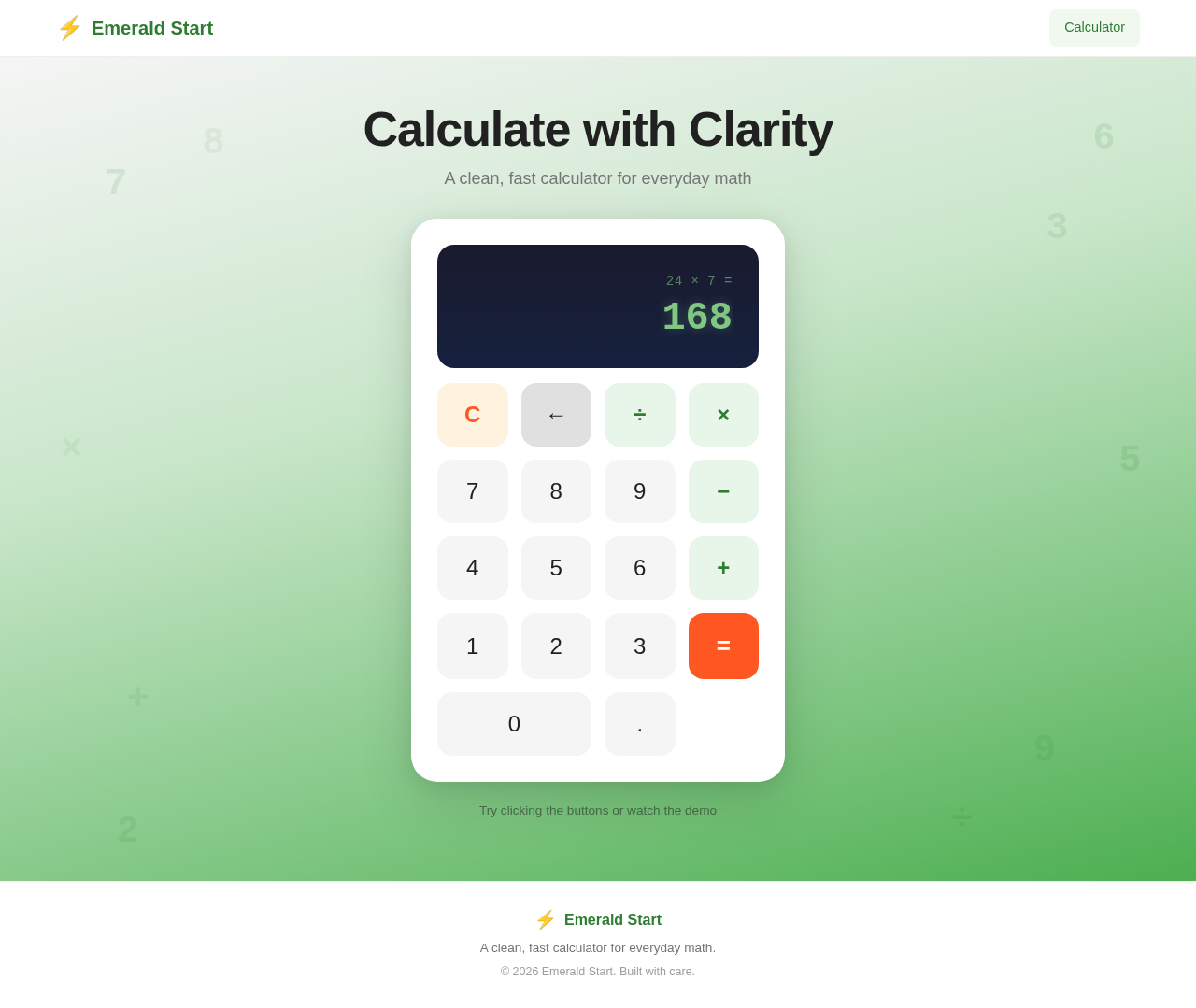
The purpose of this document is to outline the system requirements for the "emerald-start" project, which aims to develop a simple single-page calculator design. This document will serve as a guide for the development and implementation of the project.
2. System Overview
The "emerald-start" project is focused on creating a user-friendly, single-page calculator application. The application will be designed to perform basic arithmetic operations and provide a seamless user experience.
3. Functional Requirements as Story Points
- As a User, I should be able to perform basic arithmetic operations such as addition, subtraction, multiplication, and division.
- As a User, I should be able to clear the current input to start a new calculation.
- As a User, I should be able to view the result of my calculations immediately after input.
4. User Personas
- User: A general user who needs to perform basic arithmetic calculations quickly and efficiently.
Page 2 of 4
5. Core User Flows
- User opens the calculator -> Inputs numbers and selects an operation -> Views the result -> Clears input for a new calculation.
6. Visuals Colors and Theme
- primary: #4CAF50 (Emerald Green)
- primary_light: #81C784 (Light Emerald Green)
- secondary: #FFFFFF (White)
- accent: #FF5722 (Deep Orange)
- highlight: #FFC107 (Amber)
- bg: #F5F5F5 (Light Grey)
- surface: #FFFFFF (White)
- text: #212121 (Dark Grey)
- text_muted: #757575 (Grey)
- border: #BDBDBD (Light Grey)
7. Signature Design Concept
The "emerald-start" calculator will feature an interactive design concept where the calculator buttons animate with a subtle bounce effect when clicked, providing tactile feedback. The background will have a gradient transition from light grey to emerald green, creating a calming effect. The calculator display will have a digital-style font that mimics a classic calculator screen.
Page 3 of 4
LANDING HERO MOTION BRIEF
The landing page will feature a continuous animation loop where numbers and operations appear to float and settle into the calculator display, demonstrating the input process. This will be achieved using motion/react for smooth transitions and animations. The animation will reset after a few seconds, inviting interaction.
8. Interaction Model & Motion Direction
- Intended Interaction Model: Animated
- The calculator will have moderate hover transitions and click animations to enhance user interaction.
- The landing page will include a continuous 2D motion loop to demonstrate the calculator's functionality.
9. Non-Functional Requirements
- The application must load quickly and perform calculations without noticeable delay.
- The design must be responsive and accessible on various devices and screen sizes.
Page 4 of 4
10. Tech Stack
- Frontend: React for Web
- Backend: Not applicable (single-page application)
- Database: Not applicable (single-page application)
- AI Models: Not applicable
- AI Tools: Not applicable
- Local Orchestration: Not applicable
- Server Side Orchestration: Not applicable
11. Assumptions and Constraints
- The calculator will only perform basic arithmetic operations.
- The application will be a single-page design with no backend integration.
- The design will prioritize simplicity and ease of use.
12. Glossary
- Arithmetic Operations: Basic mathematical operations including addition, subtraction, multiplication, and division.
- Responsive Design: An approach to web design that makes web pages render well on a variety of devices and window or screen sizes.
 Diya Trivedi
No comments yet. Be the first!