eagle-frontend
 Umar Anayat
Create a full-stack Airbnb clone web application. Frontend: - Use React (or Next.js) - Build responsive UI similar to Airbnb - Pages: - Home page (listings grid) - Property detail page - Login / Signup page - User dashboard - Components: - Navbar - Search bar - Property cards - Booking form - Use modern UI (Tailwind CSS preferred) Backend: - Use Node.js with Express - Create REST APIs: - Auth (register/login with JWT) - Properties (CRUD operations) - Bookings (create/view bookings) - Use proper folder structure (MVC pattern) Database: - Use MongoDB - Collections: - Users - Properties - Bookings Features: - User authentication (JWT) - Add / Edit / Delete property - Search properties by location - Book a property - Store booking history - Protect routes (only logged-in users can book) Optional: - Image upload (Cloudinary) - Reviews and ratings - Admin panel Output: - Full working project - Clean code with comments - Instructions to run (frontend + backend)
Comments (0)
Sign in to leave a comment
System Requirements
System Requirements Document (SRD)
Project Name: eagle-frontend
1. Introduction
The eagle-frontend project is a full-stack web application designed to replicate the core functionality of Airbnb. This platform will allow users to browse, search, and book properties, while providing property owners and administrators with tools to manage listings and bookings. The project will prioritize a responsive and modern frontend, secure backend APIs, and a scalable database structure.
This document outlines the system requirements for eagle-frontend, focusing on core features such as user authentication, property listings, and booking management. Optional features like reviews, ratings, and image uploads will be considered for future iterations.
2. System Overview
The eagle-frontend application will consist of:
- A user-facing interface for browsing and booking properties.
- A separate admin interface for managing properties, bookings, and users.
- A backend API to handle authentication, property management, and booking operations.
- A database to store user data, property details, and booking history.
The system will be built with scalability and maintainability in mind, leveraging modern technologies like React, Node.js, and MongoDB. The frontend will prioritize responsiveness and usability, ensuring a seamless experience across devices.
Key features include:
- Secure user authentication using JWT.
- CRUD operations for property listings.
- A booking system with route protection for logged-in users.
- Search functionality to filter properties by location.
3. Functional Requirements
Core Features (Prioritized):
- As a User, I should be able to register and log in securely using JWT.
- As a User, I should be able to browse a grid of property listings on the homepage.
- As a User, I should be able to view detailed information about a property on its dedicated page.
- As a User, I should be able to search for properties by location.
- As a User, I should be able to book a property and view my booking history.
- As an Admin, I should be able to log in to a separate admin interface.
- As an Admin, I should be able to add, edit, and delete property listings.
- As an Admin, I should be able to view and manage user bookings.
Optional Features (To be added later):
- As a User, I should be able to upload images for my property listings.
- As a User, I should be able to leave reviews and ratings for properties.
- As an Admin, I should be able to manage user accounts.
4. User Personas
1. General User
- Description: A customer looking to browse and book properties.
- Goals:
- Find and book properties easily.
- Manage their bookings and account details.
- Pain Points:
- Difficulty in finding properties that match their preferences.
- Unclear booking process.
2. Property Owner
- Description: A user who lists properties for rent.
- Goals:
- Add, edit, and manage property listings.
- View bookings for their properties.
- Pain Points:
- Managing multiple properties efficiently.
3. Admin
- Description: A platform administrator responsible for overseeing the system.
- Goals:
- Manage all property listings, bookings, and user accounts.
- Ensure the platform runs smoothly.
- Pain Points:
- Handling a large volume of data and user requests.
5. Visuals Colors and Theme
Color Palette
The eagle-frontend project will use a unique, modern color palette to create a clean and inviting user interface:
- Background: #F5F9FC (light sky blue)
- Surface: #FFFFFF (pure white)
- Text: #2C3E50 (dark slate gray)
- Accent: #FF6F61 (vibrant coral)
- Muted Tones: #B0BEC5 (soft gray-blue)
This palette emphasizes readability and a welcoming aesthetic, aligning with the platform's goal of providing a seamless user experience.
6. Signature Design Concept
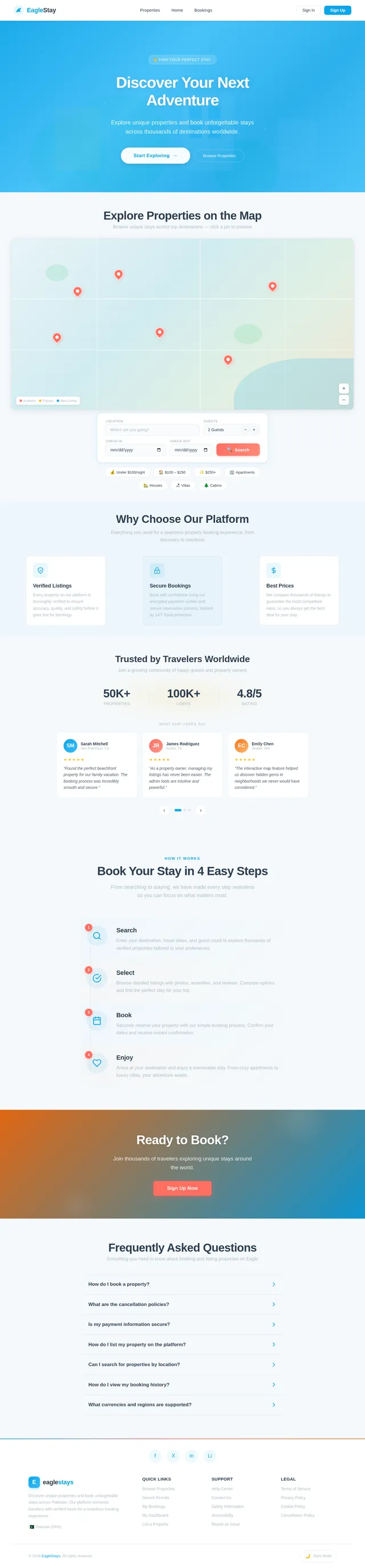
The eagle-frontend homepage will feature an interactive property map as its centerpiece.
Concept Details:
- Dynamic Map Integration: The homepage will display a full-screen map with property locations marked as interactive pins.
- Hover and Click Animations: When users hover over a pin, a small preview card will appear, showing the property name, price, and a thumbnail image. Clicking on a pin will open a detailed property page.
- Search Bar Integration: A prominent search bar will overlay the map, allowing users to filter properties by location, price range, and availability.
- Smooth Transitions: The map and property cards will feature smooth zoom and fade animations for a polished feel.
- Responsive Design: On smaller screens, the map will resize dynamically, and the property list will appear below it for easy navigation.
This bold and interactive design will make the homepage visually striking and highly functional, leaving a lasting impression on users.
7. Non-Functional Requirements
- Performance: The application should load within 3 seconds on a standard broadband connection.
- Scalability: The system should support up to 10,000 concurrent users.
- Security: All sensitive data must be encrypted, and APIs must be protected against common vulnerabilities (e.g., SQL injection, XSS).
- Usability: The interface should be intuitive and accessible, adhering to WCAG 2.1 standards.
- Maintainability: The codebase should follow industry best practices, with clear documentation and comments.
8. Tech Stack
Frontend
- React (or Next.js)
- Tailwind CSS
Backend
- Node.js with Express
Database
- MongoDB
Additional Tools
- JWT for authentication
- Docker for local orchestration
- Cloudinary (optional, for image uploads)
9. Assumptions and Constraints
- The admin panel will be a separate interface, accessible only to authorized administrators.
- Optional features like reviews, ratings, and image uploads will not be included in the initial release.
- The system will primarily target users in Pakistan (PK), with locale-specific defaults (e.g., PKR currency, UTC+5 timezone).
10. Glossary
- JWT (JSON Web Token): A secure method for transmitting information between parties as a JSON object.
- CRUD: Create, Read, Update, Delete operations for managing data.
- WCAG: Web Content Accessibility Guidelines, a standard for making web content accessible.
- MVC: Model-View-Controller, a design pattern for organizing code.
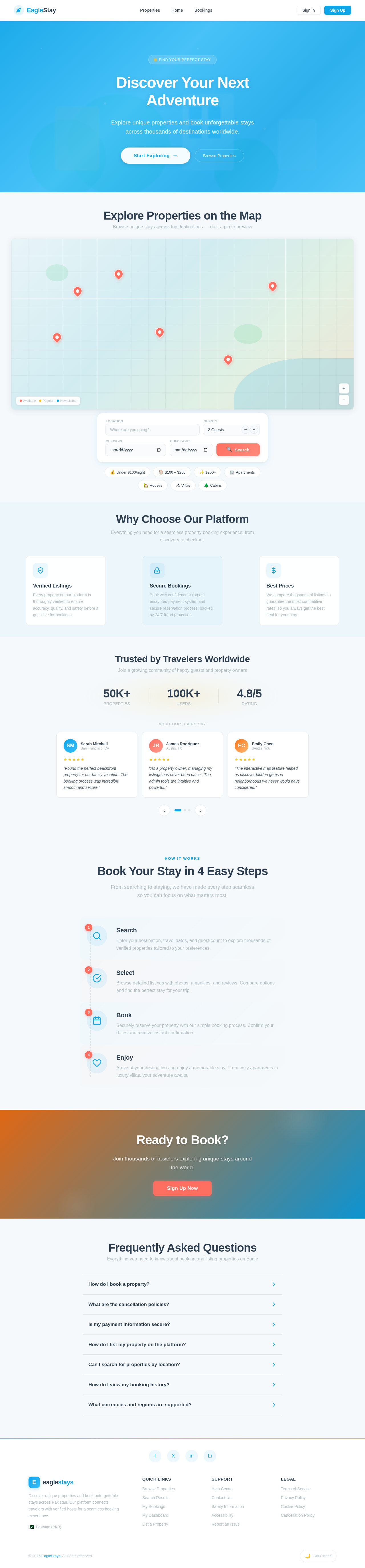
Discover Your Next Adventure
Explore unique properties and book unforgettable stays across thousands of destinations worldwide.
Explore Properties on the Map
Browse unique stays across top destinations — click a pin to preview


Why Choose Our Platform
Everything you need for a seamless property booking experience, from discovery to checkout.
Verified Listings
Every property on our platform is thoroughly verified to ensure accuracy, quality, and safety before it goes live for bookings.
Secure Bookings
Book with confidence using our encrypted payment system and secure reservation process, backed by 24/7 fraud protection.
Best Prices
We compare thousands of listings to guarantee the most competitive rates, so you always get the best deal for your stay.
Trusted by Travelers Worldwide
Join a growing community of happy guests and property owners
Book Your Stay in 4 Easy Steps
From searching to staying, we have made every step seamless so you can focus on what matters most.
Search
Enter your destination, travel dates, and guest count to explore thousands of verified properties tailored to your preferences.
Select
Browse detailed listings with photos, amenities, and reviews. Compare options and find the perfect stay for your trip.
Book
Securely reserve your property with our simple booking process. Confirm your dates and receive instant confirmation.
Enjoy
Arrive at your destination and enjoy a memorable stay. From cozy apartments to luxury villas, your adventure awaits.
Frequently Asked Questions
Everything you need to know about booking and listing properties on Eagle
No comments yet. Be the first!