Gamified Challenges
Explore a curated library of ranked coding challenges, filterable by category and difficulty. Pass submissions to earn points, climb the leaderboard, and watch your rank recalculate automatically.
Explore Challenges GidiDev
# DevForge — Full Production Platform Build Prompt ## Project Vision DevForge is a gamified developer growth platform where developers forge real coding skill through ranked coding challenges, and get verified for hiring based on proven performance rather than a resume alone. Build the complete platform — ranked challenges AND verified hiring — as one cohesive production system, not split into phases. ## Tech Stack **Backend** - Django + Django REST Framework - PostgreSQL - JWT auth (`djangorestframework-simplejwt`) - `django-cors-headers`, `python-decouple`, `django-filter`, `Pillow`, `gunicorn` **Frontend** - React + Vite - Tailwind CSS - React Router - Axios with a JWT-aware interceptor (auto-attach access token, auto-refresh on expiry) **Deployment target** - Backend: Dockerized, host-agnostic (Railway/Render/VPS) - Frontend: static build, deployable to Vercel - Fully environment-based config — no hardcoded URLs, keys, or secrets anywhere ## Core Features **Developer side** 1. Registration & login (JWT) 2. Profile with score, rank, bio, avatar 3. Challenge catalog — browsable, filterable by category and difficulty 4. Challenge detail page 5. Submission flow — attempt a challenge, get scored, see pass/fail 6. Automatic rank recalculation on passed submissions (Django signal) 7. Leaderboard — ranked list of users by total score 8. Dashboard — rank, score, submission history 9. Verification status — once a developer crosses a defined threshold (e.g. passes N challenges at a minimum difficulty/rank), they become "Verified" **Employer / hiring side** 10. Employer registration & login (separate role from Developer) 11. Employer dashboard — post jobs, view applicants 12. Job postings — title, description, required verification level/category, salary range (optional) 13. Developers can browse jobs and apply (only if they meet the job's verification requirement, or apply anyway with a "below threshold" flag — your call, but be explicit about which) 14. Employers can browse/search verified developers directly (filter by rank, category strength, verification level) instead of waiting for applications 15. Application tracking — status per application (applied / viewed / shortlisted / rejected / hired) ## Data Model ``` Category - id (PK), name (unique) User (Django's built-in User model) - extended via Profile with a role distinguishing Developer vs Employer Profile - id (PK), user (OneToOne → User) - role (choices: developer / employer) - total_score (int, default 0), rank (int, default 0) - bio (text, optional), avatar (image, optional) - is_verified (bool, default False) - verification_level (choices: none / bronze / silver / gold — or similar tiering) Challenge - id (PK), title, description (text) - category (FK → Category, nullable, on_delete=SET_NULL) - difficulty (easy / medium / hard), points (int, default 10) - created_at (auto) Submission - id (PK) - user (FK → User, related_name="submissions") - challenge (FK → Challenge, related_name="submissions") - status (passed / failed / pending, default pending) - score_awarded (int, default 0) - submitted_at (auto, newest first) Company - id (PK), owner (FK → User, the employer account) - name, description, website (optional), logo (image, optional) Job - id (PK), company (FK → Company, related_name="jobs") - title, description - required_category (FK → Category, nullable) - required_verification_level (choices: none / bronze / silver / gold) - salary_range (optional, string or two int fields — your call) - created_at (auto), is_active (bool, default True) Application - id (PK) - job (FK → Job, related_name="applications") - developer (FK → User, related_name="applications") - status (choices: applied / viewed / shortlisted / rejected / hired, default applied) - applied_at (auto) ``` **Relationships:** Category 1:N Challenge · User 1:1 Profile · User 1:N Submission · Challenge 1:N Submission · Company 1:N Job · Job 1:N Application · User(developer) 1:N Application **Verification logic:** implement as a Django signal or service function triggered after rank recalculation — check the developer's passed-submission history against verification thresholds and update `Profile.is_verified` / `verification_level` accordingly. Keep thresholds as named constants/config, not magic numbers scattered in code. ## Backend API Requirements **Auth & profile** - `POST /api/auth/register/` (accepts role: developer or employer) - `POST /api/auth/login/`, `POST /api/auth/refresh/` - `GET/PATCH /api/profile/me/` **Challenges** - `GET /api/categories/` - `GET /api/challenges/` (filter by category, difficulty) - `GET /api/challenges/<id>/` - `POST /api/challenges/<id>/submit/` (authenticated, developer only) - `GET /api/leaderboard/` - `GET /api/profile/me/submissions/` **Hiring** - `POST /api/companies/` (employer only) - `GET/PATCH /api/companies/me/` - `POST /api/jobs/` (employer only) - `GET /api/jobs/` (public, filterable by category/verification level) - `GET /api/jobs/<id>/` - `POST /api/jobs/<id>/apply/` (developer only) - `GET /api/jobs/<id>/applications/` (employer only, own jobs) - `PATCH /api/applications/<id>/` (employer updates status) - `GET /api/developers/` (employer-facing search — filter by verification level, category strength, rank) ## Frontend Pages/Routes **Public** - `/` — landing page explaining both sides (developers + employers) - `/register` (role selection: developer or employer), `/login` - `/challenges`, `/challenges/:id` - `/leaderboard` - `/jobs`, `/jobs/:id` **Developer (protected)** - `/dashboard` — rank, score, submission history, verification status - `/applications` — jobs applied to, with status **Employer (protected)** - `/employer/dashboard` — company profile, posted jobs - `/employer/jobs/new`, `/employer/jobs/:id/applicants` - `/employer/developers` — search/browse verified developers - 404 page Role-based route protection is required: a developer should not be able to access `/employer/*` routes and vice versa. ## Non-negotiable engineering standards **Backend** - DRF conventions throughout: serializers, generic views/viewsets, explicit permission classes per role - Role-based permissions enforced server-side, not just hidden in the frontend UI - All secrets via `.env` / `python-decouple` - Rank recalculation and verification logic via Django signals, not inline in views - `requirements.txt` (pinned) and `.env.example` - Django admin registered for all models **Frontend** - Component-based structure, no monolithic files - Protected + role-based routes, redirecting appropriately - JWT stored securely (httpOnly cookie preferred; if localStorage, document the tradeoff) - Loading and error states on every API call - Responsive, mobile-first Tailwind - No hardcoded API URLs — `VITE_API_URL` env variable **Both** - `backend/` and `frontend/` as separate top-level folders, each independently runnable - Root `README.md` with full setup instructions for both - CORS configured for both local dev and the deployed frontend origin ## Deliverables 1. Full backend: models, migrations, all API endpoints, role-based permissions, admin registration 2. Full frontend: all routes/pages for both developer and employer sides, full API integration, role-based auth flow 3. `requirements.txt` and `package.json` with pinned/locked versions 4. `.env.example` for both backend and frontend 5. Dockerfile for backend (gunicorn, production-ready) 6. Root `README.md`: project overview, setup for both apps, migration steps, how to run both dev servers together Build this as one complete, cohesive platform — do not stub out or fake the hiring side. Prioritize working, idiomatic, secure code over cleverness. Ask before introducing any dependency not listed above.


Sign in to leave a comment
DevForge is a gamified developer growth platform designed to enhance coding skills through ranked challenges and provide verified hiring opportunities based on performance rather than resumes. The platform targets developers seeking to improve their skills and employers looking to hire verified talent. It integrates both the challenge and hiring aspects into a single cohesive system.
DevForge is a comprehensive platform that combines gamified coding challenges with a hiring verification system. It is built using Django for the backend and React for the frontend, ensuring a robust and scalable architecture. The platform supports two primary user roles: Developers and Employers, each with distinct functionalities and access rights. Developers can engage in coding challenges, track their progress, and achieve verification status, while Employers can post job listings and search for verified developers.
The platform is delivered as a full-stack application with a Dockerized backend and a static frontend deployable to Vercel. It adheres to strict role-based access controls, ensuring that Developers and Employers have access only to their respective functionalities. The system does not include adjacent capabilities such as external integrations or third-party services beyond those specified.
Not applicable as no content_source directive was provided.
/ — Landing Page/register/login/challenges/challenges/:id/leaderboard/jobs/jobs/:id/dashboard (Developer)/applications (Developer)/employer/dashboard/employer/jobs/new/employer/jobs/:id/applicants/employer/developersAs a Developer, I should be able to register and log in using JWT authentication.
As a Developer, I should be able to view and filter a catalog of coding challenges.
As a Developer, I should be able to submit attempts for challenges and receive scores.
As a Developer, I should have my rank recalculated automatically upon passing submissions.
As a Developer, I should be able to view a leaderboard of top-ranked developers.
As a Developer, I should be able to track my verification status based on challenge performance.
As an Employer, I should be able to register and log in to manage job postings.
As an Employer, I should be able to post jobs and view applicants.
As an Employer, I should be able to search and browse verified developers.
As a Developer, I should be able to apply for jobs if I meet the verification requirements.
Developer
Employer
/register page./login page./dashboard./challenges to view available challenges./challenges/:id./jobs./jobs/:id./applications./register page and selects the employer role./login page./employer/dashboard./employer/jobs/new./employer/jobs/:id/applicants./employer/developers.The landing page features a full-bleed 3D scene with a holographic coding interface as the hero, surrounded by floating data elements on a deep navy ground. Accents of electric cyan and magenta glow create focal points. Interactive elements include a leaderboard with dynamic light sweeps and challenge cards that flip to reveal detailed information with parallax effects.
django-cors-headers, python-decouple, django-filter, Pillow, gunicorn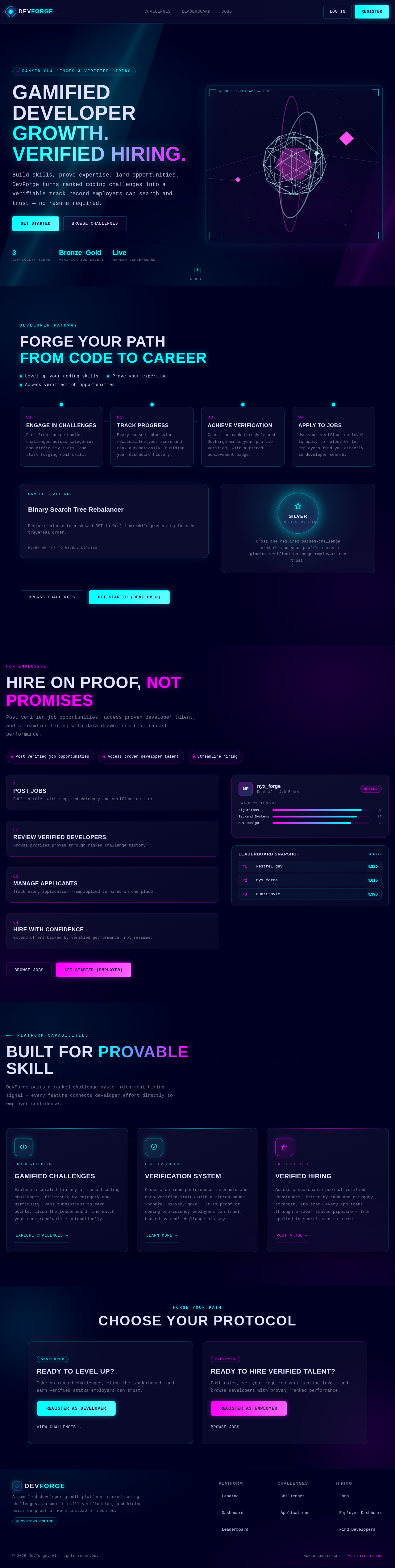
Build skills, prove expertise, land opportunities. DevForge turns ranked coding challenges into a verifiable track record employers can search and trust — no resume required.
Pick from ranked coding challenges across categories and difficulty tiers, and start forging real skill.
Every passed submission recalculates your score and rank automatically, building your dashboard history.
Cross the rank threshold and DevForge marks your profile Verified, with a tiered achievement badge.
Use your verification level to apply to roles, or let employers find you directly in developer search.
Restore balance to a skewed BST in O(n) time while preserving in-order traversal order.
Hover or tap to reveal detailsCross the required passed-challenge threshold and your profile earns a glowing verification badge employers can trust.
Post verified job opportunities, access proven developer talent, and streamline hiring with data drawn from real ranked performance.
DevForge pairs a ranked challenge system with real hiring signal — every feature connects developer effort directly to employer confidence.
Explore a curated library of ranked coding challenges, filterable by category and difficulty. Pass submissions to earn points, climb the leaderboard, and watch your rank recalculate automatically.
Explore ChallengesCross a defined performance threshold and earn Verified status with a tiered badge (bronze, silver, gold). It is proof of coding proficiency employers can trust, backed by real challenge history.
Learn MoreAccess a searchable pool of verified developers, filter by rank and category strength, and track every applicant through a clear status pipeline — from applied to shortlisted to hired.
Post a JobReady to level up?
Take on ranked challenges, climb the leaderboard, and earn verified status employers can trust.
Register as DeveloperView ChallengesReady to hire verified talent?
Post roles, set your required verification level, and browse developers with proven, ranked performance.
Register as EmployerBrowse JobsBuild skills, prove expertise, land opportunities. DevForge turns ranked coding challenges into a verifiable track record employers can search and trust — no resume required.
Pick from ranked coding challenges across categories and difficulty tiers, and start forging real skill.
Every passed submission recalculates your score and rank automatically, building your dashboard history.
Cross the rank threshold and DevForge marks your profile Verified, with a tiered achievement badge.
Use your verification level to apply to roles, or let employers find you directly in developer search.
Restore balance to a skewed BST in O(n) time while preserving in-order traversal order.
Hover or tap to reveal detailsCross the required passed-challenge threshold and your profile earns a glowing verification badge employers can trust.
Post verified job opportunities, access proven developer talent, and streamline hiring with data drawn from real ranked performance.
DevForge pairs a ranked challenge system with real hiring signal — every feature connects developer effort directly to employer confidence.
Explore a curated library of ranked coding challenges, filterable by category and difficulty. Pass submissions to earn points, climb the leaderboard, and watch your rank recalculate automatically.
Explore ChallengesCross a defined performance threshold and earn Verified status with a tiered badge (bronze, silver, gold). It is proof of coding proficiency employers can trust, backed by real challenge history.
Learn MoreAccess a searchable pool of verified developers, filter by rank and category strength, and track every applicant through a clear status pipeline — from applied to shortlisted to hired.
Post a JobReady to level up?
Take on ranked challenges, climb the leaderboard, and earn verified status employers can trust.
Register as DeveloperView ChallengesReady to hire verified talent?
Post roles, set your required verification level, and browse developers with proven, ranked performance.
Register as EmployerBrowse Jobs
No comments yet. Be the first!